 Add to Chrome
 Add to Firefox
 Add to Edge
A Regret Perspective on Online Multiple Testing
May 13, 2026
Online Multiple Testing (OMT), a fundamental pillar of sequential statistical inference, traditionally evaluates the False Discovery Rate (FDR) and statistical power in isolation, obscuring the highly asymmetric costs of false positives and false negatives in modern automated pipelines. To unify this evaluation, we introduce $\textit{Weighted Regret}$. Under this metric, we prove the $\textit{Duality of Regret Conservation}$: purely deterministic procedures ensuring strict FDR control inevitably incur an $Ω(T)$ linear regret penalty, as threshold depletion during signal-sparse cold starts forces massive false negatives. Tailored for exogenous testing streams, we propose Decoupled-OMT (DOMT) as a baseline-agnostic meta-wrapper. By incorporating a history-decoupled, strictly non-negative random perturbation, DOMT rescues purely deterministic baselines from severe threshold depletion. Crucially, it preserves exact asymptotic safety in stationary environments and rigorously bounds finite-sample error inflation during cold-starts. Guaranteeing zero additional false negatives, it yields an order-optimal $Ω(\sqrt{T})$ regret reduction in bursty environments, with a derived ``Cold-Start Tax'' characterizing the exact phase transition of algorithmic superiority. Experiments validate that DOMT consistently curtails empirical weighted regret, achieving an order-optimal sublinear mitigation of threshold depletion to navigate the non-stationary Pareto frontier.

Multi-Condition Conformal Selection
Oct 09, 2025
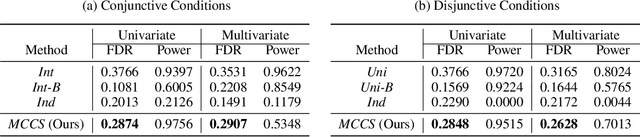

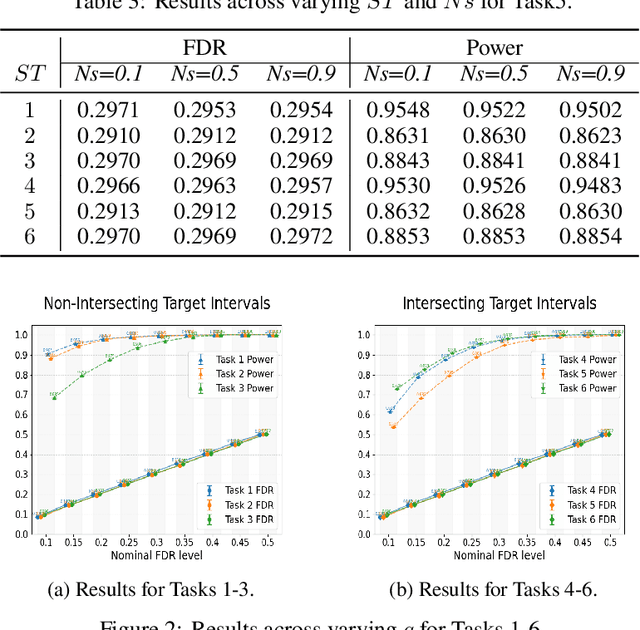
Selecting high-quality candidates from large-scale datasets is critically important in resource-constrained applications such as drug discovery, precision medicine, and the alignment of large language models. While conformal selection methods offer a rigorous solution with False Discovery Rate (FDR) control, their applicability is confined to single-threshold scenarios (i.e., y > c) and overlooks practical needs for multi-condition selection, such as conjunctive or disjunctive conditions. In this work, we propose the Multi-Condition Conformal Selection (MCCS) algorithm, which extends conformal selection to scenarios with multiple conditions. In particular, we introduce a novel nonconformity score with regional monotonicity for conjunctive conditions and a global Benjamini-Hochberg (BH) procedure for disjunctive conditions, thereby establishing finite-sample FDR control with theoretical guarantees. The integration of these components enables the proposed method to achieve rigorous FDR-controlled selection in various multi-condition environments. Extensive experiments validate the superiority of MCCS over baselines, its generalizability across diverse condition combinations, different real-world modalities, and multi-task scalability.