 Add to Chrome
 Add to Firefox
 Add to Edge
Seeing Through Fog: Towards Fog-Invariant Action Recognition
May 20, 2026
Foggy conditions are commonly encountered in real-world applications; however, existing action recognition approaches typically assume favorable weather and high-quality video inputs. On foggy days, unpredictable visibility degradation and reduced contrast obstruct the extraction of semantic cues, posing significant challenges for current action recognition methods. In this paper, we mitigate the issues faced in action recognition under foggy conditions by employing two strategies. First, we present FogAct, the first benchmark dataset for foggy action recognition, consisting of paired clean and foggy videos captured with a stereo camera system. The dataset spans 10 scenes and 55 action categories, comprising nearly 10,000 video clips. Second, we propose FogNet, a two-stream CLIP model that discovers fog-invariant semantic information hidden behind the degraded videos. FogNet learns robust representations of foggy videos with guidance from clean videos, effectively capturing shared structural and motion cues between clean and foggy videos. Extensive experiments on FogAct and three other popular datasets demonstrate that our method achieves competitive performance compared with state-of-the-art (SOTA) approaches. Our FogAct and FogNet are given in our project page.

Benchmarking and Improving GUI Agents in High-Dynamic Environments
Apr 28, 2026Recent advancements in Graphical User Interface (GUI) agents have predominantly focused on training paradigms like supervised fine-tuning (SFT) and reinforcement learning (RL). However, the challenge of high-dynamic GUI environments remains largely underexplored. Existing agents typically rely on a single screenshot after each action for decision-making, leading to a partially observable (or even unobservable) Markov decision process, where the key GUI state including important information for actions is often inadequately captured. To systematically explore this challenge, we introduce DynamicGUIBench, a comprehensive online GUI benchmark spanning ten applications and diverse interaction scenarios characterized by important interface changes between actions. Furthermore, we present DynamicUI, an agent designed for dynamic interfaces, which takes screen-recording videos of the interaction process as input and consists of three components: a dynamic perceiver, a refinement strategy, and a reflection. Specifically, the dynamic perceiver clusters frames of the GUI video, generates captions for the centroids, and iteratively selects the most informative frames as the salient dynamic context. Considering that there may be inconsistencies and noise between the selected frames and the textual context of the agent, the refinement strategy employs an action-conditioned filtering to refine thoughts to mitigate thought-action inconsistency and redundancy. Based on the refined agent trajectories, the reflection module provides effective and accurate guidance for further actions. Experiments on DynamicGUIBench demonstrate that DynamicUI significantly improves the performance in dynamic GUI environments, while maintaining competitive performance on other public benchmarks.
GUI Knowledge Bench: Revealing the Knowledge Gap Behind VLM Failures in GUI Tasks
Oct 30, 2025Large vision language models (VLMs) have advanced graphical user interface (GUI) task automation but still lag behind humans. We hypothesize this gap stems from missing core GUI knowledge, which existing training schemes (such as supervised fine tuning and reinforcement learning) alone cannot fully address. By analyzing common failure patterns in GUI task execution, we distill GUI knowledge into three dimensions: (1) interface perception, knowledge about recognizing widgets and system states; (2) interaction prediction, knowledge about reasoning action state transitions; and (3) instruction understanding, knowledge about planning, verifying, and assessing task completion progress. We further introduce GUI Knowledge Bench, a benchmark with multiple choice and yes/no questions across six platforms (Web, Android, MacOS, Windows, Linux, IOS) and 292 applications. Our evaluation shows that current VLMs identify widget functions but struggle with perceiving system states, predicting actions, and verifying task completion. Experiments on real world GUI tasks further validate the close link between GUI knowledge and task success. By providing a structured framework for assessing GUI knowledge, our work supports the selection of VLMs with greater potential prior to downstream training and provides insights for building more capable GUI agents.
Latent Chain-of-Thought? Decoding the Depth-Recurrent Transformer
Jul 02, 2025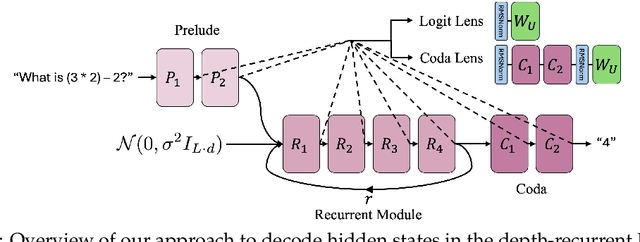
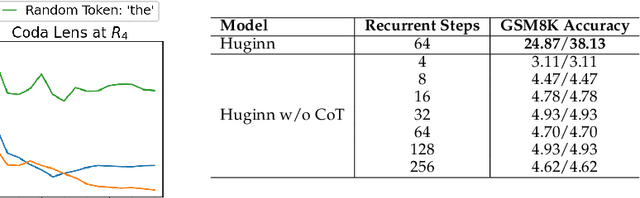
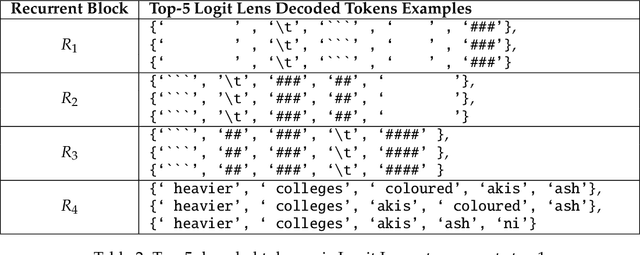
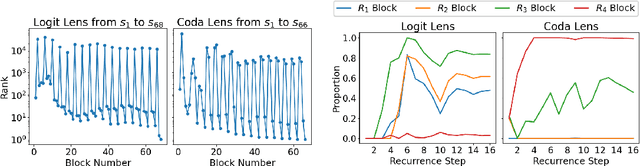
Chain-of-thought (CoT) reasoning has enabled transformer-based language models to excel at complex mathematics and multi-step planning. However, in standard decoder-only architectures, these reasoning steps are externalized in natural language, improving interpretability at the cost of efficiency. To capture reasoning that is not easily represented in words, many works have explored recurrent architectures that aim to internalize reasoning in latent space, potentially supporting latent CoT. In this paper, we investigate whether such reasoning structures emerge in Huginn-3.5B, a depth-recurrent Transformer that reuses layers at inference time without increasing parameter count. We examine the model's internal behavior on arithmetic tasks using a suite of probing techniques including the Logit Lens and Coda Lens. Our findings reveal limited evidence of interpretable latent CoT by tracking rank trajectories of final and intermediate result tokens. Furthermore, we uncover significant probing inconsistencies across recurrent blocks, where the interpretability of hidden states depends heavily on both the layer index and the decoding method. Finally, we empirically show that increasing recurrence depth yields only marginal gains and falls well short of models that explicitly externalize reasoning steps. The code is available at https://github.com/wenquanlu/huginn-latent-cot.
Language-TPP: Integrating Temporal Point Processes with Language Models for Event Analysis
Feb 11, 2025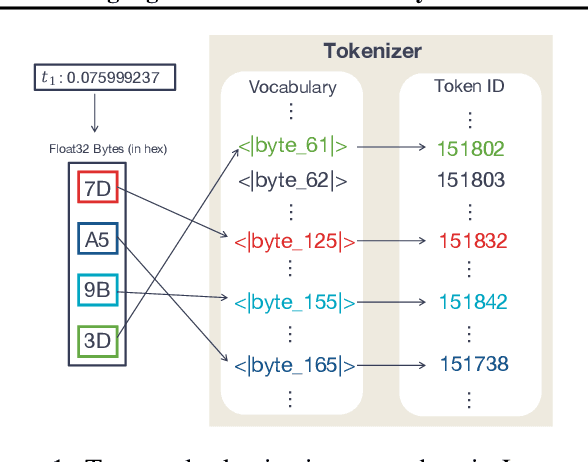
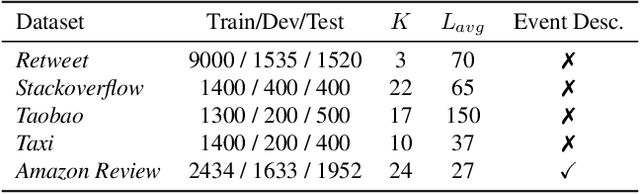
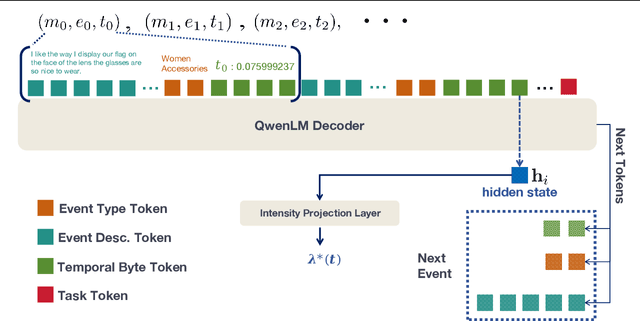
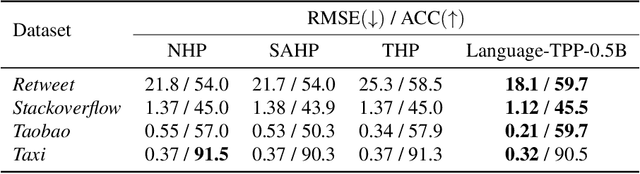
Temporal Point Processes (TPPs) have been widely used for event sequence modeling, but they often struggle to incorporate rich textual event descriptions effectively. Conversely, while Large Language Models (LLMs) have been shown remarkable capabilities in processing textual data, they lack mechanisms for handling temporal dynamics. To bridge this gap, we introduce Language-TPP, a unified framework that integrates TPPs with LLMs for enhanced event sequence modeling. Language-TPP introduces a novel temporal encoding mechanism that converts continuous time intervals into specialized byte-tokens, enabling seamless integration with standard LLM architectures. This approach allows Language-TPP to achieve state-of-the-art performance across multiple TPP tasks, including event time prediction, type prediction, and intensity estimation, on five datasets. Additionally, we demonstrate that incorporating temporal information significantly improves the quality of generated event descriptions.
Storyboard guided Alignment for Fine-grained Video Action Recognition
Oct 18, 2024Fine-grained video action recognition can be conceptualized as a video-text matching problem. Previous approaches often rely on global video semantics to consolidate video embeddings, which can lead to misalignment in video-text pairs due to a lack of understanding of action semantics at an atomic granularity level. To tackle this challenge, we propose a multi-granularity framework based on two observations: (i) videos with different global semantics may share similar atomic actions or appearances, and (ii) atomic actions within a video can be momentary, slow, or even non-directly related to the global video semantics. Inspired by the concept of storyboarding, which disassembles a script into individual shots, we enhance global video semantics by generating fine-grained descriptions using a pre-trained large language model. These detailed descriptions capture common atomic actions depicted in videos. A filtering metric is proposed to select the descriptions that correspond to the atomic actions present in both the videos and the descriptions. By employing global semantics and fine-grained descriptions, we can identify key frames in videos and utilize them to aggregate embeddings, thereby making the embedding more accurate. Extensive experiments on various video action recognition datasets demonstrate superior performance of our proposed method in supervised, few-shot, and zero-shot settings.