 Add to Chrome
 Add to Firefox
 Add to Edge
Diversified in-domain synthesis with efficient fine-tuning for few-shot classification
Dec 07, 2023
Few-shot image classification aims to learn an image classifier using only a small set of labeled examples per class. A recent research direction for improving few-shot classifiers involves augmenting the labelled samples with synthetic images created by state-of-the-art text-to-image generation models. Following this trend, we propose Diversified In-domain Synthesis with Efficient Fine-tuning (DISEF), a novel approach which addresses the generalization challenge in few-shot learning using synthetic data. DISEF consists of two main components. First, we propose a novel text-to-image augmentation pipeline that, by leveraging the real samples and their rich semantics coming from an advanced captioning model, promotes in-domain sample diversity for better generalization. Second, we emphasize the importance of effective model fine-tuning in few-shot recognition, proposing to use Low-Rank Adaptation (LoRA) for joint adaptation of the text and image encoders in a Vision Language Model. We validate our method in ten different benchmarks, consistently outperforming baselines and establishing a new state-of-the-art for few-shot classification. Code is available at https://github.com/vturrisi/disef.

Novel class discovery meets foundation models for 3D semantic segmentation
Dec 06, 2023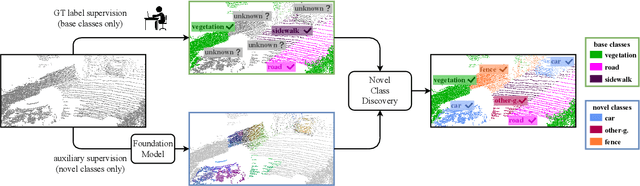
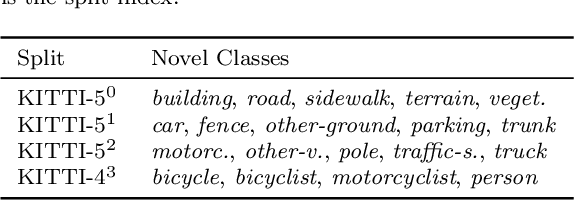
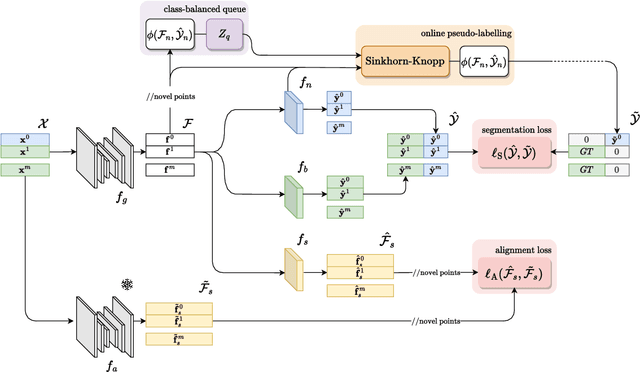
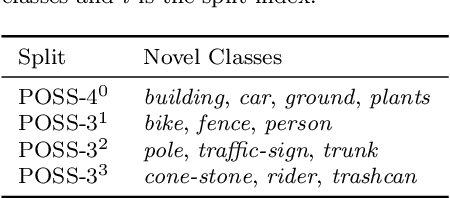
The task of Novel Class Discovery (NCD) in semantic segmentation entails training a model able to accurately segment unlabelled (novel) classes, relying on the available supervision from annotated (base) classes. Although extensively investigated in 2D image data, the extension of the NCD task to the domain of 3D point clouds represents a pioneering effort, characterized by assumptions and challenges that are not present in the 2D case. This paper represents an advancement in the analysis of point cloud data in four directions. Firstly, it introduces the novel task of NCD for point cloud semantic segmentation. Secondly, it demonstrates that directly transposing the only existing NCD method for 2D image semantic segmentation to 3D data yields suboptimal results. Thirdly, a new NCD approach based on online clustering, uncertainty estimation, and semantic distillation is presented. Lastly, a novel evaluation protocol is proposed to rigorously assess the performance of NCD in point cloud semantic segmentation. Through comprehensive evaluations on the SemanticKITTI, SemanticPOSS, and S3DIS datasets, the paper demonstrates substantial superiority of the proposed method over the considered baselines.
Collaborative Neural Painting
Dec 04, 2023The process of painting fosters creativity and rational planning. However, existing generative AI mostly focuses on producing visually pleasant artworks, without emphasizing the painting process. We introduce a novel task, Collaborative Neural Painting (CNP), to facilitate collaborative art painting generation between humans and machines. Given any number of user-input brushstrokes as the context or just the desired object class, CNP should produce a sequence of strokes supporting the completion of a coherent painting. Importantly, the process can be gradual and iterative, so allowing users' modifications at any phase until the completion. Moreover, we propose to solve this task using a painting representation based on a sequence of parametrized strokes, which makes it easy both editing and composition operations. These parametrized strokes are processed by a Transformer-based architecture with a novel attention mechanism to model the relationship between the input strokes and the strokes to complete. We also propose a new masking scheme to reflect the interactive nature of CNP and adopt diffusion models as the basic learning process for its effectiveness and diversity in the generative field. Finally, to develop and validate methods on the novel task, we introduce a new dataset of painted objects and an evaluation protocol to benchmark CNP both quantitatively and qualitatively. We demonstrate the effectiveness of our approach and the potential of the CNP task as a promising avenue for future research.
Incremental Object-Based Novelty Detection with Feedback Loop
Nov 15, 2023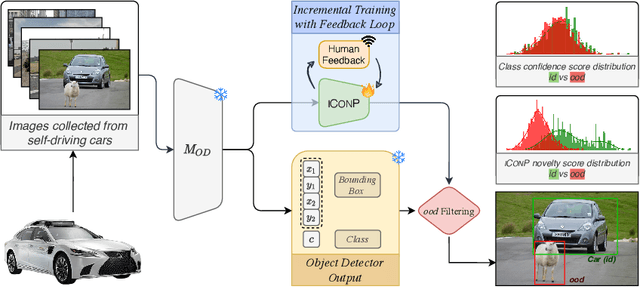
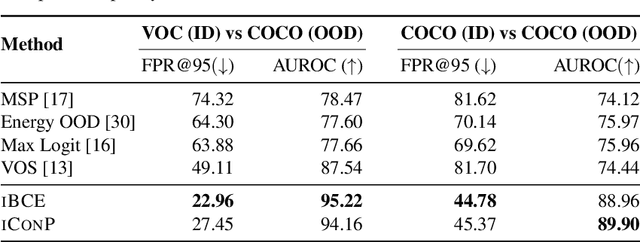
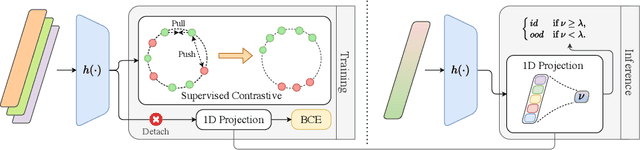
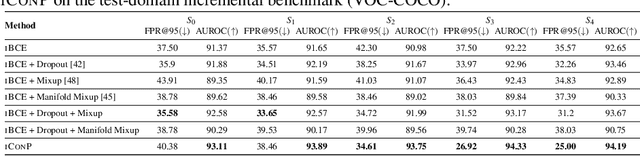
Object-based Novelty Detection (ND) aims to identify unknown objects that do not belong to classes seen during training by an object detection model. The task is particularly crucial in real-world applications, as it allows to avoid potentially harmful behaviours, e.g. as in the case of object detection models adopted in a self-driving car or in an autonomous robot. Traditional approaches to ND focus on one time offline post processing of the pretrained object detection output, leaving no possibility to improve the model robustness after training and discarding the abundant amount of out-of-distribution data encountered during deployment. In this work, we propose a novel framework for object-based ND, assuming that human feedback can be requested on the predicted output and later incorporated to refine the ND model without negatively affecting the main object detection performance. This refinement operation is repeated whenever new feedback is available. To tackle this new formulation of the problem for object detection, we propose a lightweight ND module attached on top of a pre-trained object detection model, which is incrementally updated through a feedback loop. We also propose a new benchmark to evaluate methods on this new setting and test extensively our ND approach against baselines, showing increased robustness and a successful incorporation of the received feedback.
Delving into CLIP latent space for Video Anomaly Recognition
Oct 04, 2023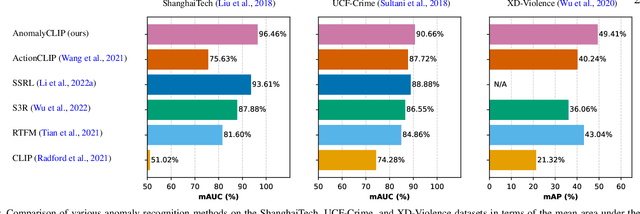
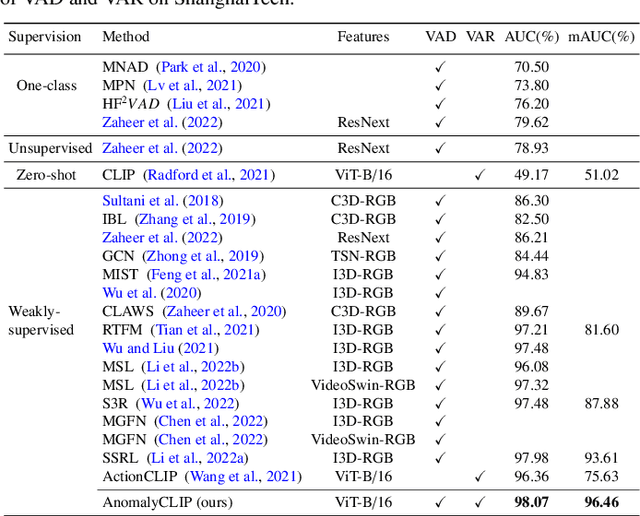
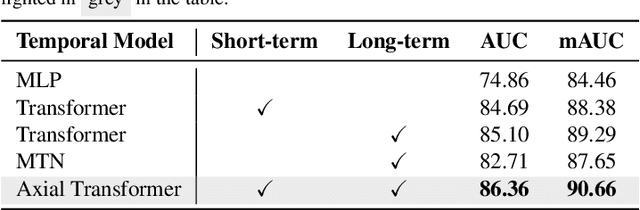
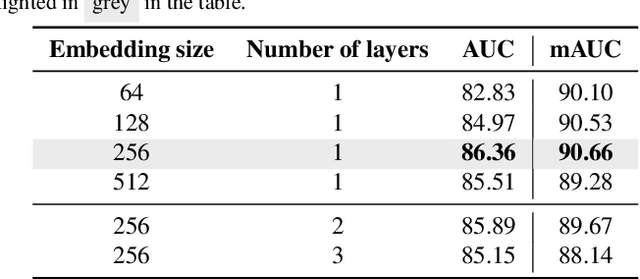
We tackle the complex problem of detecting and recognising anomalies in surveillance videos at the frame level, utilising only video-level supervision. We introduce the novel method AnomalyCLIP, the first to combine Large Language and Vision (LLV) models, such as CLIP, with multiple instance learning for joint video anomaly detection and classification. Our approach specifically involves manipulating the latent CLIP feature space to identify the normal event subspace, which in turn allows us to effectively learn text-driven directions for abnormal events. When anomalous frames are projected onto these directions, they exhibit a large feature magnitude if they belong to a particular class. We also introduce a computationally efficient Transformer architecture to model short- and long-term temporal dependencies between frames, ultimately producing the final anomaly score and class prediction probabilities. We compare AnomalyCLIP against state-of-the-art methods considering three major anomaly detection benchmarks, i.e. ShanghaiTech, UCF-Crime, and XD-Violence, and empirically show that it outperforms baselines in recognising video anomalies.
The Robust Semantic Segmentation UNCV2023 Challenge Results
Sep 27, 2023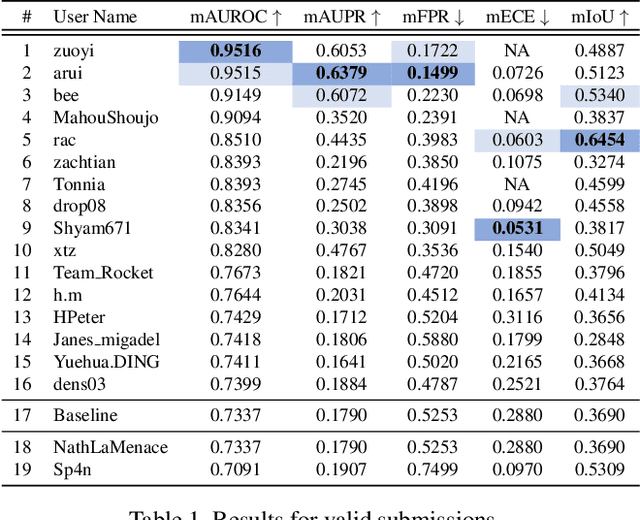
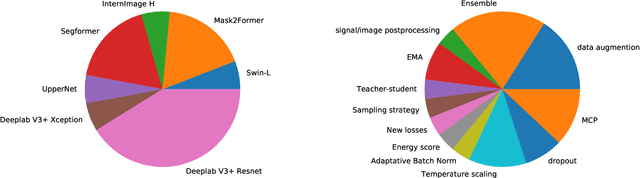
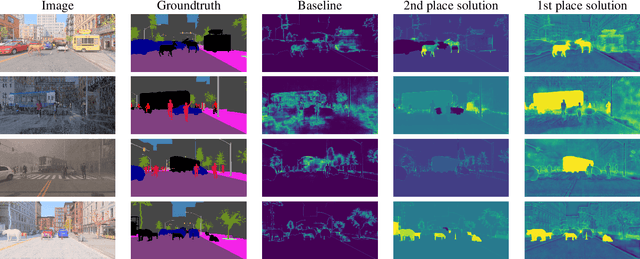
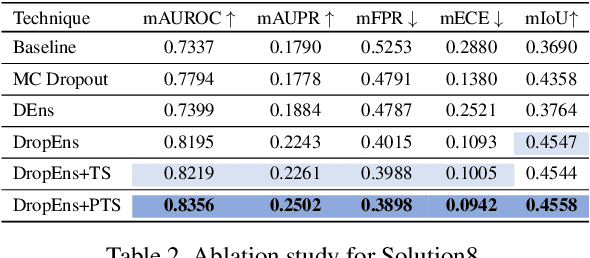
This paper outlines the winning solutions employed in addressing the MUAD uncertainty quantification challenge held at ICCV 2023. The challenge was centered around semantic segmentation in urban environments, with a particular focus on natural adversarial scenarios. The report presents the results of 19 submitted entries, with numerous techniques drawing inspiration from cutting-edge uncertainty quantification methodologies presented at prominent conferences in the fields of computer vision and machine learning and journals over the past few years. Within this document, the challenge is introduced, shedding light on its purpose and objectives, which primarily revolved around enhancing the robustness of semantic segmentation in urban scenes under varying natural adversarial conditions. The report then delves into the top-performing solutions. Moreover, the document aims to provide a comprehensive overview of the diverse solutions deployed by all participants. By doing so, it seeks to offer readers a deeper insight into the array of strategies that can be leveraged to effectively handle the inherent uncertainties associated with autonomous driving and semantic segmentation, especially within urban environments.
Compositional Semantic Mix for Domain Adaptation in Point Cloud Segmentation
Aug 29, 2023

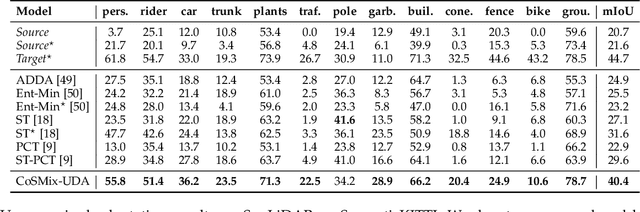

Deep-learning models for 3D point cloud semantic segmentation exhibit limited generalization capabilities when trained and tested on data captured with different sensors or in varying environments due to domain shift. Domain adaptation methods can be employed to mitigate this domain shift, for instance, by simulating sensor noise, developing domain-agnostic generators, or training point cloud completion networks. Often, these methods are tailored for range view maps or necessitate multi-modal input. In contrast, domain adaptation in the image domain can be executed through sample mixing, which emphasizes input data manipulation rather than employing distinct adaptation modules. In this study, we introduce compositional semantic mixing for point cloud domain adaptation, representing the first unsupervised domain adaptation technique for point cloud segmentation based on semantic and geometric sample mixing. We present a two-branch symmetric network architecture capable of concurrently processing point clouds from a source domain (e.g. synthetic) and point clouds from a target domain (e.g. real-world). Each branch operates within one domain by integrating selected data fragments from the other domain and utilizing semantic information derived from source labels and target (pseudo) labels. Additionally, our method can leverage a limited number of human point-level annotations (semi-supervised) to further enhance performance. We assess our approach in both synthetic-to-real and real-to-real scenarios using LiDAR datasets and demonstrate that it significantly outperforms state-of-the-art methods in both unsupervised and semi-supervised settings.
The Unreasonable Effectiveness of Large Language-Vision Models for Source-free Video Domain Adaptation
Aug 22, 2023Source-Free Video Unsupervised Domain Adaptation (SFVUDA) task consists in adapting an action recognition model, trained on a labelled source dataset, to an unlabelled target dataset, without accessing the actual source data. The previous approaches have attempted to address SFVUDA by leveraging self-supervision (e.g., enforcing temporal consistency) derived from the target data itself. In this work, we take an orthogonal approach by exploiting "web-supervision" from Large Language-Vision Models (LLVMs), driven by the rationale that LLVMs contain a rich world prior surprisingly robust to domain-shift. We showcase the unreasonable effectiveness of integrating LLVMs for SFVUDA by devising an intuitive and parameter-efficient method, which we name Domain Adaptation with Large Language-Vision models (DALL-V), that distills the world prior and complementary source model information into a student network tailored for the target. Despite the simplicity, DALL-V achieves significant improvement over state-of-the-art SFVUDA methods.
On the Effectiveness of LayerNorm Tuning for Continual Learning in Vision Transformers
Aug 18, 2023

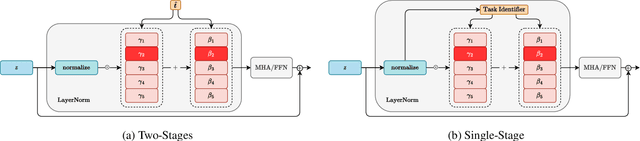

State-of-the-art rehearsal-free continual learning methods exploit the peculiarities of Vision Transformers to learn task-specific prompts, drastically reducing catastrophic forgetting. However, there is a tradeoff between the number of learned parameters and the performance, making such models computationally expensive. In this work, we aim to reduce this cost while maintaining competitive performance. We achieve this by revisiting and extending a simple transfer learning idea: learning task-specific normalization layers. Specifically, we tune the scale and bias parameters of LayerNorm for each continual learning task, selecting them at inference time based on the similarity between task-specific keys and the output of the pre-trained model. To make the classifier robust to incorrect selection of parameters during inference, we introduce a two-stage training procedure, where we first optimize the task-specific parameters and then train the classifier with the same selection procedure of the inference time. Experiments on ImageNet-R and CIFAR-100 show that our method achieves results that are either superior or on par with {the state of the art} while being computationally cheaper.
Interactive Neural Painting
Jul 31, 2023
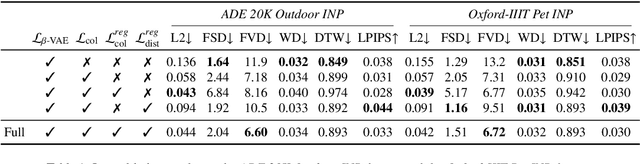

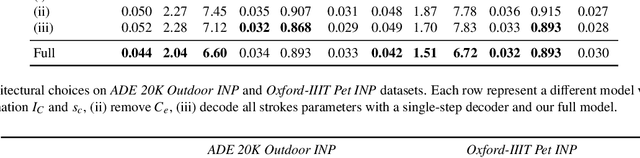
In the last few years, Neural Painting (NP) techniques became capable of producing extremely realistic artworks. This paper advances the state of the art in this emerging research domain by proposing the first approach for Interactive NP. Considering a setting where a user looks at a scene and tries to reproduce it on a painting, our objective is to develop a computational framework to assist the users creativity by suggesting the next strokes to paint, that can be possibly used to complete the artwork. To accomplish such a task, we propose I-Paint, a novel method based on a conditional transformer Variational AutoEncoder (VAE) architecture with a two-stage decoder. To evaluate the proposed approach and stimulate research in this area, we also introduce two novel datasets. Our experiments show that our approach provides good stroke suggestions and compares favorably to the state of the art. Additional details, code and examples are available at https://helia95.github.io/inp-website.