 Add to Chrome
 Add to Firefox
 Add to Edge
Deliberation Model for On-Device Spoken Language Understanding
Apr 04, 2022
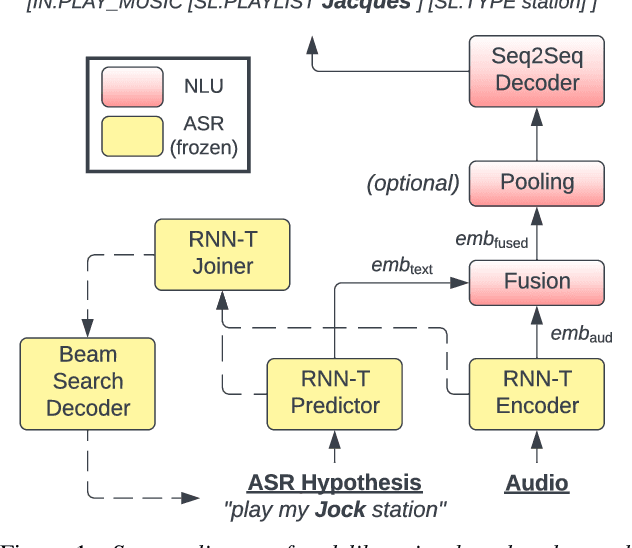

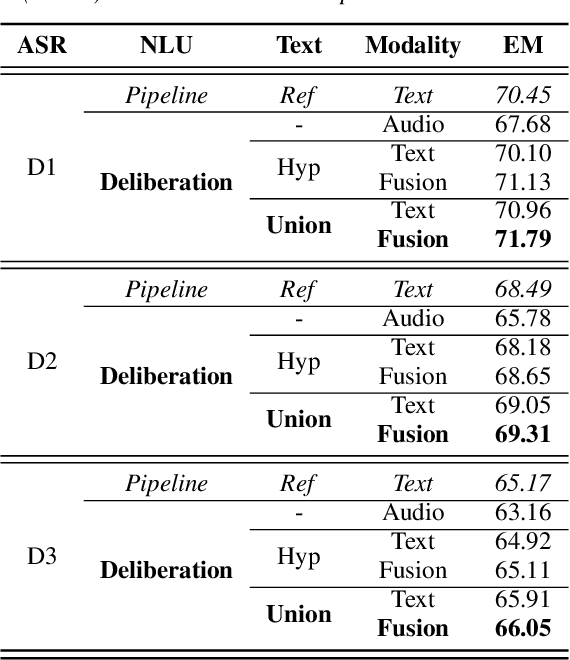
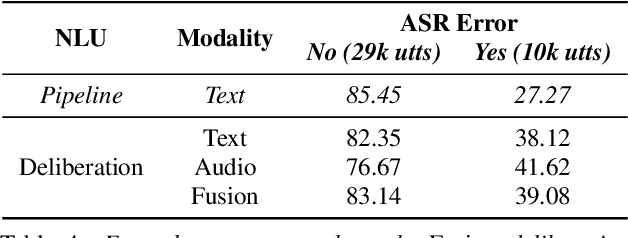
We propose a novel deliberation-based approach to end-to-end (E2E) spoken language understanding (SLU), where a streaming automatic speech recognition (ASR) model produces the first-pass hypothesis and a second-pass natural language understanding (NLU) component generates the semantic parse by conditioning on both ASR's text and audio embeddings. By formulating E2E SLU as a generalized decoder, our system is able to support complex compositional semantic structures. Furthermore, the sharing of parameters between ASR and NLU makes the system especially suitable for resource-constrained (on-device) environments; our proposed approach consistently outperforms strong pipeline NLU baselines by 0.82% to 1.34% across various operating points on the spoken version of the TOPv2 dataset. We demonstrate that the fusion of text and audio features, coupled with the system's ability to rewrite the first-pass hypothesis, makes our approach more robust to ASR errors. Finally, we show that our approach can significantly reduce the degradation when moving from natural speech to synthetic speech training, but more work is required to make text-to-speech (TTS) a viable solution for scaling up E2E SLU.

Streaming parallel transducer beam search with fast-slow cascaded encoders
Mar 29, 2022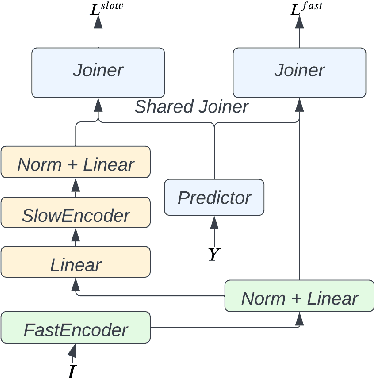
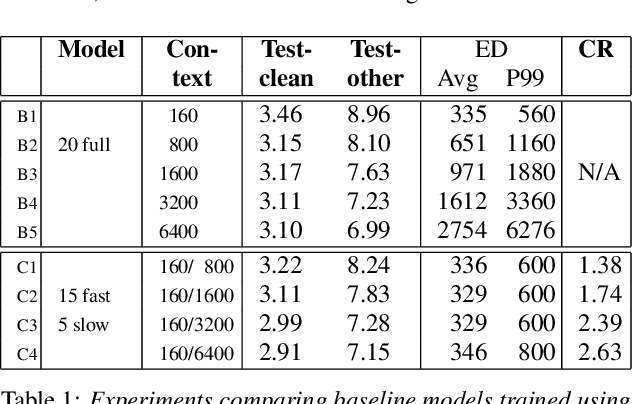
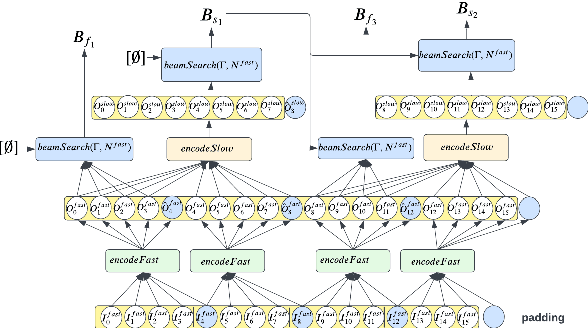
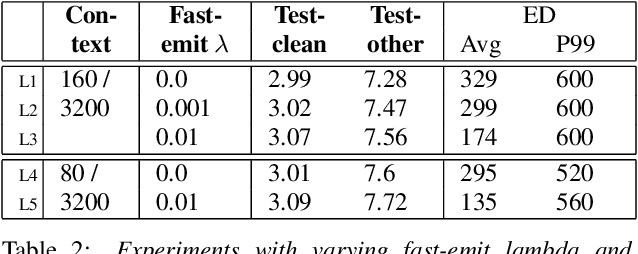
Streaming ASR with strict latency constraints is required in many speech recognition applications. In order to achieve the required latency, streaming ASR models sacrifice accuracy compared to non-streaming ASR models due to lack of future input context. Previous research has shown that streaming and non-streaming ASR for RNN Transducers can be unified by cascading causal and non-causal encoders. This work improves upon this cascaded encoders framework by leveraging two streaming non-causal encoders with variable input context sizes that can produce outputs at different audio intervals (e.g. fast and slow). We propose a novel parallel time-synchronous beam search algorithm for transducers that decodes from fast-slow encoders, where the slow encoder corrects the mistakes generated from the fast encoder. The proposed algorithm, achieves up to 20% WER reduction with a slight increase in token emission delays on the public Librispeech dataset and in-house datasets. We also explore techniques to reduce the computation by distributing processing between the fast and slow encoders. Lastly, we explore sharing the parameters in the fast encoder to reduce the memory footprint. This enables low latency processing on edge devices with low computation cost and a low memory footprint.
Neural-FST Class Language Model for End-to-End Speech Recognition
Jan 31, 2022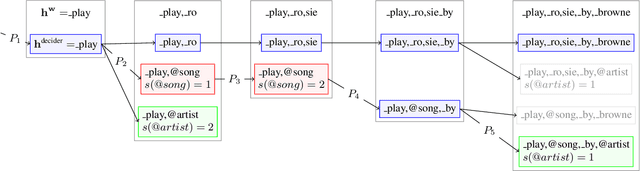
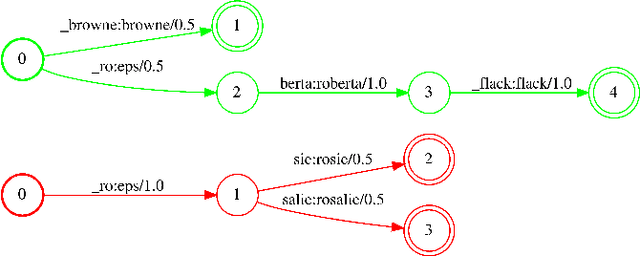
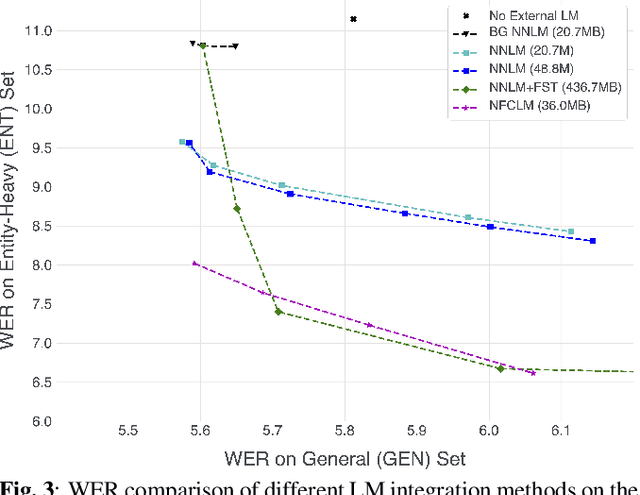
We propose Neural-FST Class Language Model (NFCLM) for end-to-end speech recognition, a novel method that combines neural network language models (NNLMs) and finite state transducers (FSTs) in a mathematically consistent framework. Our method utilizes a background NNLM which models generic background text together with a collection of domain-specific entities modeled as individual FSTs. Each output token is generated by a mixture of these components; the mixture weights are estimated with a separately trained neural decider. We show that NFCLM significantly outperforms NNLM by 15.8% relative in terms of Word Error Rate. NFCLM achieves similar performance as traditional NNLM and FST shallow fusion while being less prone to overbiasing and 12 times more compact, making it more suitable for on-device usage.
Scaling ASR Improves Zero and Few Shot Learning
Nov 29, 2021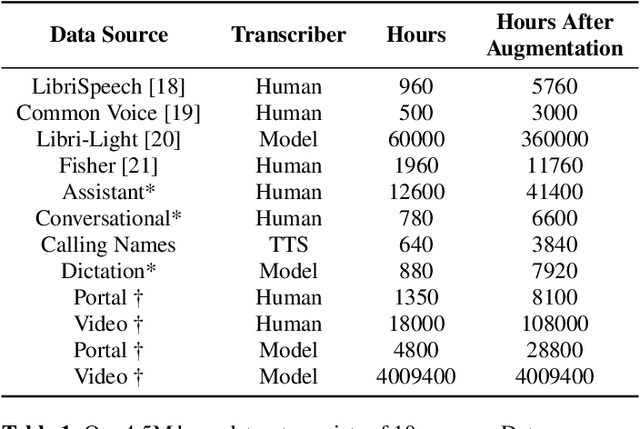
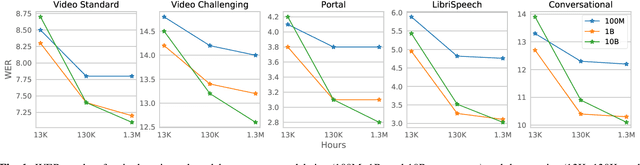
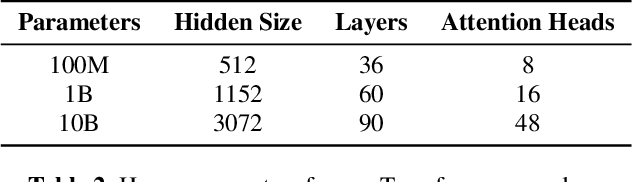
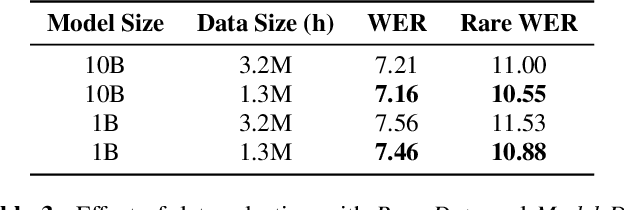
With 4.5 million hours of English speech from 10 different sources across 120 countries and models of up to 10 billion parameters, we explore the frontiers of scale for automatic speech recognition. We propose data selection techniques to efficiently scale training data to find the most valuable samples in massive datasets. To efficiently scale model sizes, we leverage various optimizations such as sparse transducer loss and model sharding. By training 1-10B parameter universal English ASR models, we push the limits of speech recognition performance across many domains. Furthermore, our models learn powerful speech representations with zero and few-shot capabilities on novel domains and styles of speech, exceeding previous results across multiple in-house and public benchmarks. For speakers with disorders due to brain damage, our best zero-shot and few-shot models achieve 22% and 60% relative improvement on the AphasiaBank test set, respectively, while realizing the best performance on public social media videos. Furthermore, the same universal model reaches equivalent performance with 500x less in-domain data on the SPGISpeech financial-domain dataset.
Evaluating User Perception of Speech Recognition System Quality with Semantic Distance Metric
Oct 11, 2021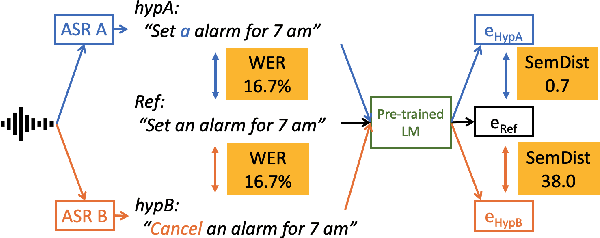
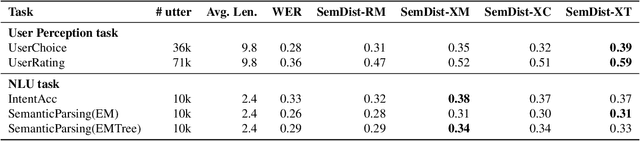
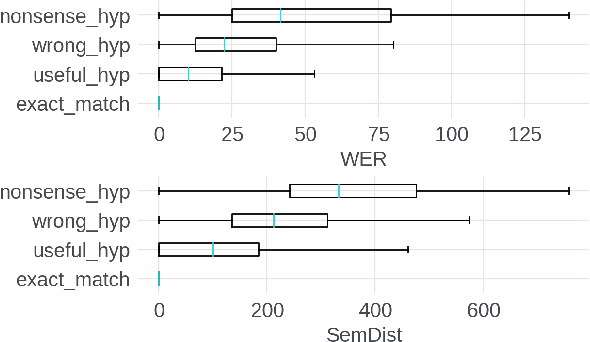
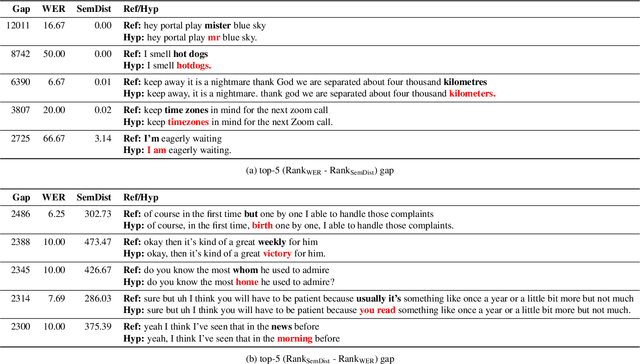
Measuring automatic speech recognition (ASR) system quality is critical for creating user-satisfying voice-driven applications. Word Error Rate (WER) has been traditionally used to evaluate ASR system quality; however, it sometimes correlates poorly with user perception of transcription quality. This is because WER weighs every word equally and does not consider semantic correctness which has a higher impact on user perception. In this work, we propose evaluating ASR output hypotheses quality with SemDist that can measure semantic correctness by using the distance between the semantic vectors of the reference and hypothesis extracted from a pre-trained language model. Our experimental results of 71K and 36K user annotated ASR output quality show that SemDist achieves higher correlation with user perception than WER. We also show that SemDist has higher correlation with downstream NLU tasks than WER.
Flexi-Transducer: Optimizing Latency, Accuracy and Compute forMulti-Domain On-Device Scenarios
Apr 06, 2021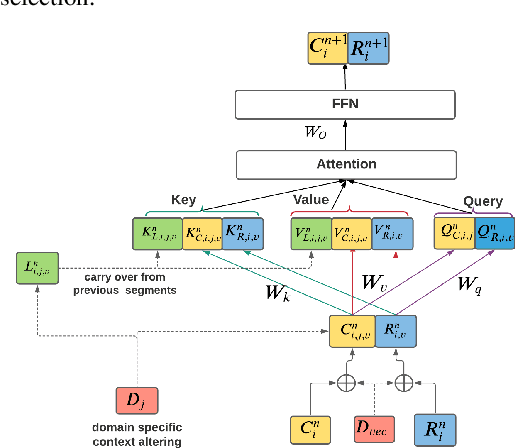
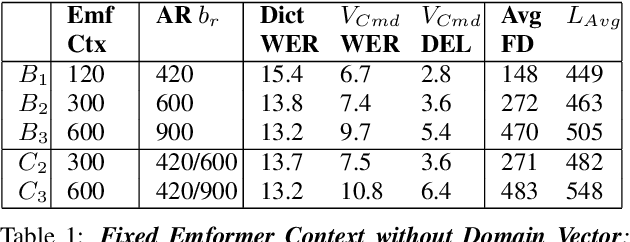
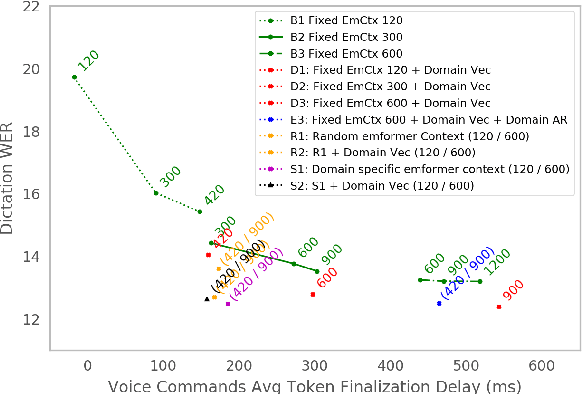
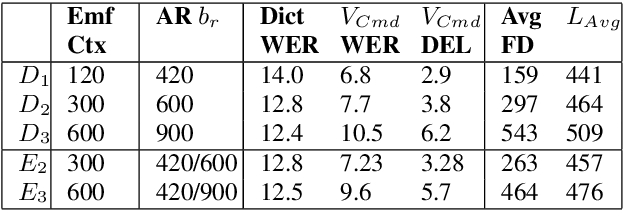
Often, the storage and computational constraints of embeddeddevices demand that a single on-device ASR model serve multiple use-cases / domains. In this paper, we propose aFlexibleTransducer(FlexiT) for on-device automatic speech recognition to flexibly deal with multiple use-cases / domains with different accuracy and latency requirements. Specifically, using a single compact model, FlexiT provides a fast response for voice commands, and accurate transcription but with more latency for dictation. In order to achieve flexible and better accuracy and latency trade-offs, the following techniques are used. Firstly, we propose using domain-specific altering of segment size for Emformer encoder that enables FlexiT to achieve flexible de-coding. Secondly, we use Alignment Restricted RNNT loss to achieve flexible fine-grained control on token emission latency for different domains. Finally, we add a domain indicator vector as an additional input to the FlexiT model. Using the combination of techniques, we show that a single model can be used to improve WERs and real time factor for dictation scenarios while maintaining optimal latency for voice commands use-cases
Dissecting User-Perceived Latency of On-Device E2E Speech Recognition
Apr 06, 2021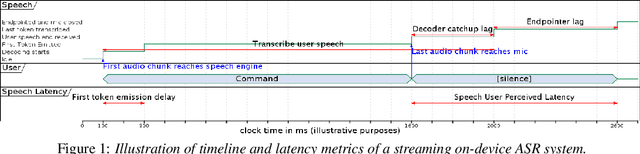
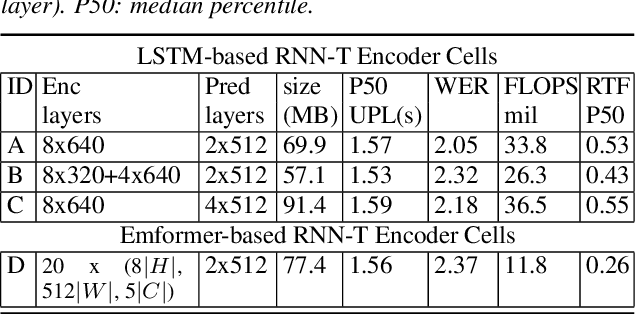
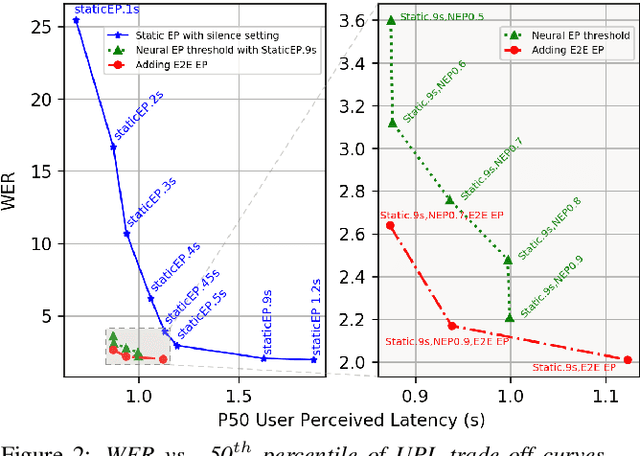
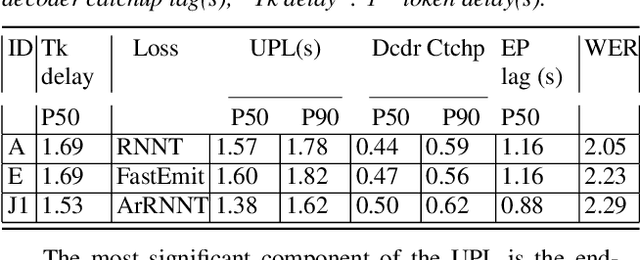
As speech-enabled devices such as smartphones and smart speakers become increasingly ubiquitous, there is growing interest in building automatic speech recognition (ASR) systems that can run directly on-device; end-to-end (E2E) speech recognition models such as recurrent neural network transducers and their variants have recently emerged as prime candidates for this task. Apart from being accurate and compact, such systems need to decode speech with low user-perceived latency (UPL), producing words as soon as they are spoken. This work examines the impact of various techniques -- model architectures, training criteria, decoding hyperparameters, and endpointer parameters -- on UPL. Our analyses suggest that measures of model size (parameters, input chunk sizes), or measures of computation (e.g., FLOPS, RTF) that reflect the model's ability to process input frames are not always strongly correlated with observed UPL. Thus, conventional algorithmic latency measurements might be inadequate in accurately capturing latency observed when models are deployed on embedded devices. Instead, we find that factors affecting token emission latency, and endpointing behavior significantly impact on UPL. We achieve the best trade-off between latency and word error rate when performing ASR jointly with endpointing, and using the recently proposed alignment regularization.
Contextualized Streaming End-to-End Speech Recognition with Trie-Based Deep Biasing and Shallow Fusion
Apr 05, 2021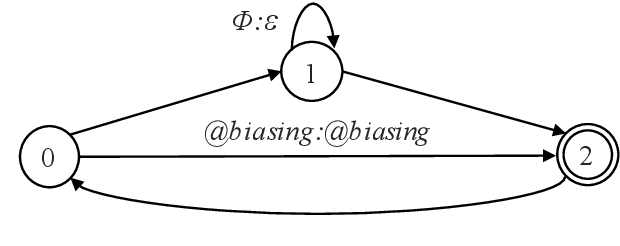
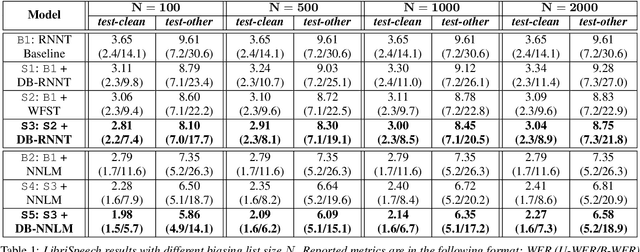
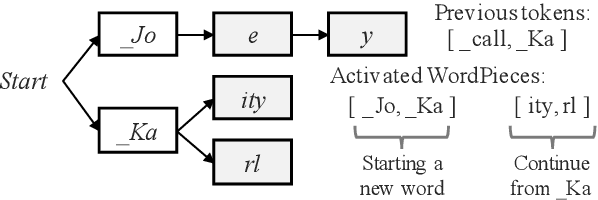
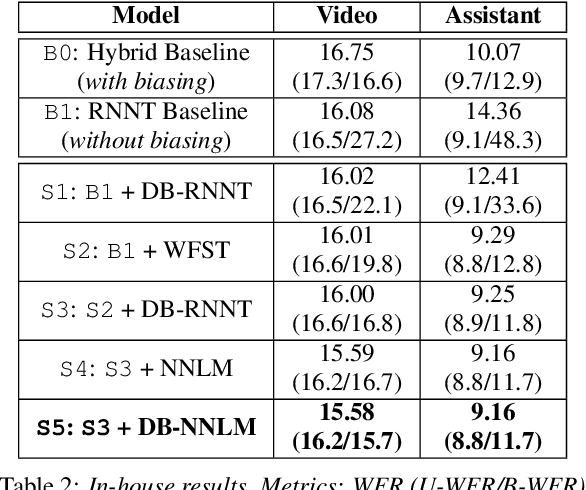
How to leverage dynamic contextual information in end-to-end speech recognition has remained an active research area. Previous solutions to this problem were either designed for specialized use cases that did not generalize well to open-domain scenarios, did not scale to large biasing lists, or underperformed on rare long-tail words. We address these limitations by proposing a novel solution that combines shallow fusion, trie-based deep biasing, and neural network language model contextualization. These techniques result in significant 19.5% relative Word Error Rate improvement over existing contextual biasing approaches and 5.4%-9.3% improvement compared to a strong hybrid baseline on both open-domain and constrained contextualization tasks, where the targets consist of mostly rare long-tail words. Our final system remains lightweight and modular, allowing for quick modification without model re-training.
Dynamic Encoder Transducer: A Flexible Solution For Trading Off Accuracy For Latency
Apr 05, 2021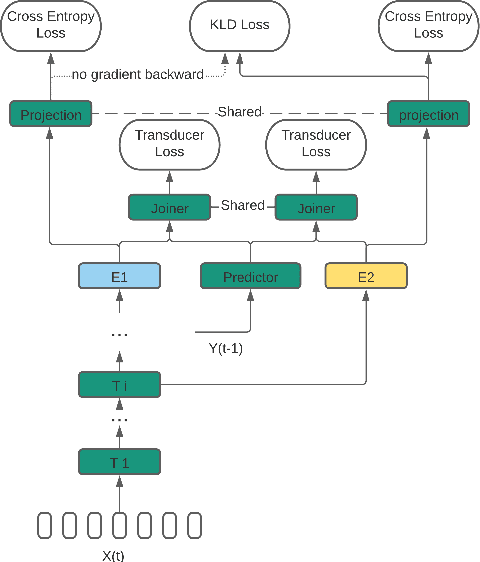
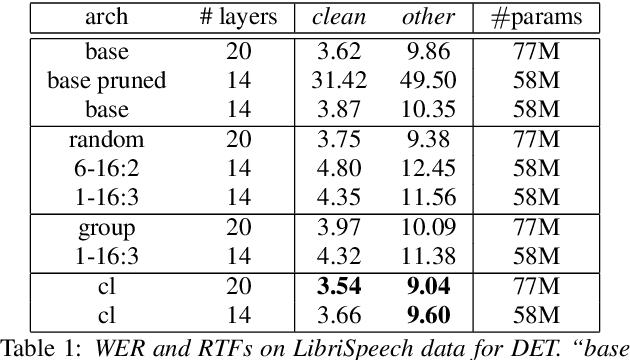
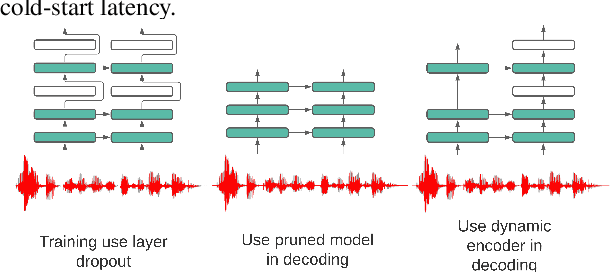
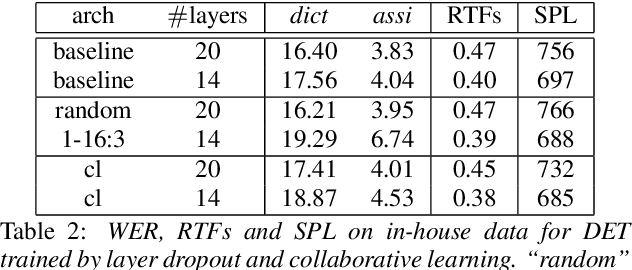
We propose a dynamic encoder transducer (DET) for on-device speech recognition. One DET model scales to multiple devices with different computation capacities without retraining or finetuning. To trading off accuracy and latency, DET assigns different encoders to decode different parts of an utterance. We apply and compare the layer dropout and the collaborative learning for DET training. The layer dropout method that randomly drops out encoder layers in the training phase, can do on-demand layer dropout in decoding. Collaborative learning jointly trains multiple encoders with different depths in one single model. Experiment results on Librispeech and in-house data show that DET provides a flexible accuracy and latency trade-off. Results on Librispeech show that the full-size encoder in DET relatively reduces the word error rate of the same size baseline by over 8%. The lightweight encoder in DET trained with collaborative learning reduces the model size by 25% but still gets similar WER as the full-size baseline. DET gets similar accuracy as a baseline model with better latency on a large in-house data set by assigning a lightweight encoder for the beginning part of one utterance and a full-size encoder for the rest.
Semantic Distance: A New Metric for ASR Performance Analysis Towards Spoken Language Understanding
Apr 05, 2021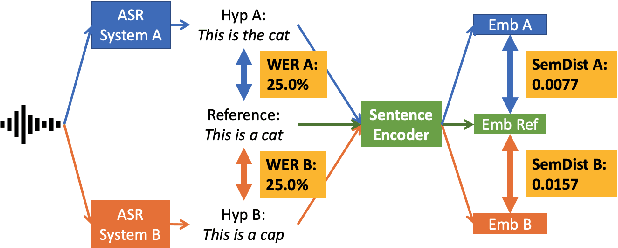

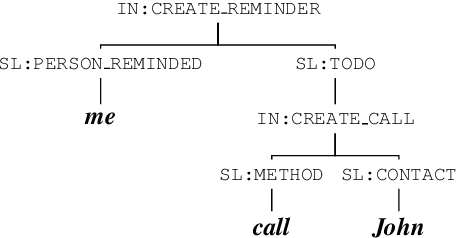
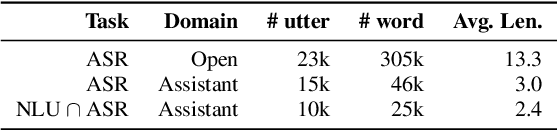
Word Error Rate (WER) has been the predominant metric used to evaluate the performance of automatic speech recognition (ASR) systems. However, WER is sometimes not a good indicator for downstream Natural Language Understanding (NLU) tasks, such as intent recognition, slot filling, and semantic parsing in task-oriented dialog systems. This is because WER takes into consideration only literal correctness instead of semantic correctness, the latter of which is typically more important for these downstream tasks. In this study, we propose a novel Semantic Distance (SemDist) measure as an alternative evaluation metric for ASR systems to address this issue. We define SemDist as the distance between a reference and hypothesis pair in a sentence-level embedding space. To represent the reference and hypothesis as a sentence embedding, we exploit RoBERTa, a state-of-the-art pre-trained deep contextualized language model based on the transformer architecture. We demonstrate the effectiveness of our proposed metric on various downstream tasks, including intent recognition, semantic parsing, and named entity recognition.