 Add to Chrome
 Add to Firefox
 Add to Edge
Generalized Inner Loop Meta-Learning
Oct 07, 2019
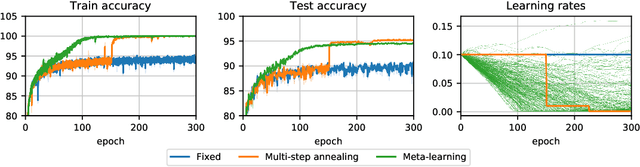

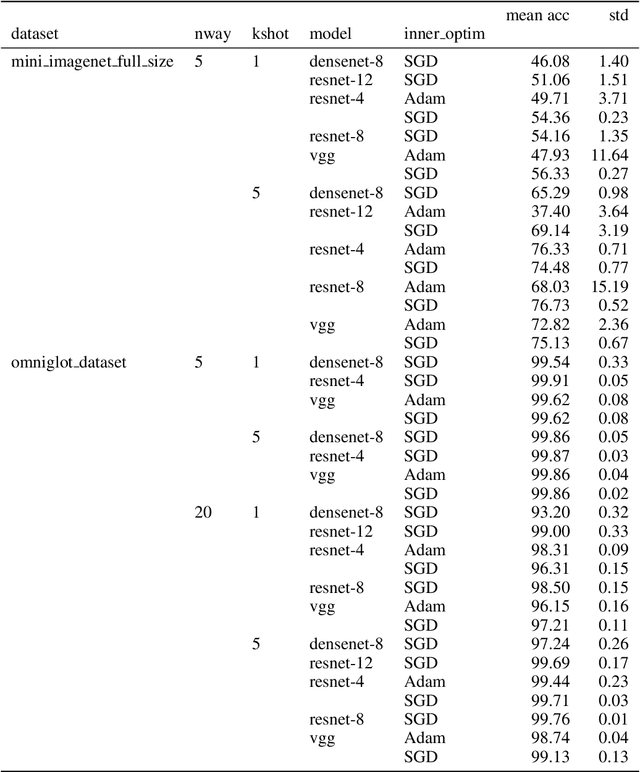
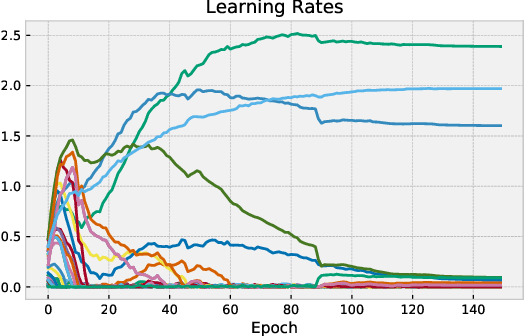
Many (but not all) approaches self-qualifying as "meta-learning" in deep learning and reinforcement learning fit a common pattern of approximating the solution to a nested optimization problem. In this paper, we give a formalization of this shared pattern, which we call GIMLI, prove its general requirements, and derive a general-purpose algorithm for implementing similar approaches. Based on this analysis and algorithm, we describe a library of our design, higher, which we share with the community to assist and enable future research into these kinds of meta-learning approaches. We end the paper by showcasing the practical applications of this framework and library through illustrative experiments and ablation studies which they facilitate.

Finding Generalizable Evidence by Learning to Convince Q&A Models
Sep 12, 2019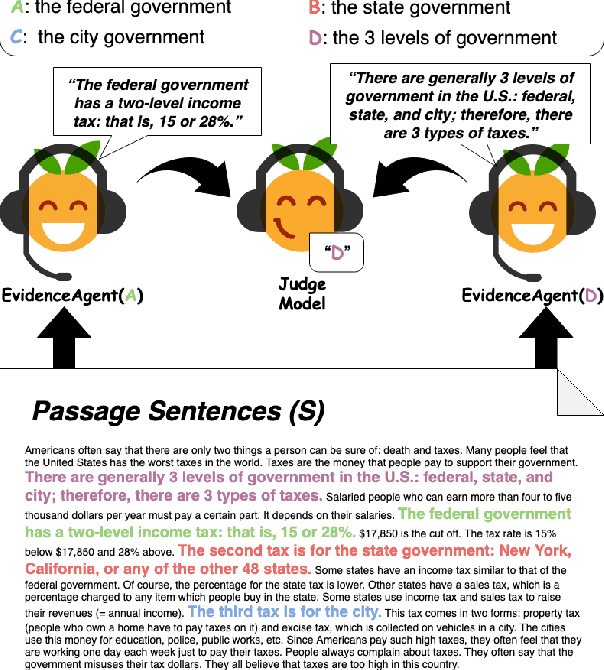
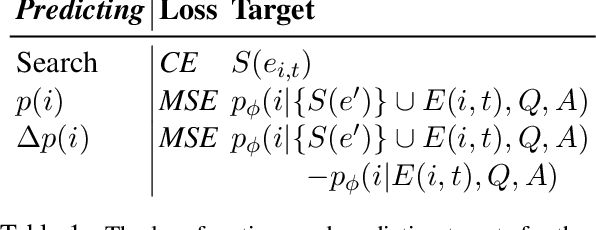
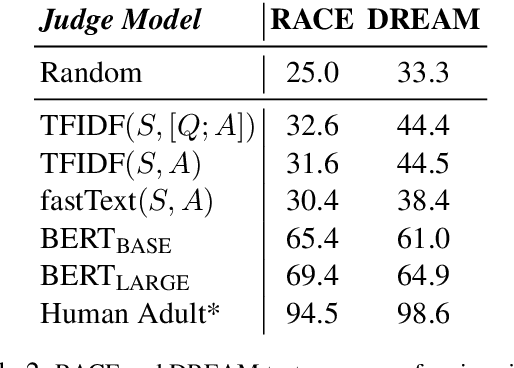
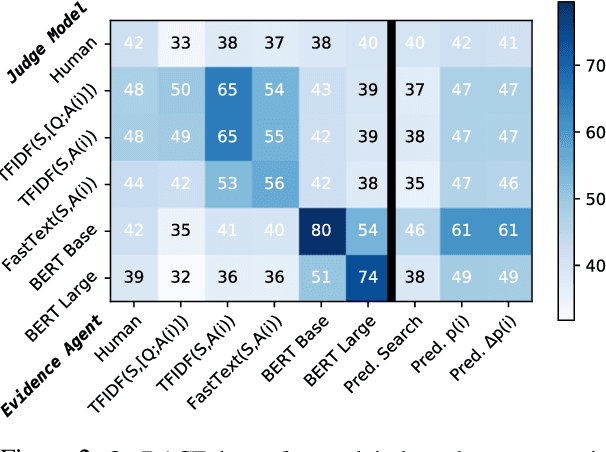
We propose a system that finds the strongest supporting evidence for a given answer to a question, using passage-based question-answering (QA) as a testbed. We train evidence agents to select the passage sentences that most convince a pretrained QA model of a given answer, if the QA model received those sentences instead of the full passage. Rather than finding evidence that convinces one model alone, we find that agents select evidence that generalizes; agent-chosen evidence increases the plausibility of the supported answer, as judged by other QA models and humans. Given its general nature, this approach improves QA in a robust manner: using agent-selected evidence (i) humans can correctly answer questions with only ~20% of the full passage and (ii) QA models can generalize to longer passages and harder questions.
Countering Language Drift via Visual Grounding
Sep 10, 2019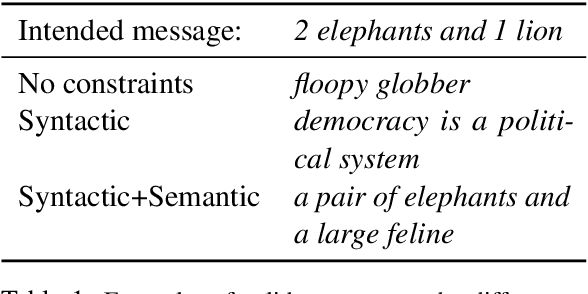
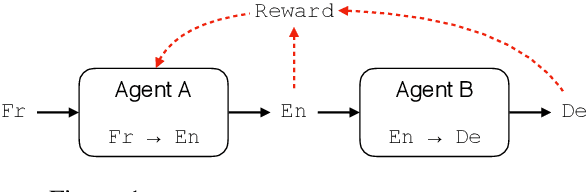
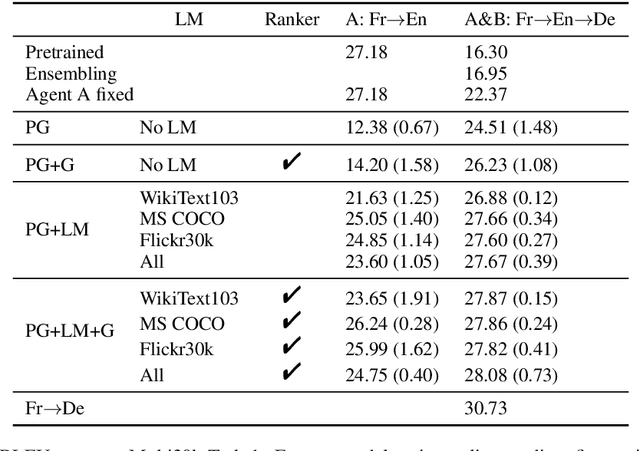
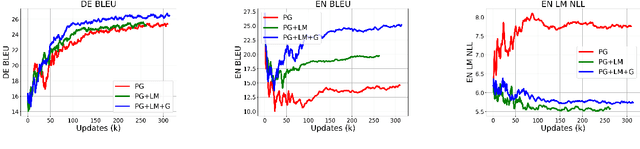
Emergent multi-agent communication protocols are very different from natural language and not easily interpretable by humans. We find that agents that were initially pretrained to produce natural language can also experience detrimental language drift: when a non-linguistic reward is used in a goal-based task, e.g. some scalar success metric, the communication protocol may easily and radically diverge from natural language. We recast translation as a multi-agent communication game and examine auxiliary training constraints for their effectiveness in mitigating language drift. We show that a combination of syntactic (language model likelihood) and semantic (visual grounding) constraints gives the best communication performance, allowing pre-trained agents to retain English syntax while learning to accurately convey the intended meaning.
Supervised Multimodal Bitransformers for Classifying Images and Text
Sep 06, 2019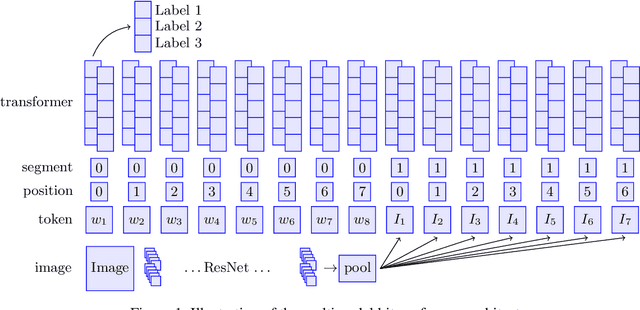

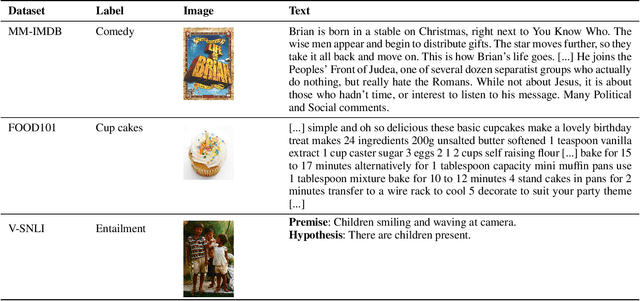
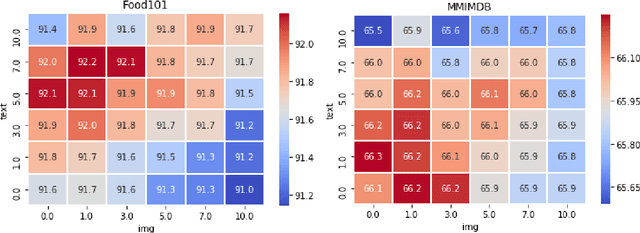
Self-supervised bidirectional transformer models such as BERT have led to dramatic improvements in a wide variety of textual classification tasks. The modern digital world is increasingly multimodal, however, and textual information is often accompanied by other modalities such as images. We introduce a supervised multimodal bitransformer model that fuses information from text and image encoders, and obtain state-of-the-art performance on various multimodal classification benchmark tasks, outperforming strong baselines, including on hard test sets specifically designed to measure multimodal performance.
Why Build an Assistant in Minecraft?
Jul 25, 2019In this document we describe a rationale for a research program aimed at building an open "assistant" in the game Minecraft, in order to make progress on the problems of natural language understanding and learning from dialogue.
What makes a good conversation? How controllable attributes affect human judgments
Apr 10, 2019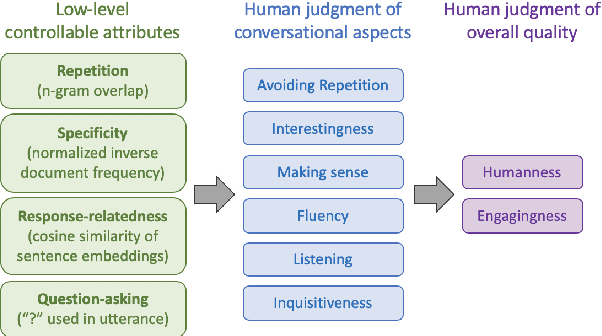
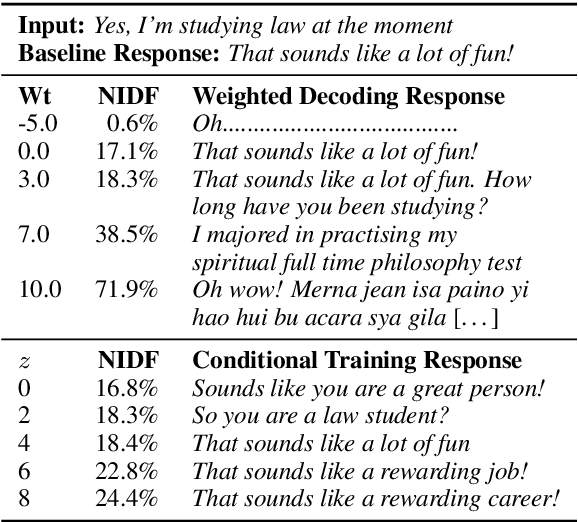
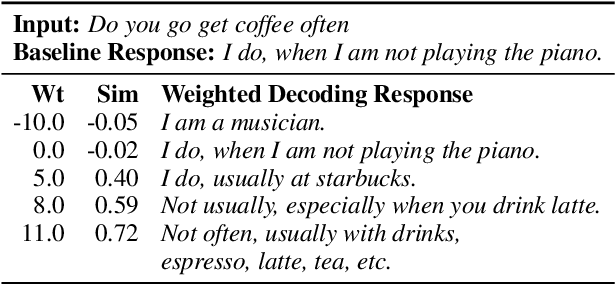
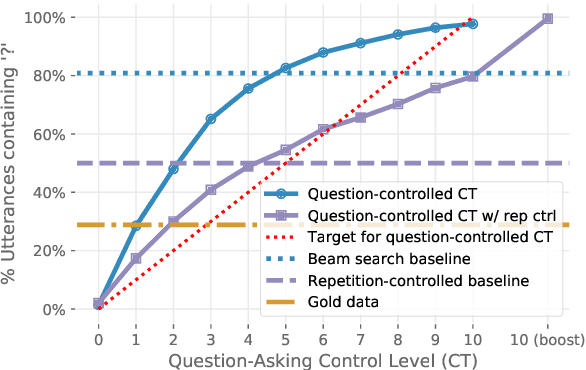
A good conversation requires balance -- between simplicity and detail; staying on topic and changing it; asking questions and answering them. Although dialogue agents are commonly evaluated via human judgments of overall quality, the relationship between quality and these individual factors is less well-studied. In this work, we examine two controllable neural text generation methods, conditional training and weighted decoding, in order to control four important attributes for chitchat dialogue: repetition, specificity, response-relatedness and question-asking. We conduct a large-scale human evaluation to measure the effect of these control parameters on multi-turn interactive conversations on the PersonaChat task. We provide a detailed analysis of their relationship to high-level aspects of conversation, and show that by controlling combinations of these variables our models obtain clear improvements in human quality judgments.
Learning to Speak and Act in a Fantasy Text Adventure Game
Mar 07, 2019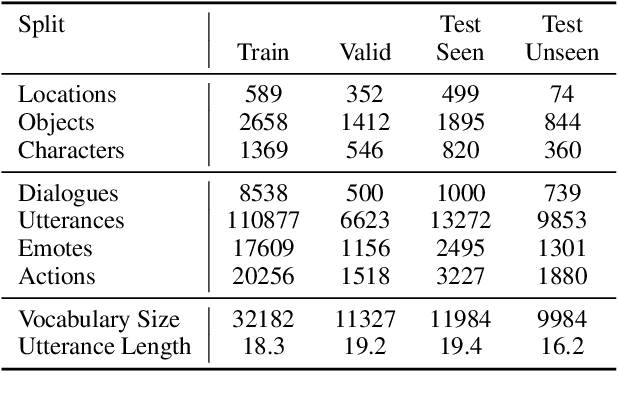
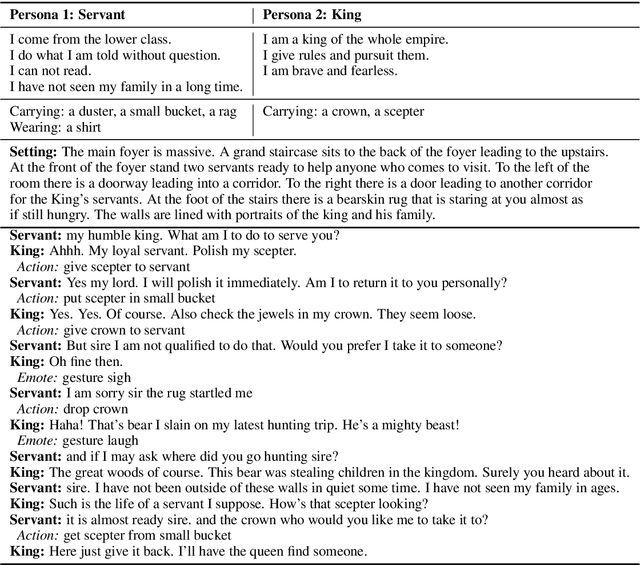
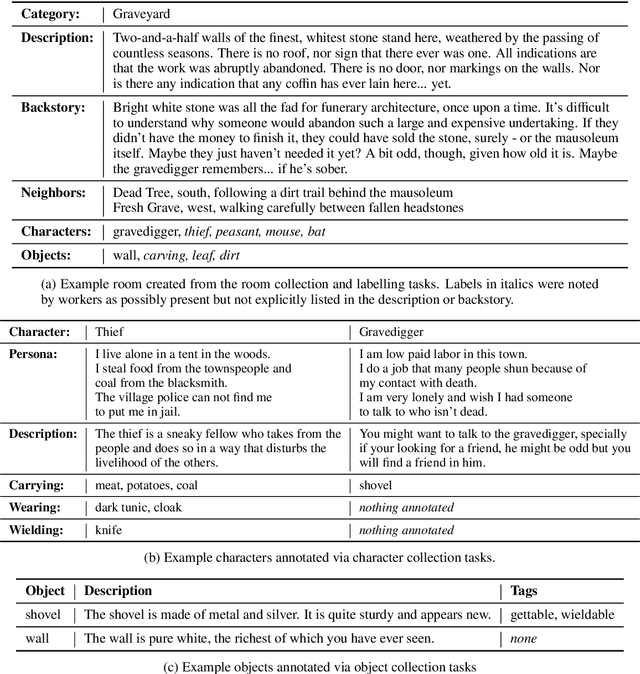

We introduce a large scale crowdsourced text adventure game as a research platform for studying grounded dialogue. In it, agents can perceive, emote, and act whilst conducting dialogue with other agents. Models and humans can both act as characters within the game. We describe the results of training state-of-the-art generative and retrieval models in this setting. We show that in addition to using past dialogue, these models are able to effectively use the state of the underlying world to condition their predictions. In particular, we show that grounding on the details of the local environment, including location descriptions, and the objects (and their affordances) and characters (and their previous actions) present within it allows better predictions of agent behavior and dialogue. We analyze the ingredients necessary for successful grounding in this setting, and how each of these factors relate to agents that can talk and act successfully.
Inferring Concept Hierarchies from Text Corpora via Hyperbolic Embeddings
Feb 03, 2019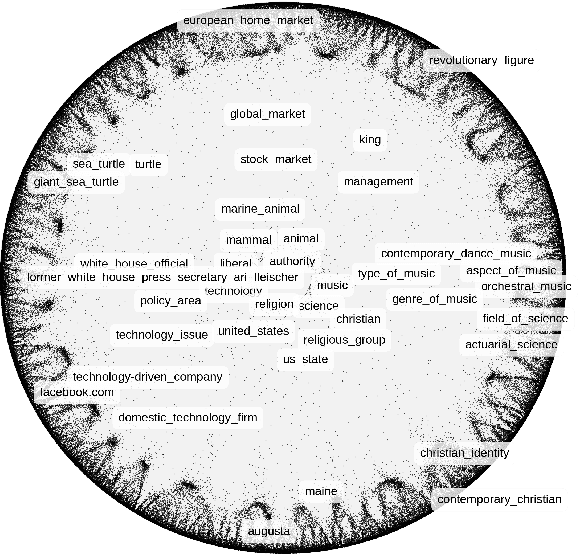
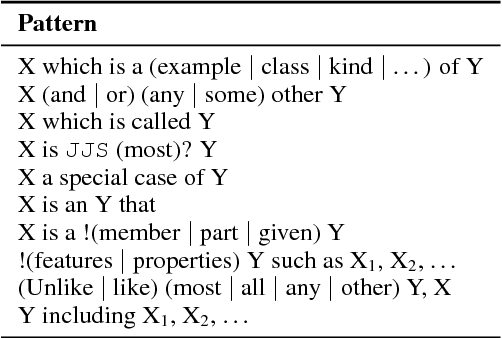
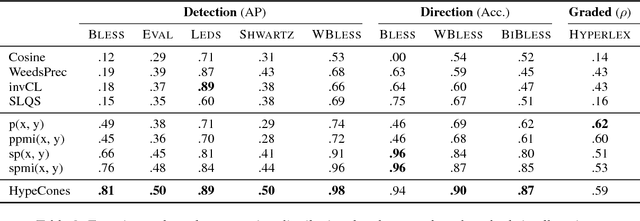
We consider the task of inferring is-a relationships from large text corpora. For this purpose, we propose a new method combining hyperbolic embeddings and Hearst patterns. This approach allows us to set appropriate constraints for inferring concept hierarchies from distributional contexts while also being able to predict missing is-a relationships and to correct wrong extractions. Moreover -- and in contrast with other methods -- the hierarchical nature of hyperbolic space allows us to learn highly efficient representations and to improve the taxonomic consistency of the inferred hierarchies. Experimentally, we show that our approach achieves state-of-the-art performance on several commonly-used benchmarks.
The Second Conversational Intelligence Challenge (ConvAI2)
Jan 31, 2019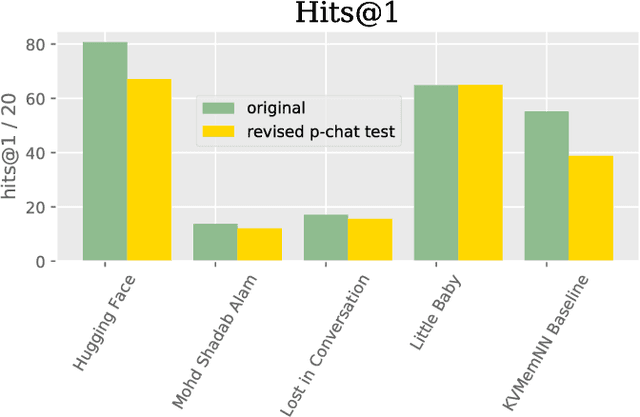

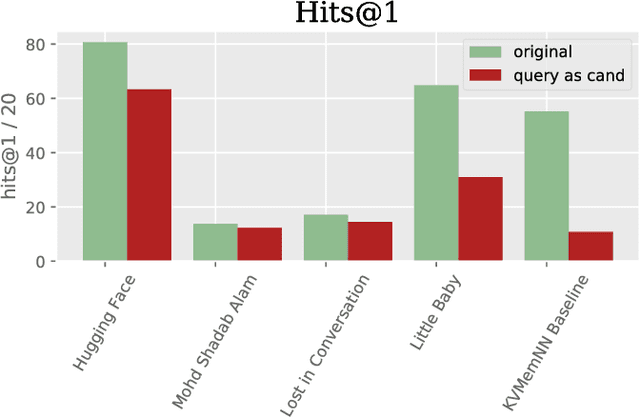
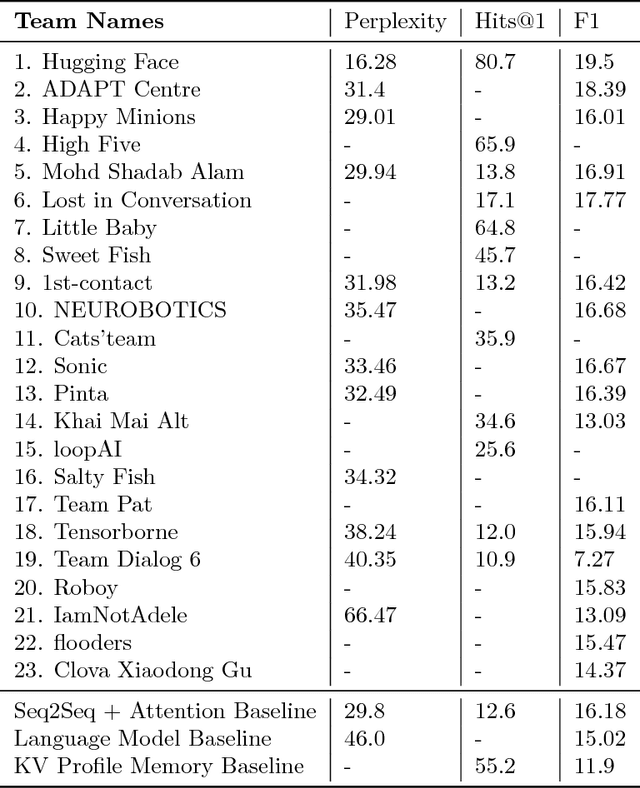
We describe the setting and results of the ConvAI2 NeurIPS competition that aims to further the state-of-the-art in open-domain chatbots. Some key takeaways from the competition are: (i) pretrained Transformer variants are currently the best performing models on this task, (ii) but to improve performance on multi-turn conversations with humans, future systems must go beyond single word metrics like perplexity to measure the performance across sequences of utterances (conversations) -- in terms of repetition, consistency and balance of dialogue acts (e.g. how many questions asked vs. answered).
No Training Required: Exploring Random Encoders for Sentence Classification
Jan 29, 2019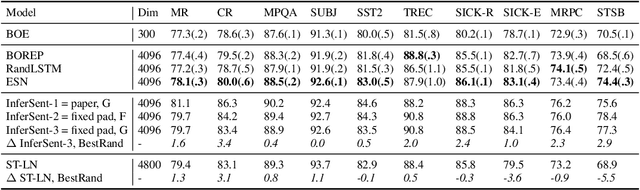
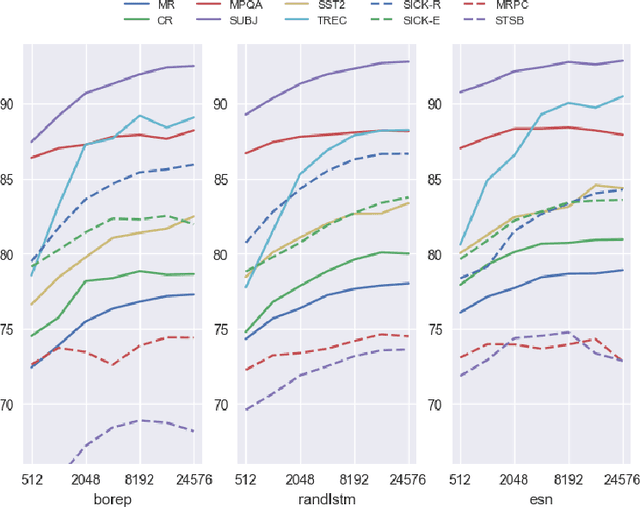
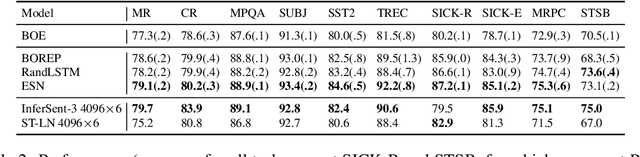

We explore various methods for computing sentence representations from pre-trained word embeddings without any training, i.e., using nothing but random parameterizations. Our aim is to put sentence embeddings on more solid footing by 1) looking at how much modern sentence embeddings gain over random methods---as it turns out, surprisingly little; and by 2) providing the field with more appropriate baselines going forward---which are, as it turns out, quite strong. We also make important observations about proper experimental protocol for sentence classification evaluation, together with recommendations for future research.