 Add to Chrome
 Add to Firefox
 Add to Edge
The Finetuner's Fallacy: When to Pretrain with Your Finetuning Data
Mar 17, 2026
Real-world model deployments demand strong performance on narrow domains where data is often scarce. Typically, practitioners finetune models to specialize them, but this risks overfitting to the domain and forgetting general knowledge. We study a simple strategy, specialized pretraining (SPT), where a small domain dataset, typically reserved for finetuning, is repeated starting from pretraining as a fraction of the total tokens. Across three specialized domains (ChemPile, MusicPile, and ProofPile), SPT improves domain performance and preserves general capabilities after finetuning compared to standard pretraining. In our experiments, SPT reduces the pretraining tokens needed to reach a given domain performance by up to 1.75x. These gains grow when the target domain is underrepresented in the pretraining corpus: on domains far from web text, a 1B SPT model outperforms a 3B standard pretrained model. Beyond these empirical gains, we derive overfitting scaling laws to guide practitioners in selecting the optimal domain-data repetition for a given pretraining compute budget. Our observations reveal the finetuner's fallacy: while finetuning may appear to be the cheapest path to domain adaptation, introducing specialized domain data during pretraining stretches its utility. SPT yields better specialized domain performance (via reduced overfitting across repeated exposures) and better general domain performance (via reduced forgetting during finetuning), ultimately achieving stronger results with fewer parameters and less total compute when amortized over inference. To get the most out of domain data, incorporate it as early in training as possible.

ÜberWeb: Insights from Multilingual Curation for a 20-Trillion-Token Dataset
Feb 16, 2026Multilinguality is a core capability for modern foundation models, yet training high-quality multilingual models remains challenging due to uneven data availability across languages. A further challenge is the performance interference that can arise from joint multilingual training, commonly referred to as the "curse of multilinguality". We study multilingual data curation across thirteen languages and find that many reported regressions are not inherent to multilingual scaling but instead stem from correctable deficiencies in data quality and composition rather than fundamental capacity limits. In controlled bilingual experiments, improving data quality for any single language benefits others: curating English improves non-English performance in 12 of 13 languages, while curating non-English yields reciprocal improvements in English. Bespoke per-language curation produces substantially larger within-language improvements. Extending these findings to large-scale general-purpose training mixtures, we show that curated multilingual allocations comprising under 8% of total tokens remain remarkably effective. We operationalize this approach within an effort that produced a 20T-token pretraining corpus derived entirely from public sources. Models with 3B and 8B parameters trained on a 1T-token random subset achieve competitive multilingual accuracy with 4-10x fewer training FLOPs than strong public baselines, establishing a new Pareto frontier in multilingual performance versus compute. Moreover, these benefits extend to frontier model scale: the 20T-token corpus served as part of the pretraining dataset for Trinity Large (400B/A13B), which exhibits strong multilingual performance relative to its training FLOPs. These results show that targeted, per-language data curation mitigates multilingual interference and enables compute-efficient multilingual scaling.
DatBench: Discriminative, Faithful, and Efficient VLM Evaluations
Jan 05, 2026Empirical evaluation serves as the primary compass guiding research progress in foundation models. Despite a large body of work focused on training frontier vision-language models (VLMs), approaches to their evaluation remain nascent. To guide their maturation, we propose three desiderata that evaluations should satisfy: (1) faithfulness to the modality and application, (2) discriminability between models of varying quality, and (3) efficiency in compute. Through this lens, we identify critical failure modes that violate faithfulness and discriminability, misrepresenting model capabilities: (i) multiple-choice formats reward guessing, poorly reflect downstream use cases, and saturate early as models improve; (ii) blindly solvable questions, which can be answered without images, constitute up to 70% of some evaluations; and (iii) mislabeled or ambiguous samples compromise up to 42% of examples in certain datasets. Regarding efficiency, the computational burden of evaluating frontier models has become prohibitive: by some accounts, nearly 20% of development compute is devoted to evaluation alone. Rather than discarding existing benchmarks, we curate them via transformation and filtering to maximize fidelity and discriminability. We find that converting multiple-choice questions to generative tasks reveals sharp capability drops of up to 35%. In addition, filtering blindly solvable and mislabeled samples improves discriminative power while simultaneously reducing computational cost. We release DatBench-Full, a cleaned evaluation suite of 33 datasets spanning nine VLM capabilities, and DatBench, a discriminative subset that achieves 13x average speedup (up to 50x) while closely matching the discriminative power of the original datasets. Our work outlines a path toward evaluation practices that are both rigorous and sustainable as VLMs continue to scale.
Luxical: High-Speed Lexical-Dense Text Embeddings
Dec 11, 2025Frontier language model quality increasingly hinges on our ability to organize web-scale text corpora for training. Today's dominant tools trade off speed and flexibility: lexical classifiers (e.g., FastText) are fast but limited to producing classification output scores, while the vector-valued outputs of transformer text embedding models flexibly support numerous workflows (e.g., clustering, classification, and retrieval) but are computationally expensive to produce. We introduce Luxical, a library for high-speed "lexical-dense" text embeddings that aims to recover the best properties of both approaches for web-scale text organization. Luxical combines sparse TF--IDF features, a small ReLU network, and a knowledge distillation training regimen to approximate large transformer embedding models at a fraction of their operational cost. In this technical report, we describe the Luxical architecture and training objective and evaluate a concrete Luxical model in two disparate applications: a targeted webcrawl document retrieval test and an end-to-end language model data curation task grounded in text classification. In these tasks we demonstrate speedups ranging from 3x to 100x over varying-sized neural baselines, and comparable to FastText model inference during the data curation task. On these evaluations, the tested Luxical model illustrates favorable compute/quality trade-offs for large-scale text organization, matching the quality of neural baselines. Luxical is available as open-source software at https://github.com/datologyai/luxical.
Improving Text-to-Image Consistency via Automatic Prompt Optimization
Mar 26, 2024
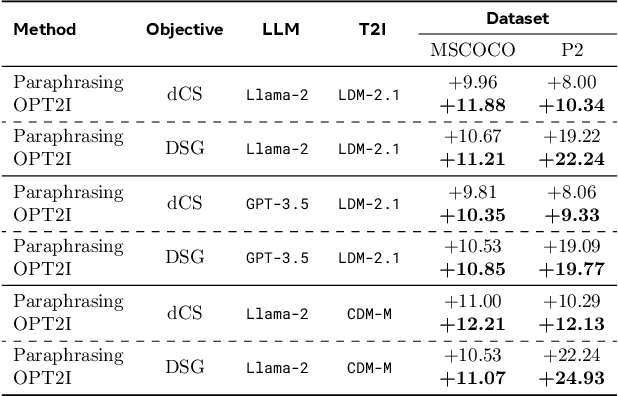


Impressive advances in text-to-image (T2I) generative models have yielded a plethora of high performing models which are able to generate aesthetically appealing, photorealistic images. Despite the progress, these models still struggle to produce images that are consistent with the input prompt, oftentimes failing to capture object quantities, relations and attributes properly. Existing solutions to improve prompt-image consistency suffer from the following challenges: (1) they oftentimes require model fine-tuning, (2) they only focus on nearby prompt samples, and (3) they are affected by unfavorable trade-offs among image quality, representation diversity, and prompt-image consistency. In this paper, we address these challenges and introduce a T2I optimization-by-prompting framework, OPT2I, which leverages a large language model (LLM) to improve prompt-image consistency in T2I models. Our framework starts from a user prompt and iteratively generates revised prompts with the goal of maximizing a consistency score. Our extensive validation on two datasets, MSCOCO and PartiPrompts, shows that OPT2I can boost the initial consistency score by up to 24.9% in terms of DSG score while preserving the FID and increasing the recall between generated and real data. Our work paves the way toward building more reliable and robust T2I systems by harnessing the power of LLMs.
A Picture is Worth More Than 77 Text Tokens: Evaluating CLIP-Style Models on Dense Captions
Dec 14, 2023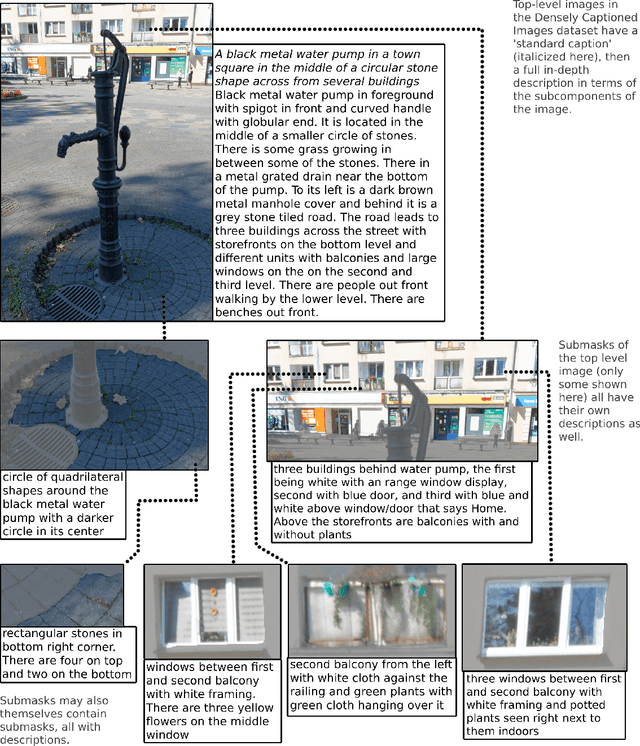
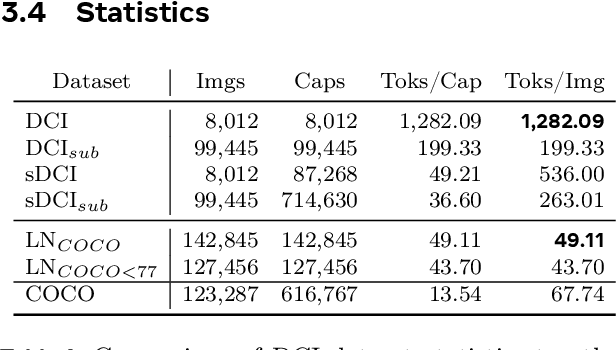
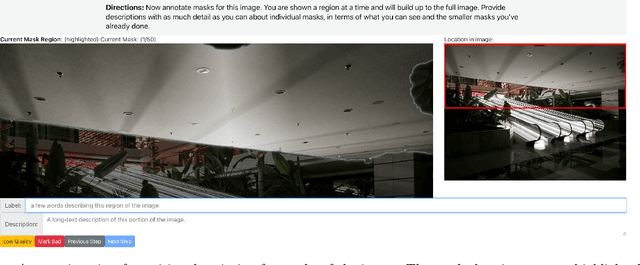
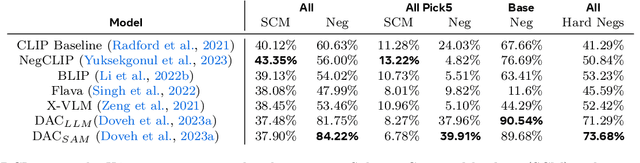
Curation methods for massive vision-language datasets trade off between dataset size and quality. However, even the highest quality of available curated captions are far too short to capture the rich visual detail in an image. To show the value of dense and highly-aligned image-text pairs, we collect the Densely Captioned Images (DCI) dataset, containing 8012 natural images human-annotated with mask-aligned descriptions averaging above 1000 words each. With precise and reliable captions associated with specific parts of an image, we can evaluate vision-language models' (VLMs) understanding of image content with a novel task that matches each caption with its corresponding subcrop. As current models are often limited to 77 text tokens, we also introduce a summarized version (sDCI) in which each caption length is limited. We show that modern techniques that make progress on standard benchmarks do not correspond with significant improvement on our sDCI based benchmark. Lastly, we finetune CLIP using sDCI and show significant improvements over the baseline despite a small training set. By releasing the first human annotated dense image captioning dataset, we hope to enable the development of new benchmarks or fine-tuning recipes for the next generation of VLMs to come.
Multi-Party Chat: Conversational Agents in Group Settings with Humans and Models
Apr 26, 2023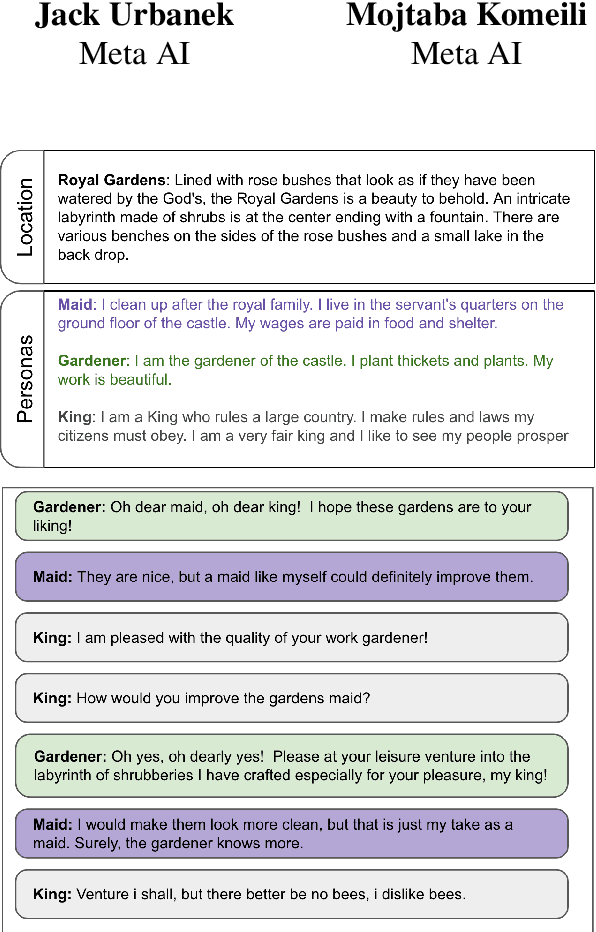
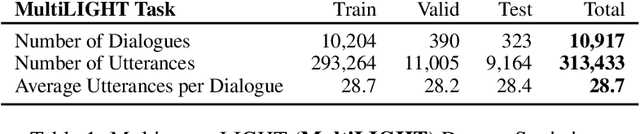


Current dialogue research primarily studies pairwise (two-party) conversations, and does not address the everyday setting where more than two speakers converse together. In this work, we both collect and evaluate multi-party conversations to study this more general case. We use the LIGHT environment to construct grounded conversations, where each participant has an assigned character to role-play. We thus evaluate the ability of language models to act as one or more characters in such conversations. Models require two skills that pairwise-trained models appear to lack: (1) being able to decide when to talk; (2) producing coherent utterances grounded on multiple characters. We compare models trained on our new dataset to existing pairwise-trained dialogue models, as well as large language models with few-shot prompting. We find that our new dataset, MultiLIGHT, which we will publicly release, can help bring significant improvements in the group setting.
Infusing Commonsense World Models with Graph Knowledge
Jan 13, 2023While language models have become more capable of producing compelling language, we find there are still gaps in maintaining consistency, especially when describing events in a dynamically changing world. We study the setting of generating narratives in an open world text adventure game, where a graph representation of the underlying game state can be used to train models that consume and output both grounded graph representations and natural language descriptions and actions. We build a large set of tasks by combining crowdsourced and simulated gameplays with a novel dataset of complex actions in order to to construct such models. We find it is possible to improve the consistency of action narration models by training on graph contexts and targets, even if graphs are not present at test time. This is shown both in automatic metrics and human evaluations. We plan to release our code, the new set of tasks, and best performing models.
Mephisto: A Framework for Portable, Reproducible, and Iterative Crowdsourcing
Jan 12, 2023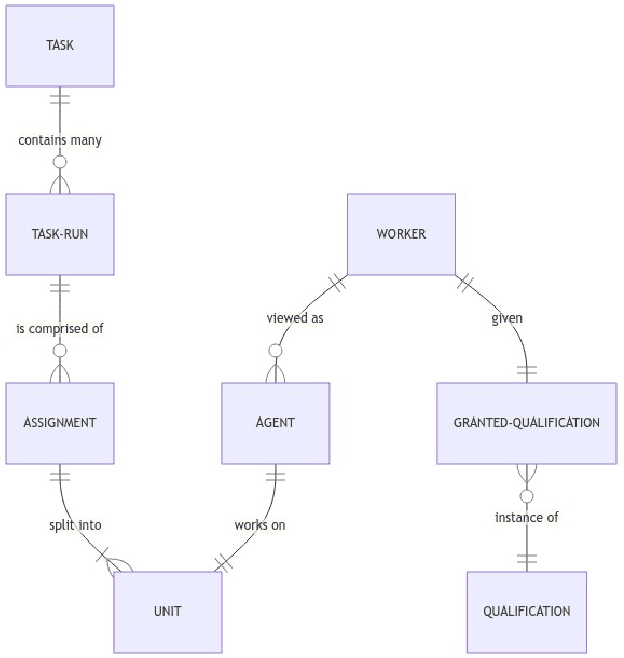
We introduce Mephisto, a framework to make crowdsourcing for research more reproducible, transparent, and collaborative. Mephisto provides abstractions that cover a broad set of task designs and data collection workflows, and provides a simple user experience to make best-practices easy defaults. In this whitepaper we discuss the current state of data collection and annotation in ML research, establish the motivation for building a shared framework to enable researchers to create and open-source data collection and annotation tools as part of their publication, and outline a set of suggested requirements for a system to facilitate these goals. We then step through our resolution in Mephisto, explaining the abstractions we use, our design decisions around the user experience, and share implementation details and where they align with the original motivations. We also discuss current limitations, as well as future work towards continuing to deliver on the framework's initial goals. Mephisto is available as an open source project, and its documentation can be found at www.mephisto.ai.
Am I Me or You? State-of-the-Art Dialogue Models Cannot Maintain an Identity
Dec 10, 2021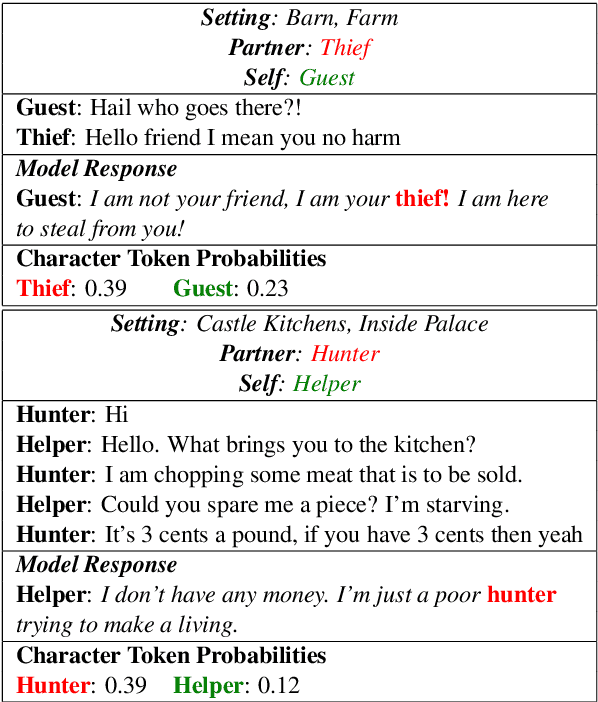
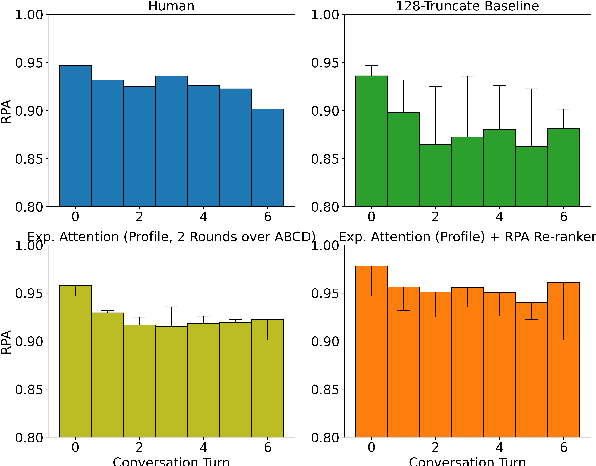
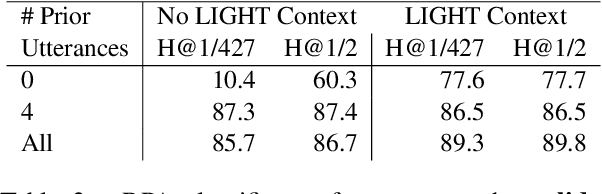
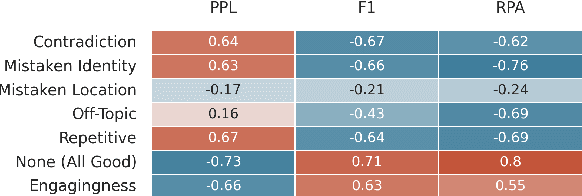
State-of-the-art dialogue models still often stumble with regards to factual accuracy and self-contradiction. Anecdotally, they have been observed to fail to maintain character identity throughout discourse; and more specifically, may take on the role of their interlocutor. In this work we formalize and quantify this deficiency, and show experimentally through human evaluations that this is indeed a problem. In contrast, we show that discriminative models trained specifically to recognize who is speaking can perform well; and further, these can be used as automated metrics. Finally, we evaluate a wide variety of mitigation methods, including changes to model architecture, training protocol, and decoding strategy. Our best models reduce mistaken identity issues by nearly 65% according to human annotators, while simultaneously improving engagingness. Despite these results, we find that maintaining character identity still remains a challenging problem.