 Add to Chrome
 Add to Firefox
 Add to Edge
Cas-DiffCom: Cascaded diffusion model for infant longitudinal super-resolution 3D medical image completion
Feb 21, 2024


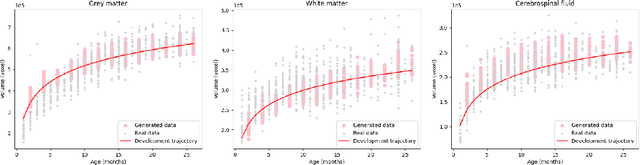
Early infancy is a rapid and dynamic neurodevelopmental period for behavior and neurocognition. Longitudinal magnetic resonance imaging (MRI) is an effective tool to investigate such a crucial stage by capturing the developmental trajectories of the brain structures. However, longitudinal MRI acquisition always meets a serious data-missing problem due to participant dropout and failed scans, making longitudinal infant brain atlas construction and developmental trajectory delineation quite challenging. Thanks to the development of an AI-based generative model, neuroimage completion has become a powerful technique to retain as much available data as possible. However, current image completion methods usually suffer from inconsistency within each individual subject in the time dimension, compromising the overall quality. To solve this problem, our paper proposed a two-stage cascaded diffusion model, Cas-DiffCom, for dense and longitudinal 3D infant brain MRI completion and super-resolution. We applied our proposed method to the Baby Connectome Project (BCP) dataset. The experiment results validate that Cas-DiffCom achieves both individual consistency and high fidelity in longitudinal infant brain image completion. We further applied the generated infant brain images to two downstream tasks, brain tissue segmentation and developmental trajectory delineation, to declare its task-oriented potential in the neuroscience field.

Transferring Ultrahigh-Field Representations for Intensity-Guided Brain Segmentation of Low-Field Magnetic Resonance Imaging
Feb 13, 2024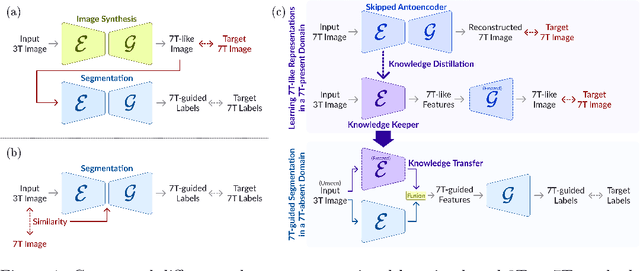
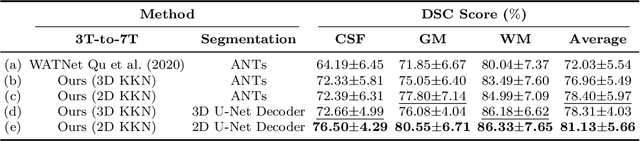
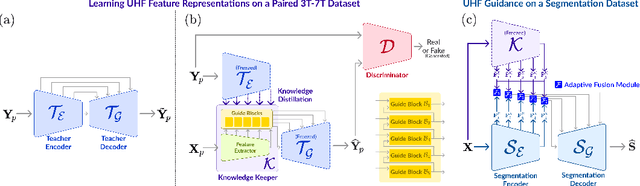
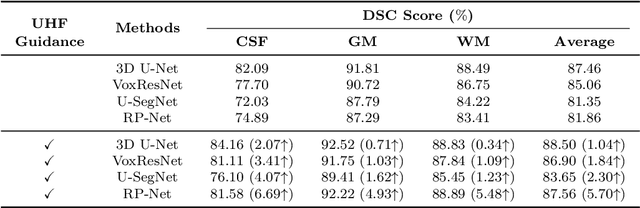
Ultrahigh-field (UHF) magnetic resonance imaging (MRI), i.e., 7T MRI, provides superior anatomical details of internal brain structures owing to its enhanced signal-to-noise ratio and susceptibility-induced contrast. However, the widespread use of 7T MRI is limited by its high cost and lower accessibility compared to low-field (LF) MRI. This study proposes a deep-learning framework that systematically fuses the input LF magnetic resonance feature representations with the inferred 7T-like feature representations for brain image segmentation tasks in a 7T-absent environment. Specifically, our adaptive fusion module aggregates 7T-like features derived from the LF image by a pre-trained network and then refines them to be effectively assimilable UHF guidance into LF image features. Using intensity-guided features obtained from such aggregation and assimilation, segmentation models can recognize subtle structural representations that are usually difficult to recognize when relying only on LF features. Beyond such advantages, this strategy can seamlessly be utilized by modulating the contrast of LF features in alignment with UHF guidance, even when employing arbitrary segmentation models. Exhaustive experiments demonstrated that the proposed method significantly outperformed all baseline models on both brain tissue and whole-brain segmentation tasks; further, it exhibited remarkable adaptability and scalability by successfully integrating diverse segmentation models and tasks. These improvements were not only quantifiable but also visible in the superlative visual quality of segmentation masks.
ScribFormer: Transformer Makes CNN Work Better for Scribble-based Medical Image Segmentation
Feb 03, 2024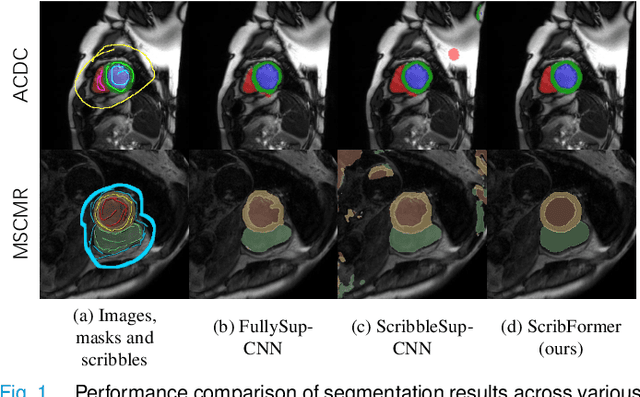
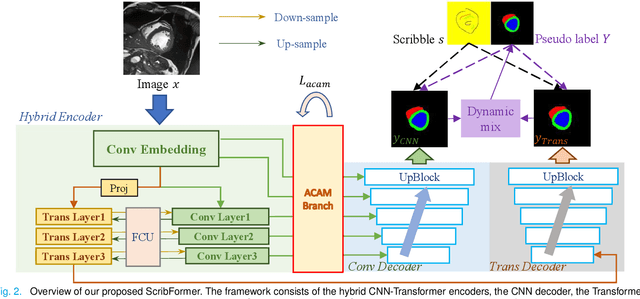


Most recent scribble-supervised segmentation methods commonly adopt a CNN framework with an encoder-decoder architecture. Despite its multiple benefits, this framework generally can only capture small-range feature dependency for the convolutional layer with the local receptive field, which makes it difficult to learn global shape information from the limited information provided by scribble annotations. To address this issue, this paper proposes a new CNN-Transformer hybrid solution for scribble-supervised medical image segmentation called ScribFormer. The proposed ScribFormer model has a triple-branch structure, i.e., the hybrid of a CNN branch, a Transformer branch, and an attention-guided class activation map (ACAM) branch. Specifically, the CNN branch collaborates with the Transformer branch to fuse the local features learned from CNN with the global representations obtained from Transformer, which can effectively overcome limitations of existing scribble-supervised segmentation methods. Furthermore, the ACAM branch assists in unifying the shallow convolution features and the deep convolution features to improve model's performance further. Extensive experiments on two public datasets and one private dataset show that our ScribFormer has superior performance over the state-of-the-art scribble-supervised segmentation methods, and achieves even better results than the fully-supervised segmentation methods. The code is released at https://github.com/HUANGLIZI/ScribFormer.
Image2Points:A 3D Point-based Context Clusters GAN for High-Quality PET Image Reconstruction
Feb 01, 2024To obtain high-quality Positron emission tomography (PET) images while minimizing radiation exposure, numerous methods have been proposed to reconstruct standard-dose PET (SPET) images from the corresponding low-dose PET (LPET) images. However, these methods heavily rely on voxel-based representations, which fall short of adequately accounting for the precise structure and fine-grained context, leading to compromised reconstruction. In this paper, we propose a 3D point-based context clusters GAN, namely PCC-GAN, to reconstruct high-quality SPET images from LPET. Specifically, inspired by the geometric representation power of points, we resort to a point-based representation to enhance the explicit expression of the image structure, thus facilitating the reconstruction with finer details. Moreover, a context clustering strategy is applied to explore the contextual relationships among points, which mitigates the ambiguities of small structures in the reconstructed images. Experiments on both clinical and phantom datasets demonstrate that our PCC-GAN outperforms the state-of-the-art reconstruction methods qualitatively and quantitatively. Code is available at https://github.com/gluucose/PCCGAN.
Predicting Infant Brain Connectivity with Federated Multi-Trajectory GNNs using Scarce Data
Jan 08, 2024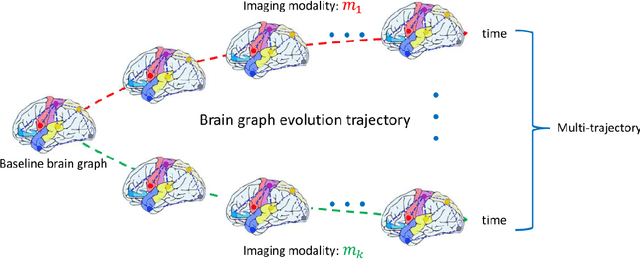
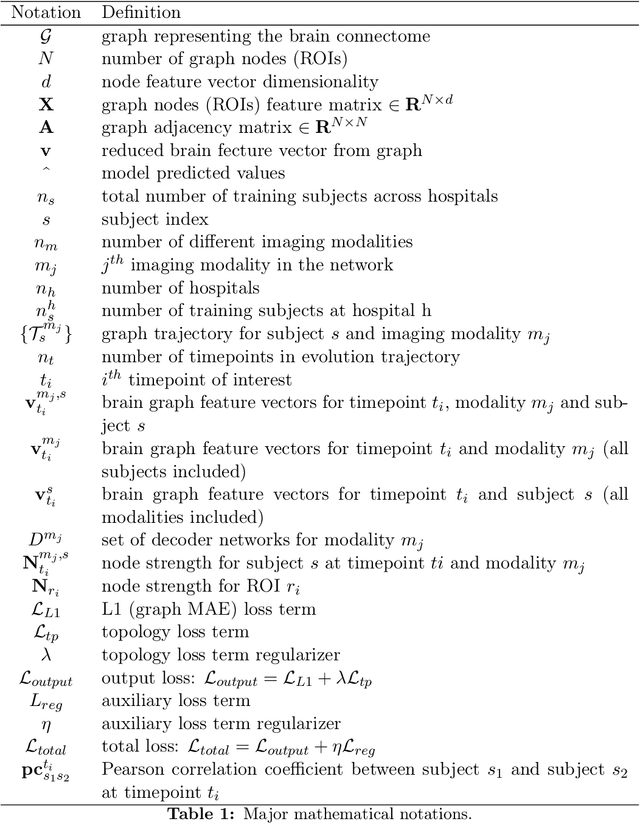
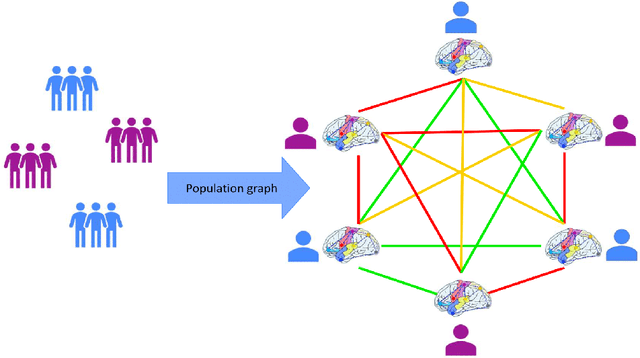
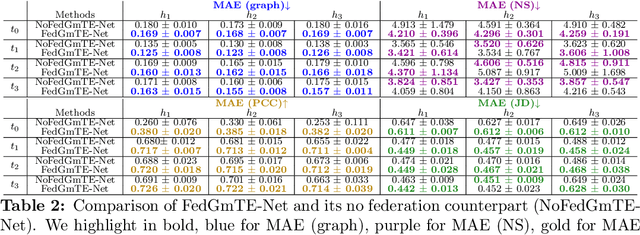
The understanding of the convoluted evolution of infant brain networks during the first postnatal year is pivotal for identifying the dynamics of early brain connectivity development. Existing deep learning solutions suffer from three major limitations. First, they cannot generalize to multi-trajectory prediction tasks, where each graph trajectory corresponds to a particular imaging modality or connectivity type (e.g., T1-w MRI). Second, existing models require extensive training datasets to achieve satisfactory performance which are often challenging to obtain. Third, they do not efficiently utilize incomplete time series data. To address these limitations, we introduce FedGmTE-Net++, a federated graph-based multi-trajectory evolution network. Using the power of federation, we aggregate local learnings among diverse hospitals with limited datasets. As a result, we enhance the performance of each hospital's local generative model, while preserving data privacy. The three key innovations of FedGmTE-Net++ are: (i) presenting the first federated learning framework specifically designed for brain multi-trajectory evolution prediction in a data-scarce environment, (ii) incorporating an auxiliary regularizer in the local objective function to exploit all the longitudinal brain connectivity within the evolution trajectory and maximize data utilization, (iii) introducing a two-step imputation process, comprising a preliminary KNN-based precompletion followed by an imputation refinement step that employs regressors to improve similarity scores and refine imputations. Our comprehensive experimental results showed the outperformance of FedGmTE-Net++ in brain multi-trajectory prediction from a single baseline graph in comparison with benchmark methods.
CLIP in Medical Imaging: A Comprehensive Survey
Dec 26, 2023


Contrastive Language-Image Pre-training (CLIP), a simple yet effective pre-training paradigm, successfully introduces text supervision to vision models. It has shown promising results across various tasks, attributable to its generalizability and interpretability. The use of CLIP has recently gained increasing interest in the medical imaging domain, serving both as a pre-training paradigm for aligning medical vision and language, and as a critical component in diverse clinical tasks. With the aim of facilitating a deeper understanding of this promising direction, this survey offers an in-depth exploration of the CLIP paradigm within the domain of medical imaging, regarding both refined CLIP pre-training and CLIP-driven applications. In this study, We (1) start with a brief introduction to the fundamentals of CLIP methodology. (2) Then, we investigate the adaptation of CLIP pre-training in the medical domain, focusing on how to optimize CLIP given characteristics of medical images and reports. (3) Furthermore, we explore the practical utilization of CLIP pre-trained models in various tasks, including classification, dense prediction, and cross-modal tasks. (4) Finally, we discuss existing limitations of CLIP in the context of medical imaging and propose forward-looking directions to address the demands of medical imaging domain. We expect that this comprehensive survey will provide researchers in the field of medical image analysis with a holistic understanding of the CLIP paradigm and its potential implications. The project page can be found on https://github.com/zhaozh10/Awesome-CLIP-in-Medical-Imaging.
Mining Gaze for Contrastive Learning toward Computer-Assisted Diagnosis
Dec 12, 2023Obtaining large-scale radiology reports can be difficult for medical images due to various reasons, limiting the effectiveness of contrastive pre-training in the medical image domain and underscoring the need for alternative methods. In this paper, we propose eye-tracking as an alternative to text reports, as it allows for the passive collection of gaze signals without disturbing radiologist's routine diagnosis process. By tracking the gaze of radiologists as they read and diagnose medical images, we can understand their visual attention and clinical reasoning. When a radiologist has similar gazes for two medical images, it may indicate semantic similarity for diagnosis, and these images should be treated as positive pairs when pre-training a computer-assisted diagnosis (CAD) network through contrastive learning. Accordingly, we introduce the Medical contrastive Gaze Image Pre-training (McGIP) as a plug-and-play module for contrastive learning frameworks. McGIP uses radiologist's gaze to guide contrastive pre-training. We evaluate our method using two representative types of medical images and two common types of gaze data. The experimental results demonstrate the practicality of McGIP, indicating its high potential for various clinical scenarios and applications.
MARformer: An Efficient Metal Artifact Reduction Transformer for Dental CBCT Images
Nov 16, 2023


Cone Beam Computed Tomography (CBCT) plays a key role in dental diagnosis and surgery. However, the metal teeth implants could bring annoying metal artifacts during the CBCT imaging process, interfering diagnosis and downstream processing such as tooth segmentation. In this paper, we develop an efficient Transformer to perform metal artifacts reduction (MAR) from dental CBCT images. The proposed MAR Transformer (MARformer) reduces computation complexity in the multihead self-attention by a new Dimension-Reduced Self-Attention (DRSA) module, based on that the CBCT images have globally similar structure. A Patch-wise Perceptive Feed Forward Network (P2FFN) is also proposed to perceive local image information for fine-grained restoration. Experimental results on CBCT images with synthetic and real-world metal artifacts show that our MARformer is efficient and outperforms previous MAR methods and two restoration Transformers.
MeLo: Low-rank Adaptation is Better than Fine-tuning for Medical Image Diagnosis
Nov 14, 2023The common practice in developing computer-aided diagnosis (CAD) models based on transformer architectures usually involves fine-tuning from ImageNet pre-trained weights. However, with recent advances in large-scale pre-training and the practice of scaling laws, Vision Transformers (ViT) have become much larger and less accessible to medical imaging communities. Additionally, in real-world scenarios, the deployments of multiple CAD models can be troublesome due to problems such as limited storage space and time-consuming model switching. To address these challenges, we propose a new method MeLo (Medical image Low-rank adaptation), which enables the development of a single CAD model for multiple clinical tasks in a lightweight manner. It adopts low-rank adaptation instead of resource-demanding fine-tuning. By fixing the weight of ViT models and only adding small low-rank plug-ins, we achieve competitive results on various diagnosis tasks across different imaging modalities using only a few trainable parameters. Specifically, our proposed method achieves comparable performance to fully fine-tuned ViT models on four distinct medical imaging datasets using about 0.17% trainable parameters. Moreover, MeLo adds only about 0.5MB of storage space and allows for extremely fast model switching in deployment and inference. Our source code and pre-trained weights are available on our website (https://absterzhu.github.io/melo.github.io/).
3D Structure-guided Network for Tooth Alignment in 2D Photograph
Oct 17, 2023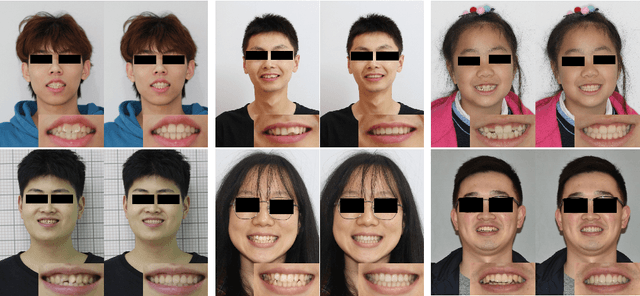
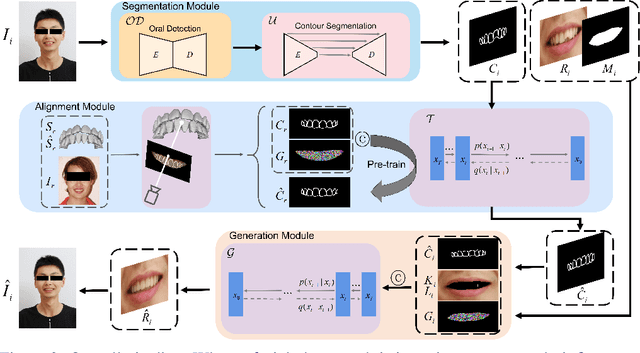
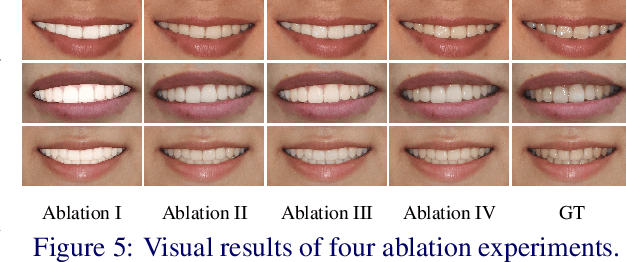
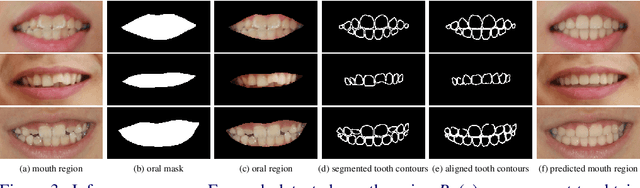
Orthodontics focuses on rectifying misaligned teeth (i.e., malocclusions), affecting both masticatory function and aesthetics. However, orthodontic treatment often involves complex, lengthy procedures. As such, generating a 2D photograph depicting aligned teeth prior to orthodontic treatment is crucial for effective dentist-patient communication and, more importantly, for encouraging patients to accept orthodontic intervention. In this paper, we propose a 3D structure-guided tooth alignment network that takes 2D photographs as input (e.g., photos captured by smartphones) and aligns the teeth within the 2D image space to generate an orthodontic comparison photograph featuring aesthetically pleasing, aligned teeth. Notably, while the process operates within a 2D image space, our method employs 3D intra-oral scanning models collected in clinics to learn about orthodontic treatment, i.e., projecting the pre- and post-orthodontic 3D tooth structures onto 2D tooth contours, followed by a diffusion model to learn the mapping relationship. Ultimately, the aligned tooth contours are leveraged to guide the generation of a 2D photograph with aesthetically pleasing, aligned teeth and realistic textures. We evaluate our network on various facial photographs, demonstrating its exceptional performance and strong applicability within the orthodontic industry.