 Add to Chrome
 Add to Firefox
 Add to Edge
AdVENTR: Autonomous Robot Navigation in Complex Outdoor Environments
Nov 15, 2023
We present a novel system, AdVENTR for autonomous robot navigation in unstructured outdoor environments that consist of uneven and vegetated terrains. Our approach is general and can enable both wheeled and legged robots to handle outdoor terrain complexity including unevenness, surface properties like poor traction, granularity, obstacle stiffness, etc. We use data from sensors including RGB cameras, 3D Lidar, IMU, robot odometry, and pose information with efficient learning-based perception and planning algorithms that can execute on edge computing hardware. Our system uses a scene-aware switching method to perceive the environment for navigation at any time instant and dynamically switches between multiple perception algorithms. We test our system in a variety of sloped, rocky, muddy, and densely vegetated terrains and demonstrate its performance on Husky and Spot robots.

UAV-Sim: NeRF-based Synthetic Data Generation for UAV-based Perception
Oct 25, 2023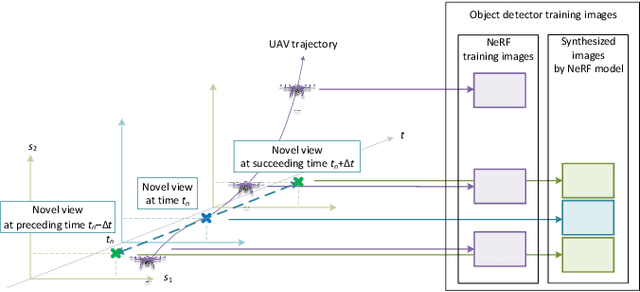

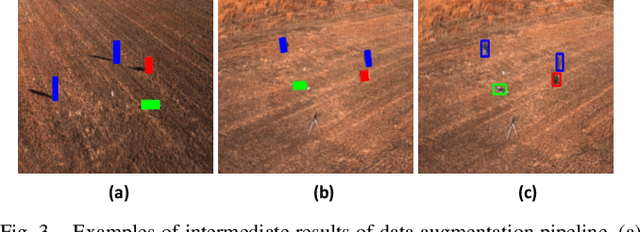
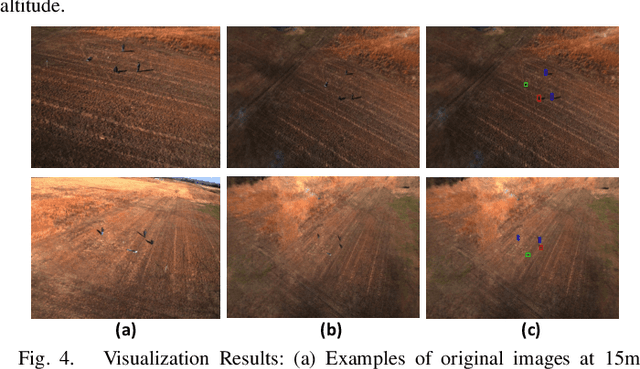
Tremendous variations coupled with large degrees of freedom in UAV-based imaging conditions lead to a significant lack of data in adequately learning UAV-based perception models. Using various synthetic renderers in conjunction with perception models is prevalent to create synthetic data to augment the learning in the ground-based imaging domain. However, severe challenges in the austere UAV-based domain require distinctive solutions to image synthesis for data augmentation. In this work, we leverage recent advancements in neural rendering to improve static and dynamic novelview UAV-based image synthesis, especially from high altitudes, capturing salient scene attributes. Finally, we demonstrate a considerable performance boost is achieved when a state-ofthe-art detection model is optimized primarily on hybrid sets of real and synthetic data instead of the real or synthetic data separately.
DALE: Generative Data Augmentation for Low-Resource Legal NLP
Oct 24, 2023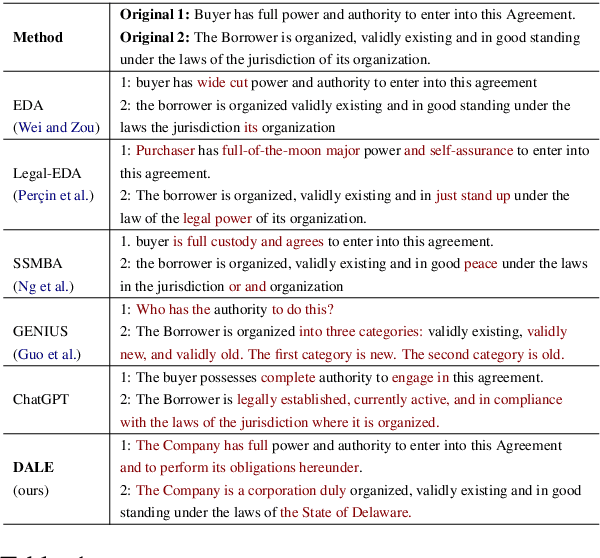
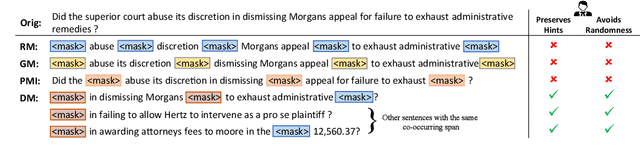


We present DALE, a novel and effective generative Data Augmentation framework for low-resource LEgal NLP. DALE addresses the challenges existing frameworks pose in generating effective data augmentations of legal documents - legal language, with its specialized vocabulary and complex semantics, morphology, and syntax, does not benefit from data augmentations that merely rephrase the source sentence. To address this, DALE, built on an Encoder-Decoder Language Model, is pre-trained on a novel unsupervised text denoising objective based on selective masking - our masking strategy exploits the domain-specific language characteristics of templatized legal documents to mask collocated spans of text. Denoising these spans helps DALE acquire knowledge about legal concepts, principles, and language usage. Consequently, it develops the ability to generate coherent and diverse augmentations with novel contexts. Finally, DALE performs conditional generation to generate synthetic augmentations for low-resource Legal NLP tasks. We demonstrate the effectiveness of DALE on 13 datasets spanning 6 tasks and 4 low-resource settings. DALE outperforms all our baselines, including LLMs, qualitatively and quantitatively, with improvements of 1%-50%.
HallusionBench: You See What You Think? Or You Think What You See? An Image-Context Reasoning Benchmark Challenging for GPT-4V, LLaVA-1.5, and Other Multi-modality Models
Oct 23, 2023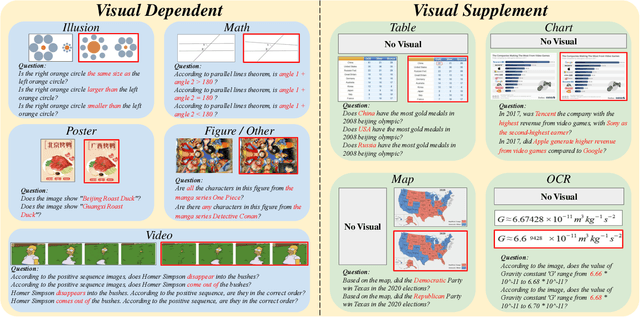
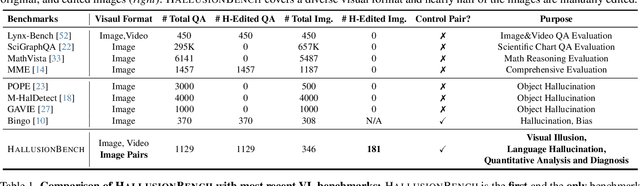
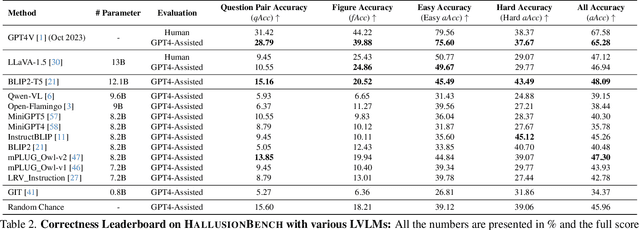
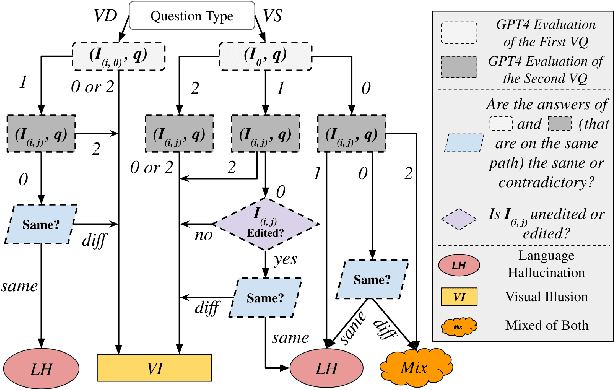
Large language models (LLMs), after being aligned with vision models and integrated into vision-language models (VLMs), can bring impressive improvement in image reasoning tasks. This was shown by the recently released GPT-4V(ison), LLaVA-1.5, etc. However, the strong language prior in these SOTA LVLMs can be a double-edged sword: they may ignore the image context and solely rely on the (even contradictory) language prior for reasoning. In contrast, the vision modules in VLMs are weaker than LLMs and may result in misleading visual representations, which are then translated to confident mistakes by LLMs. To study these two types of VLM mistakes, i.e., language hallucination and visual illusion, we curated HallusionBench, an image-context reasoning benchmark that is still challenging to even GPT-4V and LLaVA-1.5. We provide a detailed analysis of examples in HallusionBench, which sheds novel insights on the illusion or hallucination of VLMs and how to improve them in the future. The benchmark and codebase will be released at https://github.com/tianyi-lab/HallusionBench.
Towards Possibilities & Impossibilities of AI-generated Text Detection: A Survey
Oct 23, 2023Large Language Models (LLMs) have revolutionized the domain of natural language processing (NLP) with remarkable capabilities of generating human-like text responses. However, despite these advancements, several works in the existing literature have raised serious concerns about the potential misuse of LLMs such as spreading misinformation, generating fake news, plagiarism in academia, and contaminating the web. To address these concerns, a consensus among the research community is to develop algorithmic solutions to detect AI-generated text. The basic idea is that whenever we can tell if the given text is either written by a human or an AI, we can utilize this information to address the above-mentioned concerns. To that end, a plethora of detection frameworks have been proposed, highlighting the possibilities of AI-generated text detection. But in parallel to the development of detection frameworks, researchers have also concentrated on designing strategies to elude detection, i.e., focusing on the impossibilities of AI-generated text detection. This is a crucial step in order to make sure the detection frameworks are robust enough and it is not too easy to fool a detector. Despite the huge interest and the flurry of research in this domain, the community currently lacks a comprehensive analysis of recent developments. In this survey, we aim to provide a concise categorization and overview of current work encompassing both the prospects and the limitations of AI-generated text detection. To enrich the collective knowledge, we engage in an exhaustive discussion on critical and challenging open questions related to ongoing research on AI-generated text detection.
Indoor Wireless Signal Modeling with Smooth Surface Diffraction Effects
Oct 16, 2023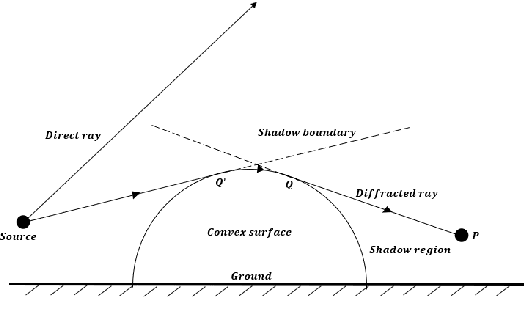
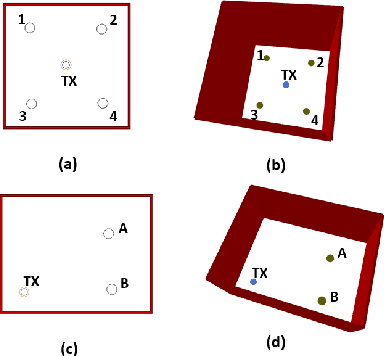
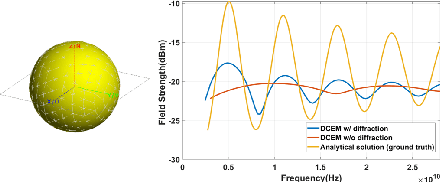
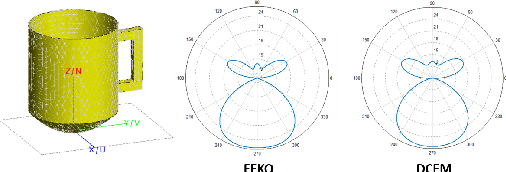
We present a novel algorithm that enhances the accuracy of electromagnetic field simulations in indoor environments by incorporating the Uniform Geometrical Theory of Diffraction (UTD) for surface diffraction. This additional diffraction phenomenology is important for the design of modern wireless systems and allows us to capture the effects of more complex scene geometries. Central to our methodology is the Dynamic Coherence-Based EM Ray Tracing Simulator (DCEM), and we augment that formulation with smooth surface UTD and present techniques to efficiently compute the ray paths. We validate our additions by comparing them to analytical solutions of a sphere, method of moments solutions from FEKO, and ray-traced indoor scenes from WinProp. Our algorithm improves shadow region predicted powers by about 5dB compared to our previous work, and captures nuanced field effects beyond shadow boundaries. We highlight the performance on different indoor scenes and observe 60% faster computation time over WinProp.
CompA: Addressing the Gap in Compositional Reasoning in Audio-Language Models
Oct 12, 2023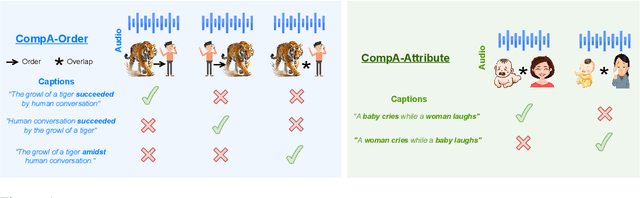

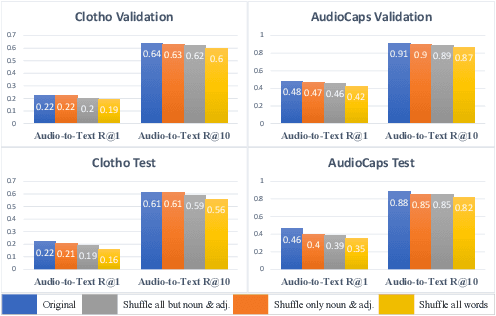
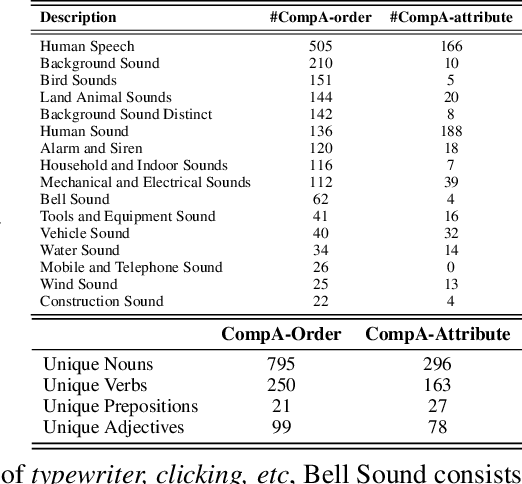
A fundamental characteristic of audio is its compositional nature. Audio-language models (ALMs) trained using a contrastive approach (e.g., CLAP) that learns a shared representation between audio and language modalities have improved performance in many downstream applications, including zero-shot audio classification, audio retrieval, etc. However, the ability of these models to effectively perform compositional reasoning remains largely unexplored and necessitates additional research. In this paper, we propose CompA, a collection of two expert-annotated benchmarks with a majority of real-world audio samples, to evaluate compositional reasoning in ALMs. Our proposed CompA-order evaluates how well an ALM understands the order or occurrence of acoustic events in audio, and CompA-attribute evaluates attribute binding of acoustic events. An instance from either benchmark consists of two audio-caption pairs, where both audios have the same acoustic events but with different compositions. An ALM is evaluated on how well it matches the right audio to the right caption. Using this benchmark, we first show that current ALMs perform only marginally better than random chance, thereby struggling with compositional reasoning. Next, we propose CompA-CLAP, where we fine-tune CLAP using a novel learning method to improve its compositional reasoning abilities. To train CompA-CLAP, we first propose improvements to contrastive training with composition-aware hard negatives, allowing for more focused training. Next, we propose a novel modular contrastive loss that helps the model learn fine-grained compositional understanding and overcomes the acute scarcity of openly available compositional audios. CompA-CLAP significantly improves over all our baseline models on the CompA benchmark, indicating its superior compositional reasoning capabilities.
AG-CVG: Coverage Planning with a Mobile Recharging UGV and an Energy-Constrained UAV
Oct 11, 2023
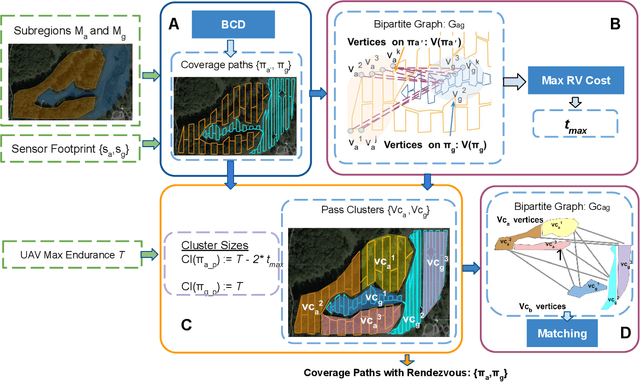


In this paper, we present an approach for coverage path planning for a team of an energy-constrained Unmanned Aerial Vehicle (UAV) and an Unmanned Ground Vehicle (UGV). Both the UAV and the UGV have predefined areas that they have to cover. The goal is to perform complete coverage by both robots while minimizing the coverage time. The UGV can also serve as a mobile recharging station. The UAV and UGV need to occasionally rendezvous for recharging. We propose a heuristic method to address this NP-Hard planning problem. Our approach involves initially determining coverage paths without factoring in energy constraints. Subsequently, we cluster segments of these paths and employ graph matching to assign UAV clusters to UGV clusters for efficient recharging management. We perform numerical analysis on real-world coverage applications and show that compared with a greedy approach our method reduces rendezvous overhead on average by 11.33\%. We demonstrate proof-of-concept with a team of a VOXL m500 drone and a Clearpath Jackal ground vehicle, providing a complete system from the offline algorithm to the field execution.
LANCAR: Leveraging Language for Context-Aware Robot Locomotion in Unstructured Environments
Sep 30, 2023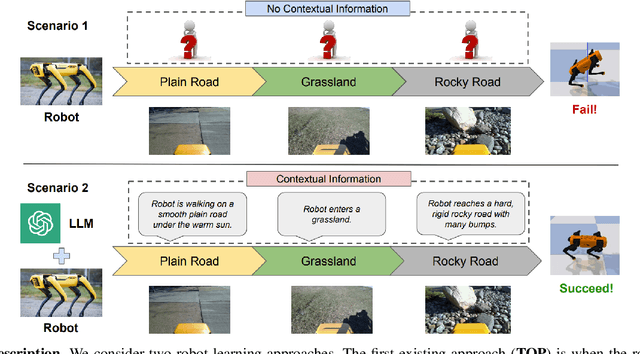
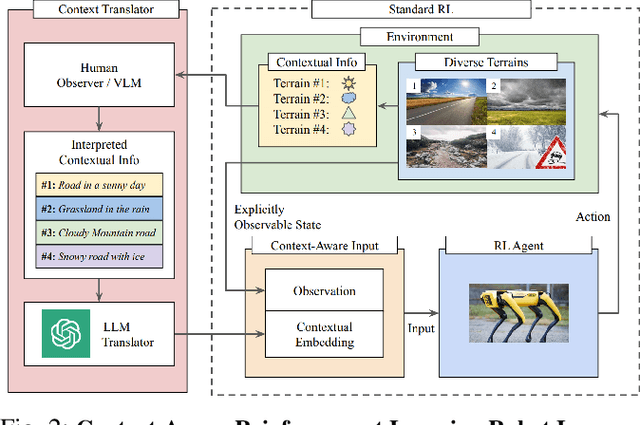
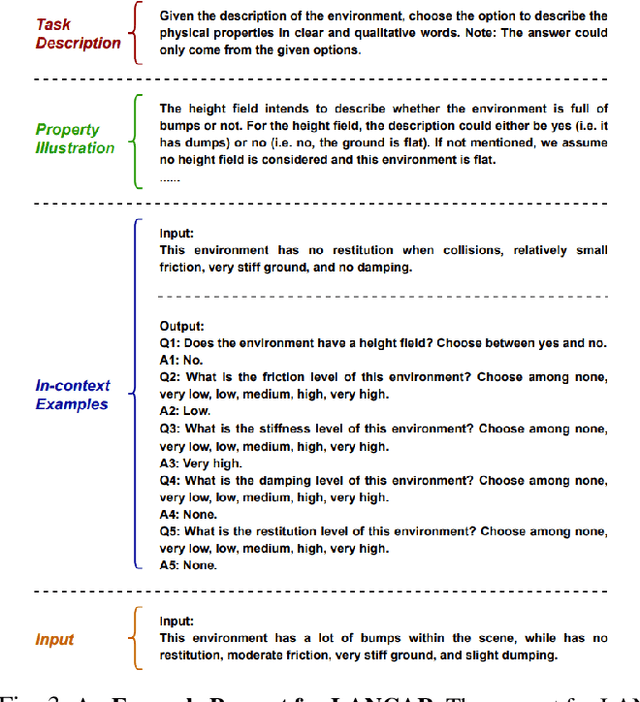
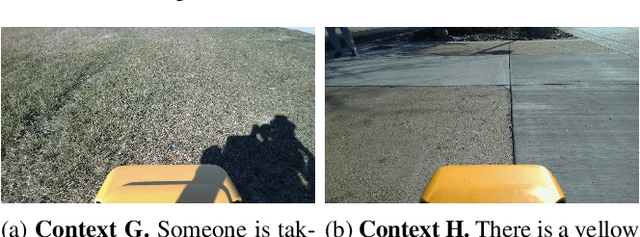
Robotic locomotion is a challenging task, especially in unstructured terrains. In practice, the optimal locomotion policy can be context-dependent by using the contextual information of encountered terrains in decision-making. Humans can interpret the environmental context for robots, but the ambiguity of human language makes it challenging to use in robot locomotion directly. In this paper, we propose a novel approach, LANCAR, that introduces a context translator that works with reinforcement learning (RL) agents for context-aware locomotion. Our formulation allows a robot to interpret the contextual information from environments generated by human observers or Vision-Language Models (VLM) with Large Language Models (LLM) and use this information to generate contextual embeddings. We incorporate the contextual embeddings with the robot's internal environmental observations as the input to the RL agent's decision neural network. We evaluate LANCAR with contextual information in varying ambiguity levels and compare its performance using several alternative approaches. Our experimental results demonstrate that our approach exhibits good generalizability and adaptability across diverse terrains, by achieving at least 10% of performance improvement in episodic reward over baselines. The experiment video can be found at the following link: https://raaslab.org/projects/LLM_Context_Estimation/.
Using Lidar Intensity for Robot Navigation
Sep 28, 2023We present Multi-Layer Intensity Map, a novel 3D object representation for robot perception and autonomous navigation. Intensity maps consist of multiple stacked layers of 2D grid maps each derived from reflected point cloud intensities corresponding to a certain height interval. The different layers of intensity maps can be used to simultaneously estimate obstacles' height, solidity/density, and opacity. We demonstrate that intensity maps' can help accurately differentiate obstacles that are safe to navigate through (e.g. beaded/string curtains, pliable tall grass), from ones that must be avoided (e.g. transparent surfaces such as glass walls, bushes, trees, etc.) in indoor and outdoor environments. Further, to handle narrow passages, and navigate through non-solid obstacles in dense environments, we propose an approach to adaptively inflate or enlarge the obstacles detected on intensity maps based on their solidity, and the robot's preferred velocity direction. We demonstrate these improved navigation capabilities in real-world narrow, dense environments using a real Turtlebot and Boston Dynamics Spot robots. We observe significant increases in success rates to more than 50%, up to a 9.5% decrease in normalized trajectory length, and up to a 22.6% increase in the F-score compared to current navigation methods using other sensor modalities.