 Add to Chrome
 Add to Firefox
 Add to Edge
One Body, Two Minds: Variable Autonomy Approach for a Co-embodied Robotic Hand
Jun 24, 2026
Assistive robotic systems face a fundamental trade-off: fully autonomous systems lack user agency, while fully user-controlled systems demand continuous cognitive effort. Existing shared autonomy approaches blend human and robot commands but are mostly deployed in separate physical bodies. We introduce co-embodiment with variable autonomy, where human and robot share a single physical body and operate at different autonomy levels across task phases, from mutual autonomy during object search and grasping to human-dominant control during actuation. We present a co-embodied, wearable robotic hand that has its own ``mind'' and operates with variable autonomy levels. A learning-from-demonstration visuomotor diffusion policy enables autonomous grasping when the user positions the hand near known objects. Once grasped, the system signals completion and the human can actuate the grasped tool (drill, spray bottle, infrared thermometer, lighter, and ice-cream scoop) via hands-free head gestures. The human retains veto authority at all times through a release gesture that returns the system to the initial phase. Unlike blended autonomy, where control is continuously negotiated, our co-embodied approach consists of variable autonomy from full human control to full independent actions while maintaining physical coupling, realizing a one body, two minds paradigm. In a user study with 44 participants performing five bimanual tasks, users rapidly adapted to this ``two minds'' paradigm: completion times improved by 23.3% across trials ($p < 0.001$, Cohen's $d = 0.94$), the best-performing policy variant reached a 93.6% task success rate, and acceptance ratings were high (5.70/7 overall impression, 5.52/7 daily use willingness). This work establishes co-embodiment with variable autonomy as a viable approach for assistive robotics, enabling human-robot collaboration through co-embodiment.

Elevator-LIO: Robust LiDAR-Inertial Odometry for Multi-Floor Navigation under Elevator-Induced Non-Inertial Motion
May 23, 2026This paper presents Elevator-LIO, a LiDAR-inertial odometry framework designed to achieve continuous robot localization during elevator travel, thereby supporting cross-floor robotic tasks. To address the state-estimation problem in non-inertial frames, Elevator-LIO establishes a decoupled state-estimation model that separately models the robot motion relative to the elevator and the elevator motion itself, and embeds it into a mode-dependent iterated error-state Kalman filter framework. This framework degenerates to conventional LIO estimation in ordinary indoor environments, while enabling the propagation and constrained update of elevator-related states in elevator non-inertial environments, thereby achieving continuous and stable localization. An elevator mode manager detects elevator entry and exit events using LiDAR ranging statistics and estimated states, and introduces event-triggered zero-velocity and zero-acceleration updates when the elevator stops to suppress accumulated vertical drift. In addition, this paper adopts an adaptive voxel downsampling strategy to maintain a stable number of effective points under significant environmental scale changes. We conduct extensive experiments on 20 real-world sequences containing 79 elevator rides, including practical challenges such as large-scale spaces, long vertical travel, dynamic pedestrian interference, and mirror reflections. The results show that Elevator-LIO maintains continuous localization accuracy in all sequences, with terminal height error below 1 cm in 17 sequences. In contrast, existing representative localization systems perform poorly on these elevator sequences. Tests on the Hilti 2022/2023 datasets further show that the proposed method remains competitive in standard indoor scenarios. The project page is available at https://xiaofan4122.github.io/Elevator_LIO_Page/.
The Laplacian Mechanism Improves Transformers by Reshaping Token Geometry
Feb 10, 2026Transformers leverage attention, the residual connection, and layer normalization to control the variance of token representations. We propose to modify attention into a Laplacian mechanism that gives the model more direct control over token variance. We conjecture that this helps transformers achieve the ideal token geometry. To investigate our conjecture, we first show that incorporating the Laplacian mechanism into transformers induces consistent improvements across benchmarks in computer vision and language. Next, we study how the Laplacian mechanism impacts the geometry of token representations using various tools: 1) principal component analysis, 2) cosine similarity metric, 3) analysis of variance, and 4) Neural Collapse metrics. Our investigation shows that the Laplacian mechanism reshapes token embeddings toward a geometry of maximal separability: tokens collapse according to their classes, and the class means exhibit Neural Collapse.
Multimodal "Puppeteer": An Exploration of Robot Teleoperation Via Virtual Counterpart with LLM-Driven Voice and Gesture Interaction in Augmented Reality
Jun 16, 2025The integration of robotics and augmented reality (AR) holds transformative potential for advancing human-robot interaction (HRI), offering enhancements in usability, intuitiveness, accessibility, and collaborative task performance. This paper introduces and evaluates a novel multimodal AR-based robot puppeteer framework that enables intuitive teleoperation via virtual counterpart through large language model (LLM)-driven voice commands and hand gesture interactions. Utilizing the Meta Quest 3, users interact with a virtual counterpart robot in real-time, effectively "puppeteering" its physical counterpart within an AR environment. We conducted a within-subject user study with 42 participants performing robotic cube pick-and-place with pattern matching tasks under two conditions: gesture-only interaction and combined voice-and-gesture interaction. Both objective performance metrics and subjective user experience (UX) measures were assessed, including an extended comparative analysis between roboticists and non-roboticists. The results provide key insights into how multimodal input influences contextual task efficiency, usability, and user satisfaction in AR-based HRI. Our findings offer practical design implications for designing effective AR-enhanced HRI systems.
FLAME: A Federated Learning Benchmark for Robotic Manipulation
Mar 03, 2025Recent progress in robotic manipulation has been fueled by large-scale datasets collected across diverse environments. Training robotic manipulation policies on these datasets is traditionally performed in a centralized manner, raising concerns regarding scalability, adaptability, and data privacy. While federated learning enables decentralized, privacy-preserving training, its application to robotic manipulation remains largely unexplored. We introduce FLAME (Federated Learning Across Manipulation Environments), the first benchmark designed for federated learning in robotic manipulation. FLAME consists of: (i) a set of large-scale datasets of over 160,000 expert demonstrations of multiple manipulation tasks, collected across a wide range of simulated environments; (ii) a training and evaluation framework for robotic policy learning in a federated setting. We evaluate standard federated learning algorithms in FLAME, showing their potential for distributed policy learning and highlighting key challenges. Our benchmark establishes a foundation for scalable, adaptive, and privacy-aware robotic learning.
Advancing User-Voice Interaction: Exploring Emotion-Aware Voice Assistants Through a Role-Swapping Approach
Feb 21, 2025As voice assistants (VAs) become increasingly integrated into daily life, the need for emotion-aware systems that can recognize and respond appropriately to user emotions has grown. While significant progress has been made in speech emotion recognition (SER) and sentiment analysis, effectively addressing user emotions-particularly negative ones-remains a challenge. This study explores human emotional response strategies in VA interactions using a role-swapping approach, where participants regulate AI emotions rather than receiving pre-programmed responses. Through speech feature analysis and natural language processing (NLP), we examined acoustic and linguistic patterns across various emotional scenarios. Results show that participants favor neutral or positive emotional responses when engaging with negative emotional cues, highlighting a natural tendency toward emotional regulation and de-escalation. Key acoustic indicators such as root mean square (RMS), zero-crossing rate (ZCR), and jitter were identified as sensitive to emotional states, while sentiment polarity and lexical diversity (TTR) distinguished between positive and negative responses. These findings provide valuable insights for developing adaptive, context-aware VAs capable of delivering empathetic, culturally sensitive, and user-aligned responses. By understanding how humans naturally regulate emotions in AI interactions, this research contributes to the design of more intuitive and emotionally intelligent voice assistants, enhancing user trust and engagement in human-AI interactions.
LLM-Driven Augmented Reality Puppeteer: Controller-Free Voice-Commanded Robot Teleoperation
Feb 13, 2025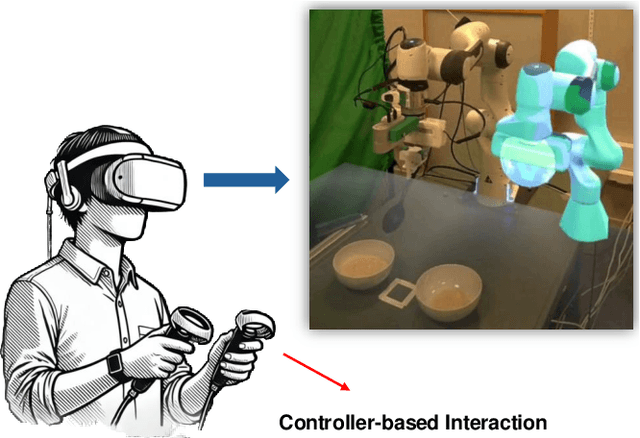
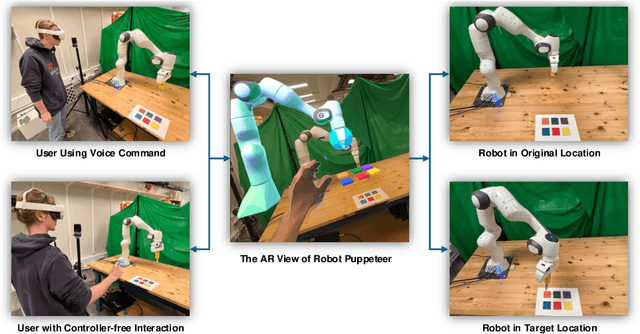
The integration of robotics and augmented reality (AR) presents transformative opportunities for advancing human-robot interaction (HRI) by improving usability, intuitiveness, and accessibility. This work introduces a controller-free, LLM-driven voice-commanded AR puppeteering system, enabling users to teleoperate a robot by manipulating its virtual counterpart in real time. By leveraging natural language processing (NLP) and AR technologies, our system -- prototyped using Meta Quest 3 -- eliminates the need for physical controllers, enhancing ease of use while minimizing potential safety risks associated with direct robot operation. A preliminary user demonstration successfully validated the system's functionality, demonstrating its potential for safer, more intuitive, and immersive robotic control.
The 1st InterAI Workshop: Interactive AI for Human-centered Robotics
Sep 17, 2024The workshop is affiliated with 33nd IEEE International Conference on Robot and Human Interactive Communication (RO-MAN 2024) August 26~30, 2023 / Pasadena, CA, USA. It is designed as a half-day event, extending over four hours from 9:00 to 12:30 PST time. It accommodates both in-person and virtual attendees (via Zoom), ensuring a flexible participation mode. The agenda is thoughtfully crafted to include a diverse range of sessions: two keynote speeches that promise to provide insightful perspectives, two dedicated paper presentation sessions, an interactive panel discussion to foster dialogue among experts which facilitates deeper dives into specific topics, and a 15-minute coffee break. The workshop website: https://sites.google.com/view/interaiworkshops/home.
Puppeteer Your Robot: Augmented Reality Leader-Follower Teleoperation
Jul 16, 2024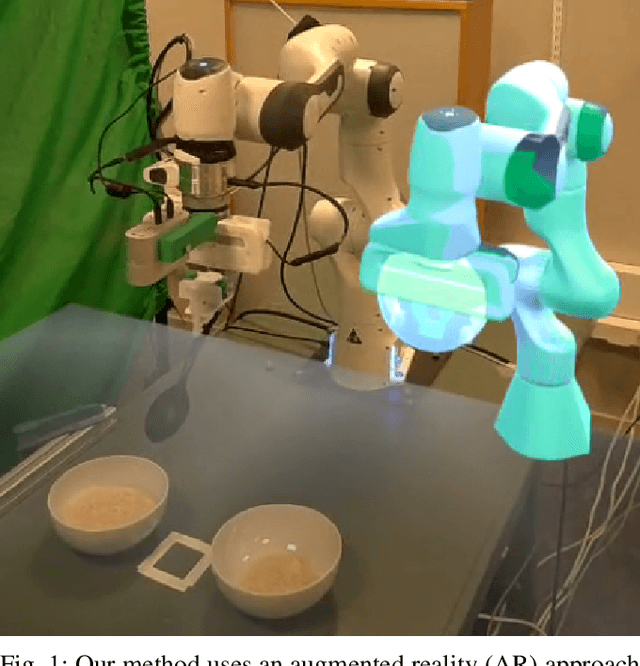
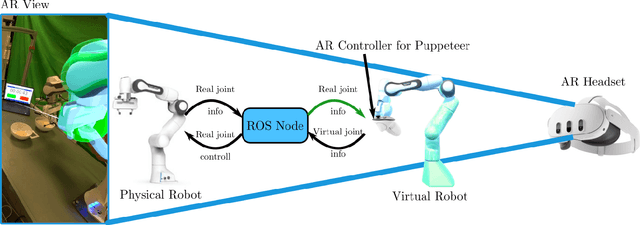
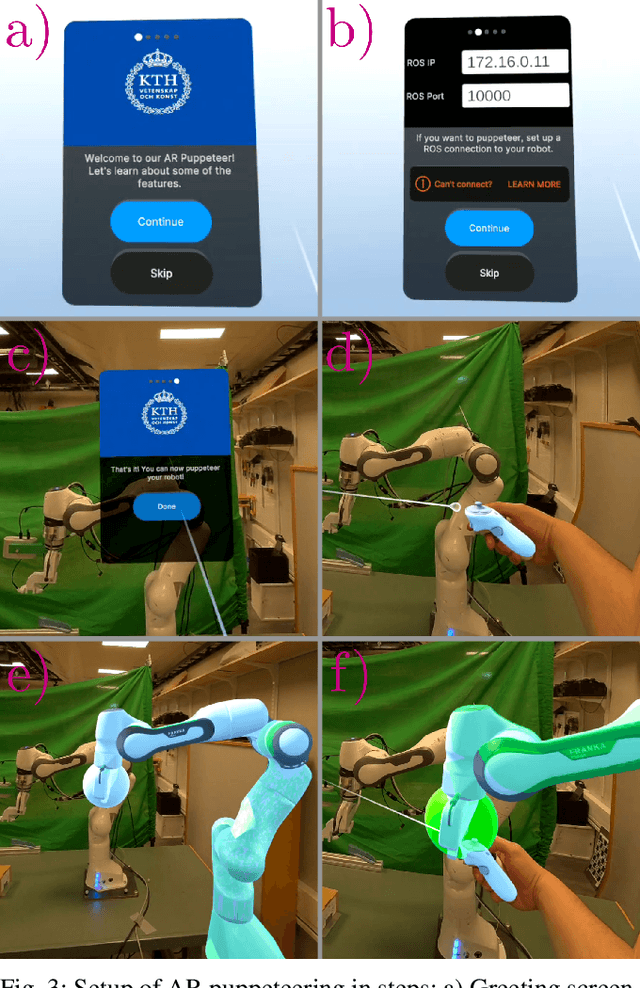
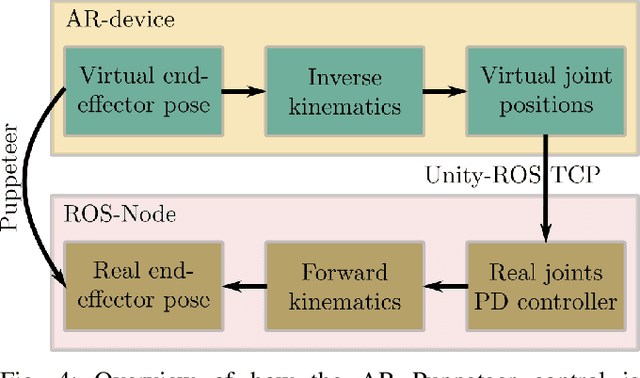
High-quality demonstrations are necessary when learning complex and challenging manipulation tasks. In this work, we introduce an approach to puppeteer a robot by controlling a virtual robot in an augmented reality setting. Our system allows for retaining the advantages of being intuitive from a physical leader-follower side while avoiding the unnecessary use of expensive physical setup. In addition, the user is endowed with additional information using augmented reality. We validate our system with a pilot study n=10 on a block stacking and rice scooping tasks where the majority rates the system favorably. Oculus App and corresponding ROS code are available on the project website: https://ar-puppeteer.github.io/
Vision Beyond Boundaries: An Initial Design Space of Domain-specific Large Vision Models in Human-robot Interaction
Apr 23, 2024The emergence of Large Vision Models (LVMs) is following in the footsteps of the recent prosperity of Large Language Models (LLMs) in following years. However, there's a noticeable gap in structured research applying LVMs to Human-Robot Interaction (HRI), despite extensive evidence supporting the efficacy of vision models in enhancing interactions between humans and robots. Recognizing the vast and anticipated potential, we introduce an initial design space that incorporates domain-specific LVMs, chosen for their superior performance over normal models. We delve into three primary dimensions: HRI contexts, vision-based tasks, and specific domains. The empirical validation was implemented among 15 experts across six evaluated metrics, showcasing the primary efficacy in relevant decision-making scenarios. We explore the process of ideation and potential application scenarios, envisioning this design space as a foundational guideline for future HRI system design, emphasizing accurate domain alignment and model selection.