 Add to Chrome
 Add to Firefox
 Add to Edge
Scaling Agent Learning via Experience Synthesis
Nov 10, 2025
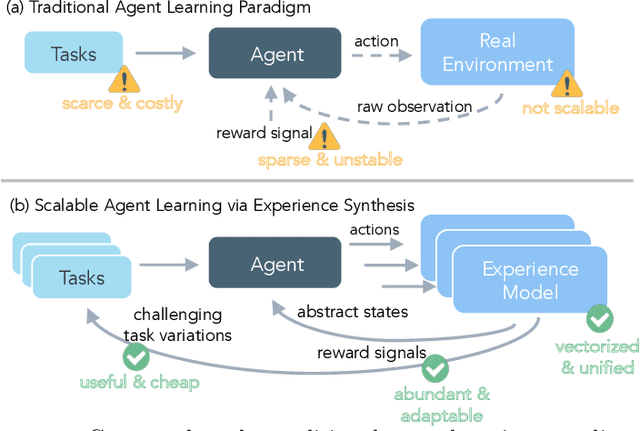
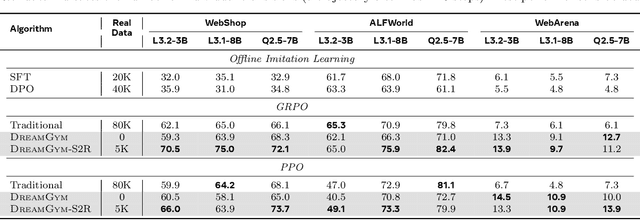
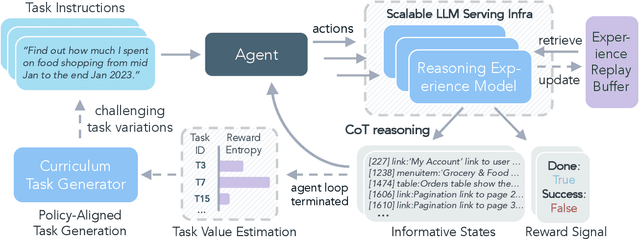
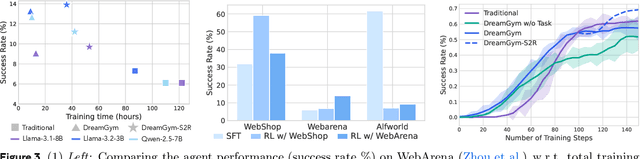
While reinforcement learning (RL) can empower autonomous agents by enabling self-improvement through interaction, its practical adoption remains challenging due to costly rollouts, limited task diversity, unreliable reward signals, and infrastructure complexity, all of which obstruct the collection of scalable experience data. To address these challenges, we introduce DreamGym, the first unified framework designed to synthesize diverse experiences with scalability in mind to enable effective online RL training for autonomous agents. Rather than relying on expensive real-environment rollouts, DreamGym distills environment dynamics into a reasoning-based experience model that derives consistent state transitions and feedback signals through step-by-step reasoning, enabling scalable agent rollout collection for RL. To improve the stability and quality of transitions, DreamGym leverages an experience replay buffer initialized with offline real-world data and continuously enriched with fresh interactions to actively support agent training. To improve knowledge acquisition, DreamGym adaptively generates new tasks that challenge the current agent policy, enabling more effective online curriculum learning. Experiments across diverse environments and agent backbones demonstrate that DreamGym substantially improves RL training, both in fully synthetic settings and in sim-to-real transfer scenarios. On non-RL-ready tasks like WebArena, DreamGym outperforms all baselines by over 30%. And in RL-ready but costly settings, it matches GRPO and PPO performance using only synthetic interactions. When transferring a policy trained purely on synthetic experiences to real-environment RL, DreamGym yields significant additional performance gains while requiring far fewer real-world interactions, providing a scalable warm-start strategy for general-purpose RL.

VMDT: Decoding the Trustworthiness of Video Foundation Models
Nov 07, 2025As foundation models become more sophisticated, ensuring their trustworthiness becomes increasingly critical; yet, unlike text and image, the video modality still lacks comprehensive trustworthiness benchmarks. We introduce VMDT (Video-Modal DecodingTrust), the first unified platform for evaluating text-to-video (T2V) and video-to-text (V2T) models across five key trustworthiness dimensions: safety, hallucination, fairness, privacy, and adversarial robustness. Through our extensive evaluation of 7 T2V models and 19 V2T models using VMDT, we uncover several significant insights. For instance, all open-source T2V models evaluated fail to recognize harmful queries and often generate harmful videos, while exhibiting higher levels of unfairness compared to image modality models. In V2T models, unfairness and privacy risks rise with scale, whereas hallucination and adversarial robustness improve -- though overall performance remains low. Uniquely, safety shows no correlation with model size, implying that factors other than scale govern current safety levels. Our findings highlight the urgent need for developing more robust and trustworthy video foundation models, and VMDT provides a systematic framework for measuring and tracking progress toward this goal. The code is available at https://sunblaze-ucb.github.io/VMDT-page/.
AccidentBench: Benchmarking Multimodal Understanding and Reasoning in Vehicle Accidents and Beyond
Sep 30, 2025Rapid advances in multimodal models demand benchmarks that rigorously evaluate understanding and reasoning in safety-critical, dynamic real-world settings. We present AccidentBench, a large-scale benchmark that combines vehicle accident scenarios with Beyond domains, safety-critical settings in air and water that emphasize spatial and temporal reasoning (e.g., navigation, orientation, multi-vehicle motion). The benchmark contains approximately 2000 videos and over 19000 human-annotated question--answer pairs spanning multiple video lengths (short/medium/long) and difficulty levels (easy/medium/hard). Tasks systematically probe core capabilities: temporal, spatial, and intent understanding and reasoning. By unifying accident-centric traffic scenes with broader safety-critical scenarios in air and water, AccidentBench offers a comprehensive, physically grounded testbed for evaluating models under real-world variability. Evaluations of state-of-the-art models (e.g., Gemini-2.5 Pro and GPT-5) show that even the strongest models achieve only about 18% accuracy on the hardest tasks and longest videos, revealing substantial gaps in real-world temporal, spatial, and intent reasoning. AccidentBench is designed to expose these critical gaps and drive the development of multimodal models that are safer, more robust, and better aligned with real-world safety-critical challenges. The code and dataset are available at: https://github.com/SafeRL-Lab/AccidentBench
RepIt: Representing Isolated Targets to Steer Language Models
Sep 16, 2025While activation steering in large language models (LLMs) is a growing area of research, methods can often incur broader effects than desired. This motivates isolation of purer concept vectors to enable targeted interventions and understand LLM behavior at a more granular level. We present RepIt, a simple and data-efficient framework for isolating concept-specific representations. Across five frontier LLMs, RepIt enables precise interventions: it selectively suppresses refusal on targeted concepts while preserving refusal elsewhere, producing models that answer WMD-related questions while still scoring as safe on standard benchmarks. We further show that the corrective signal localizes to just 100-200 neurons and that robust target representations can be extracted from as few as a dozen examples on a single A6000. This efficiency raises a dual concern: manipulations can be performed with modest compute and data to extend to underrepresented data-scarce topics while evading existing benchmarks. By disentangling refusal vectors with RepIt, this work demonstrates that targeted interventions can counteract overgeneralization, laying the foundation for more granular control of model behavior.
MIRAGE-Bench: LLM Agent is Hallucinating and Where to Find Them
Jul 28, 2025


Hallucinations pose critical risks for large language model (LLM)-based agents, often manifesting as hallucinative actions resulting from fabricated or misinterpreted information within the cognitive context. While recent studies have exposed such failures, existing evaluations remain fragmented and lack a principled testbed. In this paper, we present MIRAGE-Bench--Measuring Illusions in Risky AGEnt settings--the first unified benchmark for eliciting and evaluating hallucinations in interactive LLM-agent scenarios. We begin by introducing a three-part taxonomy to address agentic hallucinations: actions that are unfaithful to (i) task instructions, (ii) execution history, or (iii) environment observations. To analyze, we first elicit such failures by performing a systematic audit of existing agent benchmarks, then synthesize test cases using a snapshot strategy that isolates decision points in deterministic and reproducible manners. To evaluate hallucination behaviors, we adopt a fine-grained-level LLM-as-a-Judge paradigm with tailored risk-aware prompts, enabling scalable, high-fidelity assessment of agent actions without enumerating full action spaces. MIRAGE-Bench provides actionable insights on failure modes of LLM agents and lays the groundwork for principled progress in mitigating hallucinations in interactive environments.
Machine Bullshit: Characterizing the Emergent Disregard for Truth in Large Language Models
Jul 10, 2025Bullshit, as conceptualized by philosopher Harry Frankfurt, refers to statements made without regard to their truth value. While previous work has explored large language model (LLM) hallucination and sycophancy, we propose machine bullshit as an overarching conceptual framework that can allow researchers to characterize the broader phenomenon of emergent loss of truthfulness in LLMs and shed light on its underlying mechanisms. We introduce the Bullshit Index, a novel metric quantifying LLMs' indifference to truth, and propose a complementary taxonomy analyzing four qualitative forms of bullshit: empty rhetoric, paltering, weasel words, and unverified claims. We conduct empirical evaluations on the Marketplace dataset, the Political Neutrality dataset, and our new BullshitEval benchmark (2,400 scenarios spanning 100 AI assistants) explicitly designed to evaluate machine bullshit. Our results demonstrate that model fine-tuning with reinforcement learning from human feedback (RLHF) significantly exacerbates bullshit and inference-time chain-of-thought (CoT) prompting notably amplify specific bullshit forms, particularly empty rhetoric and paltering. We also observe prevalent machine bullshit in political contexts, with weasel words as the dominant strategy. Our findings highlight systematic challenges in AI alignment and provide new insights toward more truthful LLM behavior.
The Singapore Consensus on Global AI Safety Research Priorities
Jun 25, 2025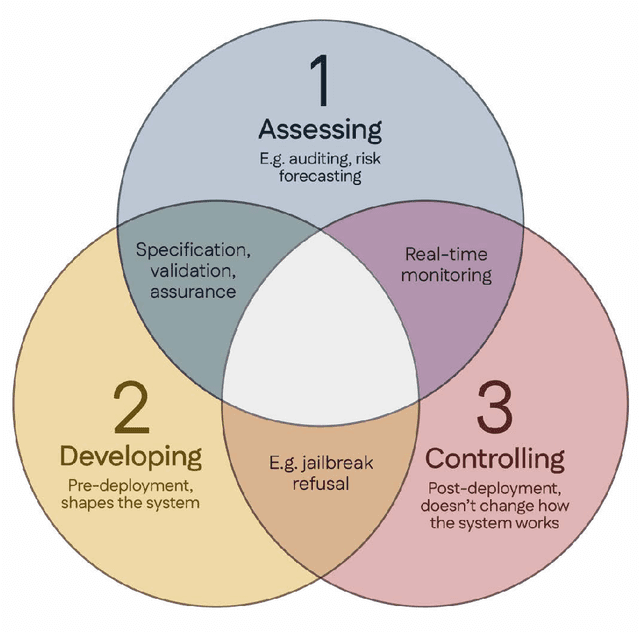
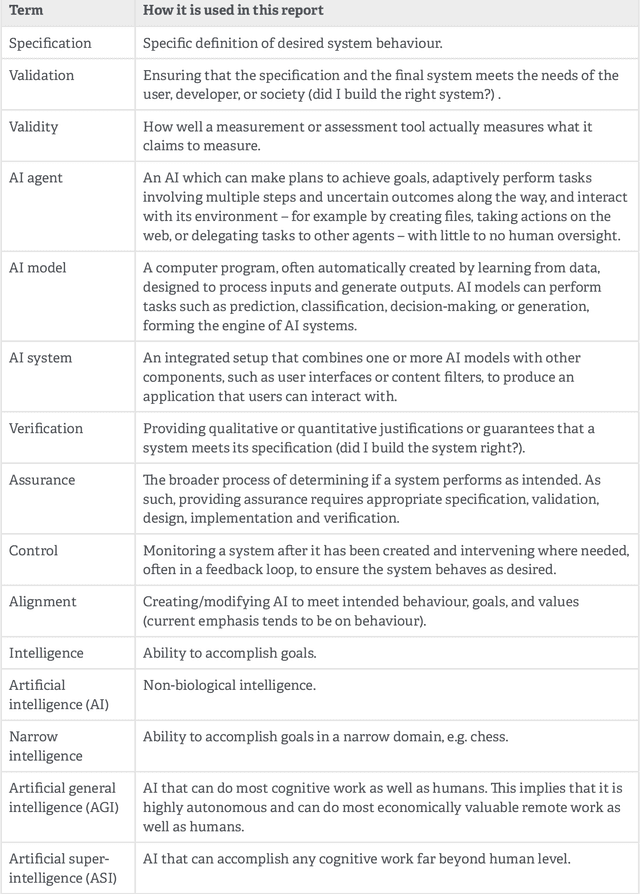
Rapidly improving AI capabilities and autonomy hold significant promise of transformation, but are also driving vigorous debate on how to ensure that AI is safe, i.e., trustworthy, reliable, and secure. Building a trusted ecosystem is therefore essential -- it helps people embrace AI with confidence and gives maximal space for innovation while avoiding backlash. The "2025 Singapore Conference on AI (SCAI): International Scientific Exchange on AI Safety" aimed to support research in this space by bringing together AI scientists across geographies to identify and synthesise research priorities in AI safety. This resulting report builds on the International AI Safety Report chaired by Yoshua Bengio and backed by 33 governments. By adopting a defence-in-depth model, this report organises AI safety research domains into three types: challenges with creating trustworthy AI systems (Development), challenges with evaluating their risks (Assessment), and challenges with monitoring and intervening after deployment (Control).
OMEGA: Can LLMs Reason Outside the Box in Math? Evaluating Exploratory, Compositional, and Transformative Generalization
Jun 23, 2025Recent large-scale language models (LLMs) with long Chain-of-Thought reasoning-such as DeepSeek-R1-have achieved impressive results on Olympiad-level mathematics benchmarks. However, they often rely on a narrow set of strategies and struggle with problems that require a novel way of thinking. To systematically investigate these limitations, we introduce OMEGA-Out-of-distribution Math Problems Evaluation with 3 Generalization Axes-a controlled yet diverse benchmark designed to evaluate three axes of out-of-distribution generalization, inspired by Boden's typology of creativity: (1) Exploratory-applying known problem solving skills to more complex instances within the same problem domain; (2) Compositional-combining distinct reasoning skills, previously learned in isolation, to solve novel problems that require integrating these skills in new and coherent ways; and (3) Transformative-adopting novel, often unconventional strategies by moving beyond familiar approaches to solve problems more effectively. OMEGA consists of programmatically generated training-test pairs derived from templated problem generators across geometry, number theory, algebra, combinatorics, logic, and puzzles, with solutions verified using symbolic, numerical, or graphical methods. We evaluate frontier (or top-tier) LLMs and observe sharp performance degradation as problem complexity increases. Moreover, we fine-tune the Qwen-series models across all generalization settings and observe notable improvements in exploratory generalization, while compositional generalization remains limited and transformative reasoning shows little to no improvement. By isolating and quantifying these fine-grained failures, OMEGA lays the groundwork for advancing LLMs toward genuine mathematical creativity beyond mechanical proficiency.
AgentSynth: Scalable Task Generation for Generalist Computer-Use Agents
Jun 17, 2025We introduce AgentSynth, a scalable and cost-efficient pipeline for automatically synthesizing high-quality tasks and trajectory datasets for generalist computer-use agents. Leveraging information asymmetry, AgentSynth constructs subtasks that are simple during generation but significantly more challenging when composed into long-horizon tasks, enabling the creation of over 6,000 diverse and realistic tasks. Our pipeline begins with an LLM-based task proposer guided by a persona, followed by an execution agent that completes the task and logs the trajectory. This process is repeated iteratively to form a sequence of subtasks, which are then summarized by a separate agent into a composite task of controllable difficulty. A key strength of AgentSynth is its ability to precisely modulate task complexity by varying the number of subtasks. Empirical evaluations show that state-of-the-art LLM agents suffer a steep performance drop, from 18% success at difficulty level 1 to just 4% at level 6, highlighting the benchmark's difficulty and discriminative power. Moreover, our pipeline achieves a low average cost of \$0.60 per trajectory, orders of magnitude cheaper than human annotations. Our code and data are publicly available at https://github.com/sunblaze-ucb/AgentSynth
Pushing the Limits of Safety: A Technical Report on the ATLAS Challenge 2025
Jun 14, 2025Multimodal Large Language Models (MLLMs) have enabled transformative advancements across diverse applications but remain susceptible to safety threats, especially jailbreak attacks that induce harmful outputs. To systematically evaluate and improve their safety, we organized the Adversarial Testing & Large-model Alignment Safety Grand Challenge (ATLAS) 2025}. This technical report presents findings from the competition, which involved 86 teams testing MLLM vulnerabilities via adversarial image-text attacks in two phases: white-box and black-box evaluations. The competition results highlight ongoing challenges in securing MLLMs and provide valuable guidance for developing stronger defense mechanisms. The challenge establishes new benchmarks for MLLM safety evaluation and lays groundwork for advancing safer multimodal AI systems. The code and data for this challenge are openly available at https://github.com/NY1024/ATLAS_Challenge_2025.