 Add to Chrome
 Add to Firefox
 Add to Edge
SCDBench: A Benchmark for LLM-Based Smart Contract Decompilers
May 27, 2026
Smart contract decompilation aims to recover high-level source code from bytecode, but evaluating decompilers remains difficult because existing studies use narrow datasets, inconsistent metrics, and limited semantic consistency checks. This gap is increasingly important as large language models (LLMs) begin to generate source-like Solidity that may compile and appear plausible, even when its semantics diverge from the original contract. We introduce SCDBench, a dataset and benchmark methodology for LLM-based smart contract decompilation. The dataset contains 600 real-world Solidity contracts with paired bytecode inputs, ground-truth source code, and replayable semantic checkpoints. SCDBench evaluates decompiler outputs through four cumulative stages: format completeness, compilability, Application Binary Interface (ABI) recovery, and semantic consistency via differential replay. We evaluate Claude Opus 4.7, GPT-5.3-Codex, and GLM-5 in a zero-shot decompilation setting, including GLM-5 variants with and without extended reasoning and a zero-shot compilation-repair setting. The results show that frontier LLMs can often produce structured and compilable Solidity, but achieving semantic consistency remains far from solved: the best-performing frontier model perfectly decompiles only 42/600 contracts. We further show that introducing same-model compilation repair substantially improves performance at modest additional cost. SCDBench establishes a common ground for rigorous, reproducible evaluation and aims to accelerate the development of reliable smart contract decompilers for blockchain security and transparency.

Measuring Safety Alignment Effects in Autonomous Security Agents
May 19, 2026Do stock safety-aligned language models and their uncensored or abliterated derivatives behave differently when run as autonomous security agents? Single-turn refusal benchmarks cannot answer this question: security agents must inspect repositories, call tools, and produce vulnerability evidence inside authorized sandboxes. We present a trace-based benchmark of 30 local vulnerability-analysis tasks with fixed tools, deterministic success predicates, redaction rules, and grounding checks, and compare four stock models against uncensored or abliterated derivatives: Gemma 4 31B, Gemma 4 26B A4B, Qwen2.5-Coder 7B, and Llama 3.1 8B. The artifact contains 1,500 security-agent traces and 800 non-security control traces. The Gemma pairs show large less-restricted gains on security tasks: 14.0% versus 0.7% success for 31B and 10.7% versus 0.0% for 26B, with higher mean grounding (3.91 versus 3.27 and 4.12 versus 1.64 out of five) and 0.0% refusal, suppressed-action, and unsafe-action rates in the 31B traces. However, controls and non-Gemma pairs rule out a clean security-specific or universal less-restricted effect: Gemma gaps also appear on ordinary coding tasks, Qwen2.5-Coder success is lower for the less-restricted derivative (2.0% versus 5.3%), and the abliterated Llama derivative fails the tool protocol. Across all families, hard proof-of-trigger and patch-verification tasks remain unsolved. These results show that safety alignment effects in autonomous security agents should be measured at the system level, separating refusal, unsafe action, tool reliability, and evidence grounding rather than treating refusal rate as the safety signal.
CrackMeBench: Binary Reverse Engineering for Agents
May 11, 2026Benchmarks for coding agents increasingly measure source-level software repair, and cybersecurity benchmarks increasingly measure broad capture-the-flag performance. Classical binary reverse engineering remains less precisely specified: given only an executable, can an agent recover validation logic and produce an input, serial, artifact, or key generator accepted by the program? We introduce CrackMeBench, a benchmark for evaluating language-model agents on educational CrackMe-style reverse-engineering tasks. CrackMeBench focuses on deterministic binary validation problems with executable oracles, symbol-poor binaries, explicit local tool access, and externally scored submissions rather than free-form explanations. The v0 benchmark combines eight public calibration CrackMes with twelve generated main-score tasks built from seeded C, Rust, and Go templates, and agents run through an equal shell interface in a no-network Linux Docker sandbox with standard reverse-engineering tools. In a three-model evaluation with a five-minute budget and three scored submissions per task, pass@3 on the generated split is 11/12 tasks (92%) for GPT-5.5, 7/12 (58%) for Claude Opus 4.7, and 5/12 (42%) for Kimi K2. The harder generated half separates the models more sharply, with pass@3 of 5/6, 2/6, and 1/6, respectively; on the eight-task public calibration split, pass@3 is 3/8, 2/8, and 1/8. CrackMeBench records pass@1 and pass@3, scored submissions, wall-clock time, command traces, tool categories, provider-reported token usage, estimated cost, and qualitative failure labels, providing a reproducible testbed for measuring progress from source-code reasoning toward autonomous binary analysis while restricting scope to educational, purpose-built programs.
Patch2Vuln: Agentic Reconstruction of Vulnerabilities from Linux Distribution Binary Patches
May 07, 2026Security updates create a short but important window in which defenders and attackers can compare vulnerable and patched software. Yet in many operational settings, the most accessible artifacts are binary packages rather than source patches or advisory text. This paper asks whether a language-model agent, restricted to local binary-derived evidence, can reconstruct the security meaning of Linux distribution updates. Patch2Vuln is a local, resumable pipeline that extracts old/new ELF pairs, diffs them with Ghidra and Ghidriff, ranks changed functions, builds candidate dossiers, and asks an offline agent to produce a preliminary audit, bounded validation plan, and final audit. We evaluate Patch2Vuln on 25 Ubuntu `.deb` package pairs: 20 security-update pairs and five negative controls, all manually adjudicated against private source-patch and binary-function ground truth. The agent localizes a verified security-relevant patch function in 10 of 20 security pairs and assigns an accepted final root-cause class in 11 of 20. Oracle diagnostics show that six security pairs fail before model reasoning because the binary differ or ranker omits the right function, with one additional context-export miss. A separate bounded validation pass produces two target-level minimized behavioral old/new differentials, both for tcpdump, but no crash, timeout, sanitizer finding, or memory-corruption proof; all five negative controls are classified as unknown and produce no validation differentials. These results support agentic vulnerability reconstruction from binary patches as a useful research target while showing that binary-diff coverage and local behavioral validation remain the limiting components.
Towards Optimal Agentic Architectures for Offensive Security Tasks
Apr 20, 2026Agentic security systems increasingly audit live targets with tool-using LLMs, but prior systems fix a single coordination topology, leaving unclear when additional agents help and when they only add cost. We treat topology choice as an empirical systems question. We introduce a controlled benchmark of 20 interactive targets (10 web/API and 10 binary), each exposing one endpoint-reachable ground-truth vulnerability, evaluated in whitebox and blackbox modes. The core study executes 600 runs over five architecture families, three model families, and both access modes, with a separate 60-run long-context pilot reported only in the appendix. On the completed core benchmark, detection-any reaches 58.0% and validated detection reaches 49.8%. MAS-Indep attains the highest validated detection rate (64.2%), while SAS is the strongest efficiency baseline at $0.058 per validated finding. Whitebox materially outperforms blackbox (67.0% vs. 32.7% validated detection), and web materially outperforms binary (74.3% vs. 25.3%). Bootstrap confidence intervals and paired target-level deltas show that the dominant effects are observability and domain, while some leading whitebox topologies remain statistically close. The main result is a non-monotonic cost-quality frontier: broader coordination can improve coverage, but it does not dominate once latency, token cost, and exploit-validation difficulty are taken into account.
TxRay: Agentic Postmortem of Live Blockchain Attacks
Feb 01, 2026Decentralized Finance (DeFi) has turned blockchains into financial infrastructure, allowing anyone to trade, lend, and build protocols without intermediaries, but this openness exposes pools of value controlled by code. Within five years, the DeFi ecosystem has lost over 15.75B USD to reported exploits. Many exploits arise from permissionless opportunities that any participant can trigger using only public state and standard interfaces, which we call Anyone-Can-Take (ACT) opportunities. Despite on-chain transparency, postmortem analysis remains slow and manual: investigations start from limited evidence, sometimes only a single transaction hash, and must reconstruct the exploit lifecycle by recovering related transactions, contract code, and state dependencies. We present TxRay, a Large Language Model (LLM) agentic postmortem system that uses tool calls to reconstruct live ACT attacks from limited evidence. Starting from one or more seed transactions, TxRay recovers the exploit lifecycle, derives an evidence-backed root cause, and generates a runnable, self-contained Proof of Concept (PoC) that deterministically reproduces the incident. TxRay self-checks postmortems by encoding incident-specific semantic oracles as executable assertions. To evaluate PoC correctness and quality, we develop PoCEvaluator, an independent agentic execution-and-review evaluator. On 114 incidents from DeFiHackLabs, TxRay produces an expert-aligned root cause and an executable PoC for 105 incidents, achieving 92.11% end-to-end reproduction. Under PoCEvaluator, 98.1% of TxRay PoCs avoid hard-coding attacker addresses, a +24.8pp lift over DeFiHackLabs. In a live deployment, TxRay delivers validated root causes in 40 minutes and PoCs in 59 minutes at median latency. TxRay's oracle-validated PoCs enable attack imitation, improving coverage by 15.6% and 65.5% over STING and APE.
Multi-Agent Penetration Testing AI for the Web
Aug 28, 2025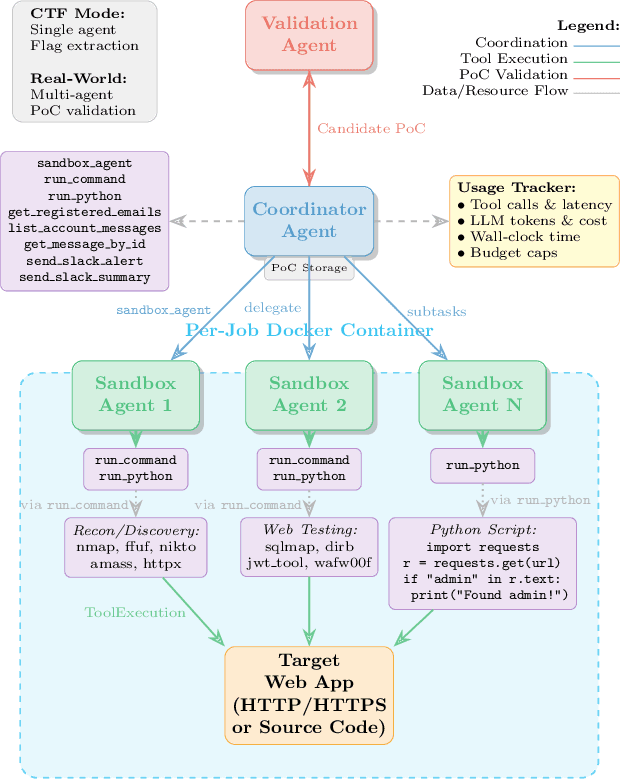

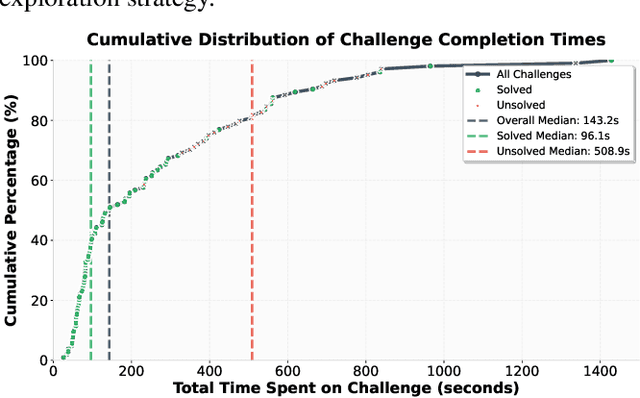
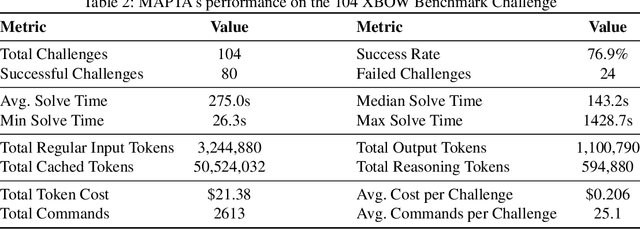
AI-powered development platforms are making software creation accessible to a broader audience, but this democratization has triggered a scalability crisis in security auditing. With studies showing that up to 40% of AI-generated code contains vulnerabilities, the pace of development now vastly outstrips the capacity for thorough security assessment. We present MAPTA, a multi-agent system for autonomous web application security assessment that combines large language model orchestration with tool-grounded execution and end-to-end exploit validation. On the 104-challenge XBOW benchmark, MAPTA achieves 76.9% overall success with perfect performance on SSRF and misconfiguration vulnerabilities, 83% success on broken authorization, and strong results on injection attacks including server-side template injection (85%) and SQL injection (83%). Cross-site scripting (57%) and blind SQL injection (0%) remain challenging. Our comprehensive cost analysis across all challenges totals $21.38 with a median cost of $0.073 for successful attempts versus $0.357 for failures. Success correlates strongly with resource efficiency, enabling practical early-stopping thresholds at approximately 40 tool calls or $0.30 per challenge. MAPTA's real-world findings are impactful given both the popularity of the respective scanned GitHub repositories (8K-70K stars) and MAPTA's low average operating cost of $3.67 per open-source assessment: MAPTA discovered critical vulnerabilities including RCEs, command injections, secret exposure, and arbitrary file write vulnerabilities. Findings are responsibly disclosed, 10 findings are under CVE review.
Blockchain Large Language Models
Apr 29, 2023

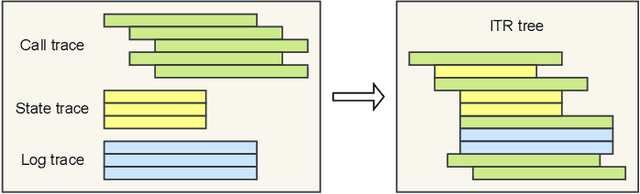

This paper presents a dynamic, real-time approach to detecting anomalous blockchain transactions. The proposed tool, BlockGPT, generates tracing representations of blockchain activity and trains from scratch a large language model to act as a real-time Intrusion Detection System. Unlike traditional methods, BlockGPT is designed to offer an unrestricted search space and does not rely on predefined rules or patterns, enabling it to detect a broader range of anomalies. We demonstrate the effectiveness of BlockGPT through its use as an anomaly detection tool for Ethereum transactions. In our experiments, it effectively identifies abnormal transactions among a dataset of 68M transactions and has a batched throughput of 2284 transactions per second on average. Our results show that, BlockGPT identifies abnormal transactions by ranking 49 out of 124 attacks among the top-3 most abnormal transactions interacting with their victim contracts. This work makes contributions to the field of blockchain transaction analysis by introducing a custom data encoding compatible with the transformer architecture, a domain-specific tokenization technique, and a tree encoding method specifically crafted for the Ethereum Virtual Machine (EVM) trace representation.
Exploring the Advantages of Transformers for High-Frequency Trading
Feb 20, 2023This paper explores the novel deep learning Transformers architectures for high-frequency Bitcoin-USDT log-return forecasting and compares them to the traditional Long Short-Term Memory models. A hybrid Transformer model, called \textbf{HFformer}, is then introduced for time series forecasting which incorporates a Transformer encoder, linear decoder, spiking activations, and quantile loss function, and does not use position encoding. Furthermore, possible high-frequency trading strategies for use with the HFformer model are discussed, including trade sizing, trading signal aggregation, and minimal trading threshold. Ultimately, the performance of the HFformer and Long Short-Term Memory models are assessed and results indicate that the HFformer achieves a higher cumulative PnL than the LSTM when trading with multiple signals during backtesting.