 Add to Chrome
 Add to Firefox
 Add to Edge
Navigation beyond Wayfinding: Robots Collaborating with Visually Impaired Users for Environmental Interactions
Mar 15, 2026
Robotic guidance systems have shown promise in supporting blind and visually impaired (BVI) individuals with wayfinding and obstacle avoidance. However, most existing systems assume a clear path and do not support a critical aspect of navigation - environmental interactions that require manipulating objects to enable movement. These interactions are challenging for a human-robot pair because they demand (i) precise localization and manipulation of interaction targets (e.g., pressing elevator buttons) and (ii) dynamic coordination between the user's and robot's movements (e.g., pulling out a chair to sit). We present a collaborative human-robot approach that combines our robotic guide dog's precise sensing and localization capabilities with the user's ability to perform physical manipulation. The system alternates between two modes: lead mode, where the robot detects and guides the user to the target, and adaptation mode, where the robot adjusts its motion as the user interacts with the environment (e.g., opening a door). Evaluation results show that our system enables navigation that is safer, smoother, and more efficient than both a traditional white cane and a non-adaptive guiding system, with the performance gap widening as tasks demand higher precision in locating interaction targets. These findings highlight the promise of human-robot collaboration in advancing assistive technologies toward more generalizable and realistic navigation support.

Robi Butler: Remote Multimodal Interactions with Household Robot Assistant
Sep 30, 2024In this paper, we introduce Robi Butler, a novel household robotic system that enables multimodal interactions with remote users. Building on the advanced communication interfaces, Robi Butler allows users to monitor the robot's status, send text or voice instructions, and select target objects by hand pointing. At the core of our system is a high-level behavior module, powered by Large Language Models (LLMs), that interprets multimodal instructions to generate action plans. These plans are composed of a set of open vocabulary primitives supported by Vision Language Models (VLMs) that handle both text and pointing queries. The integration of the above components allows Robi Butler to ground remote multimodal instructions in the real-world home environment in a zero-shot manner. We demonstrate the effectiveness and efficiency of this system using a variety of daily household tasks that involve remote users giving multimodal instructions. Additionally, we conducted a user study to analyze how multimodal interactions affect efficiency and user experience during remote human-robot interaction and discuss the potential improvements.
TOM: A Development Platform For Wearable Intelligent Assistants
Jul 22, 2024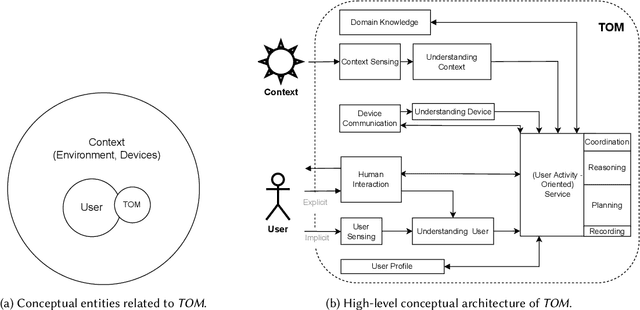
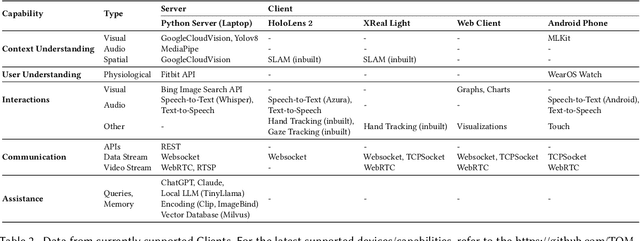
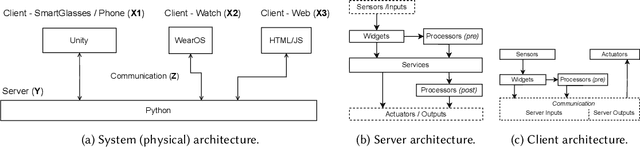
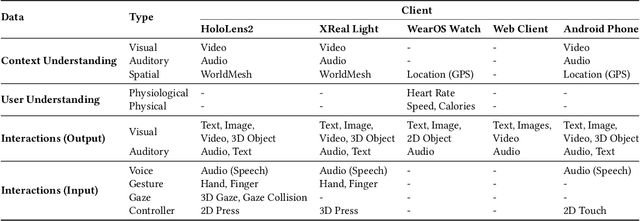
Advanced digital assistants can significantly enhance task performance, reduce user burden, and provide personalized guidance to improve users' abilities. However, the development of such intelligent digital assistants presents a formidable challenge. To address this, we introduce TOM, a conceptual architecture and software platform (https://github.com/TOM-Platform) designed to support the development of intelligent wearable assistants that are contextually aware of both the user and the environment. This system was developed collaboratively with AR/MR researchers, HCI researchers, AI/Robotic researchers, and software developers, and it continues to evolve to meet the diverse requirements of these stakeholders. TOM facilitates the creation of intelligent assistive AR applications for daily activities and supports the recording and analysis of user interactions, integration of new devices, and the provision of assistance for various activities. Additionally, we showcase several proof-of-concept assistive services and discuss the challenges involved in developing such services.
* 14 pages, 6 figures, 2 tables