 Add to Chrome
 Add to Firefox
 Add to Edge
Dual-Process Atomic Skill Learning: Decoupling Semantic Reasoning and Real-Time Control
Jul 12, 2026
Language-conditioned Imitation Learning (IL) is essential for enabling robots to perform complex tasks following natural language instructions. However, generalizing to multi-step compositional tasks remains a significant challenge. While hierarchical approaches attempt to address this by decomposing tasks into atomic skills, existing methods often suffer from training instability and codebook collapse due to the tight coupling between high-level skill reasoning and low-level action generation in joint training paradigms. Inspired by the Dual-Process Theory of cognition, we propose Dual-Process Atomic Skill Learning (DASL), a novel asynchronous hierarchical imitation learning framework that decouples slow semantic reasoning from fast, real-time motion control. DASL comprises a Slow-Frequency Policy that predicts interpretable, discrete skills via Vector Quantization, and a High-Frequency Policy that leverages a latent diffusion model and a Decision Transformer to generate precise actions conditioned on these latent skills. By asynchronously coordinating these modules and utilizing diffusion to structure the latent space, our framework mitigates the skill codebook interference problem common in joint training paradigms. Evaluations across simulation benchmarks and experiment demonstrate that DASL significantly outperforms state-of-the-art baselines, excelling in skill acquisition and compositional generalization to unseen instructions. GitHub page: https://github.com/Hatakekaka/DASL

GCNGrasp-VP: Affordance-Guided View Planning for Efficient Task-Oriented Grasping
Jun 17, 2026Task-oriented grasping performance degrades significantly when object views suffer from occlusions. Existing task-oriented grasping methods typically assume task-relevant regions are visible in the initial frame, while view planning approaches enable active perception but often ignore task semantics and rely on time-consuming scene reconstruction. To address these limitations, we present GCNGrasp-VP, an efficient framework integrating affordance field prediction with active view planning. Central to this framework is GCNGrasp-v2, a task-oriented grasp model that simultaneously supports grasp evaluation and affordance field prediction, achieving constant-time inference complexity. Leveraging this capability, our Affordance-guided View Planner (Affordance-VP) utilizes the affordance field as an information gain metric to guide camera observation of task-relevant regions without requiring scene reconstruction. View planning results show that our method significantly outperforms scene-uncertainty-driven baselines with only one view adjustment. Real-world validation further confirms substantial improvements in grasp success rates for single-object scenarios while maintaining millisecond-level computational latency. Code and models are available at https://github.com/Instinct323/GCNGrasp-VP.
Beyond Accuracy: Measuring Bias Acknowledgment in Chain-of-Thought Reasoning for Responsible AI Evaluation
Jun 13, 2026Reasoning models are increasingly used in settings where the final answer is not the only object of review: educational tools may show students intermediate steps, decision-support systems may require human oversight, and audit workflows may inspect traces for misleading or biased input. In such settings, two responses can receive the same final-answer score while differing in whether the trace explicitly flags injected biasing content. Accuracy-only evaluation collapses these cases. We study this gap as a measurement blind spot for responsible evaluation and introduce a minimal trace-level diagnostic with two axes: \emph{susceptibility} (whether the bias breaks a previously correct answer) and \emph{acknowledgment} (whether the trace contains a rubric-defined surface reference to the injected content). Across thousands of biased GSM8K trials, GPT-4o and Claude Sonnet~4 have similar susceptibility rates ($1.3\%$ vs.\ $1.2\%$) but substantially different acknowledgment rates ($13.0\%$ vs.\ $75.0\%$) under the same rubric.
VLAConf: Calibrated Task-Success Confidence for Vision-Language-Action Models
May 28, 2026Confidence estimation for Vision-Language-Action (VLA) models is essential for robots to perform manipulation tasks in the open world, providing crucial signals for risk-sensitive decision-making and failure anticipation. Existing confidence estimation methods typically rely on ensemble-based paradigms or action-token probabilities to predict the likelihood of task success. However, they still encounter challenges in computational efficiency and cross-architecture generalizability. These methods usually require repeated sampling, leading to inference inefficiency, and are restricted to VLA models with discrete action outputs, making them difficult to apply to continuous action spaces. To address this issue, we propose VLAConf, a one-class discriminative confidence framework. By leveraging frozen pretrained VLA internal representations, VLAConf directly estimates step-wise anomaly scores in a single forward pass using a lightweight confidence head, thereby eliminating the overhead of exhaustive resampling. We additionally use step-conditioned modeling to encode rollout-phase information along the manipulation trajectory. Experiments on the LIBERO benchmark demonstrate that VLAConf significantly improves the quality of the confidence signal constructed for post-hoc calibration, outperforming existing baselines by a large margin in inference efficiency. The effectiveness of VLAConf is further validated in real-robot experiments. To access the source code and supplementary videos, visit https://sites.google.com/view/vlaconf.
Grasp as You Dream: Imitating Functional Grasping from Generated Human Demonstrations
Apr 08, 2026Building generalist robots capable of performing functional grasping in everyday, open-world environments remains a significant challenge due to the vast diversity of objects and tasks. Existing methods are either constrained to narrow object/task sets or rely on prohibitively large-scale data collection to capture real-world variability. In this work, we present an alternative approach, GraspDreamer, a method that leverages human demonstrations synthesized by visual generative models (VGMs) (e.g., video generation models) to enable zero-shot functional grasping without labor-intensive data collection. The key idea is that VGMs pre-trained on internet-scale human data implicitly encode generalized priors about how humans interact with the physical world, which can be combined with embodiment-specific action optimization to enable functional grasping with minimal effort. Extensive experiments on the public benchmarks with different robot hands demonstrate the superior data efficiency and generalization performance of GraspDreamer compared to previous methods. Real-world evaluations further validate the effectiveness on real robots. Additionally, we showcase that GraspDreamer can (1) be naturally extended to downstream manipulation tasks, and (2) can generate data to support visuomotor policy learning.
Easy-IIL: Reducing Human Operational Burden in Interactive Imitation Learning via Assistant Experts
Mar 13, 2026Interactive Imitation Learning (IIL) typically relies on extensive human involvement for both offline demonstration and online interaction. Prior work primarily focuses on reducing human effort in passive monitoring rather than active operation. Interestingly, structured model-based imitation approaches achieve comparable performance with significantly fewer demonstrations than end-to-end imitation learning policies in the low-data regime. However, these methods are typically surpassed by end-to-end policies as the data increases. Leveraging this insight, we propose Easy-IIL, a framework that utilizes off-the-shelf model-based imitation methods as an assistant expert to replace active human operation for the majority of data collection. The human expert only provides a single demonstration to initialize the assistant expert and intervenes in critical states where the task is approaching failure. Furthermore, Easy-IIL can maintain IIL performance by preserving both offline and online data quality. Extensive simulation and real-world experiments demonstrate that Easy-IIL significantly reduces human operational burden while maintaining performance comparable to mainstream IIL baselines. User studies further confirm that Easy-IIL reduces subjective workload on the human expert. Project page: https://sites.google.com/view/easy-iil
Keyword Mamba: Spoken Keyword Spotting with State Space Models
Aug 10, 2025Keyword spotting (KWS) is an essential task in speech processing. It is widely used in voice assistants and smart devices. Deep learning models like CNNs, RNNs, and Transformers have performed well in KWS. However, they often struggle to handle long-term patterns and stay efficient at the same time. In this work, we present Keyword Mamba, a new architecture for KWS. It uses a neural state space model (SSM) called Mamba. We apply Mamba along the time axis and also explore how it can replace the self-attention part in Transformer models. We test our model on the Google Speech Commands datasets. The results show that Keyword Mamba reaches strong accuracy with fewer parameters and lower computational cost. To our knowledge, this is the first time a state space model has been used for KWS. These results suggest that Mamba has strong potential in speech-related tasks.
FUNCTO: Function-Centric One-Shot Imitation Learning for Tool Manipulation
Feb 17, 2025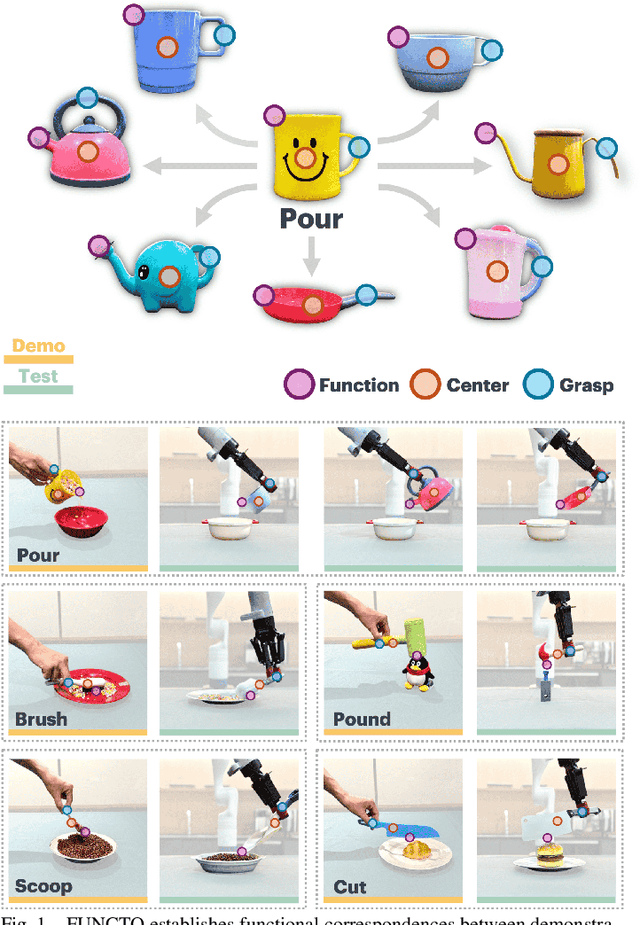
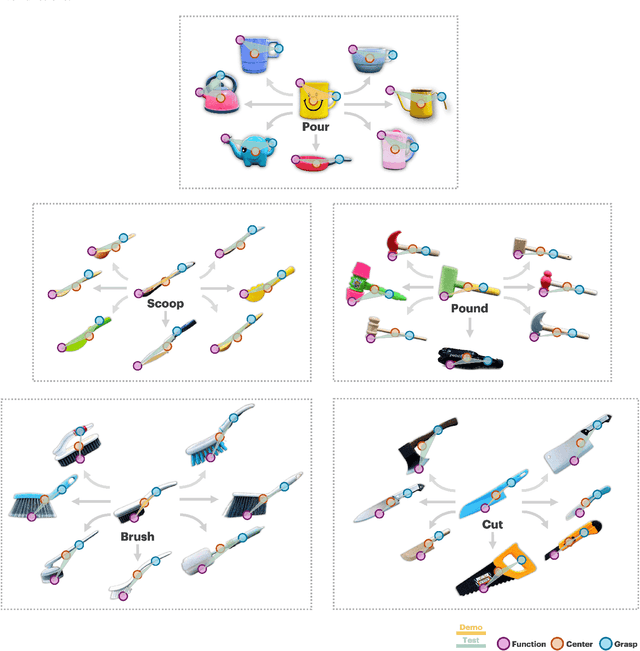
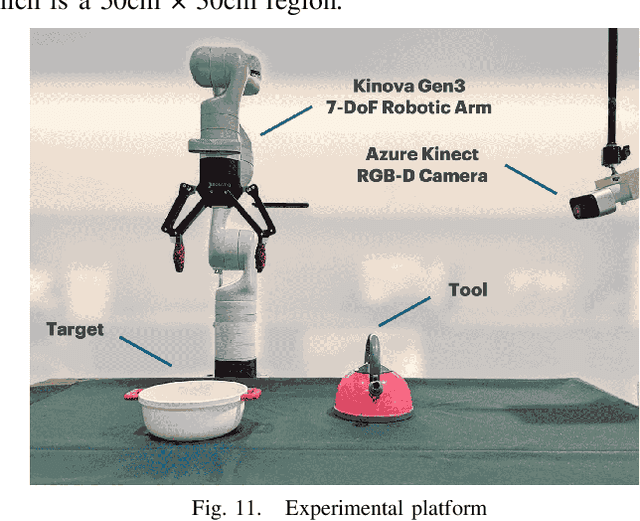
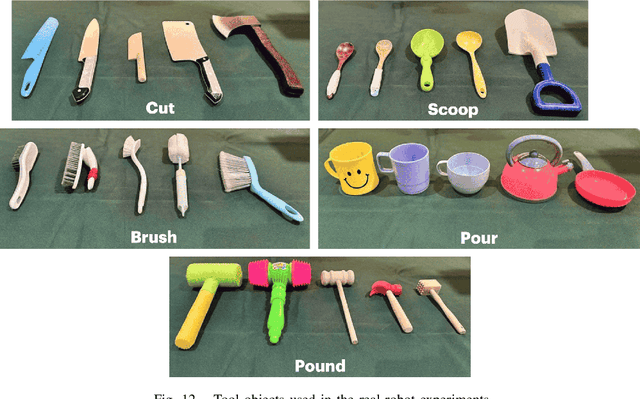
Learning tool use from a single human demonstration video offers a highly intuitive and efficient approach to robot teaching. While humans can effortlessly generalize a demonstrated tool manipulation skill to diverse tools that support the same function (e.g., pouring with a mug versus a teapot), current one-shot imitation learning (OSIL) methods struggle to achieve this. A key challenge lies in establishing functional correspondences between demonstration and test tools, considering significant geometric variations among tools with the same function (i.e., intra-function variations). To address this challenge, we propose FUNCTO (Function-Centric OSIL for Tool Manipulation), an OSIL method that establishes function-centric correspondences with a 3D functional keypoint representation, enabling robots to generalize tool manipulation skills from a single human demonstration video to novel tools with the same function despite significant intra-function variations. With this formulation, we factorize FUNCTO into three stages: (1) functional keypoint extraction, (2) function-centric correspondence establishment, and (3) functional keypoint-based action planning. We evaluate FUNCTO against exiting modular OSIL methods and end-to-end behavioral cloning methods through real-robot experiments on diverse tool manipulation tasks. The results demonstrate the superiority of FUNCTO when generalizing to novel tools with intra-function geometric variations. More details are available at https://sites.google.com/view/functo.
Leveraging Semantic and Geometric Information for Zero-Shot Robot-to-Human Handover
Sep 26, 2024Human-robot interaction (HRI) encompasses a wide range of collaborative tasks, with handover being one of the most fundamental. As robots become more integrated into human environments, the potential for service robots to assist in handing objects to humans is increasingly promising. In robot-to-human (R2H) handover, selecting the optimal grasp is crucial for success, as it requires avoiding interference with the humans preferred grasp region and minimizing intrusion into their workspace. Existing methods either inadequately consider geometric information or rely on data-driven approaches, which often struggle to generalize across diverse objects. To address these limitations, we propose a novel zero-shot system that combines semantic and geometric information to generate optimal handover grasps. Our method first identifies grasp regions using semantic knowledge from vision-language models (VLMs) and, by incorporating customized visual prompts, achieves finer granularity in region grounding. A grasp is then selected based on grasp distance and approach angle to maximize human ease and avoid interference. We validate our approach through ablation studies and real-world comparison experiments. Results demonstrate that our system improves handover success rates and provides a more user-preferred interaction experience. Videos, appendixes and more are available at https://sites.google.com/view/vlm-handover/.
RTAGrasp: Learning Task-Oriented Grasping from Human Videos via Retrieval, Transfer, and Alignment
Sep 24, 2024Task-oriented grasping (TOG) is crucial for robots to accomplish manipulation tasks, requiring the determination of TOG positions and directions. Existing methods either rely on costly manual TOG annotations or only extract coarse grasping positions or regions from human demonstrations, limiting their practicality in real-world applications. To address these limitations, we introduce RTAGrasp, a Retrieval, Transfer, and Alignment framework inspired by human grasping strategies. Specifically, our approach first effortlessly constructs a robot memory from human grasping demonstration videos, extracting both TOG position and direction constraints. Then, given a task instruction and a visual observation of the target object, RTAGrasp retrieves the most similar human grasping experience from its memory and leverages semantic matching capabilities of vision foundation models to transfer the TOG constraints to the target object in a training-free manner. Finally, RTAGrasp aligns the transferred TOG constraints with the robot's action for execution. Evaluations on the public TOG benchmark, TaskGrasp dataset, show the competitive performance of RTAGrasp on both seen and unseen object categories compared to existing baseline methods. Real-world experiments further validate its effectiveness on a robotic arm. Our code, appendix, and video are available at \url{https://sites.google.com/view/rtagrasp/home}.