 Add to Chrome
 Add to Firefox
 Add to Edge
UAV-MapFusion: RTK-Aligned Uncertainty-Aware Coarse-to-Fine Multi-Session UAV Mapping
Jun 25, 2026
Large-scale point cloud maps are essential for robotics and spatial intelligence tasks. UAVs provide an efficient means for large-scale map acquisition; however, due to limited flight endurance and onboard storage, mapping a large-scale scene within a single flight remains difficult. Existing multi-session map merging methods can extend the mapping range, yet in UAV scenarios they still struggle to simultaneously suppress long-range drift and preserve local geometric accuracy. To address this issue, an uncertainty-aware multi-session point cloud map merging and coarse-to-fine optimization system is proposed. The proposed method first performs initial multi-session map merging based on a scene graph, and then incorporates RTK observations through an RTK spatiotemporal alignment module, where temporal offsets are estimated using Dynamic Time Warping (DTW), and continuous RTK constraints are recovered using Multi-Output Gaussian Processes (MOGP) under incomplete sampling and frame dropouts. On this basis, a unified uncertainty-aware factor graph is constructed, and local geometric accuracy is further improved through iterative plane-factor refinement. Experiments on real-world datasets validate the effectiveness and robustness of the proposed method. To facilitate further research and development in the community, our code and dataset will be publicly released.

LIT-GS: LiDAR-Inertial-Thermal Gaussian Splatting for Illumination-Robust Mapping
Jun 18, 2026Gaussian Splatting has enabled real-time neural rendering, yet existing LiDAR-inertial-visual (LIV) Gaussian mapping pipelines remain fragile under illumination changes and texture-deficient scenes due to their reliance on RGB photometric cues. We present LIT-GS, a LiDAR-inertial-thermal Gaussian Splatting framework that injects LiDAR-derived plane geometry as an explicit constraint in both pose/structure refinement and Gaussian optimization. Specifically, we exploit LIV visual map points as confidence-aware cross-modal anchors to establish reliable thermal-LiDAR associations, and incorporate weighted LiDAR point-to-plane residuals into bundle adjustment to jointly refine camera poses and 3D points under weak thermal supervision. Building on the refined structure, we further introduce a LiDAR-plane-regularized differentiable splatting objective that constrains rendered 3D points to align with locally observed planes, mitigating surface thickening and structural drift in low-contrast thermal imagery. Experiments on proprietary sequences and public datasets demonstrate that LIT-GS consistently improves geometric accuracy and rendering quality over state-of-the-art LIV-based Gaussian Splatting baselines, particularly in challenging lighting conditions.
FAST-LIVGO: A Degeneracy-Robust LiDAR-Inertial-Visual-GNSS Fusion Odometry
Jun 17, 2026Robust state estimation and mapping in long-term, large-scale, and highly dynamic environments remains a key challenge in robotics. Existing LiDAR-Inertial-Visual Odometry (LIVO) systems achieve strong local accuracy but suffer from accumulated drift over long distances and may fail in geometrically degraded or textureless scenes. Meanwhile, GNSS-aided fusion frameworks often rely on LiDAR or visual odometry for state prediction and outlier rejection, making them vulnerable when odometry degenerates. To address these limitations, we propose a tightly coupled LiDAR-Inertial-Visual-GNSS fusion framework based on an Error-State Iterated Kalman Filter. An online spatiotemporal alignment module using Dynamic Time Warping is introduced for highly dynamic conditions. To better exploit GNSS precision, we develop observation models based on Doppler shifts and fixed-anchor Time-Differenced Carrier Phase, providing millimeter-level relative constraints without augmenting historical anchor states. We further design a degeneracy-aware dual-mode outlier rejection strategy that switches between LIVO-prior-guided rejection and GNSS-aided recovery according to the LIVO degeneracy level. Experiments on the public M3DGR dataset and a custom 20~m/s fixed-wing UAV dataset demonstrate that our system reduces accumulated drift and map ghosting, outperforming state-of-the-art methods in accuracy and robustness.
FAST-Calib: LiDAR-Camera Extrinsic Calibration in One Second
Jul 23, 2025This paper proposes FAST-Calib, a fast and user-friendly LiDAR-camera extrinsic calibration tool based on a custom-made 3D target. FAST-Calib supports both mechanical and solid-state LiDARs by leveraging an efficient and reliable edge extraction algorithm that is agnostic to LiDAR scan patterns. It also compensates for edge dilation artifacts caused by LiDAR spot spread through ellipse fitting, and supports joint optimization across multiple scenes. We validate FAST-Calib on three LiDAR models (Ouster, Avia, and Mid360), each paired with a wide-angle camera. Experimental results demonstrate superior accuracy and robustness compared to existing methods. With point-to-point registration errors consistently below 6.5mm and total processing time under 0.7s, FAST-Calib provides an efficient, accurate, and target-based automatic calibration pipeline. We have open-sourced our code and dataset on GitHub to benefit the robotics community.
GS-SDF: LiDAR-Augmented Gaussian Splatting and Neural SDF for Geometrically Consistent Rendering and Reconstruction
Mar 13, 2025Digital twins are fundamental to the development of autonomous driving and embodied artificial intelligence. However, achieving high-granularity surface reconstruction and high-fidelity rendering remains a challenge. Gaussian splatting offers efficient photorealistic rendering but struggles with geometric inconsistencies due to fragmented primitives and sparse observational data in robotics applications. Existing regularization methods, which rely on render-derived constraints, often fail in complex environments. Moreover, effectively integrating sparse LiDAR data with Gaussian splatting remains challenging. We propose a unified LiDAR-visual system that synergizes Gaussian splatting with a neural signed distance field. The accurate LiDAR point clouds enable a trained neural signed distance field to offer a manifold geometry field, This motivates us to offer an SDF-based Gaussian initialization for physically grounded primitive placement and a comprehensive geometric regularization for geometrically consistent rendering and reconstruction. Experiments demonstrate superior reconstruction accuracy and rendering quality across diverse trajectories. To benefit the community, the codes will be released at https://github.com/hku-mars/GS-SDF.
FAST-LIVO2 on Resource-Constrained Platforms: LiDAR-Inertial-Visual Odometry with Efficient Memory and Computation
Jan 23, 2025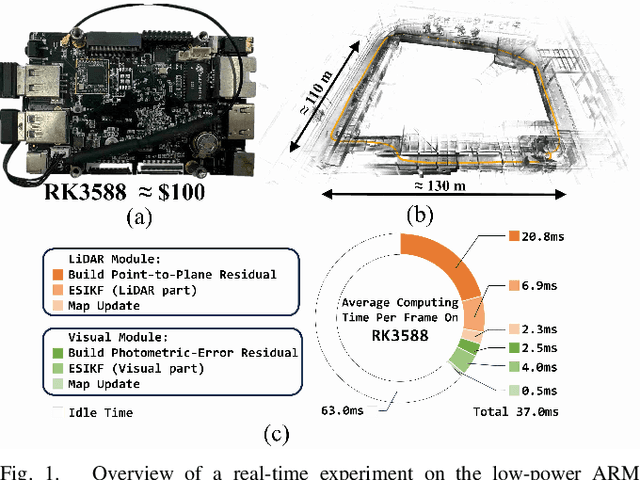
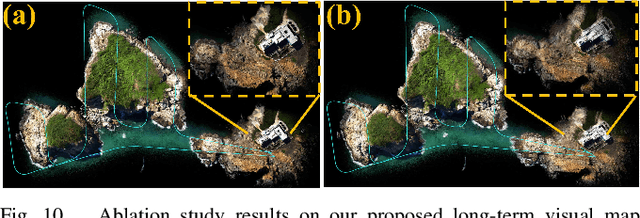
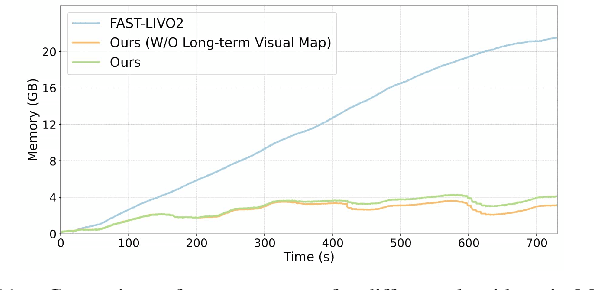
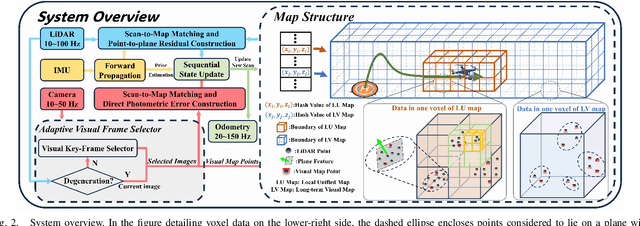
This paper presents a lightweight LiDAR-inertial-visual odometry system optimized for resource-constrained platforms. It integrates a degeneration-aware adaptive visual frame selector into error-state iterated Kalman filter (ESIKF) with sequential updates, improving computation efficiency significantly while maintaining a similar level of robustness. Additionally, a memory-efficient mapping structure combining a locally unified visual-LiDAR map and a long-term visual map achieves a good trade-off between performance and memory usage. Extensive experiments on x86 and ARM platforms demonstrate the system's robustness and efficiency. On the Hilti dataset, our system achieves a 33% reduction in per-frame runtime and 47% lower memory usage compared to FAST-LIVO2, with only a 3 cm increase in RMSE. Despite this slight accuracy trade-off, our system remains competitive, outperforming state-of-the-art (SOTA) LIO methods such as FAST-LIO2 and most existing LIVO systems. These results validate the system's capability for scalable deployment on resource-constrained edge computing platforms.
GS-LIVO: Real-Time LiDAR, Inertial, and Visual Multi-sensor Fused Odometry with Gaussian Mapping
Jan 15, 2025
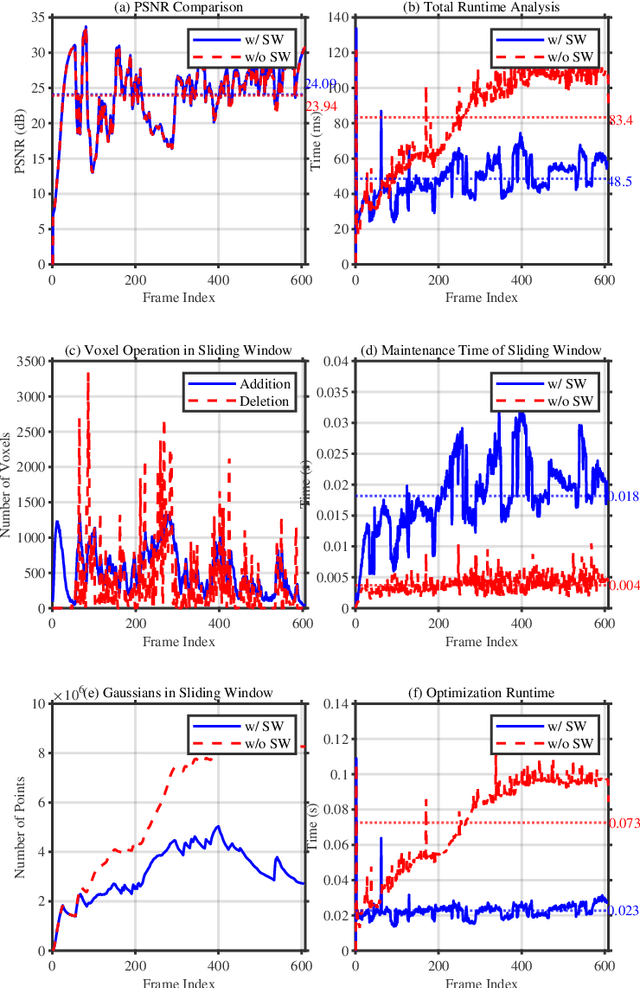


In recent years, 3D Gaussian splatting (3D-GS) has emerged as a novel scene representation approach. However, existing vision-only 3D-GS methods often rely on hand-crafted heuristics for point-cloud densification and face challenges in handling occlusions and high GPU memory and computation consumption. LiDAR-Inertial-Visual (LIV) sensor configuration has demonstrated superior performance in localization and dense mapping by leveraging complementary sensing characteristics: rich texture information from cameras, precise geometric measurements from LiDAR, and high-frequency motion data from IMU. Inspired by this, we propose a novel real-time Gaussian-based simultaneous localization and mapping (SLAM) system. Our map system comprises a global Gaussian map and a sliding window of Gaussians, along with an IESKF-based odometry. The global Gaussian map consists of hash-indexed voxels organized in a recursive octree, effectively covering sparse spatial volumes while adapting to different levels of detail and scales. The Gaussian map is initialized through multi-sensor fusion and optimized with photometric gradients. Our system incrementally maintains a sliding window of Gaussians, significantly reducing GPU computation and memory consumption by only optimizing the map within the sliding window. Moreover, we implement a tightly coupled multi-sensor fusion odometry with an iterative error state Kalman filter (IESKF), leveraging real-time updating and rendering of the Gaussian map. Our system represents the first real-time Gaussian-based SLAM framework deployable on resource-constrained embedded systems, demonstrated on the NVIDIA Jetson Orin NX platform. The framework achieves real-time performance while maintaining robust multi-sensor fusion capabilities. All implementation algorithms, hardware designs, and CAD models will be publicly available.
Voxel-SLAM: A Complete, Accurate, and Versatile LiDAR-Inertial SLAM System
Oct 11, 2024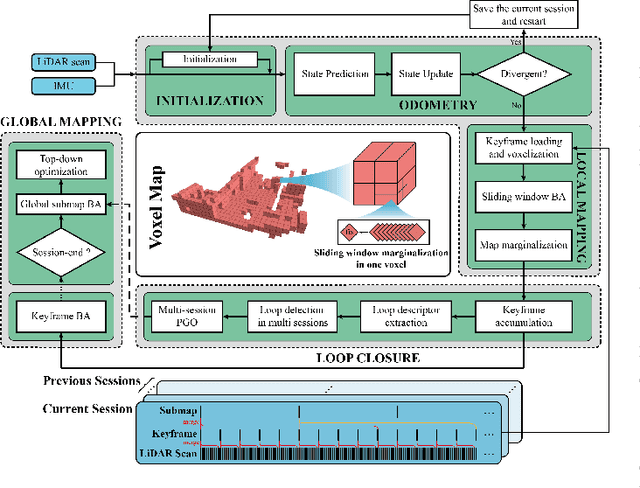
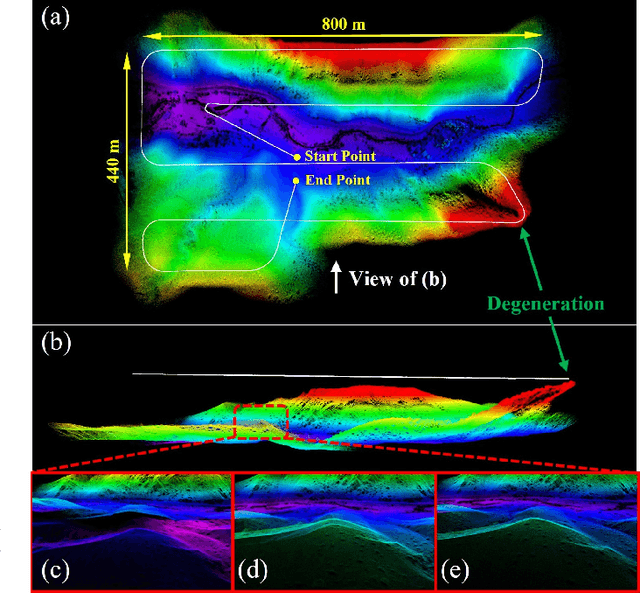
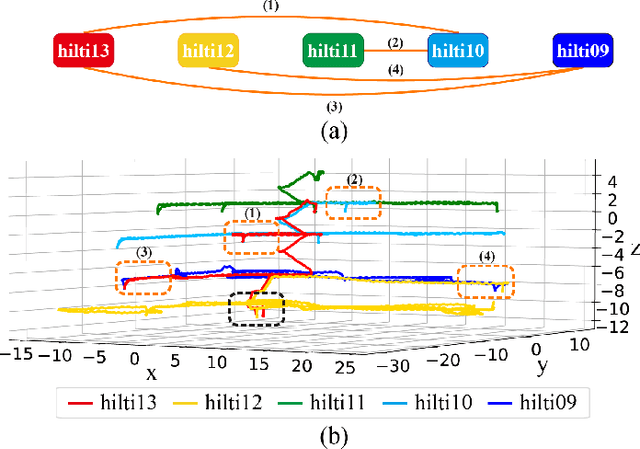
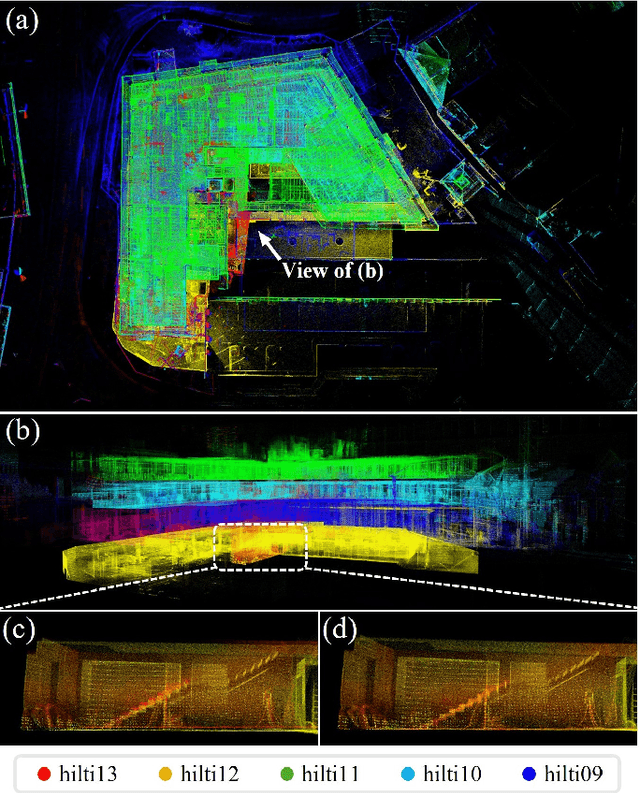
In this work, we present Voxel-SLAM: a complete, accurate, and versatile LiDAR-inertial SLAM system that fully utilizes short-term, mid-term, long-term, and multi-map data associations to achieve real-time estimation and high precision mapping. The system consists of five modules: initialization, odometry, local mapping, loop closure, and global mapping, all employing the same map representation, an adaptive voxel map. The initialization provides an accurate initial state estimation and a consistent local map for subsequent modules, enabling the system to start with a highly dynamic initial state. The odometry, exploiting the short-term data association, rapidly estimates current states and detects potential system divergence. The local mapping, exploiting the mid-term data association, employs a local LiDAR-inertial bundle adjustment (BA) to refine the states (and the local map) within a sliding window of recent LiDAR scans. The loop closure detects previously visited places in the current and all previous sessions. The global mapping refines the global map with an efficient hierarchical global BA. The loop closure and global mapping both exploit long-term and multi-map data associations. We conducted a comprehensive benchmark comparison with other state-of-the-art methods across 30 sequences from three representative scenes, including narrow indoor environments using hand-held equipment, large-scale wilderness environments with aerial robots, and urban environments on vehicle platforms. Other experiments demonstrate the robustness and efficiency of the initialization, the capacity to work in multiple sessions, and relocalization in degenerated environments.
Neural Surface Reconstruction and Rendering for LiDAR-Visual Systems
Sep 09, 2024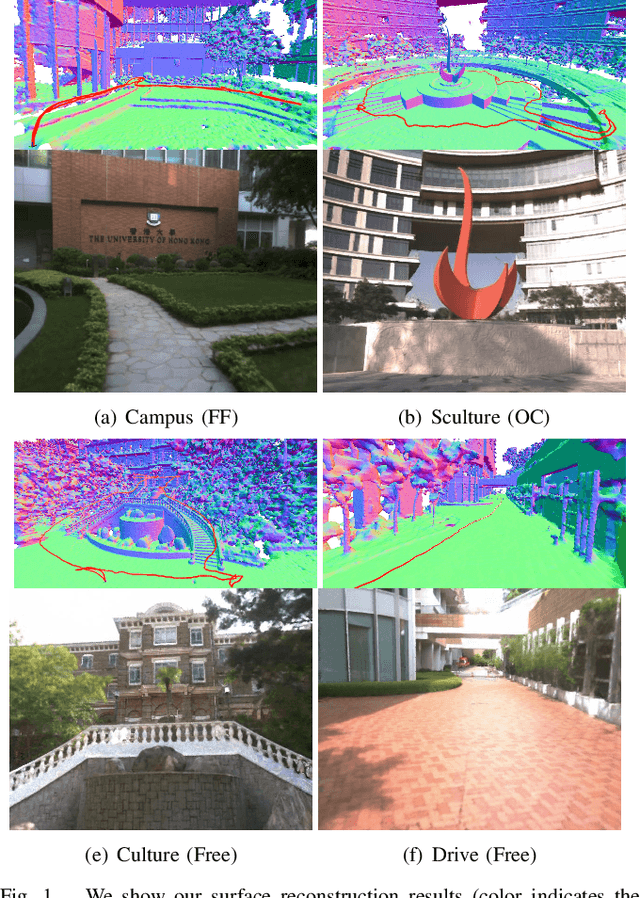


This paper presents a unified surface reconstruction and rendering framework for LiDAR-visual systems, integrating Neural Radiance Fields (NeRF) and Neural Distance Fields (NDF) to recover both appearance and structural information from posed images and point clouds. We address the structural visible gap between NeRF and NDF by utilizing a visible-aware occupancy map to classify space into the free, occupied, visible unknown, and background regions. This classification facilitates the recovery of a complete appearance and structure of the scene. We unify the training of the NDF and NeRF using a spatial-varying scale SDF-to-density transformation for levels of detail for both structure and appearance. The proposed method leverages the learned NDF for structure-aware NeRF training by an adaptive sphere tracing sampling strategy for accurate structure rendering. In return, NeRF further refines structural in recovering missing or fuzzy structures in the NDF. Extensive experiments demonstrate the superior quality and versatility of the proposed method across various scenarios. To benefit the community, the codes will be released at \url{https://github.com/hku-mars/M2Mapping}.
MFCalib: Single-shot and Automatic Extrinsic Calibration for LiDAR and Camera in Targetless Environments Based on Multi-Feature Edge
Sep 02, 2024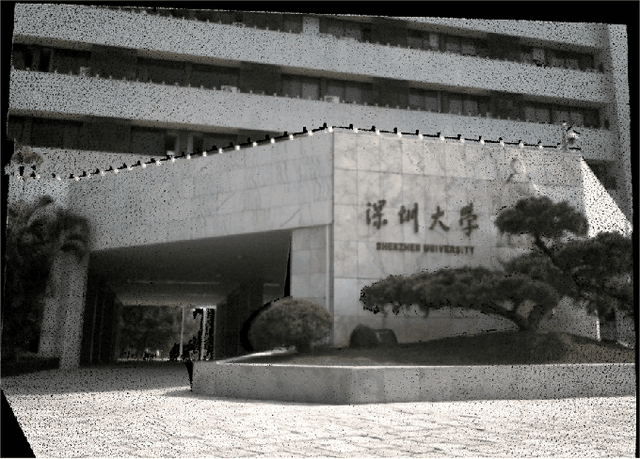
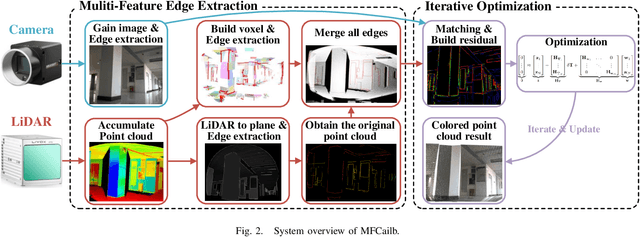
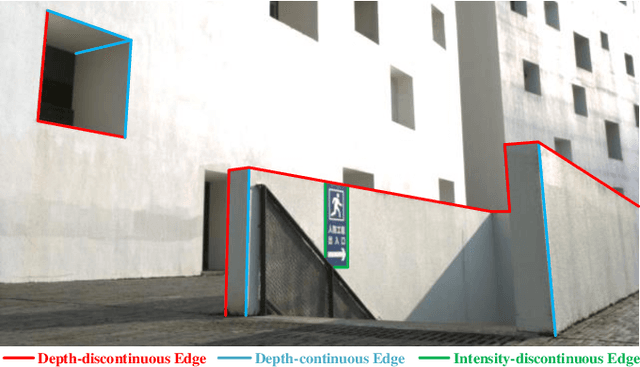

This paper presents MFCalib, an innovative extrinsic calibration technique for LiDAR and RGB camera that operates automatically in targetless environments with a single data capture. At the heart of this method is using a rich set of edge information, significantly enhancing calibration accuracy and robustness. Specifically, we extract both depth-continuous and depth-discontinuous edges, along with intensity-discontinuous edges on planes. This comprehensive edge extraction strategy ensures our ability to achieve accurate calibration with just one round of data collection, even in complex and varied settings. Addressing the uncertainty of depth-discontinuous edges, we delve into the physical measurement principles of LiDAR and develop a beam model, effectively mitigating the issue of edge inflation caused by the LiDAR beam. Extensive experiment results demonstrate that MFCalib outperforms the state-of-the-art targetless calibration methods across various scenes, achieving and often surpassing the precision of multi-scene calibrations in a single-shot collection. To support community development, we make our code available open-source on GitHub.