 Add to Chrome
 Add to Firefox
 Add to Edge
LIT-GS: LiDAR-Inertial-Thermal Gaussian Splatting for Illumination-Robust Mapping
Jun 18, 2026
Gaussian Splatting has enabled real-time neural rendering, yet existing LiDAR-inertial-visual (LIV) Gaussian mapping pipelines remain fragile under illumination changes and texture-deficient scenes due to their reliance on RGB photometric cues. We present LIT-GS, a LiDAR-inertial-thermal Gaussian Splatting framework that injects LiDAR-derived plane geometry as an explicit constraint in both pose/structure refinement and Gaussian optimization. Specifically, we exploit LIV visual map points as confidence-aware cross-modal anchors to establish reliable thermal-LiDAR associations, and incorporate weighted LiDAR point-to-plane residuals into bundle adjustment to jointly refine camera poses and 3D points under weak thermal supervision. Building on the refined structure, we further introduce a LiDAR-plane-regularized differentiable splatting objective that constrains rendered 3D points to align with locally observed planes, mitigating surface thickening and structural drift in low-contrast thermal imagery. Experiments on proprietary sequences and public datasets demonstrate that LIT-GS consistently improves geometric accuracy and rendering quality over state-of-the-art LIV-based Gaussian Splatting baselines, particularly in challenging lighting conditions.

MFCalib: Single-shot and Automatic Extrinsic Calibration for LiDAR and Camera in Targetless Environments Based on Multi-Feature Edge
Sep 02, 2024
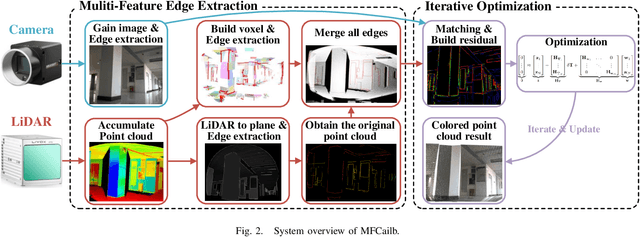
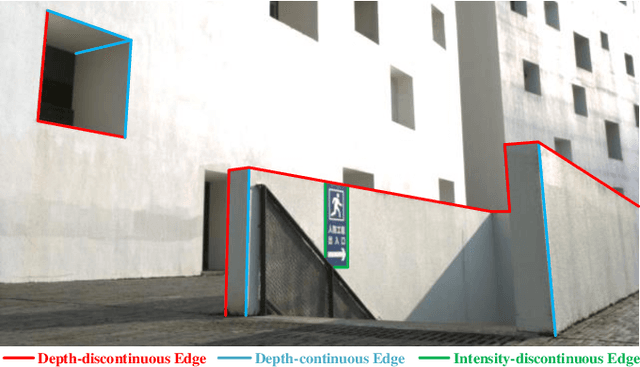

This paper presents MFCalib, an innovative extrinsic calibration technique for LiDAR and RGB camera that operates automatically in targetless environments with a single data capture. At the heart of this method is using a rich set of edge information, significantly enhancing calibration accuracy and robustness. Specifically, we extract both depth-continuous and depth-discontinuous edges, along with intensity-discontinuous edges on planes. This comprehensive edge extraction strategy ensures our ability to achieve accurate calibration with just one round of data collection, even in complex and varied settings. Addressing the uncertainty of depth-discontinuous edges, we delve into the physical measurement principles of LiDAR and develop a beam model, effectively mitigating the issue of edge inflation caused by the LiDAR beam. Extensive experiment results demonstrate that MFCalib outperforms the state-of-the-art targetless calibration methods across various scenes, achieving and often surpassing the precision of multi-scene calibrations in a single-shot collection. To support community development, we make our code available open-source on GitHub.