 Add to Chrome
 Add to Firefox
 Add to Edge
LLM-MLFFN: Multi-Level Autonomous Driving Behavior Feature Fusion via Large Language Model
Mar 03, 2026
Accurate classification of autonomous vehicle (AV) driving behaviors is critical for safety validation, performance diagnosis, and traffic integration analysis. However, existing approaches primarily rely on numerical time-series modeling and often lack semantic abstraction, limiting interpretability and robustness in complex traffic environments. This paper presents LLM-MLFFN, a novel large language model (LLM)-enhanced multi-level feature fusion network designed to address the complexities of multi-dimensional driving data. The proposed LLM-MLFFN framework integrates priors from largescale pre-trained models and employs a multi-level approach to enhance classification accuracy. LLM-MLFFN comprises three core components: (1) a multi-level feature extraction module that extracts statistical, behavioral, and dynamic features to capture the quantitative aspects of driving behaviors; (2) a semantic description module that leverages LLMs to transform raw data into high-level semantic features; and (3) a dual-channel multi-level feature fusion network that combines numerical and semantic features using weighted attention mechanisms to improve robustness and prediction accuracy. Evaluation on the Waymo open trajectory dataset demonstrates the superior performance of the proposed LLM-MLFFN, achieving a classification accuracy of over 94%, surpassing existing machine learning models. Ablation studies further validate the critical contributions of multi-level fusion, feature extraction strategies, and LLM-derived semantic reasoning. These results suggest that integrating structured feature modeling with language-driven semantic abstraction provides a principled and interpretable pathway for robust autonomous driving behavior classification.

MMVC: Learned Multi-Mode Video Compression with Block-based Prediction Mode Selection and Density-Adaptive Entropy Coding
Apr 05, 2023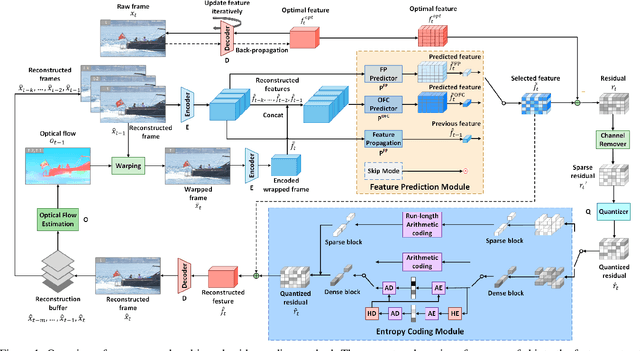

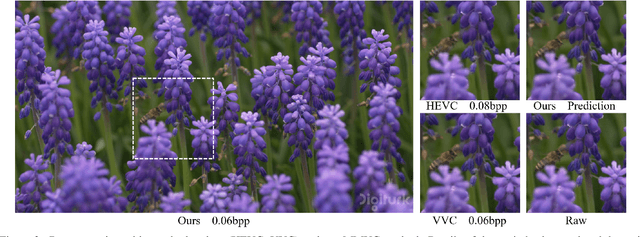
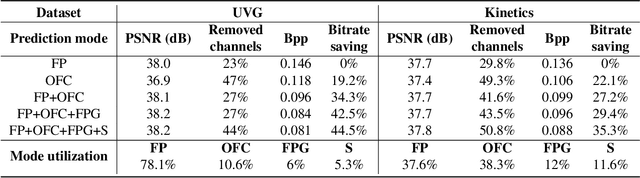
Learning-based video compression has been extensively studied over the past years, but it still has limitations in adapting to various motion patterns and entropy models. In this paper, we propose multi-mode video compression (MMVC), a block wise mode ensemble deep video compression framework that selects the optimal mode for feature domain prediction adapting to different motion patterns. Proposed multi-modes include ConvLSTM-based feature domain prediction, optical flow conditioned feature domain prediction, and feature propagation to address a wide range of cases from static scenes without apparent motions to dynamic scenes with a moving camera. We partition the feature space into blocks for temporal prediction in spatial block-based representations. For entropy coding, we consider both dense and sparse post-quantization residual blocks, and apply optional run-length coding to sparse residuals to improve the compression rate. In this sense, our method uses a dual-mode entropy coding scheme guided by a binary density map, which offers significant rate reduction surpassing the extra cost of transmitting the binary selection map. We validate our scheme with some of the most popular benchmarking datasets. Compared with state-of-the-art video compression schemes and standard codecs, our method yields better or competitive results measured with PSNR and MS-SSIM.