 Add to Chrome
 Add to Firefox
 Add to Edge
DBPnet: Damper Characteristics-Based Bayesian Physics-Informed Neural Network for Wheel Load Estimation
May 24, 2026
Advanced driver assistance systems (ADAS) play an important role in modern automotive intelligence, significantly enhancing vehicle safety and stability. The performance of ADAS critically relies on accurate and reliable vehicle state estimation, particularly from vehicle dynamic sensors. Among these signals, wheel load is a key variable for chassis control and safety-critical functions, yet it remains difficult to estimate robustly due to complex suspension geometry, nonlinear dynamics, and measurement noise. To address this issue, we propose DBPnet, a Bayesian physics-informed neural network (PINN) with a physics-aware embedding module inspired by damper characteristics. First, this paper presents a suspension linkage-level modeling (SLLM) approach that constructs a nonlinear instantaneous dynamic model by explicitly considering the complex geometric structure of the suspension. Building upon SLLM, Bayesian inference is integrated into the PINN to effectively cope with noise and uncertainty in the vehicle chassis system, thereby improving the model's robustness. Then, a physics-informed loss function is employed to ensure consistency with fundamental physical principles, while the damper characteristics-inspired embedding module extracts temporal variation features of input signals and incorporates them into each layer of the PINN, ensuring that physical observations guide the neural network without being constrained by fixed physical models. Extensive evaluations on high-fidelity simulations and real-world experiments demonstrate that our DBPnet consistently achieves lower RMSE and MaxError than baseline methods. These results highlight the potential of our DBPnet to advance wheel load estimation and contribute to the development of more reliable ADAS actuator functions.

PILD: Physics-Informed Learning via Diffusion
Jan 29, 2026Diffusion models have emerged as powerful generative tools for modeling complex data distributions, yet their purely data-driven nature limits applicability in practical engineering and scientific problems where physical laws need to be followed. This paper proposes Physics-Informed Learning via Diffusion (PILD), a framework that unifies diffusion modeling and first-principles physical constraints by introducing a virtual residual observation sampled from a Laplace distribution to supervise generation during training. To further integrate physical laws, a conditional embedding module is incorporated to inject physical information into the denoising network at multiple layers, ensuring consistent guidance throughout the diffusion process. The proposed PILD framework is concise, modular, and broadly applicable to problems governed by ordinary differential equations, partial differential equations, as well as algebraic equations or inequality constraints. Extensive experiments across engineering and scientific tasks including estimating vehicle trajectories, tire forces, Darcy flow and plasma dynamics, demonstrate that our PILD substantially improves accuracy, stability, and generalization over existing physics-informed and diffusion-based baselines.
Fourier Feature Attribution: A New Efficiency Attribution Method
Apr 02, 2025
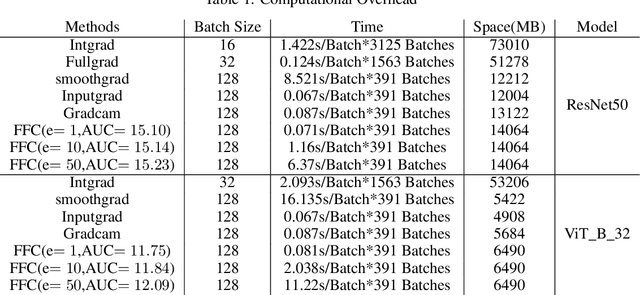
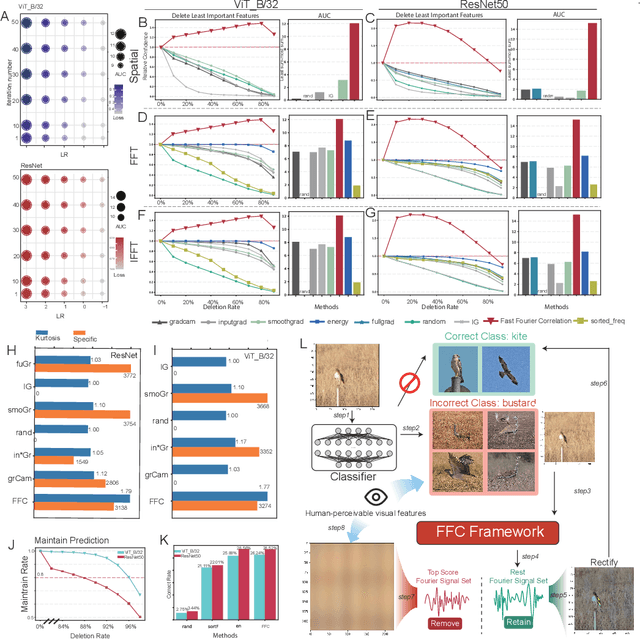
The study of neural networks from the perspective of Fourier features has garnered significant attention. While existing analytical research suggests that neural networks tend to learn low-frequency features, a clear attribution method for identifying the specific learned Fourier features has remained elusive. To bridge this gap, we propose a novel Fourier feature attribution method grounded in signal decomposition theory. Additionally, we analyze the differences between game-theoretic attribution metrics for Fourier and spatial domain features, demonstrating that game-theoretic evaluation metrics are better suited for Fourier-based feature attribution. Our experiments show that Fourier feature attribution exhibits superior feature selection capabilities compared to spatial domain attribution methods. For instance, in the case of Vision Transformers (ViTs) on the ImageNet dataset, only $8\%$ of the Fourier features are required to maintain the original predictions for $80\%$ of the samples. Furthermore, we compare the specificity of features identified by our method against traditional spatial domain attribution methods. Results reveal that Fourier features exhibit greater intra-class concentration and inter-class distinctiveness, indicating their potential for more efficient classification and explainable AI algorithms.