 Add to Chrome
 Add to Firefox
 Add to Edge
EchoCache: Energy-Guided Cross-Modal Caching for Efficient Audio-Driven Video Generation
Aug 03, 2026
Audio-driven video generation (A2V) has achieved promising progress in synthesizing temporally coherent and audio-visually aligned videos, yet its inference remains expensive due to the iterative denoising process of diffusion models. Existing caching methods mainly exploit temporal redundancy in visual features while overlooking the cross-modal alignment of A2V, where audio drives visual generation with highly non-uniform temporal importance. In this paper, we identify two levels of misalignment in existing A2V caching methods: temporal-semantic and computation-storage misalignment. To address them, we propose EchoCache, an energy-guided cross-modal caching framework for efficient A2V generation. EchoCache leverages audio time-frequency energy as a saliency anchor to guide latent-level cache updates and further introduces a dynamic timestep-latent caching mechanism with quantized cache management for joint efficiency and memory optimization. Extensive experiments on mainstream A2V models show that EchoCache consistently improves the latency-quality trade-off while preserving generation quality and audio-visual consistency. In particular, on Wan2.2-S2V over the EMTD benchmark, EchoCache achieves a 2.46x speedup with the best overall performance. Code is available at https://github.com/IF-LAB-PKU/EchoCache.

MoECa: Aligning Feature Reuse with Expert Decomposition in Diffusion Transformers
Jun 14, 2026Diffusion Transformers with Mixture-of-Experts (DiT-MoE) improve model capacity under sparse activation, but diffusion inference is still bottlenecked by redundant computation across timesteps. Existing caching methods mainly operate at the token level, which becomes suboptimal in DiT-MoE because each token update is internally decomposed into multiple routed expert branches. Our analysis shows that cross-timestep redundancy in DiT-MoE is better characterized at the expert-branch level than at the whole-token level. Based on this observation, we propose MoECa, a fine-grained caching framework that performs branch-level feature reuse across timesteps. MoECa further introduces expert-aware adaptive control and synchronized cache updates across MoE and attention paths to maintain stable intermediate states. Experiments on multiple DiT-MoE models show that MoECa consistently achieves a better speed-quality trade-off than prior caching methods, with up to 2.83$\times$ inference speedup and minimal quality degradation.
RoboECC: Multi-Factor-Aware Edge-Cloud Collaborative Deployment for VLA Models
Mar 21, 2026Vision-Language-Action (VLA) models are mainstream in embodied intelligence but face high inference costs. Edge-Cloud Collaborative (ECC) deployment offers an effective fix by easing edge-device computing pressure to meet real-time needs. However, existing ECC frameworks are suboptimal for VLA models due to two challenges: (1) Diverse model structures hinder optimal ECC segmentation point identification; (2) Even if the optimal split point is determined, changes in network bandwidth can cause performance drift. To address these issues, we propose a novel ECC deployment framework for various VLA models, termed RoboECC. Specifically, we propose a model-hardware co-aware segmentation strategy to help find the optimal segmentation point for various VLA models. Moreover, we propose a network-aware deployment adjustment approach to adapt to the network fluctuations for maintaining optimal performance. Experiments demonstrate that RoboECC achieves a speedup of up to 3.28x with only 2.55x~2.62x overhead.
HeiSD: Hybrid Speculative Decoding for Embodied Vision-Language-Action Models with Kinematic Awareness
Mar 18, 2026Vision-Language-Action (VLA) Models have become the mainstream solution for robot control, but suffer from slow inference speeds. Speculative Decoding (SD) is a promising acceleration method which can be divided into two categories: drafter-based SD and retrieval-based SD. Existing methods fail to analyze the advantages and disadvantages of these two types of SD in VLA models, leading to their sole application or optimization. In this paper, we analyze the trajectory patterns of robots controlled by the VLA model and derive a key insight: the two types of SD should be used in a hybrid manner. However, achieving hybrid SD in VLA models poses several challenges: (1) draft rejection and persistent errors in retrieval-based SD; (2) difficulty in determining the hybrid boundary. To address these, we propose the HeiSD framework. We propose a retrieval-based SD optimization method in HeiSD,which contains a verify-skip mechanism and a sequence-wise relaxed acceptance strategy. Moreover, we proposed a kinematic-based fused metric in HeiSD to automatically determine the hybrid boundary. Experimental results demonstrate that HeiSD attains a speedup of up to 2.45x in simulation benchmarks and 2.06x~2.41x in real-world scenarios, while sustaining a high task success rate.
RAPID: Redundancy-Aware and Compatibility-Optimal Edge-Cloud Partitioned Inference for Diverse VLA Models
Mar 12, 2026Vision Language Action (VLA) models are mainstream in embodied intelligence but face high inference costs. Edge-Cloud Collaborative (ECC) inference offers an effective fix by easing edge-device computing pressure to meet real-time needs. However, existing ECC frameworks are suboptimal for VLA models due to two challenges: (1) Mainstream environment-oriented edge-cloud partitioning methods are susceptible to interference from visual noise; (2) Existing edge-cloud partitioning methods overlook the step-wise redundancy unique to embodied tasks, thereby disrupting the physical continuity of motion. To address these issues, we propose a novel ECC inference framework, termed RAPID. Specifically, we developed an implementation tailored to the proposed framework. Experiments demonstrate this achieves a speedup of up to 1.73x with only 5%~7% overhead.
DyQ-VLA: Temporal-Dynamic-Aware Quantization for Embodied Vision-Language-Action Models
Mar 09, 2026Vision-Language-Action (VLA) models are dominant in embodied intelligence but are constrained by inference overheads. While model quantization alleviates these bottlenecks for edge deployment, static quantization approaches remain suboptimal for VLAs due to two critical challenges: (1) Temporal-dynamic sensitivity, where fixed precision wastes resources by ignoring stage-varying error tolerances; and (2) Real-time allocation, where identifying real-time sensitivity to guide bit allocation remains unsolved. To address these challenges, we propose DyQ-VLA, a dynamic quantization framework for VLAs. Specifically, a sensitivity-aware switching strategy leverages real-time kinematic proxies to trigger the bit-width switch, while a kinematic-guided module dynamically allocates the optimal bit-width. Experiments show that DyQ-VLA requires only 30.9% of the original memory footprint while maintaining 99.5% of its original performance, achieving 1.49x simulation and up to 1.43x real-world speedups.
KERV: Kinematic-Rectified Speculative Decoding for Embodied VLA Models
Mar 02, 2026Vision-Language-Action (VLA) models build a token-domain robot control paradigm, yet suffer from low speed. Speculative Decoding (SD) is an optimization strategy that can boost inference speed. Two key issues emerge when integrating VLA and SD: first, SD relies on re-inference to address token errors, which is computationally expensive; second, to mitigate token errors, the acceptance threshold in SD requires careful adjustment. Existing works fail to address the above two issues effectively. Meanwhile, as the bridge between AI and the physical world, existing embodied intelligence has overlooked the application of robotic kinematics. To address these issues, we innovatively combine token-domain VLA models with kinematic-domain prediction for SD, proposing a kinematic-rectified SD framework named KERV. We employ a kinematics-based Kalman Filter to predict actions and compensate for SD errors, avoiding costly re-inference. Moreover, we design a kinematics-based adjustment strategy to dynamically rectify the acceptance threshold, addressing the difficulty of threshold determination. Experimental results across diverse tasks and environments demonstrate that KERV achieves 27%~37% acceleration with nearly no Success Rate loss.
Towards Explainable Artificial Intelligence (XAI): A Data Mining Perspective
Jan 13, 2024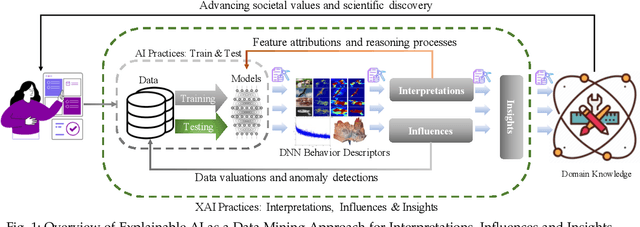
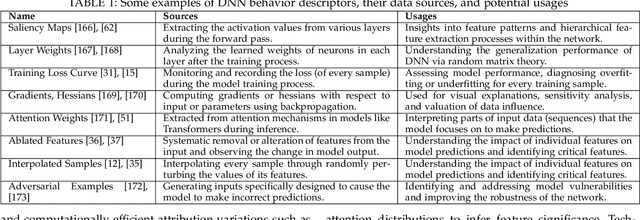
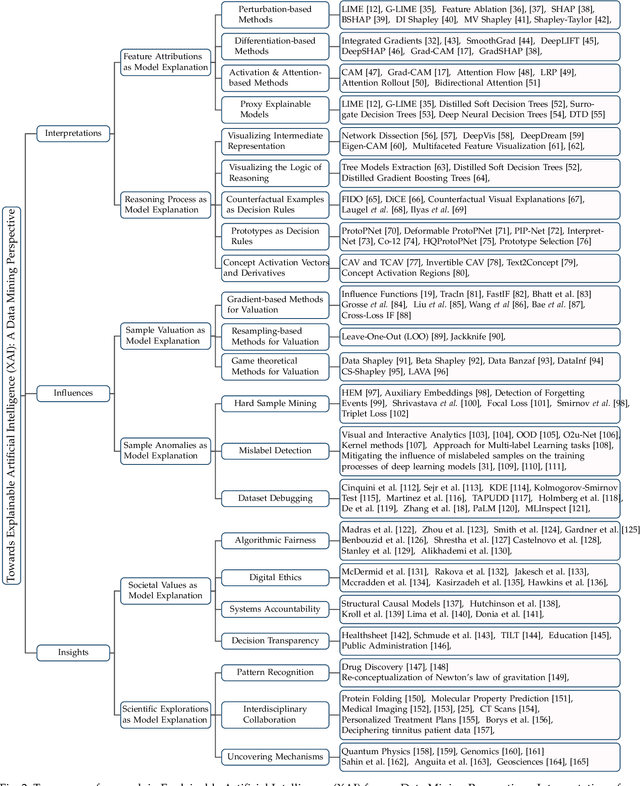
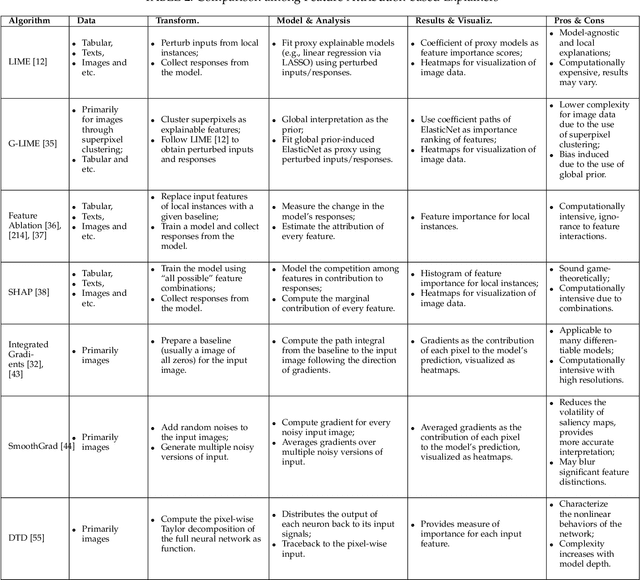
Given the complexity and lack of transparency in deep neural networks (DNNs), extensive efforts have been made to make these systems more interpretable or explain their behaviors in accessible terms. Unlike most reviews, which focus on algorithmic and model-centric perspectives, this work takes a "data-centric" view, examining how data collection, processing, and analysis contribute to explainable AI (XAI). We categorize existing work into three categories subject to their purposes: interpretations of deep models, referring to feature attributions and reasoning processes that correlate data points with model outputs; influences of training data, examining the impact of training data nuances, such as data valuation and sample anomalies, on decision-making processes; and insights of domain knowledge, discovering latent patterns and fostering new knowledge from data and models to advance social values and scientific discovery. Specifically, we distill XAI methodologies into data mining operations on training and testing data across modalities, such as images, text, and tabular data, as well as on training logs, checkpoints, models and other DNN behavior descriptors. In this way, our study offers a comprehensive, data-centric examination of XAI from a lens of data mining methods and applications.