 Add to Chrome
 Add to Firefox
 Add to Edge
Behavioral Controllability of Agentic Models for Information Extraction: From Fixed Workflows to Reflective Agents
Jul 17, 2026
Large language model (LLM) agents are increasingly used for complex information-extraction tasks, yet it remains unclear whether agentic components such as reflection and memory lead to observable and controllable improvements over fixed LLM workflows. We study this question through conference-paper dataset extraction, where a system must identify datasets mentioned in scholarly PDFs and produce structured records. We compare a fixed workflow baseline with reflective agent variants and specify an optimized agent condition (S2) that extends the same task with richer PDF tools and dynamic tool selection. Our evaluation emphasizes process-level behavior--including tool execution, retries, reflection, memory use, runtime, and failure recovery--while treating extraction coverage and field completeness as secondary outcome measures. The paper characterizes when agentic mechanisms change system behavior, whether these changes improve task completion, and how the observed failure modes motivate an optimized agent design under the same evaluation harness.

On the Opportunities of (Re)-Exploring Atmospheric Science by Foundation Models: A Case Study
Jul 25, 2024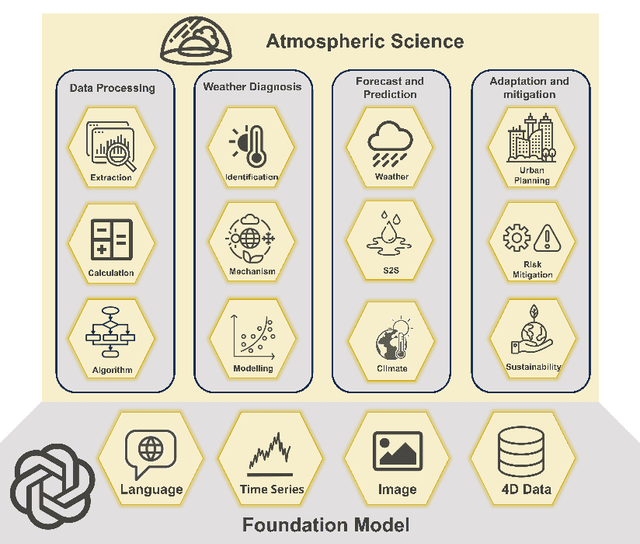
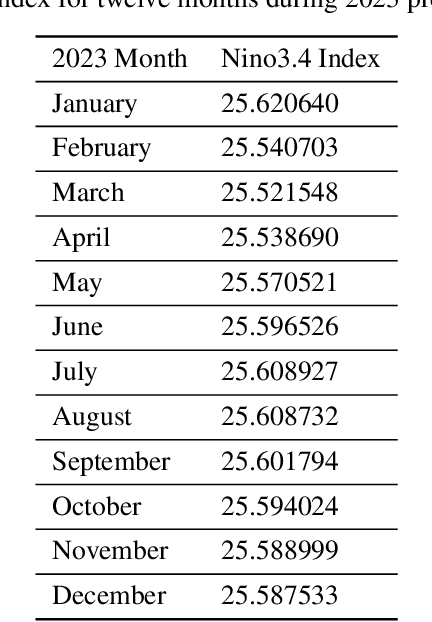
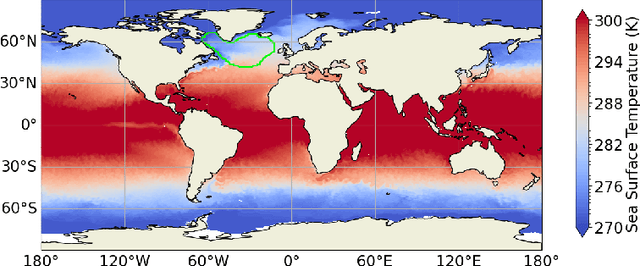
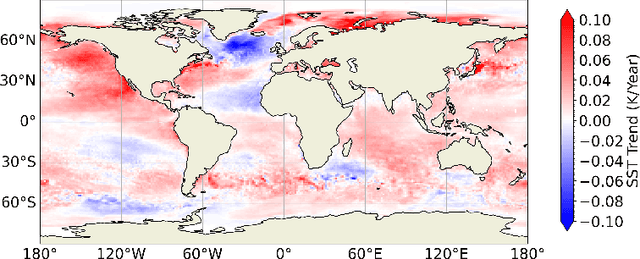
Most state-of-the-art AI applications in atmospheric science are based on classic deep learning approaches. However, such approaches cannot automatically integrate multiple complicated procedures to construct an intelligent agent, since each functionality is enabled by a separate model learned from independent climate datasets. The emergence of foundation models, especially multimodal foundation models, with their ability to process heterogeneous input data and execute complex tasks, offers a substantial opportunity to overcome this challenge. In this report, we want to explore a central question - how the state-of-the-art foundation model, i.e., GPT-4o, performs various atmospheric scientific tasks. Toward this end, we conduct a case study by categorizing the tasks into four main classes, including climate data processing, physical diagnosis, forecast and prediction, and adaptation and mitigation. For each task, we comprehensively evaluate the GPT-4o's performance along with a concrete discussion. We hope that this report may shed new light on future AI applications and research in atmospheric science.
Incremental Collaborative Beam Alignment for Millimeter Wave Cell-Free MIMO Systems
Aug 16, 2023Millimeter wave (mmWave) cell-free MIMO achieves an extremely high rate while its beam alignment (BA) suffers from excessive overhead due to a large number of transceivers. Recently, user location and probing measurements are utilized for BA based on machine learning (ML) models, e.g., deep neural network (DNN). However, most of these ML models are centralized with high communication and computational overhead and give no specific consideration to practical issues, e.g., limited training data and real-time model updates. In this paper, we study the {probing} beam-based BA for mmWave cell-free MIMO downlink with the help of broad learning (BL). For channels without and with uplink-downlink reciprocity, we propose the user-side and base station (BS)-side BL-aided incremental collaborative BA approaches. Via transforming the centralized BL into a distributed learning with data and feature splitting respectively, the user-side and BS-side schemes realize implicit sharing of multiple user data and multiple BS features. Simulations confirm that the user-side scheme is applicable to fast time-varying and/or non-stationary channels, while the BS-side scheme is suitable for systems with low-bandwidth fronthaul links and a central unit with limited computing power. The advantages of proposed schemes are also demonstrated compared to traditional and DNN-aided BA schemes.