 Add to Chrome
 Add to Firefox
 Add to Edge
S2SServiceBench: A Multimodal Benchmark for Last-Mile S2S Climate Services
Feb 15, 2026
Subseasonal-to-seasonal (S2S) forecasts play an essential role in providing a decision-critical weeks-to-months planning window for climate resilience and sustainability, yet a growing bottleneck is the last-mile gap: translating scientific forecasts into trusted, actionable climate services, requiring reliable multimodal understanding and decision-facing reasoning under uncertainty. Meanwhile, multimodal large language models (MLLMs) and corresponding agentic paradigms have made rapid progress in supporting various workflows, but it remains unclear whether they can reliably generate decision-making deliverables from operational service products (e.g., actionable signal comprehension, decision-making handoff, and decision analysis & planning) under uncertainty. We introduce S2SServiceBench, a multimodal benchmark for last-mile S2S climate services curated from an operational climate-service system to evaluate this capability. S2SServiceBenchcovers 10 service products with about 150+ expert-selected cases in total, spanning six application domains - Agriculture, Disasters, Energy, Finance, Health, and Shipping. Each case is instantiated at three service levels, yielding around 500 tasks and 1,000+ evaluation items across climate resilience and sustainability applications. Using S2SServiceBench, we benchmark state-of-the-art MLLMs and agents, and analyze performance across products and service levels, revealing persistent challenges in S2S service plot understanding and reasoning - namely, actionable signal comprehension, operationalizing uncertainty into executable handoffs, and stable, evidence-grounded analysis and planning for dynamic hazards-while offering actionable guidance for building future climate-service agents.

On the Opportunities of (Re)-Exploring Atmospheric Science by Foundation Models: A Case Study
Jul 25, 2024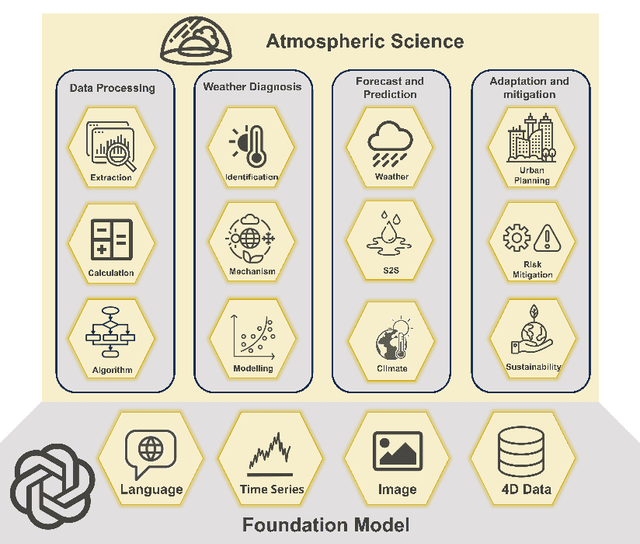
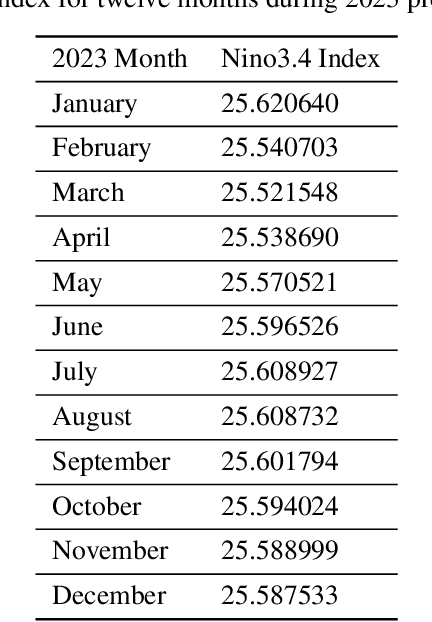
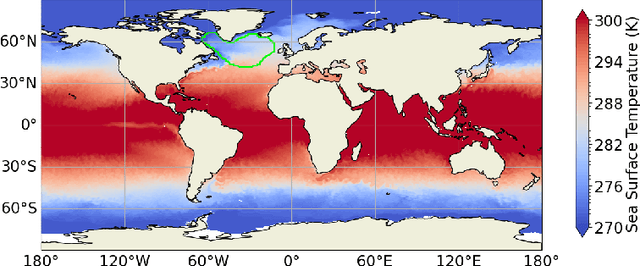
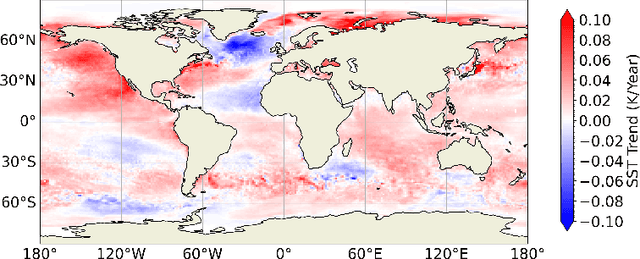
Most state-of-the-art AI applications in atmospheric science are based on classic deep learning approaches. However, such approaches cannot automatically integrate multiple complicated procedures to construct an intelligent agent, since each functionality is enabled by a separate model learned from independent climate datasets. The emergence of foundation models, especially multimodal foundation models, with their ability to process heterogeneous input data and execute complex tasks, offers a substantial opportunity to overcome this challenge. In this report, we want to explore a central question - how the state-of-the-art foundation model, i.e., GPT-4o, performs various atmospheric scientific tasks. Toward this end, we conduct a case study by categorizing the tasks into four main classes, including climate data processing, physical diagnosis, forecast and prediction, and adaptation and mitigation. For each task, we comprehensively evaluate the GPT-4o's performance along with a concrete discussion. We hope that this report may shed new light on future AI applications and research in atmospheric science.