 Add to Chrome
 Add to Firefox
 Add to Edge
Producing Plankton Classifiers that are Robust to Dataset Shift
Jan 25, 2024
Modern plankton high-throughput monitoring relies on deep learning classifiers for species recognition in water ecosystems. Despite satisfactory nominal performances, a significant challenge arises from Dataset Shift, which causes performances to drop during deployment. In our study, we integrate the ZooLake dataset with manually-annotated images from 10 independent days of deployment, serving as test cells to benchmark Out-Of-Dataset (OOD) performances. Our analysis reveals instances where classifiers, initially performing well in In-Dataset conditions, encounter notable failures in practical scenarios. For example, a MobileNet with a 92% nominal test accuracy shows a 77% OOD accuracy. We systematically investigate conditions leading to OOD performance drops and propose a preemptive assessment method to identify potential pitfalls when classifying new data, and pinpoint features in OOD images that adversely impact classification. We present a three-step pipeline: (i) identifying OOD degradation compared to nominal test performance, (ii) conducting a diagnostic analysis of degradation causes, and (iii) providing solutions. We find that ensembles of BEiT vision transformers, with targeted augmentations addressing OOD robustness, geometric ensembling, and rotation-based test-time augmentation, constitute the most robust model, which we call BEsT model. It achieves an 83% OOD accuracy, with errors concentrated on container classes. Moreover, it exhibits lower sensitivity to dataset shift, and reproduces well the plankton abundances. Our proposed pipeline is applicable to generic plankton classifiers, contingent on the availability of suitable test cells. By identifying critical shortcomings and offering practical procedures to fortify models against dataset shift, our study contributes to the development of more reliable plankton classification technologies.

Robustness Verification of Deep Reinforcement Learning Based Control Systems using Reward Martingales
Dec 15, 2023Deep Reinforcement Learning (DRL) has gained prominence as an effective approach for control systems. However, its practical deployment is impeded by state perturbations that can severely impact system performance. Addressing this critical challenge requires robustness verification about system performance, which involves tackling two quantitative questions: (i) how to establish guaranteed bounds for expected cumulative rewards, and (ii) how to determine tail bounds for cumulative rewards. In this work, we present the first approach for robustness verification of DRL-based control systems by introducing reward martingales, which offer a rigorous mathematical foundation to characterize the impact of state perturbations on system performance in terms of cumulative rewards. Our verified results provide provably quantitative certificates for the two questions. We then show that reward martingales can be implemented and trained via neural networks, against different types of control policies. Experimental results demonstrate that our certified bounds tightly enclose simulation outcomes on various DRL-based control systems, indicating the effectiveness and generality of the proposed approach.
Learn to Optimize Denoising Scores for 3D Generation: A Unified and Improved Diffusion Prior on NeRF and 3D Gaussian Splatting
Dec 08, 2023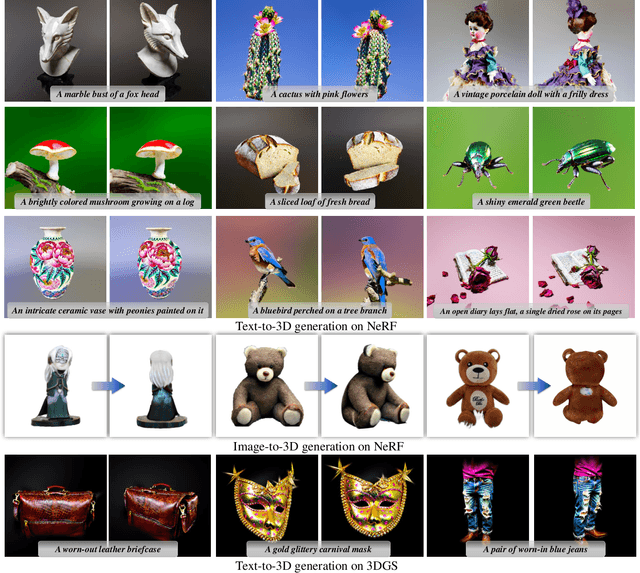
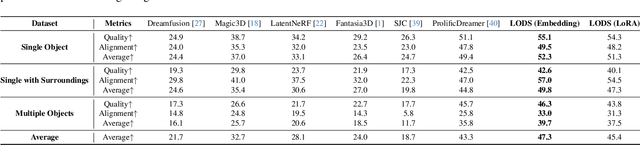
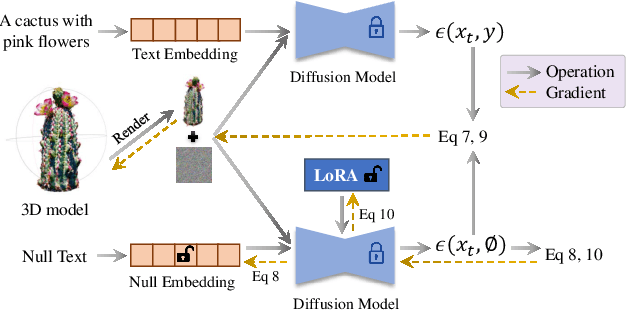

We propose a unified framework aimed at enhancing the diffusion priors for 3D generation tasks. Despite the critical importance of these tasks, existing methodologies often struggle to generate high-caliber results. We begin by examining the inherent limitations in previous diffusion priors. We identify a divergence between the diffusion priors and the training procedures of diffusion models that substantially impairs the quality of 3D generation. To address this issue, we propose a novel, unified framework that iteratively optimizes both the 3D model and the diffusion prior. Leveraging the different learnable parameters of the diffusion prior, our approach offers multiple configurations, affording various trade-offs between performance and implementation complexity. Notably, our experimental results demonstrate that our method markedly surpasses existing techniques, establishing new state-of-the-art in the realm of text-to-3D generation. Furthermore, our approach exhibits impressive performance on both NeRF and the newly introduced 3D Gaussian Splatting backbones. Additionally, our framework yields insightful contributions to the understanding of recent score distillation methods, such as the VSD and DDS loss.
Divide-and-Conquer Strategy for Large-Scale Dynamic Bayesian Network Structure Learning
Dec 04, 2023Dynamic Bayesian Networks (DBNs), renowned for their interpretability, have become increasingly vital in representing complex stochastic processes in various domains such as gene expression analysis, healthcare, and traffic prediction. Structure learning of DBNs from data is challenging, particularly for datasets with thousands of variables. Most current algorithms for DBN structure learning are adaptations from those used in static Bayesian Networks (BNs), and are typically focused on small-scale problems. In order to solve large-scale problems while taking full advantage of existing algorithms, this paper introduces a novel divide-and-conquer strategy, originally developed for static BNs, and adapts it for large-scale DBN structure learning. In this work, we specifically concentrate on 2 Time-sliced Bayesian Networks (2-TBNs), a special class of DBNs. Furthermore, we leverage the prior knowledge of 2-TBNs to enhance the performance of the strategy we introduce. Our approach significantly improves the scalability and accuracy of 2-TBN structure learning. Experimental results demonstrate the effectiveness of our method, showing substantial improvements over existing algorithms in both computational efficiency and structure learning accuracy. On problem instances with more than 1,000 variables, our approach improves two accuracy metrics by 74.45% and 110.94% on average , respectively, while reducing runtime by 93.65% on average.
Towards Redundancy-Free Sub-networks in Continual Learning
Dec 01, 2023Catastrophic Forgetting (CF) is a prominent issue in continual learning. Parameter isolation addresses this challenge by masking a sub-network for each task to mitigate interference with old tasks. However, these sub-networks are constructed relying on weight magnitude, which does not necessarily correspond to the importance of weights, resulting in maintaining unimportant weights and constructing redundant sub-networks. To overcome this limitation, inspired by information bottleneck, which removes redundancy between adjacent network layers, we propose \textbf{\underline{I}nformation \underline{B}ottleneck \underline{M}asked sub-network (IBM)} to eliminate redundancy within sub-networks. Specifically, IBM accumulates valuable information into essential weights to construct redundancy-free sub-networks, not only effectively mitigating CF by freezing the sub-networks but also facilitating new tasks training through the transfer of valuable knowledge. Additionally, IBM decomposes hidden representations to automate the construction process and make it flexible. Extensive experiments demonstrate that IBM consistently outperforms state-of-the-art methods. Notably, IBM surpasses the state-of-the-art parameter isolation method with a 70\% reduction in the number of parameters within sub-networks and an 80\% decrease in training time.
Continual Referring Expression Comprehension via Dual Modular Memorization
Nov 25, 2023Referring Expression Comprehension (REC) aims to localize an image region of a given object described by a natural-language expression. While promising performance has been demonstrated, existing REC algorithms make a strong assumption that training data feeding into a model are given upfront, which degrades its practicality for real-world scenarios. In this paper, we propose Continual Referring Expression Comprehension (CREC), a new setting for REC, where a model is learning on a stream of incoming tasks. In order to continuously improve the model on sequential tasks without forgetting prior learned knowledge and without repeatedly re-training from a scratch, we propose an effective baseline method named Dual Modular Memorization (DMM), which alleviates the problem of catastrophic forgetting by two memorization modules: Implicit-Memory and Explicit-Memory. Specifically, the former module aims to constrain drastic changes to important parameters learned on old tasks when learning a new task; while the latter module maintains a buffer pool to dynamically select and store representative samples of each seen task for future rehearsal. We create three benchmarks for the new CREC setting, by respectively re-splitting three widely-used REC datasets RefCOCO, RefCOCO+ and RefCOCOg into sequential tasks. Extensive experiments on the constructed benchmarks demonstrate that our DMM method significantly outperforms other alternatives, based on two popular REC backbones. We make the source code and benchmarks publicly available to foster future progress in this field: https://github.com/zackschen/DMM.
Class Gradient Projection For Continual Learning
Nov 25, 2023Catastrophic forgetting is one of the most critical challenges in Continual Learning (CL). Recent approaches tackle this problem by projecting the gradient update orthogonal to the gradient subspace of existing tasks. While the results are remarkable, those approaches ignore the fact that these calculated gradients are not guaranteed to be orthogonal to the gradient subspace of each class due to the class deviation in tasks, e.g., distinguishing "Man" from "Sea" v.s. differentiating "Boy" from "Girl". Therefore, this strategy may still cause catastrophic forgetting for some classes. In this paper, we propose Class Gradient Projection (CGP), which calculates the gradient subspace from individual classes rather than tasks. Gradient update orthogonal to the gradient subspace of existing classes can be effectively utilized to minimize interference from other classes. To improve the generalization and efficiency, we further design a Base Refining (BR) algorithm to combine similar classes and refine class bases dynamically. Moreover, we leverage a contrastive learning method to improve the model's ability to handle unseen tasks. Extensive experiments on benchmark datasets demonstrate the effectiveness of our proposed approach. It improves the previous methods by 2.0% on the CIFAR-100 dataset.
Building Real-World Meeting Summarization Systems using Large Language Models: A Practical Perspective
Nov 08, 2023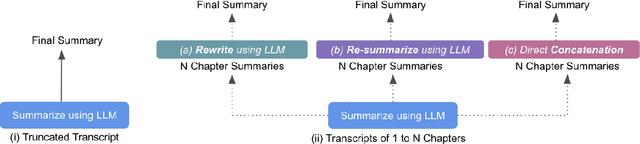
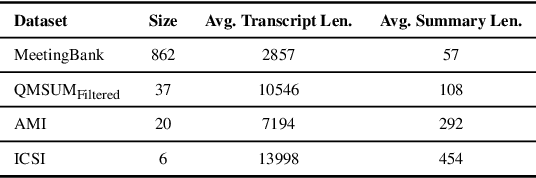
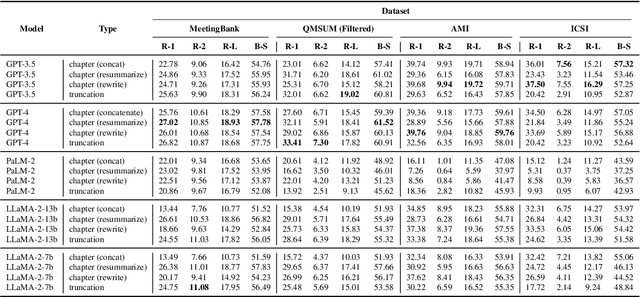
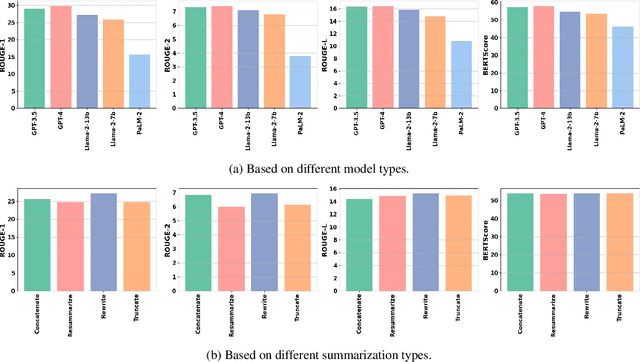
This paper studies how to effectively build meeting summarization systems for real-world usage using large language models (LLMs). For this purpose, we conduct an extensive evaluation and comparison of various closed-source and open-source LLMs, namely, GPT-4, GPT- 3.5, PaLM-2, and LLaMA-2. Our findings reveal that most closed-source LLMs are generally better in terms of performance. However, much smaller open-source models like LLaMA- 2 (7B and 13B) could still achieve performance comparable to the large closed-source models even in zero-shot scenarios. Considering the privacy concerns of closed-source models for only being accessible via API, alongside the high cost associated with using fine-tuned versions of the closed-source models, the opensource models that can achieve competitive performance are more advantageous for industrial use. Balancing performance with associated costs and privacy concerns, the LLaMA-2-7B model looks more promising for industrial usage. In sum, this paper offers practical insights on using LLMs for real-world business meeting summarization, shedding light on the trade-offs between performance and cost.
Uncertainty Estimation for Safety-critical Scene Segmentation via Fine-grained Reward Maximization
Nov 05, 2023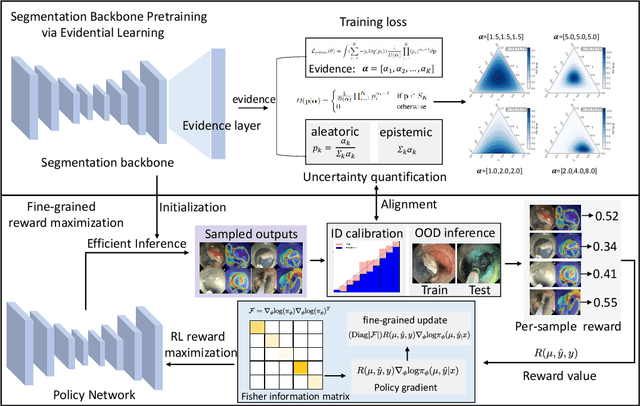
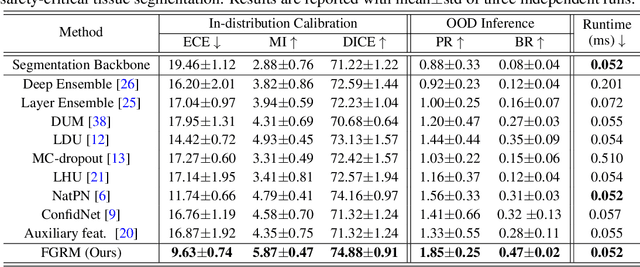
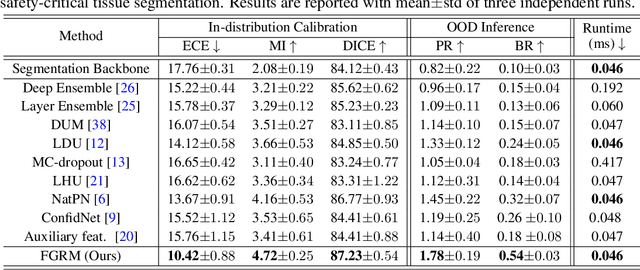
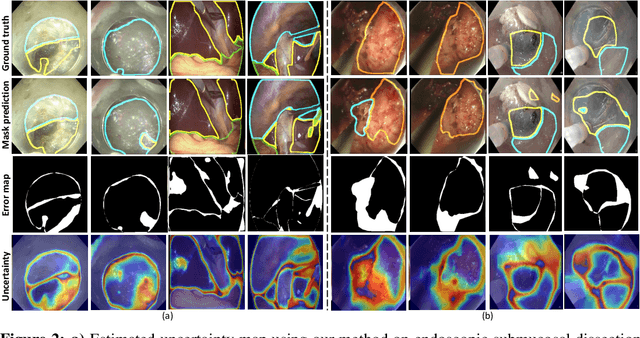
Uncertainty estimation plays an important role for future reliable deployment of deep segmentation models in safety-critical scenarios such as medical applications. However, existing methods for uncertainty estimation have been limited by the lack of explicit guidance for calibrating the prediction risk and model confidence. In this work, we propose a novel fine-grained reward maximization (FGRM) framework, to address uncertainty estimation by directly utilizing an uncertainty metric related reward function with a reinforcement learning based model tuning algorithm. This would benefit the model uncertainty estimation through direct optimization guidance for model calibration. Specifically, our method designs a new uncertainty estimation reward function using the calibration metric, which is maximized to fine-tune an evidential learning pre-trained segmentation model for calibrating prediction risk. Importantly, we innovate an effective fine-grained parameter update scheme, which imposes fine-grained reward-weighting of each network parameter according to the parameter importance quantified by the fisher information matrix. To the best of our knowledge, this is the first work exploring reward optimization for model uncertainty estimation in safety-critical vision tasks. The effectiveness of our method is demonstrated on two large safety-critical surgical scene segmentation datasets under two different uncertainty estimation settings. With real-time one forward pass at inference, our method outperforms state-of-the-art methods by a clear margin on all the calibration metrics of uncertainty estimation, while maintaining a high task accuracy for the segmentation results. Code is available at \url{https://github.com/med-air/FGRM}.
Adversarial Attacks on Cooperative Multi-agent Bandits
Nov 03, 2023Cooperative multi-agent multi-armed bandits (CMA2B) consider the collaborative efforts of multiple agents in a shared multi-armed bandit game. We study latent vulnerabilities exposed by this collaboration and consider adversarial attacks on a few agents with the goal of influencing the decisions of the rest. More specifically, we study adversarial attacks on CMA2B in both homogeneous settings, where agents operate with the same arm set, and heterogeneous settings, where agents have distinct arm sets. In the homogeneous setting, we propose attack strategies that, by targeting just one agent, convince all agents to select a particular target arm $T-o(T)$ times while incurring $o(T)$ attack costs in $T$ rounds. In the heterogeneous setting, we prove that a target arm attack requires linear attack costs and propose attack strategies that can force a maximum number of agents to suffer linear regrets while incurring sublinear costs and only manipulating the observations of a few target agents. Numerical experiments validate the effectiveness of our proposed attack strategies.