 Add to Chrome
 Add to Firefox
 Add to Edge
Generalized Recognition of Basic Surgical Actions Enables Skill Assessment and Vision-Language-Model-based Surgical Planning
Mar 13, 2026
Artificial intelligence, imaging, and large language models have the potential to transform surgical practice, training, and automation. Understanding and modeling of basic surgical actions (BSA), the fundamental unit of operation in any surgery, is important to drive the evolution of this field. In this paper, we present a BSA dataset comprising 10 basic actions across 6 surgical specialties with over 11,000 video clips, which is the largest to date. Based on the BSA dataset, we developed a new foundation model that conducts general-purpose recognition of basic actions. Our approach demonstrates robust cross-specialist performance in experiments validated on datasets from different procedural types and various body parts. Furthermore, we demonstrate downstream applications enabled by the BAS foundation model through surgical skill assessment in prostatectomy using domain-specific knowledge, and action planning in cholecystectomy and nephrectomy using large vision-language models. Multinational surgeons' evaluation of the language model's output of the action planning explainable texts demonstrated clinical relevance. These findings indicate that basic surgical actions can be robustly recognized across scenarios, and an accurate BSA understanding model can essentially facilitate complex applications and speed up the realization of surgical superintelligence.

Uncertainty Estimation for Safety-critical Scene Segmentation via Fine-grained Reward Maximization
Nov 05, 2023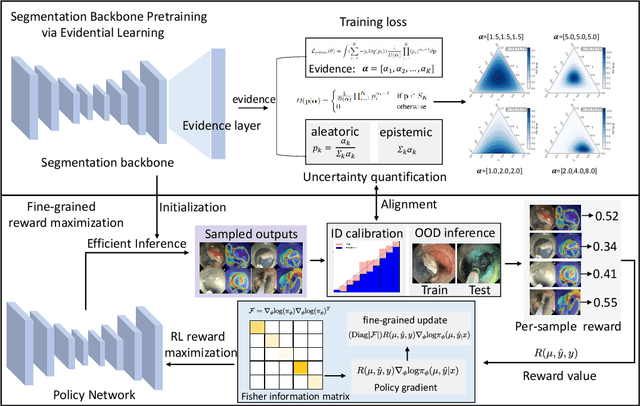
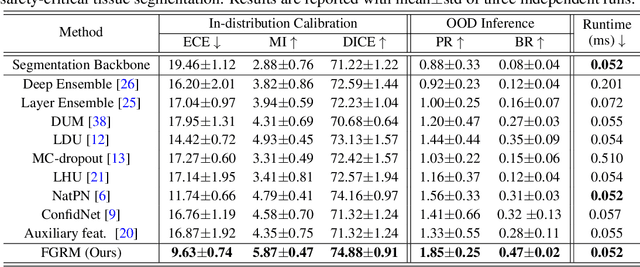
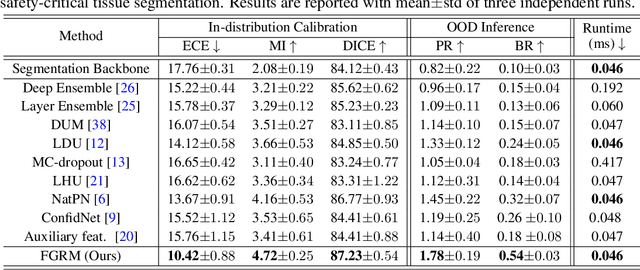
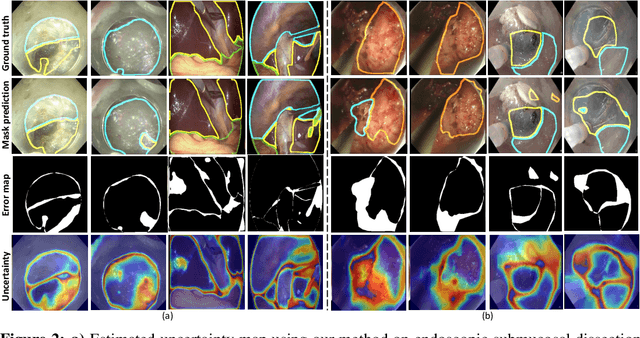
Uncertainty estimation plays an important role for future reliable deployment of deep segmentation models in safety-critical scenarios such as medical applications. However, existing methods for uncertainty estimation have been limited by the lack of explicit guidance for calibrating the prediction risk and model confidence. In this work, we propose a novel fine-grained reward maximization (FGRM) framework, to address uncertainty estimation by directly utilizing an uncertainty metric related reward function with a reinforcement learning based model tuning algorithm. This would benefit the model uncertainty estimation through direct optimization guidance for model calibration. Specifically, our method designs a new uncertainty estimation reward function using the calibration metric, which is maximized to fine-tune an evidential learning pre-trained segmentation model for calibrating prediction risk. Importantly, we innovate an effective fine-grained parameter update scheme, which imposes fine-grained reward-weighting of each network parameter according to the parameter importance quantified by the fisher information matrix. To the best of our knowledge, this is the first work exploring reward optimization for model uncertainty estimation in safety-critical vision tasks. The effectiveness of our method is demonstrated on two large safety-critical surgical scene segmentation datasets under two different uncertainty estimation settings. With real-time one forward pass at inference, our method outperforms state-of-the-art methods by a clear margin on all the calibration metrics of uncertainty estimation, while maintaining a high task accuracy for the segmentation results. Code is available at \url{https://github.com/med-air/FGRM}.