 Add to Chrome
 Add to Firefox
 Add to Edge
Entropy Is Not Enough: Unlocking Effective Reinforcement Learning for Visual Reasoning via Vision-Anchored Token Selection
Jun 03, 2026
While token-level entropy is commonly recognized as effective for credit assignment in text-only reinforcement learning with verifiable rewards (RLVR), it remains unclear whether this mechanism still holds in visual reasoning. Our controlled study shows that this mechanism collapses in visual reasoning due to the omission of vision-sensitive tokens with naturally low entropy. Although existing multimodal RL methods increasingly acknowledge the importance of visual perception, they struggle to satisfy the inherent demand for interleaving precise perceptual grounding with semantic reasoning, either lacking systematic visual measurements or overlooking that token entropy primarily drives semantic exploration. To address this, we introduce VEPO (Vision-Entropy token-selection for Policy Optimization), an effective RL framework explicitly integrating visual sensitivity with token entropy via a principled multiplicative coupling, where VEPO redirects gradient credit toward tokens which are simultaneously visually grounded and highly informative. Extensive experiments demonstrate VEPO's leading performance, significantly outperforming the entropy-only baseline by 2.28 points at 7B-scale and 3.15 points at 3B-scale. Ablations further substantiate the soundness of our method.

Mitigating Object Hallucinations in LVLMs via Attention Imbalance Rectification
Mar 25, 2026Object hallucination in Large Vision-Language Models (LVLMs) severely compromises their reliability in real-world applications, posing a critical barrier to their deployment in high-stakes scenarios such as autonomous driving and medical image analysis. Through systematic empirical investigation, we identify that the imbalanced attention allocation, both across modalities (i.e., vision and language) and within modalities (among individual tokens), exhibits a strong causal correlation with the occurrence of object hallucination. Leveraging this insight, we introduce a novel concept termed attention imbalance, which not only quantifies the degree of attention disparity but also visually delineates the underlying patterns (e.g., over-attentiveness to irrelevant language tokens or under-attentiveness to discriminative visual features) that drive object hallucination. To mitigate object hallucination, we further propose Attention Imbalance Rectification (AIR), a lightweight decoding-time intervention method that reallocates attention weights and adjusts attention distributions to rectify modality-wise and token-wise imbalances. Extensive evaluations on four mainstream LVLMs and three benchmarks (CHAIR, POPE, and MM-Vet) with seven baselines demonstrate that AIR consistently reduces object hallucination rates, achieving up to a 35.1% reduction compared to the baselines, while improving up to 15.9% of LVLMs' general capability across diverse vision-language tasks.
Neural Theorem Proving for Verification Conditions: A Real-World Benchmark
Jan 26, 2026Theorem proving is fundamental to program verification, where the automated proof of Verification Conditions (VCs) remains a primary bottleneck. Real-world program verification frequently encounters hard VCs that existing Automated Theorem Provers (ATPs) cannot prove, leading to a critical need for extensive manual proofs that burden practical application. While Neural Theorem Proving (NTP) has achieved significant success in mathematical competitions, demonstrating the potential of machine learning approaches to formal reasoning, its application to program verification--particularly VC proving--remains largely unexplored. Despite existing work on annotation synthesis and verification-related theorem proving, no benchmark has specifically targeted this fundamental bottleneck: automated VC proving. This work introduces Neural Theorem Proving for Verification Conditions (NTP4VC), presenting the first real-world multi-language benchmark for this task. From real-world projects such as Linux and Contiki-OS kernel, our benchmark leverages industrial pipelines (Why3 and Frama-C) to generate semantically equivalent test cases across formal languages of Isabelle, Lean, and Rocq. We evaluate large language models (LLMs), both general-purpose and those fine-tuned for theorem proving, on NTP4VC. Results indicate that although LLMs show promise in VC proving, significant challenges remain for program verification, highlighting a large gap and opportunity for future research.
Quantitative Verification of Omega-regular Properties in Probabilistic Programming
Dec 25, 2025Probabilistic programming provides a high-level framework for specifying statistical models as executable programs with built-in randomness and conditioning. Existing inference techniques, however, typically compute posterior distributions over program states at fixed time points, most often at termination, thereby failing to capture the temporal evolution of probabilistic behaviors. We introduce temporal posterior inference (TPI), a new framework that unifies probabilistic programming with temporal logic by computing posterior distributions over execution traces that satisfy omega-regular specifications, conditioned on possibly temporal observations. To obtain rigorous quantitative guarantees, we develop a new method for computing upper and lower bounds on the satisfaction probabilities of omega-regular properties. Our approach decomposes Rabin acceptance conditions into persistence and recurrence components and constructs stochastic barrier certificates that soundly bound each component. We implement our approach in a prototype tool, TPInfer, and evaluate it on a suite of benchmarks, demonstrating effective and efficient inference over rich temporal properties in probabilistic models.
DEVAL: A Framework for Evaluating and Improving the Derivation Capability of Large Language Models
Nov 18, 2025Assessing the reasoning ability of Large Language Models (LLMs) over data remains an open and pressing research question. Compared with LLMs, human reasoning can derive corresponding modifications to the output based on certain kinds of changes to the input. This reasoning pattern, which relies on abstract rules that govern relationships between changes of data, has not been comprehensively described or evaluated in LLMs. In this paper, we formally define this reasoning pattern as the Derivation Relation (DR) and introduce the concept of Derivation Capability (DC), i.e. applying DR by making the corresponding modification to the output whenever the input takes certain changes. To assess DC, a systematically constructed evaluation framework named DEVAL is proposed and used to evaluate five popular LLMs and one Large Reasoning Model in seven mainstream tasks. The evaluation results show that mainstream LLMs, such as GPT-4o and Claude3.5, exhibit moderate DR recognition capabilities but reveal significant drop-offs on applying DR effectively in problem-solving scenarios. To improve this, we propose a novel prompt engineering approach called Derivation Prompting (DP). It achieves an average improvement of 15.2% in DC for all tested LLMs, outperforming commonly used prompt engineering techniques.
Unifying Qualitative and Quantitative Safety Verification of DNN-Controlled Systems
Apr 02, 2024The rapid advance of deep reinforcement learning techniques enables the oversight of safety-critical systems through the utilization of Deep Neural Networks (DNNs). This underscores the pressing need to promptly establish certified safety guarantees for such DNN-controlled systems. Most of the existing verification approaches rely on qualitative approaches, predominantly employing reachability analysis. However, qualitative verification proves inadequate for DNN-controlled systems as their behaviors exhibit stochastic tendencies when operating in open and adversarial environments. In this paper, we propose a novel framework for unifying both qualitative and quantitative safety verification problems of DNN-controlled systems. This is achieved by formulating the verification tasks as the synthesis of valid neural barrier certificates (NBCs). Initially, the framework seeks to establish almost-sure safety guarantees through qualitative verification. In cases where qualitative verification fails, our quantitative verification method is invoked, yielding precise lower and upper bounds on probabilistic safety across both infinite and finite time horizons. To facilitate the synthesis of NBCs, we introduce their $k$-inductive variants. We also devise a simulation-guided approach for training NBCs, aiming to achieve tightness in computing precise certified lower and upper bounds. We prototype our approach into a tool called $\textsf{UniQQ}$ and showcase its efficacy on four classic DNN-controlled systems.
Robustness Verification of Deep Reinforcement Learning Based Control Systems using Reward Martingales
Dec 15, 2023Deep Reinforcement Learning (DRL) has gained prominence as an effective approach for control systems. However, its practical deployment is impeded by state perturbations that can severely impact system performance. Addressing this critical challenge requires robustness verification about system performance, which involves tackling two quantitative questions: (i) how to establish guaranteed bounds for expected cumulative rewards, and (ii) how to determine tail bounds for cumulative rewards. In this work, we present the first approach for robustness verification of DRL-based control systems by introducing reward martingales, which offer a rigorous mathematical foundation to characterize the impact of state perturbations on system performance in terms of cumulative rewards. Our verified results provide provably quantitative certificates for the two questions. We then show that reward martingales can be implemented and trained via neural networks, against different types of control policies. Experimental results demonstrate that our certified bounds tightly enclose simulation outcomes on various DRL-based control systems, indicating the effectiveness and generality of the proposed approach.
BBReach: Tight and Scalable Black-Box Reachability Analysis of Deep Reinforcement Learning Systems
Nov 21, 2022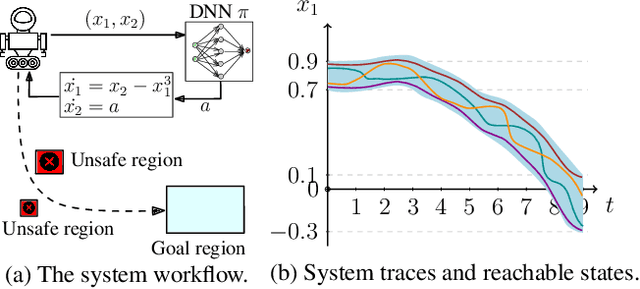
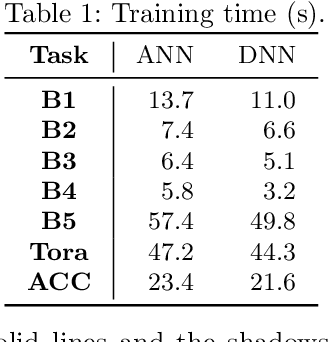
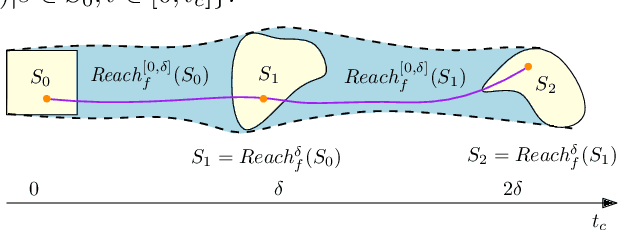
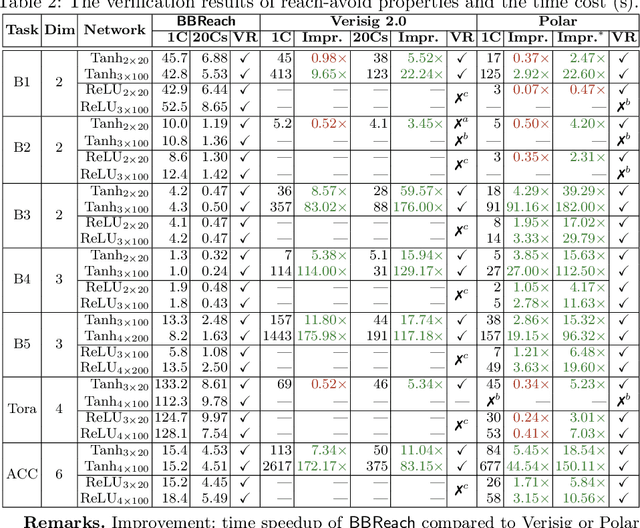
Reachability analysis is a promising technique to automatically prove or disprove the reliability and safety of AI-empowered software systems that are developed by using Deep Reinforcement Learning (DRL). Existing approaches suffer however from limited scalability and large overestimation as they must over-approximate the complex and almost inexplicable system components, namely deep neural networks (DNNs). In this paper we propose a novel, tight and scalable reachability analysis approach for DRL systems. By training on abstract states, our approach treats the embedded DNNs as black boxes to avoid the over-approximation for neural networks in computing reachable sets. To tackle the state explosion problem inherent to abstraction-based approaches, we devise a novel adjacent interval aggregation algorithm which balances the growth of abstract states and the overestimation caused by the abstraction. We implement a tool, called BBReach, and assess it on an extensive benchmark of control systems to demonstrate its tightness, scalability, and efficiency.