 Add to Chrome
 Add to Firefox
 Add to Edge
VisEditBench: Can Vision-Language Models Edit Visualization Code from Multimodal Feedback?
Aug 11, 2026
Vision-language models (VLMs) have shown strong capabilities in generating visualization code from textual or visual specifications. However, real-world visualization authoring is inherently iterative: users frequently revise existing visualizations to repair flawed charts or adapt them to desired styles. Existing benchmarks primarily evaluate generation from scratch, leaving visualization code editing from multimodal feedback largely unexplored. We introduce VisEditBench, a benchmark of 1,395 human-annotated visualization code-editing tasks grounded in realistic visualization workflows and failure cases. VisEditBench covers two practical settings: feedback-guided repair, where models revise visualization code using buggy or marked charts together with textual feedback, and reference-guided restyling, where models modify code to match a target chart image. Evaluating 20 state-of-the-art VLMs reveals that visualization code editing remains challenging: Claude-4.6-Sonnet achieves the best overall pass rate of 74.46%, while most open-source models remain below 50%. Performance is particularly weak on visually grounded style adaptation, where Claude-4.6-Sonnet achieves only 55.71%. To establish a strong baseline, we further propose VisEditAgent, a render-grounded editing framework that iteratively generates, executes, validates, and refines candidate edits. Built on GPT-4o, VisEditAgent improves overall pass rate from 55.75% to 67.99%, demonstrating the importance of render-grounded feedback for faithful visualization editing. We will release VisEditBench at https://github.com/vis-nlp/VisEditBench.

DSAgentBench: Can Agents Automate End-to-End Data-Science Workflows in Real Computer Environments?
Aug 11, 2026Real-world data science involves long-horizon workflows that span data wrangling, exploration, modeling, visualization, and validation, and require coordinated use of tools such as notebooks, IDEs, terminals, browsers, and databases within real operating environments. Yet existing benchmarks lack real-computer interaction and do not evaluate whether agents can execute complete end-to-end data-science workflows in realistic computing environments, failing to capture the multi-stage, multi-tool nature of data-science practice. We introduce DSAgentBench, the first benchmark to evaluate whether agents can automate full data-science workflows inside real computer environments. DSAgentBench contains 275 diverse tasks covering the entire data-science life-cycle, reflecting the complexity and tool coordination required in practice. Each task requires grounding decisions in intermediate outputs and coordinated tool use, and includes a deterministic evaluator that verifies analytical correctness, visual outputs, and model performance rather than code-only execution. Our extensive experiments with 15 closed- and open-source models show that even the strongest agent, Claude-4.6-Sonnet, achieves only 56.70% task success, while all open-source agents remain below 1%, frequently failing at tool orchestration, OS grounding, and multi-step reasoning. These results reveal a substantial capability gap between current agentic systems and real data-science workflows, positioning DSAgentBench as a foundation for developing grounded, verifiable, autonomous data-science agents. We release DSAgentBench at https://github.com/vis-nlp/DSAgentBench.
Beyond Text-to-SQL: An Agentic LLM System for Governed Enterprise Analytics APIs
May 20, 2026Enterprise analytics aims to make organizational data accessible for decision-making, yet non-technical users still face barriers when using traditional business intelligence tools or Text-to-SQL systems. While recent Text-to-SQL approaches based on Large Language Models (LLMs) promise natural language access to structured data, they fall short in enterprise settings where analytics pipelines rely on governed APIs rather than raw databases. In practice, these APIs encapsulate complex business logic to ensure consistency, auditability, and security. However, delegating mathematical or aggregation logic to an LLM introduces reliability and compliance risks. To this end, we present Analytic Agent, an LLM-based agentic system that translates natural language intents into secure interactions with enterprise analytics APIs. Evaluated on 90 real enterprise use cases constructed by domain experts, it reliably interprets user goals, validates permissions, executes governed queries, and generates compliant visualizations through multi-step reasoning and policy-aware orchestration.
From Text to Voice: A Reproducible and Verifiable Framework for Evaluating Tool Calling LLM Agents
May 14, 2026Voice agents increasingly require reliable tool use from speech, whereas prominent tool-calling benchmarks remain text-based. We study whether verified text benchmarks can be converted into controlled audio-based tool calling evaluations without re-annotating the tool schema and gold labels. Our dataset-agnostic framework uses text-to-speech, speaker variation, and environmental noise to create paired text-audio instances while preserving the original dataset annotations. Based on extensive evaluation of 7 omni-modal models on audio-converted versions of Confetti and When2Call, our framework demonstrates that the performance is strongly model- and task-dependent: Gemini-3.1-Flash-Live obtains the highest Confetti score (70.4), whereas GPT-Realtime-1.5 performs best on When2Call (71.9). On Confetti, the text-to-voice gap ranges from 1.8 points for Qwen3-Omni to 4.8 points for GPT-Realtime-1.5. A targeted analysis of failure cases demonstrates that degradations most often reflect misunderstandings of argument values in the speech. Considering real-world deployment scenarios, we further report text-only results, an ambiguity-based reformulation stress test, and a reference-free LLM-as-judge protocol validated against human preferences. Notably, we find that open-source Qwen3 judges with at least 8B parameters exceed 80% agreement with proprietary judges, supporting privacy-preserving evaluation. Overall, our framework provides a verifiable and reproducible first-stage diagnostic that complements purpose-built audio corpora.
Lost in Translation: Do LVLM Judges Generalize Across Languages?
Apr 21, 2026Automatic evaluators such as reward models play a central role in the alignment and evaluation of large vision-language models (LVLMs). Despite their growing importance, these evaluators are almost exclusively assessed on English-centric benchmarks, leaving open the question of how well these evaluators generalize across languages. To answer this question, we introduce MM-JudgeBench, the first large-scale benchmark for multilingual and multimodal judge model evaluation, which includes over 60K pairwise preference instances spanning 25 typologically diverse languages. MM-JudgeBench integrates two complementary subsets: a general vision-language preference evaluation subset extending VL-RewardBench, and a chart-centric visual-text reasoning subset derived from OpenCQA, enabling systematic analysis of reward models (i.e., LVLM judges) across diverse settings. We additionally release a multilingual training set derived from MM-RewardBench, disjoint from our evaluation data, to support domain adaptation. By evaluating 22 LVLMs (15 open-source, 7 proprietary), we uncover substantial cross-lingual performance variance in our proposed benchmark. Our analysis further shows that model size and architecture are poor predictors of multilingual robustness, and that even state-of-the-art LVLM judges exhibit inconsistent behavior across languages. Together, these findings expose fundamental limitations of current reward modeling and underscore the necessity of multilingual, multimodal benchmarks for developing reliable automated evaluators.
Assessing the Quality of Mental Health Support in LLM Responses through Multi-Attribute Human Evaluation
Jan 26, 2026The escalating global mental health crisis, marked by persistent treatment gaps, availability, and a shortage of qualified therapists, positions Large Language Models (LLMs) as a promising avenue for scalable support. While LLMs offer potential for accessible emotional assistance, their reliability, therapeutic relevance, and alignment with human standards remain challenging to address. This paper introduces a human-grounded evaluation methodology designed to assess LLM generated responses in therapeutic dialogue. Our approach involved curating a dataset of 500 mental health conversations from datasets with real-world scenario questions and evaluating the responses generated by nine diverse LLMs, including closed source and open source models. More specifically, these responses were evaluated by two psychiatric trained experts, who independently rated each on a 5 point Likert scale across a comprehensive 6 attribute rubric. This rubric captures Cognitive Support and Affective Resonance, providing a multidimensional perspective on therapeutic quality. Our analysis reveals that LLMs provide strong cognitive reliability by producing safe, coherent, and clinically appropriate information, but they demonstrate unstable affective alignment. Although closed source models (e.g., GPT-4o) offer balanced therapeutic responses, open source models show greater variability and emotional flatness. We reveal a persistent cognitive-affective gap and highlight the need for failure aware, clinically grounded evaluation frameworks that prioritize relational sensitivity alongside informational accuracy in mental health oriented LLMs. We advocate for balanced evaluation protocols with human in the loop that center on therapeutic sensitivity and provide a framework to guide the responsible design and clinical oversight of mental health oriented conversational AI.
Stop Taking Tokenizers for Granted: They Are Core Design Decisions in Large Language Models
Jan 19, 2026Tokenization underlies every large language model, yet it remains an under-theorized and inconsistently designed component. Common subword approaches such as Byte Pair Encoding (BPE) offer scalability but often misalign with linguistic structure, amplify bias, and waste capacity across languages and domains. This paper reframes tokenization as a core modeling decision rather than a preprocessing step. We argue for a context-aware framework that integrates tokenizer and model co-design, guided by linguistic, domain, and deployment considerations. Standardized evaluation and transparent reporting are essential to make tokenization choices accountable and comparable. Treating tokenization as a core design problem, not a technical afterthought, can yield language technologies that are fairer, more efficient, and more adaptable.
Aligning Text, Code, and Vision: A Multi-Objective Reinforcement Learning Framework for Text-to-Visualization
Jan 08, 2026Text-to-Visualization (Text2Vis) systems translate natural language queries over tabular data into concise answers and executable visualizations. While closed-source LLMs generate functional code, the resulting charts often lack semantic alignment and clarity, qualities that can only be assessed post-execution. Open-source models struggle even more, frequently producing non-executable or visually poor outputs. Although supervised fine-tuning can improve code executability, it fails to enhance overall visualization quality, as traditional SFT loss cannot capture post-execution feedback. To address this gap, we propose RL-Text2Vis, the first reinforcement learning framework for Text2Vis generation. Built on Group Relative Policy Optimization (GRPO), our method uses a novel multi-objective reward that jointly optimizes textual accuracy, code validity, and visualization quality using post-execution feedback. By training Qwen2.5 models (7B and 14B), RL-Text2Vis achieves a 22% relative improvement in chart quality over GPT-4o on the Text2Vis benchmark and boosts code execution success from 78% to 97% relative to its zero-shot baseline. Our models significantly outperform strong zero-shot and supervised baselines and also demonstrate robust generalization to out-of-domain datasets like VIS-Eval and NVBench. These results establish GRPO as an effective strategy for structured, multimodal reasoning in visualization generation. We release our code at https://github.com/vis-nlp/RL-Text2Vis.
When Can We Trust LLMs in Mental Health? Large-Scale Benchmarks for Reliable LLM Evaluation
Oct 21, 2025Evaluating Large Language Models (LLMs) for mental health support is challenging due to the emotionally and cognitively complex nature of therapeutic dialogue. Existing benchmarks are limited in scale, reliability, often relying on synthetic or social media data, and lack frameworks to assess when automated judges can be trusted. To address the need for large-scale dialogue datasets and judge reliability assessment, we introduce two benchmarks that provide a framework for generation and evaluation. MentalBench-100k consolidates 10,000 one-turn conversations from three real scenarios datasets, each paired with nine LLM-generated responses, yielding 100,000 response pairs. MentalAlign-70k}reframes evaluation by comparing four high-performing LLM judges with human experts across 70,000 ratings on seven attributes, grouped into Cognitive Support Score (CSS) and Affective Resonance Score (ARS). We then employ the Affective Cognitive Agreement Framework, a statistical methodology using intraclass correlation coefficients (ICC) with confidence intervals to quantify agreement, consistency, and bias between LLM judges and human experts. Our analysis reveals systematic inflation by LLM judges, strong reliability for cognitive attributes such as guidance and informativeness, reduced precision for empathy, and some unreliability in safety and relevance. Our contributions establish new methodological and empirical foundations for reliable, large-scale evaluation of LLMs in mental health. We release the benchmarks and codes at: https://github.com/abeerbadawi/MentalBench/
Evolution of ReID: From Early Methods to LLM Integration
Jun 16, 2025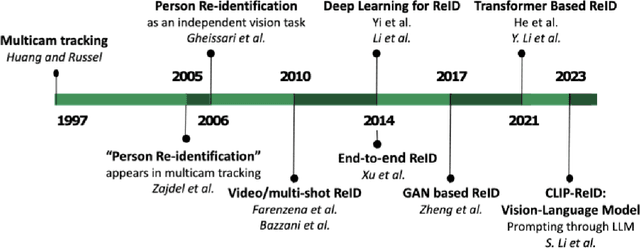
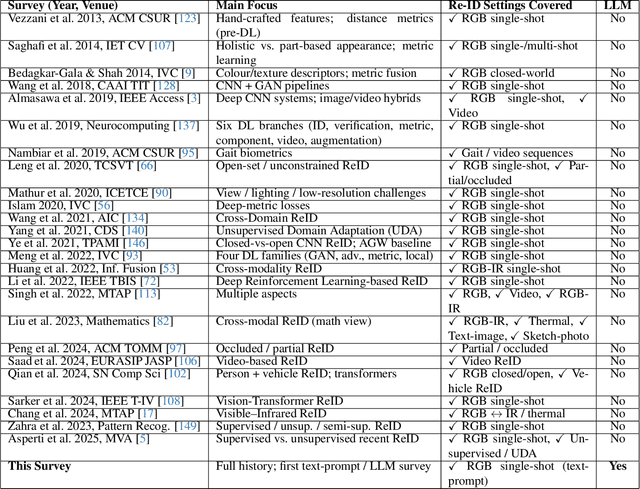
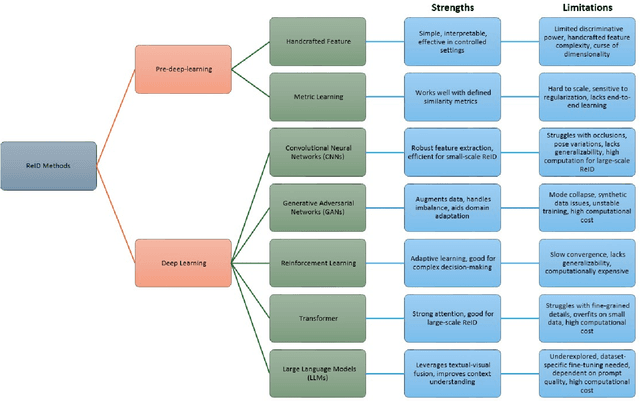
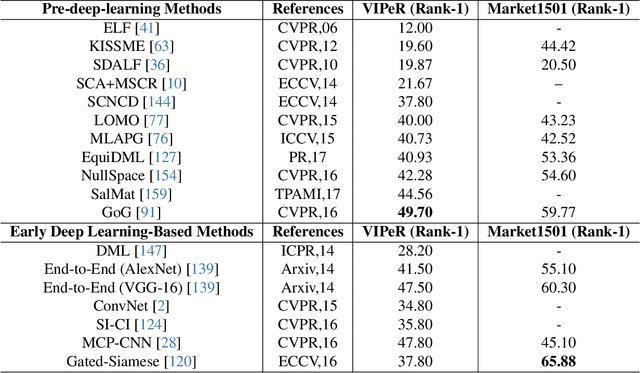
Person re-identification (ReID) has evolved from handcrafted feature-based methods to deep learning approaches and, more recently, to models incorporating large language models (LLMs). Early methods struggled with variations in lighting, pose, and viewpoint, but deep learning addressed these issues by learning robust visual features. Building on this, LLMs now enable ReID systems to integrate semantic and contextual information through natural language. This survey traces that full evolution and offers one of the first comprehensive reviews of ReID approaches that leverage LLMs, where textual descriptions are used as privileged information to improve visual matching. A key contribution is the use of dynamic, identity-specific prompts generated by GPT-4o, which enhance the alignment between images and text in vision-language ReID systems. Experimental results show that these descriptions improve accuracy, especially in complex or ambiguous cases. To support further research, we release a large set of GPT-4o-generated descriptions for standard ReID datasets. By bridging computer vision and natural language processing, this survey offers a unified perspective on the field's development and outlines key future directions such as better prompt design, cross-modal transfer learning, and real-world adaptability.