 Add to Chrome
 Add to Firefox
 Add to Edge
Advancing Video Self-Supervised Learning via Image Foundation Models
May 25, 2025
In the past decade, image foundation models (IFMs) have achieved unprecedented progress. However, the potential of directly using IFMs for video self-supervised representation learning has largely been overlooked. In this study, we propose an advancing video self-supervised learning (AdViSe) approach, aimed at significantly reducing the training overhead of video representation models using pre-trained IFMs. Specifically, we first introduce temporal modeling modules (ResNet3D) to IFMs, constructing a video representation model. We then employ a video self-supervised learning approach, playback rate perception, to train temporal modules while freezing the IFM components. Experiments on UCF101 demonstrate that AdViSe achieves performance comparable to state-of-the-art methods while reducing training time by $3.4\times$ and GPU memory usage by $8.2\times$. This study offers fresh insights into low-cost video self-supervised learning based on pre-trained IFMs. Code is available at https://github.com/JingwWu/advise-video-ssl.

SwarmDiff: Swarm Robotic Trajectory Planning in Cluttered Environments via Diffusion Transformer
May 21, 2025Swarm robotic trajectory planning faces challenges in computational efficiency, scalability, and safety, particularly in complex, obstacle-dense environments. To address these issues, we propose SwarmDiff, a hierarchical and scalable generative framework for swarm robots. We model the swarm's macroscopic state using Probability Density Functions (PDFs) and leverage conditional diffusion models to generate risk-aware macroscopic trajectory distributions, which then guide the generation of individual robot trajectories at the microscopic level. To ensure a balance between the swarm's optimal transportation and risk awareness, we integrate Wasserstein metrics and Conditional Value at Risk (CVaR). Additionally, we introduce a Diffusion Transformer (DiT) to improve sampling efficiency and generation quality by capturing long-range dependencies. Extensive simulations and real-world experiments demonstrate that SwarmDiff outperforms existing methods in computational efficiency, trajectory validity, and scalability, making it a reliable solution for swarm robotic trajectory planning.
Detection of Underwater Multi-Targets Based on Self-Supervised Learning and Deformable Path Aggregation Feature Pyramid Network
May 21, 2025To overcome the constraints of the underwater environment and improve the accuracy and robustness of underwater target detection models, this paper develops a specialized dataset for underwater target detection and proposes an efficient algorithm for underwater multi-target detection. A self-supervised learning based on the SimSiam structure is employed for the pre-training of underwater target detection network. To address the problems of low detection accuracy caused by low contrast, mutual occlusion and dense distribution of underwater targets in underwater object detection, a detection model suitable for underwater target detection is proposed by introducing deformable convolution and dilated convolution. The proposed detection model can obtain more effective information by increasing the receptive field. In addition, the regression loss function EIoU is introduced, which improves model performance by separately calculating the width and height losses of the predicted box. Experiment results show that the accuracy of the underwater target detection has been improved by the proposed detector.
Convolutional Long Short-Term Memory Neural Networks Based Numerical Simulation of Flow Field
May 21, 2025Computational Fluid Dynamics (CFD) is the main approach to analyzing flow field. However, the convergence and accuracy depend largely on mathematical models of flow, numerical methods, and time consumption. Deep learning-based analysis of flow filed provides an alternative. For the task of flow field prediction, an improved Convolutional Long Short-Term Memory (Con-vLSTM) Neural Network is proposed as the baseline network in consideration of the temporal and spatial characteristics of flow field. Combining dynamic mesh technology and User-Defined Function (UDF), numerical simulations of flow around a circular cylinder were conducted. Flow field snapshots were used to sample data from the cylinder's wake region at different time instants, constructing a flow field dataset with sufficient volume and rich flow state var-iations. Residual networks and attention mechanisms are combined with the standard ConvLSTM model. Compared with the standard ConvLSTM model, the results demonstrate that the improved ConvLSTM model can extract more temporal and spatial features while having fewer parameters and shorter train-ing time.
MRGRP: Empowering Courier Route Prediction in Food Delivery Service with Multi-Relational Graph
May 17, 2025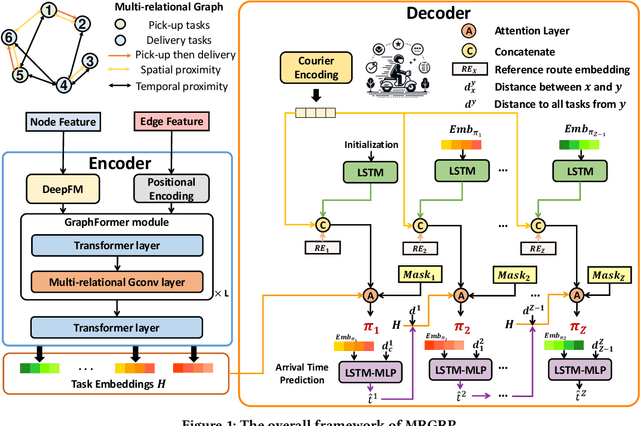
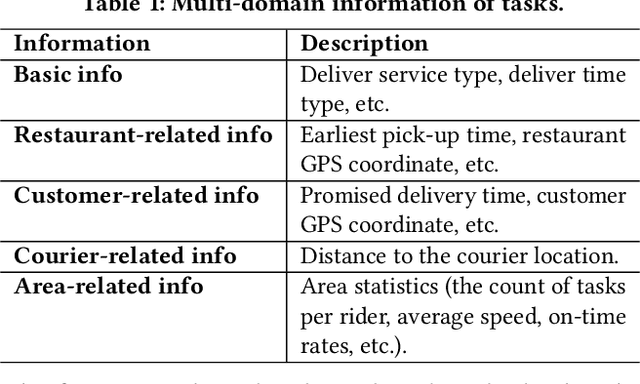
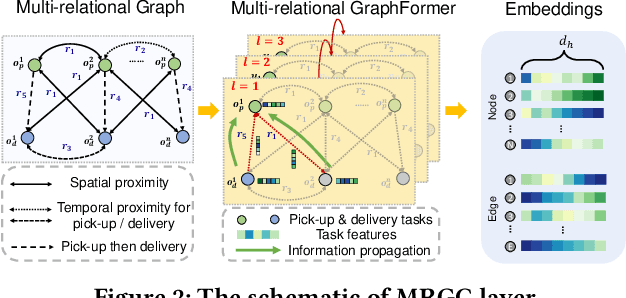
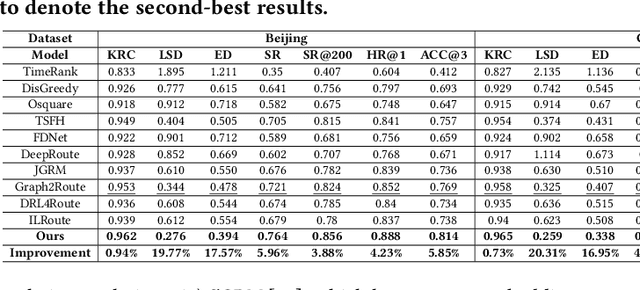
Instant food delivery has become one of the most popular web services worldwide due to its convenience in daily life. A fundamental challenge is accurately predicting courier routes to optimize task dispatch and improve delivery efficiency. This enhances satisfaction for couriers and users and increases platform profitability. The current heuristic prediction method uses only limited human-selected task features and ignores couriers preferences, causing suboptimal results. Additionally, existing learning-based methods do not fully capture the diverse factors influencing courier decisions or the complex relationships among them. To address this, we propose a Multi-Relational Graph-based Route Prediction (MRGRP) method that models fine-grained correlations among tasks affecting courier decisions for accurate prediction. We encode spatial and temporal proximity, along with pickup-delivery relationships, into a multi-relational graph and design a GraphFormer architecture to capture these complex connections. We also introduce a route decoder that leverages courier information and dynamic distance and time contexts for prediction, using existing route solutions as references to improve outcomes. Experiments show our model achieves state-of-the-art route prediction on offline data from cities of various sizes. Deployed on the Meituan Turing platform, it surpasses the current heuristic algorithm, reaching a high route prediction accuracy of 0.819, essential for courier and user satisfaction in instant food delivery.
iSegMan: Interactive Segment-and-Manipulate 3D Gaussians
May 17, 2025The efficient rendering and explicit nature of 3DGS promote the advancement of 3D scene manipulation. However, existing methods typically encounter challenges in controlling the manipulation region and are unable to furnish the user with interactive feedback, which inevitably leads to unexpected results. Intuitively, incorporating interactive 3D segmentation tools can compensate for this deficiency. Nevertheless, existing segmentation frameworks impose a pre-processing step of scene-specific parameter training, which limits the efficiency and flexibility of scene manipulation. To deliver a 3D region control module that is well-suited for scene manipulation with reliable efficiency, we propose interactive Segment-and-Manipulate 3D Gaussians (iSegMan), an interactive segmentation and manipulation framework that only requires simple 2D user interactions in any view. To propagate user interactions to other views, we propose Epipolar-guided Interaction Propagation (EIP), which innovatively exploits epipolar constraint for efficient and robust interaction matching. To avoid scene-specific training to maintain efficiency, we further propose the novel Visibility-based Gaussian Voting (VGV), which obtains 2D segmentations from SAM and models the region extraction as a voting game between 2D Pixels and 3D Gaussians based on Gaussian visibility. Taking advantage of the efficient and precise region control of EIP and VGV, we put forth a Manipulation Toolbox to implement various functions on selected regions, enhancing the controllability, flexibility and practicality of scene manipulation. Extensive results on 3D scene manipulation and segmentation tasks fully demonstrate the significant advantages of iSegMan. Project page is available at https://zhao-yian.github.io/iSegMan.
Aquarius: A Family of Industry-Level Video Generation Models for Marketing Scenarios
May 14, 2025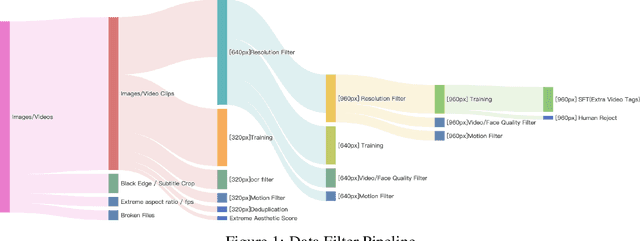
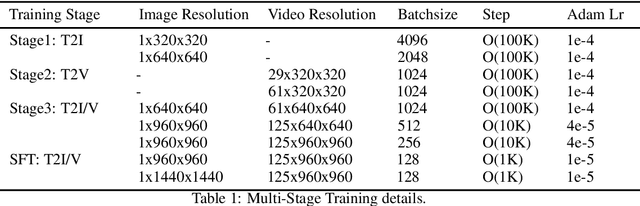
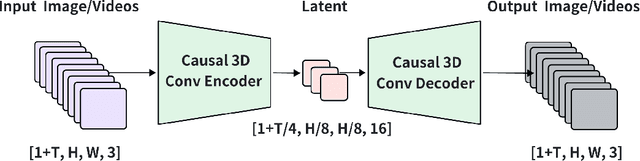
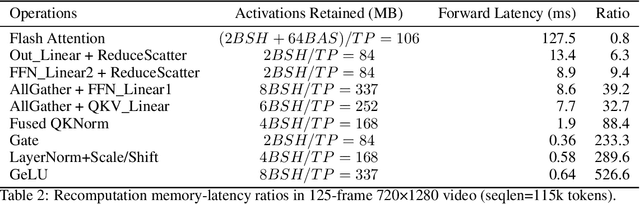
This report introduces Aquarius, a family of industry-level video generation models for marketing scenarios designed for thousands-xPU clusters and models with hundreds of billions of parameters. Leveraging efficient engineering architecture and algorithmic innovation, Aquarius demonstrates exceptional performance in high-fidelity, multi-aspect-ratio, and long-duration video synthesis. By disclosing the framework's design details, we aim to demystify industrial-scale video generation systems and catalyze advancements in the generative video community. The Aquarius framework consists of five components: Distributed Graph and Video Data Processing Pipeline: Manages tens of thousands of CPUs and thousands of xPUs via automated task distribution, enabling efficient video data processing. Additionally, we are about to open-source the entire data processing framework named "Aquarius-Datapipe". Model Architectures for Different Scales: Include a Single-DiT architecture for 2B models and a Multimodal-DiT architecture for 13.4B models, supporting multi-aspect ratios, multi-resolution, and multi-duration video generation. High-Performance infrastructure designed for video generation model training: Incorporating hybrid parallelism and fine-grained memory optimization strategies, this infrastructure achieves 36% MFU at large scale. Multi-xPU Parallel Inference Acceleration: Utilizes diffusion cache and attention optimization to achieve a 2.35x inference speedup. Multiple marketing-scenarios applications: Including image-to-video, text-to-video (avatar), video inpainting and video personalization, among others. More downstream applications and multi-dimensional evaluation metrics will be added in the upcoming version updates.
Fusing Bidirectional Chains of Thought and Reward Mechanisms A Method for Enhancing Question-Answering Capabilities of Large Language Models for Chinese Intangible Cultural Heritage
May 14, 2025The rapid development of large language models (LLMs) has provided significant support and opportunities for the advancement of domain-specific LLMs. However, fine-tuning these large models using Intangible Cultural Heritage (ICH) data inevitably faces challenges such as bias, incorrect knowledge inheritance, and catastrophic forgetting. To address these issues, we propose a novel training method that integrates a bidirectional chains of thought and a reward mechanism. This method is built upon ICH-Qwen, a large language model specifically designed for the field of intangible cultural heritage. The proposed method enables the model to not only perform forward reasoning but also enhances the accuracy of the generated answers by utilizing reverse questioning and reverse reasoning to activate the model's latent knowledge. Additionally, a reward mechanism is introduced during training to optimize the decision-making process. This mechanism improves the quality of the model's outputs through structural and content evaluations with different weighting schemes. We conduct comparative experiments on ICH-Qwen, with results demonstrating that our method outperforms 0-shot, step-by-step reasoning, knowledge distillation, and question augmentation methods in terms of accuracy, Bleu-4, and Rouge-L scores on the question-answering task. Furthermore, the paper highlights the effectiveness of combining the bidirectional chains of thought and reward mechanism through ablation experiments. In addition, a series of generalizability experiments are conducted, with results showing that the proposed method yields improvements on various domain-specific datasets and advanced models in areas such as Finance, Wikidata, and StrategyQA. This demonstrates that the method is adaptable to multiple domains and provides a valuable approach for model training in future applications across diverse fields.
Explainable AI for Correct Root Cause Analysis of Product Quality in Injection Moulding
Apr 29, 2025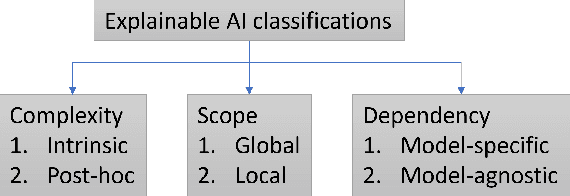
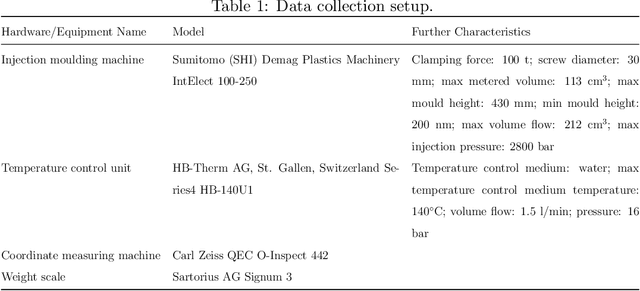

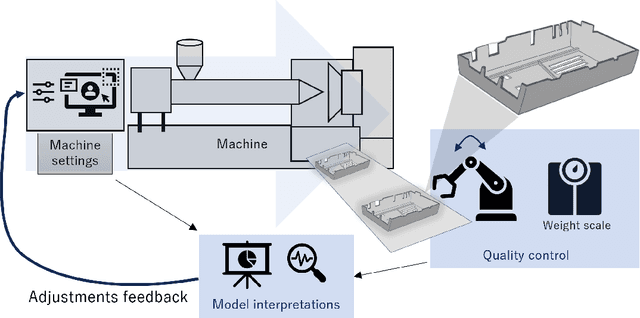
If a product deviates from its desired properties in the injection moulding process, its root cause analysis can be aided by models that relate the input machine settings with the output quality characteristics. The machine learning models tested in the quality prediction are mostly black boxes; therefore, no direct explanation of their prognosis is given, which restricts their applicability in the quality control. The previously attempted explainability methods are either restricted to tree-based algorithms only or do not emphasize on the fact that some explainability methods can lead to wrong root cause identification of a product's deviation from its desired properties. This study first shows that the interactions among the multiple input machine settings do exist in real experimental data collected as per a central composite design. Then, the model-agnostic explainable AI methods are compared for the first time to show that different explainability methods indeed lead to different feature impact analysis in injection moulding. Moreover, it is shown that the better feature attribution translates to the correct cause identification and actionable insights for the injection moulding process. Being model agnostic, explanations on both random forest and multilayer perceptron are performed for the cause analysis, as both models have the mean absolute percentage error of less than 0.05% on the experimental dataset.
NANO-SLAM : Natural Gradient Gaussian Approximation for Vehicle SLAM
Apr 27, 2025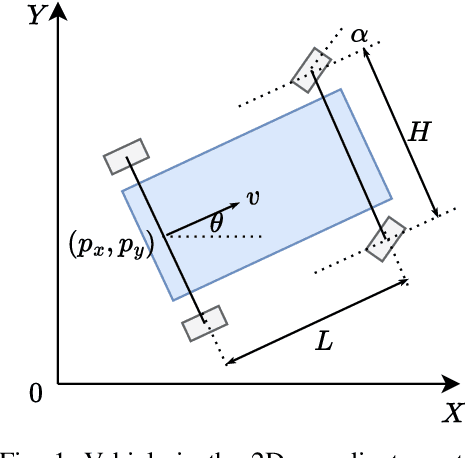
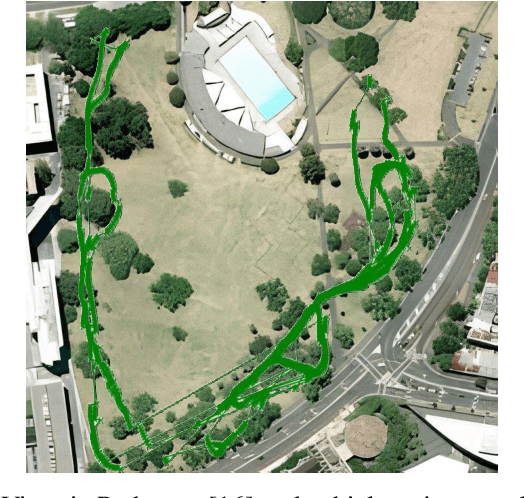
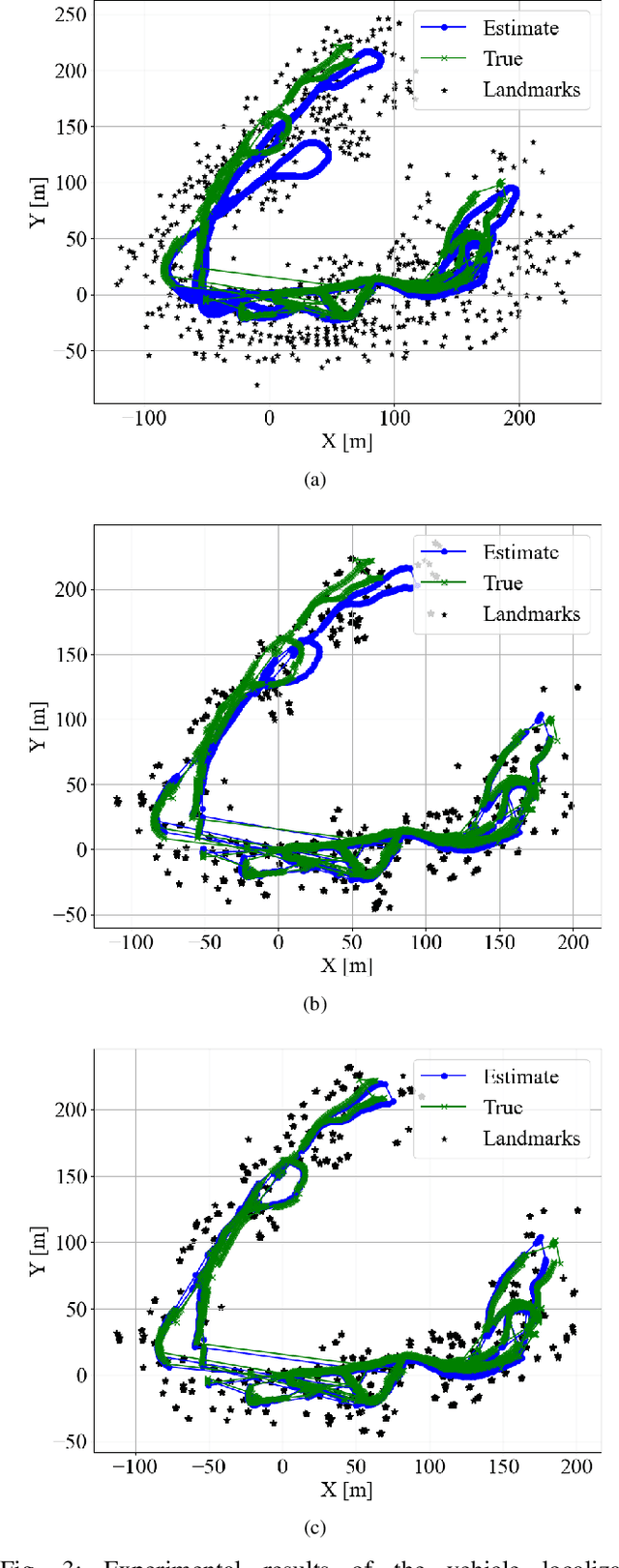
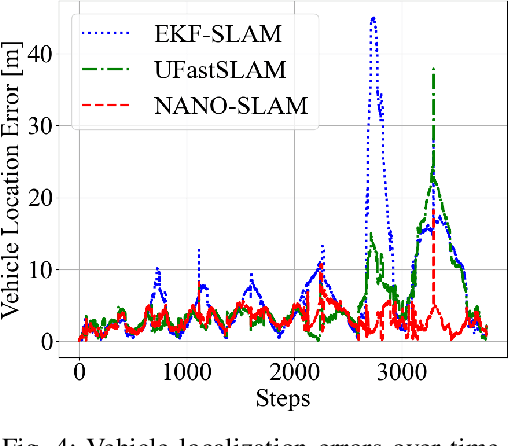
Accurate localization is a challenging task for autonomous vehicles, particularly in GPS-denied environments such as urban canyons and tunnels. In these scenarios, simultaneous localization and mapping (SLAM) offers a more robust alternative to GPS-based positioning, enabling vehicles to determine their position using onboard sensors and surrounding environment's landmarks. Among various vehicle SLAM approaches, Rao-Blackwellized particle filter (RBPF) stands out as one of the most widely adopted methods due to its efficient solution with logarithmic complexity relative to the map size. RBPF approximates the posterior distribution of the vehicle pose using a set of Monte Carlo particles through two main steps: sampling and importance weighting. The key to effective sampling lies in solving a distribution that closely approximates the posterior, known as the sampling distribution, to accelerate convergence. Existing methods typically derive this distribution via linearization, which introduces significant approximation errors due to the inherent nonlinearity of the system. To address this limitation, we propose a novel vehicle SLAM method called \textit{N}atural Gr\textit{a}dient Gaussia\textit{n} Appr\textit{o}ximation (NANO)-SLAM, which avoids linearization errors by modeling the sampling distribution as the solution to an optimization problem over Gaussian parameters and solving it using natural gradient descent. This approach improves the accuracy of the sampling distribution and consequently enhances localization performance. Experimental results on the long-distance Sydney Victoria Park vehicle SLAM dataset show that NANO-SLAM achieves over 50\% improvement in localization accuracy compared to the most widely used vehicle SLAM algorithms, with minimal additional computational cost.