 Add to Chrome
 Add to Firefox
 Add to Edge
EvasionBench: Detecting Evasive Answers in Financial Q&A via Multi-Model Consensus and LLM-as-Judge
Jan 14, 2026
Detecting evasive answers in earnings calls is critical for financial transparency, yet progress is hindered by the lack of large-scale benchmarks. We introduce EvasionBench, comprising 30,000 training samples and 1,000 human-annotated test samples (Cohen's Kappa 0.835) across three evasion levels. Our key contribution is a multi-model annotation framework leveraging a core insight: disagreement between frontier LLMs signals hard examples most valuable for training. We mine boundary cases where two strong annotators conflict, using a judge to resolve labels. This approach outperforms single-model distillation by 2.4 percent, with judge-resolved samples improving generalization despite higher training loss (0.421 vs 0.393) - evidence that disagreement mining acts as implicit regularization. Our trained model Eva-4B (4B parameters) achieves 81.3 percent accuracy, outperforming its base by 25 percentage points and approaching frontier LLM performance at a fraction of inference cost.

DramaBench: A Six-Dimensional Evaluation Framework for Drama Script Continuation
Dec 23, 2025Drama script continuation requires models to maintain character consistency, advance plot coherently, and preserve dramatic structurecapabilities that existing benchmarks fail to evaluate comprehensively. We present DramaBench, the first large-scale benchmark for evaluating drama script continuation across six independent dimensions: Format Standards, Narrative Efficiency, Character Consistency, Emotional Depth, Logic Consistency, and Conflict Handling. Our framework combines rulebased analysis with LLM-based labeling and statistical metrics, ensuring objective and reproducible evaluation. We conduct comprehensive evaluation of 8 state-of-the-art language models on 1,103 scripts (8,824 evaluations total), with rigorous statistical significance testing (252 pairwise comparisons, 65.9% significant) and human validation (188 scripts, substantial agreement on 3/5 dimensions). Our ablation studies confirm all six dimensions capture independent quality aspects (mean | r | = 0.020). DramaBench provides actionable, dimensionspecific feedback for model improvement and establishes a rigorous standard for creative writing evaluation.
Follow Everything: A Leader-Following and Obstacle Avoidance Framework with Goal-Aware Adaptation
May 01, 2025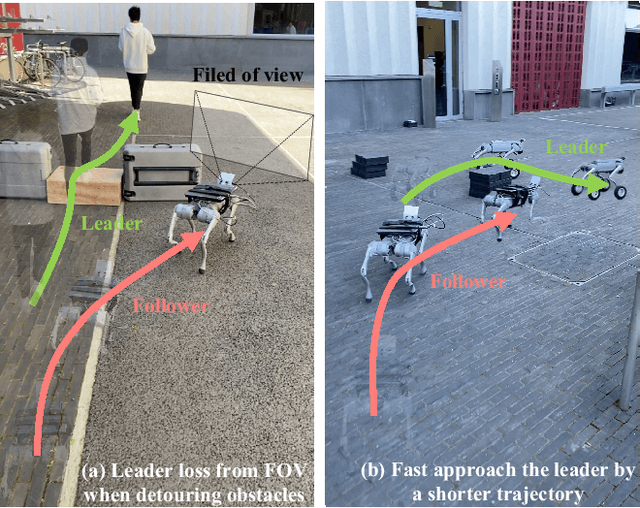
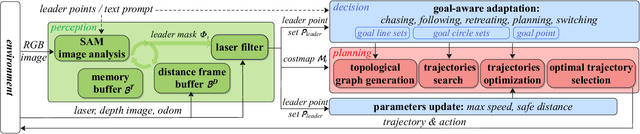
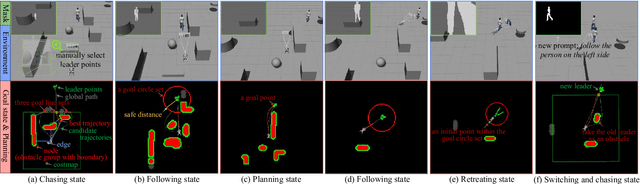
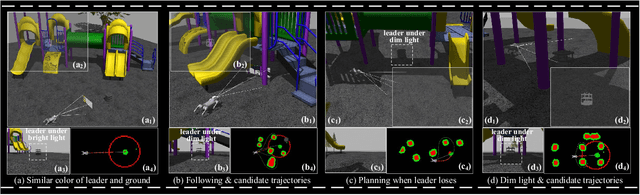
Robust and flexible leader-following is a critical capability for robots to integrate into human society. While existing methods struggle to generalize to leaders of arbitrary form and often fail when the leader temporarily leaves the robot's field of view, this work introduces a unified framework addressing both challenges. First, traditional detection models are replaced with a segmentation model, allowing the leader to be anything. To enhance recognition robustness, a distance frame buffer is implemented that stores leader embeddings at multiple distances, accounting for the unique characteristics of leader-following tasks. Second, a goal-aware adaptation mechanism is designed to govern robot planning states based on the leader's visibility and motion, complemented by a graph-based planner that generates candidate trajectories for each state, ensuring efficient following with obstacle avoidance. Simulations and real-world experiments with a legged robot follower and various leaders (human, ground robot, UAV, legged robot, stop sign) in both indoor and outdoor environments show competitive improvements in follow success rate, reduced visual loss duration, lower collision rate, and decreased leader-follower distance.