 Add to Chrome
 Add to Firefox
 Add to Edge
Variable-Length Generative Protein Design via Generalized Poisson Flow
Jul 10, 2026
The ability to generate variable-length proteins is crucial in protein design, where the optimal length is often unknown and tightly coupled to designability. Current diffusion- and flow-based generative models typically require the protein length to be specified before sampling, limiting their flexibility in exploring the feasible design space. To address this limitation, we introduce Generalized Poisson Flow (GPFlow), a variable-length generative framework that learns the rate function of an inhomogeneous generalized Poisson process by minimizing its negative log-likelihood. We establish population-level guarantees for recovering the joint multimodal distribution and derive an upper bound on the KL divergence between the data and generated distributions. We comprehensively evaluate GPFlow across structure and sequence design, motif scaffolding, and peptide co-design, spanning Euclidean, categorical, and Riemannian modalities to fully validate its variable-length generation quality. In unconditional design, GPFlow improves structural designability and achieves the best distributional fitness for sequence design compared to their corresponding fixed-length baselines, while perfectly recovering the length distribution. In conditional motif scaffolding, GPFlow ranks first on 10 of 16 structure-based design tasks with significantly more unique successes and also achieves more passed tasks in sequence-based design. In peptide co-design, GPFlow remains competitive even without access to a native-length oracle.

A-CODE: Fully Atomic Protein Co-Design with Unified Multimodal Diffusion
May 05, 2026We present A-CODE, a fully atomic unified one-stage protein co-design model that simultaneously refines discrete atom types and continuous atom coordinates. Unlike predominant two-stage methods that cascade structure design with amino acid-level sequence design, our approach is fully atomic within a unified multimodal diffusion framework, in which residue identities are inferred solely from atom-level predictions. Built upon the powerful all-atom architecture, A-CODE achieves superior designability for unconditional protein generation, outperforming all existing one-stage and two-stage design models. For binder design, A-CODE rivals and even outperforms existing state-of-the-art two-stage design models and, compared with the existing one-stage co-design model, achieves a drastic tenfold improvement in success rate on hard tasks. The inherent flexibility of our atomic formulation enables, for the first time, seamless adaptation to non-canonical amino acid (ncAA) modeling. Our fully atomic framework establishes a new, versatile foundation for all-atom generative modeling that can be naturally extended to complex biomolecular systems.
h-MINT: Modeling Pocket-Ligand Binding with Hierarchical Molecular Interaction Network
Apr 25, 2026Accurate molecular representations are critical for drug discovery, and a central challenge lies in capturing the chemical environment of molecular fragments, as key interactions, such as H-bond and π stacking, occur only under specific local conditions. Most existing approaches represent molecules as atom-level graphs; however, atom-level representations can hardly express higher-order chemical context (e.g., stereochemistry, lone pairs, conjugation). Fragment-based methods (e.g., principal subgraph, predefined functional groups) fail to preserve essential information such as chirality, aromaticity, and ionic states. This work addresses these limitations from two aspects. (i) OverlapBPE tokenization. We propose a novel data-driven molecule tokenization method. Unlike existing approaches, our method allows overlapping fragments, reflecting the inherently fuzzy boundaries of small-molecule substructures and, together with enriched chemical information at the token level, thereby preserving a more complete chemical context. (ii) h-MINT model. OverlapBPE induces many-to-many atom-fragment mappings, which necessitate a new hierarchical architecture. We therefore develop a hierarchical molecular interaction network capable of jointly modeling interactions at both atom and fragment levels. By supporting fragment overlaps, the model naturally accommodates the many-to-many atom-fragment mappings introduced by the OverlapBPE scheme. Extensive evaluation against state-of-the-art methods shows our method improves binding affinity prediction by 2-4% Pearson/Spearman correlation on PDBBind and LBA, enhances virtual screening by 1-3% in key metrics on DUD-E and LIT-PCBA, and achieves the best overall HTS performance on PubChem assays. Further analysis demonstrates that our method effectively captures interactive information while maintaining good generalization.
LangFlow: Continuous Diffusion Rivals Discrete in Language Modeling
Apr 14, 2026Continuous diffusion has been the foundation of high-fidelity, controllable, and few-step generation of many data modalities such as images. However, in language modeling, prior continuous diffusion language models (DLMs) lag behind discrete counterparts due to the sparse data space and the underexplored design space. In this work, we close this gap with LangFlow, the first continuous DLM to rival discrete diffusion, by connecting embedding-space DLMs to Flow Matching via Bregman divergence, alongside three key innovations: (1) we derive a novel ODE-based NLL bound for principled evaluation of continuous flow-based language models; (2) we propose an information-uniform principle for setting the noise schedule, which motivates a learnable noise scheduler based on a Gumbel distribution; and (3) we revise prior training protocols by incorporating self-conditioning, as we find it improves both likelihood and sample quality of embedding-space DLMs with effects substantially different from discrete diffusion. Putting everything together, LangFlow rivals top discrete DLMs on both the perplexity (PPL) and the generative perplexity (Gen. PPL), reaching a PPL of 30.0 on LM1B and 24.6 on OpenWebText. It even exceeds autoregressive baselines in zero-shot transfer on 4 out of 7 benchmarks. LangFlow provides the first clear evidence that continuous diffusion is a promising paradigm for language modeling. Homepage: https://github.com/nealchen2003/LangFlow
M3: High-fidelity Text-to-Image Generation via Multi-Modal, Multi-Agent and Multi-Round Visual Reasoning
Feb 05, 2026Generative models have achieved impressive fidelity in text-to-image synthesis, yet struggle with complex compositional prompts involving multiple constraints. We introduce \textbf{M3 (Multi-Modal, Multi-Agent, Multi-Round)}, a training-free framework that systematically resolves these failures through iterative inference-time refinement. M3 orchestrates off-the-shelf foundation models in a robust multi-agent loop: a Planner decomposes prompts into verifiable checklists, while specialized Checker, Refiner, and Editor agents surgically correct constraints one at a time, with a Verifier ensuring monotonic improvement. Applied to open-source models, M3 achieves remarkable results on the challenging OneIG-EN benchmark, with our Qwen-Image+M3 surpassing commercial flagship systems including Imagen4 (0.515) and Seedream 3.0 (0.530), reaching state-of-the-art performance (0.532 overall). This demonstrates that intelligent multi-agent reasoning can elevate open-source models beyond proprietary alternatives. M3 also substantially improves GenEval compositional metrics, effectively doubling spatial reasoning performance on hardened test sets. As a plug-and-play module compatible with any pre-trained T2I model, M3 establishes a new paradigm for compositional generation without costly retraining.
$α$-Flow: A Unified Framework for Continuous-State Discrete Flow Matching Models
Apr 14, 2025Recent efforts have extended the flow-matching framework to discrete generative modeling. One strand of models directly works with the continuous probabilities instead of discrete tokens, which we colloquially refer to as Continuous-State Discrete Flow Matching (CS-DFM). Existing CS-DFM models differ significantly in their representations and geometric assumptions. This work presents a unified framework for CS-DFM models, under which the existing variants can be understood as operating on different $\alpha$-representations of probabilities. Building upon the theory of information geometry, we introduce $\alpha$-Flow, a family of CS-DFM models that adheres to the canonical $\alpha$-geometry of the statistical manifold, and demonstrate its optimality in minimizing the generalized kinetic energy. Theoretically, we show that the flow matching loss for $\alpha$-flow establishes a unified variational bound for the discrete negative log-likelihood. We comprehensively evaluate different instantiations of $\alpha$-flow on various discrete generation domains to demonstrate their effectiveness in discrete generative modeling, including intermediate values whose geometries have never been explored before. $\alpha$-flow significantly outperforms its discrete-state counterpart in image and protein sequence generation and better captures the entropy in language modeling.
Online Reward-Weighted Fine-Tuning of Flow Matching with Wasserstein Regularization
Feb 09, 2025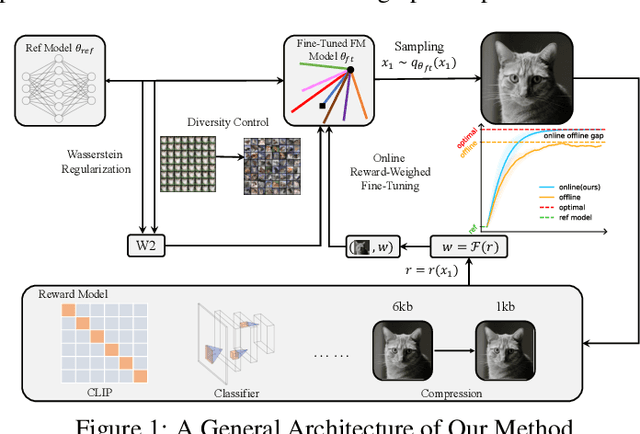
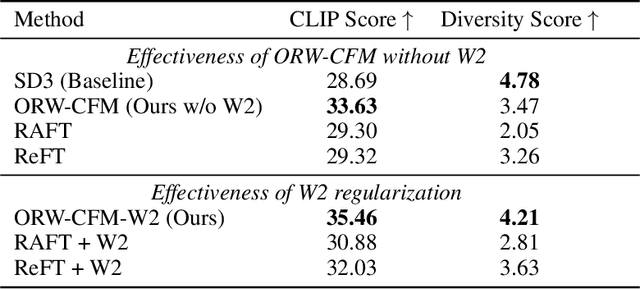
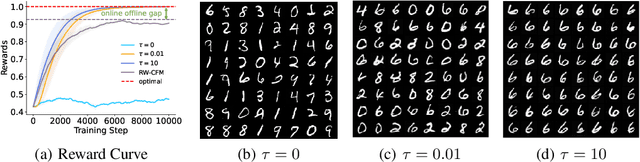
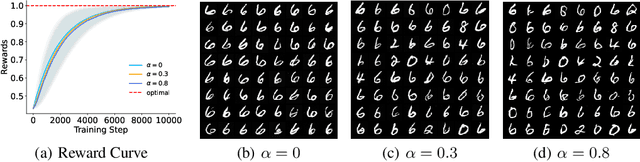
Recent advancements in reinforcement learning (RL) have achieved great success in fine-tuning diffusion-based generative models. However, fine-tuning continuous flow-based generative models to align with arbitrary user-defined reward functions remains challenging, particularly due to issues such as policy collapse from overoptimization and the prohibitively high computational cost of likelihoods in continuous-time flows. In this paper, we propose an easy-to-use and theoretically sound RL fine-tuning method, which we term Online Reward-Weighted Conditional Flow Matching with Wasserstein-2 Regularization (ORW-CFM-W2). Our method integrates RL into the flow matching framework to fine-tune generative models with arbitrary reward functions, without relying on gradients of rewards or filtered datasets. By introducing an online reward-weighting mechanism, our approach guides the model to prioritize high-reward regions in the data manifold. To prevent policy collapse and maintain diversity, we incorporate Wasserstein-2 (W2) distance regularization into our method and derive a tractable upper bound for it in flow matching, effectively balancing exploration and exploitation of policy optimization. We provide theoretical analyses to demonstrate the convergence properties and induced data distributions of our method, establishing connections with traditional RL algorithms featuring Kullback-Leibler (KL) regularization and offering a more comprehensive understanding of the underlying mechanisms and learning behavior of our approach. Extensive experiments on tasks including target image generation, image compression, and text-image alignment demonstrate the effectiveness of our method, where our method achieves optimal policy convergence while allowing controllable trade-offs between reward maximization and diversity preservation.
Hard Constraint Guided Flow Matching for Gradient-Free Generation of PDE Solutions
Dec 02, 2024Generative models that satisfy hard constraints are crucial in many scientific and engineering applications where physical laws or system requirements must be strictly respected. However, many existing constrained generative models, especially those developed for computer vision, rely heavily on gradient information, often sparse or computationally expensive in fields like partial differential equations (PDEs). In this work, we introduce a novel framework for adapting pre-trained, unconstrained flow-matching models to satisfy constraints exactly in a zero-shot manner without requiring expensive gradient computations or fine-tuning. Our framework, ECI sampling, alternates between extrapolation (E), correction (C), and interpolation (I) stages during each iterative sampling step of flow matching sampling to ensure accurate integration of constraint information while preserving the validity of the generation. We demonstrate the effectiveness of our approach across various PDE systems, showing that ECI-guided generation strictly adheres to physical constraints and accurately captures complex distribution shifts induced by these constraints. Empirical results demonstrate that our framework consistently outperforms baseline approaches in various zero-shot constrained generation tasks and also achieves competitive results in the regression tasks without additional fine-tuning.
Hotspot-Driven Peptide Design via Multi-Fragment Autoregressive Extension
Nov 26, 2024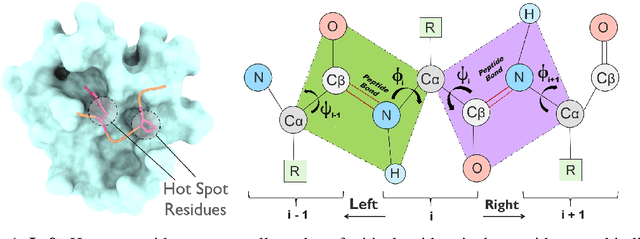

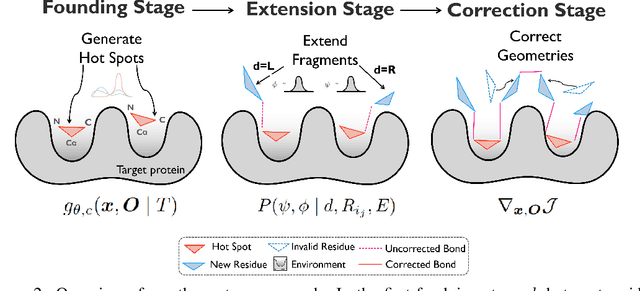

Peptides, short chains of amino acids, interact with target proteins, making them a unique class of protein-based therapeutics for treating human diseases. Recently, deep generative models have shown great promise in peptide generation. However, several challenges remain in designing effective peptide binders. First, not all residues contribute equally to peptide-target interactions. Second, the generated peptides must adopt valid geometries due to the constraints of peptide bonds. Third, realistic tasks for peptide drug development are still lacking. To address these challenges, we introduce PepHAR, a hot-spot-driven autoregressive generative model for designing peptides targeting specific proteins. Building on the observation that certain hot spot residues have higher interaction potentials, we first use an energy-based density model to fit and sample these key residues. Next, to ensure proper peptide geometry, we autoregressively extend peptide fragments by estimating dihedral angles between residue frames. Finally, we apply an optimization process to iteratively refine fragment assembly, ensuring correct peptide structures. By combining hot spot sampling with fragment-based extension, our approach enables de novo peptide design tailored to a target protein and allows the incorporation of key hot spot residues into peptide scaffolds. Extensive experiments, including peptide design and peptide scaffold generation, demonstrate the strong potential of PepHAR in computational peptide binder design.
Geometric Point Attention Transformer for 3D Shape Reassembly
Nov 26, 2024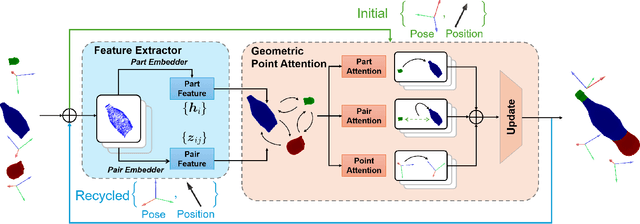
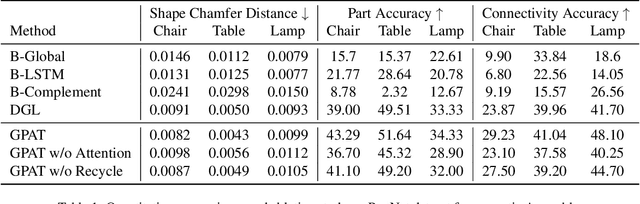
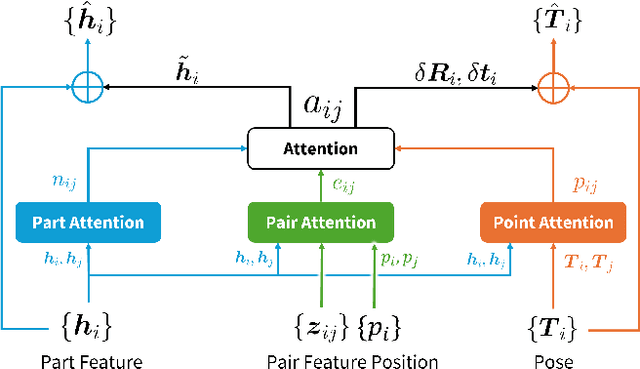
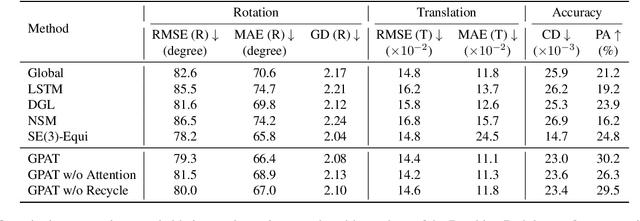
Shape assembly, which aims to reassemble separate parts into a complete object, has gained significant interest in recent years. Existing methods primarily rely on networks to predict the poses of individual parts, but often fail to effectively capture the geometric interactions between the parts and their poses. In this paper, we present the Geometric Point Attention Transformer (GPAT), a network specifically designed to address the challenges of reasoning about geometric relationships. In the geometric point attention module, we integrate both global shape information and local pairwise geometric features, along with poses represented as rotation and translation vectors for each part. To enable iterative updates and dynamic reasoning, we introduce a geometric recycling scheme, where each prediction is fed into the next iteration for refinement. We evaluate our model on both the semantic and geometric assembly tasks, showing that it outperforms previous methods in absolute pose estimation, achieving accurate pose predictions and high alignment accuracy.