 Add to Chrome
 Add to Firefox
 Add to Edge
AIF: Asynchronous Inference Framework for Cost-Effective Pre-Ranking
Nov 17, 2025
In industrial recommendation systems, pre-ranking models based on deep neural networks (DNNs) commonly adopt a sequential execution framework: feature fetching and model forward computation are triggered only after receiving candidates from the upstream retrieval stage. This design introduces inherent bottlenecks, including redundant computations of identical users/items and increased latency due to strictly sequential operations, which jointly constrain the model's capacity and system efficiency. To address these limitations, we propose the Asynchronous Inference Framework (AIF), a cost-effective computational architecture that decouples interaction-independent components, those operating within a single user or item, from real-time prediction. AIF reorganizes the model inference process by performing user-side computations in parallel with the retrieval stage and conducting item-side computations in a nearline manner. This means that interaction-independent components are calculated just once and completed before the real-time prediction phase of the pre-ranking stage. As a result, AIF enhances computational efficiency and reduces latency, freeing up resources to significantly improve the feature set and model architecture of interaction-independent components. Moreover, we delve into model design within the AIF framework, employing approximated methods for interaction-dependent components in online real-time predictions. By co-designing both the framework and the model, our solution achieves notable performance gains without significantly increasing computational and latency costs. This has enabled the successful deployment of AIF in the Taobao display advertising system.

MOON2.0: Dynamic Modality-balanced Multimodal Representation Learning for E-commerce Product Understanding
Nov 16, 2025The rapid growth of e-commerce calls for multimodal models that comprehend rich visual and textual product information. Although recent multimodal large language models (MLLMs) for product understanding exhibit strong capability in representation learning for e-commerce, they still face three challenges: (i) the modality imbalance induced by modality mixed training; (ii) underutilization of the intrinsic alignment relationships among visual and textual information within a product; and (iii) limited handling of noise in e-commerce multimodal data. To address these, we propose MOON2.0, a dynamic modality-balanced multimodal representation learning framework for e-commerce product understanding. MOON2.0 comprises: (1) a Modality-driven Mixture-of-Experts (MoE) module that adaptively processes input samples by their modality composition, enabling Multimodal Joint Learning to mitigate the modality imbalance; (2) a Dual-level Alignment method to better leverage semantic alignment properties inside individual products; and (3) an MLLM-based Image-text Co-augmentation strategy that integrates textual enrichment with visual expansion, coupled with Dynamic Sample Filtering to improve training data quality. We further introduce MBE2.0, a co-augmented multimodal representation benchmark for e-commerce representation learning and evaluation. Experiments show that MOON2.0 delivers state-of-the-art zero-shot performance on MBE2.0 and multiple public datasets. Furthermore, attention-based heatmap visualization provides qualitative evidence of improved multimodal alignment of MOON2.0.
From Scaling to Structured Expressivity: Rethinking Transformers for CTR Prediction
Nov 15, 2025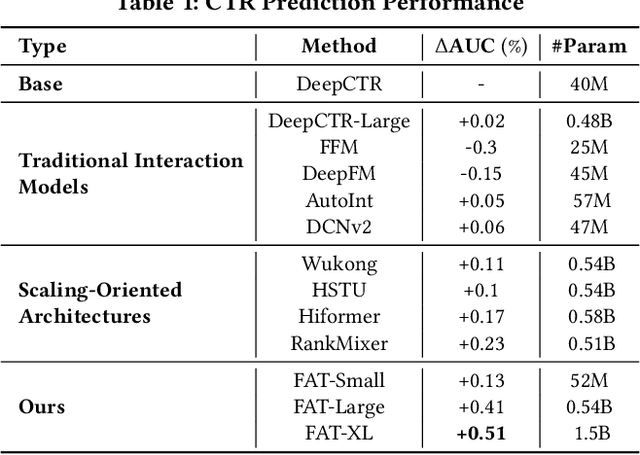
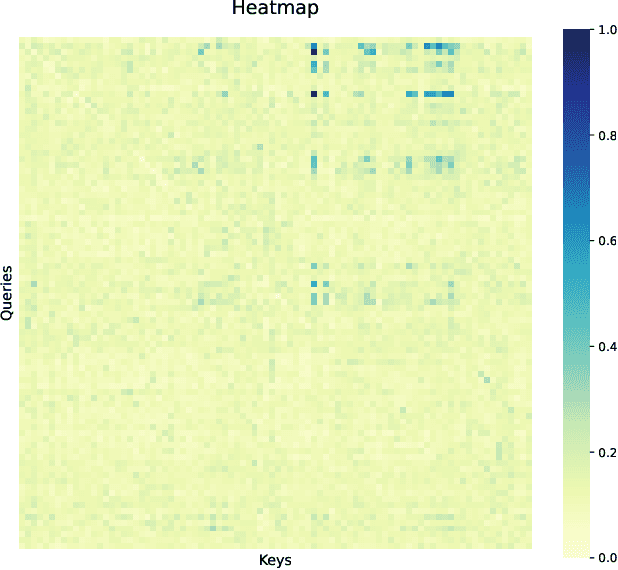
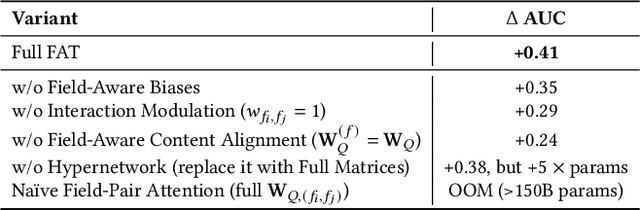
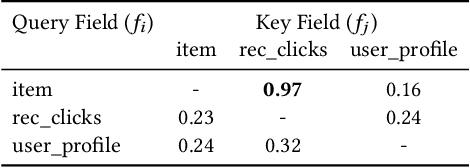
Despite massive investments in scale, deep models for click-through rate (CTR) prediction often exhibit rapidly diminishing returns - a stark contrast to the smooth, predictable gains seen in large language models. We identify the root cause as a structural misalignment: Transformers assume sequential compositionality, while CTR data demand combinatorial reasoning over high-cardinality semantic fields. Unstructured attention spreads capacity indiscriminately, amplifying noise under extreme sparsity and breaking scalable learning. To restore alignment, we introduce the Field-Aware Transformer (FAT), which embeds field-based interaction priors into attention through decomposed content alignment and cross-field modulation. This design ensures model complexity scales with the number of fields F, not the total vocabulary size n >> F, leading to tighter generalization and, critically, observed power-law scaling in AUC as model width increases. We present the first formal scaling law for CTR models, grounded in Rademacher complexity, that explains and predicts this behavior. On large-scale benchmarks, FAT improves AUC by up to +0.51% over state-of-the-art methods. Deployed online, it delivers +2.33% CTR and +0.66% RPM. Our work establishes that effective scaling in recommendation arises not from size, but from structured expressivity-architectural coherence with data semantics.
Time-Layer Adaptive Alignment for Speaker Similarity in Flow-Matching Based Zero-Shot TTS
Nov 13, 2025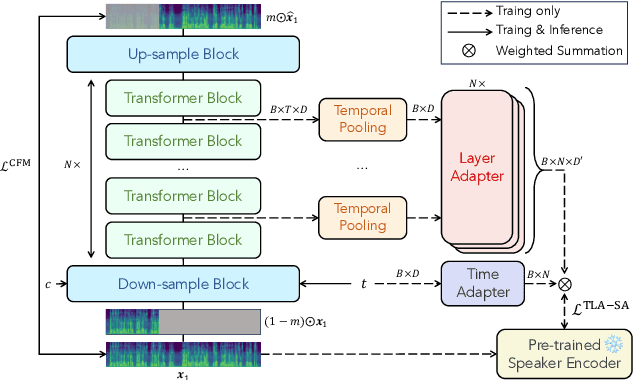

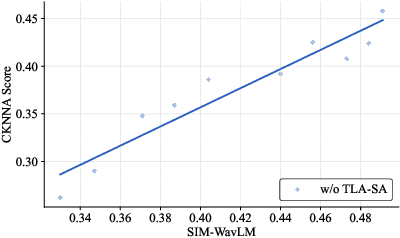
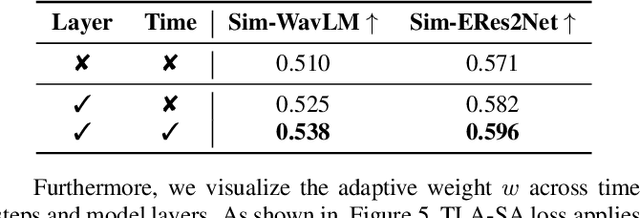
Flow-Matching (FM)-based zero-shot text-to-speech (TTS) systems exhibit high-quality speech synthesis and robust generalization capabilities. However, the speaker representation ability of such systems remains underexplored, primarily due to the lack of explicit speaker-specific supervision in the FM framework. To this end, we conduct an empirical analysis of speaker information distribution and reveal its non-uniform allocation across time steps and network layers, underscoring the need for adaptive speaker alignment. Accordingly, we propose Time-Layer Adaptive Speaker Alignment (TLA-SA), a loss that enhances speaker consistency by jointly leveraging temporal and hierarchical variations in speaker information. Experimental results show that TLA-SA significantly improves speaker similarity compared to baseline systems on both research- and industrial-scale datasets and generalizes effectively across diverse model architectures, including decoder-only language models (LM) and FM-based TTS systems free of LM.
Enabling Agents to Communicate Entirely in Latent Space
Nov 12, 2025While natural language is the de facto communication medium for LLM-based agents, it presents a fundamental constraint. The process of downsampling rich, internal latent states into discrete tokens inherently limits the depth and nuance of information that can be transmitted, thereby hindering collaborative problem-solving. Inspired by human mind-reading, we propose Interlat (Inter-agent Latent Space Communication), a paradigm that leverages the last hidden states of an LLM as a representation of its mind for direct transmission (termed latent communication). An additional compression process further compresses latent communication via entirely latent space reasoning. Experiments demonstrate that Interlat outperforms both fine-tuned chain-of-thought (CoT) prompting and single-agent baselines, promoting more exploratory behavior and enabling genuine utilization of latent information. Further compression not only substantially accelerates inference but also maintains competitive performance through an efficient information-preserving mechanism. We position this work as a feasibility study of entirely latent space inter-agent communication, and our results highlight its potential, offering valuable insights for future research.
Think before Recommendation: Autonomous Reasoning-enhanced Recommender
Oct 27, 2025The core task of recommender systems is to learn user preferences from historical user-item interactions. With the rapid development of large language models (LLMs), recent research has explored leveraging the reasoning capabilities of LLMs to enhance rating prediction tasks. However, existing distillation-based methods suffer from limitations such as the teacher model's insufficient recommendation capability, costly and static supervision, and superficial transfer of reasoning ability. To address these issues, this paper proposes RecZero, a reinforcement learning (RL)-based recommendation paradigm that abandons the traditional multi-model and multi-stage distillation approach. Instead, RecZero trains a single LLM through pure RL to autonomously develop reasoning capabilities for rating prediction. RecZero consists of two key components: (1) "Think-before-Recommendation" prompt construction, which employs a structured reasoning template to guide the model in step-wise analysis of user interests, item features, and user-item compatibility; and (2) rule-based reward modeling, which adopts group relative policy optimization (GRPO) to compute rewards for reasoning trajectories and optimize the LLM. Additionally, the paper explores a hybrid paradigm, RecOne, which combines supervised fine-tuning with RL, initializing the model with cold-start reasoning samples and further optimizing it with RL. Experimental results demonstrate that RecZero and RecOne significantly outperform existing baseline methods on multiple benchmark datasets, validating the superiority of the RL paradigm in achieving autonomous reasoning-enhanced recommender systems.
REVISION:Reflective Intent Mining and Online Reasoning Auxiliary for E-commerce Visual Search System Optimization
Oct 26, 2025In Taobao e-commerce visual search, user behavior analysis reveals a large proportion of no-click requests, suggesting diverse and implicit user intents. These intents are expressed in various forms and are difficult to mine and discover, thereby leading to the limited adaptability and lag in platform strategies. This greatly restricts users' ability to express diverse intents and hinders the scalability of the visual search system. This mismatch between user implicit intent expression and system response defines the User-SearchSys Intent Discrepancy. To alleviate the issue, we propose a novel framework REVISION. This framework integrates offline reasoning mining with online decision-making and execution, enabling adaptive strategies to solve implicit user demands. In the offline stage, we construct a periodic pipeline to mine discrepancies from historical no-click requests. Leveraging large models, we analyze implicit intent factors and infer optimal suggestions by jointly reasoning over query and product metadata. These inferred suggestions serve as actionable insights for refining platform strategies. In the online stage, REVISION-R1-3B, trained on the curated offline data, performs holistic analysis over query images and associated historical products to generate optimization plans and adaptively schedule strategies across the search pipeline. Our framework offers a streamlined paradigm for integrating large models with traditional search systems, enabling end-to-end intelligent optimization across information aggregation and user interaction. Experimental results demonstrate that our approach improves the efficiency of implicit intent mining from large-scale search logs and significantly reduces the no-click rate.
Identity-Preserving Image-to-Video Generation via Reward-Guided Optimization
Oct 16, 2025Recent advances in image-to-video (I2V) generation have achieved remarkable progress in synthesizing high-quality, temporally coherent videos from static images. Among all the applications of I2V, human-centric video generation includes a large portion. However, existing I2V models encounter difficulties in maintaining identity consistency between the input human image and the generated video, especially when the person in the video exhibits significant expression changes and movements. This issue becomes critical when the human face occupies merely a small fraction of the image. Since humans are highly sensitive to identity variations, this poses a critical yet under-explored challenge in I2V generation. In this paper, we propose Identity-Preserving Reward-guided Optimization (IPRO), a novel video diffusion framework based on reinforcement learning to enhance identity preservation. Instead of introducing auxiliary modules or altering model architectures, our approach introduces a direct and effective tuning algorithm that optimizes diffusion models using a face identity scorer. To improve performance and accelerate convergence, our method backpropagates the reward signal through the last steps of the sampling chain, enabling richer gradient feedback. We also propose a novel facial scoring mechanism that treats faces in ground-truth videos as facial feature pools, providing multi-angle facial information to enhance generalization. A KL-divergence regularization is further incorporated to stabilize training and prevent overfitting to the reward signal. Extensive experiments on Wan 2.2 I2V model and our in-house I2V model demonstrate the effectiveness of our method. Our project and code are available at \href{https://ipro-alimama.github.io/}{https://ipro-alimama.github.io/}.
SMEC: Rethinking Matryoshka Representation Learning for Retrieval Embedding Compression
Oct 14, 2025Large language models (LLMs) generate high-dimensional embeddings that capture rich semantic and syntactic information. However, high-dimensional embeddings exacerbate computational complexity and storage requirements, thereby hindering practical deployment. To address these challenges, we propose a novel training framework named Sequential Matryoshka Embedding Compression (SMEC). This framework introduces the Sequential Matryoshka Representation Learning(SMRL) method to mitigate gradient variance during training, the Adaptive Dimension Selection (ADS) module to reduce information degradation during dimension pruning, and the Selectable Cross-batch Memory (S-XBM) module to enhance unsupervised learning between high- and low-dimensional embeddings. Experiments on image, text, and multimodal datasets demonstrate that SMEC achieves significant dimensionality reduction while maintaining performance. For instance, on the BEIR dataset, our approach improves the performance of compressed LLM2Vec embeddings (256 dimensions) by 1.1 points and 2.7 points compared to the Matryoshka-Adaptor and Search-Adaptor models, respectively.
MeSH: Memory-as-State-Highways for Recursive Transformers
Oct 09, 2025Recursive transformers reuse parameters and iterate over hidden states multiple times, decoupling compute depth from parameter depth. However, under matched compute, recursive models with fewer parameters often lag behind non-recursive counterparts. By probing hidden states, we trace this performance gap to two primary bottlenecks: undifferentiated computation, where the core is forced to adopt a similar computational pattern at every iteration, and information overload, where long-lived and transient information must coexist in a single hidden state. To address the issues, we introduce a Memory-as-State-Highways (MeSH) scheme, which externalizes state management into an explicit memory buffer and employs lightweight routers to dynamically diversify computation across iterations. Probing visualizations confirm that MeSH successfully resolves the pathologies by inducing functional specialization across iterations. On the Pythia suite (160M-1.4B), MeSH-enhanced recursive transformers consistently improve over recursive baselines and outperforms its larger non-recursive counterpart at the 1.4B scale, improving average downstream accuracy by +1.06% with 33% fewer non-embedding parameters. Our analysis establishes MeSH as a scalable and principled architecture for building stronger recursive models.