 Add to Chrome
 Add to Firefox
 Add to Edge
Segmentation-guided Layer-wise Image Vectorization with Gradient Fills
Aug 28, 2024
The widespread use of vector graphics creates a significant demand for vectorization methods. While recent learning-based techniques have shown their capability to create vector images of clear topology, filling these primitives with gradients remains a challenge. In this paper, we propose a segmentation-guided vectorization framework to convert raster images into concise vector graphics with radial gradient fills. With the guidance of an embedded gradient-aware segmentation subroutine, our approach progressively appends gradient-filled B\'ezier paths to the output, where primitive parameters are initiated with our newly designed initialization technique and are optimized to minimize our novel loss function. We build our method on a differentiable renderer with traditional segmentation algorithms to develop it as a model-free tool for raster-to-vector conversion. It is tested on various inputs to demonstrate its feasibility, independent of datasets, to synthesize vector graphics with improved visual quality and layer-wise topology compared to prior work.

IAA: Inner-Adaptor Architecture Empowers Frozen Large Language Model with Multimodal Capabilities
Aug 23, 2024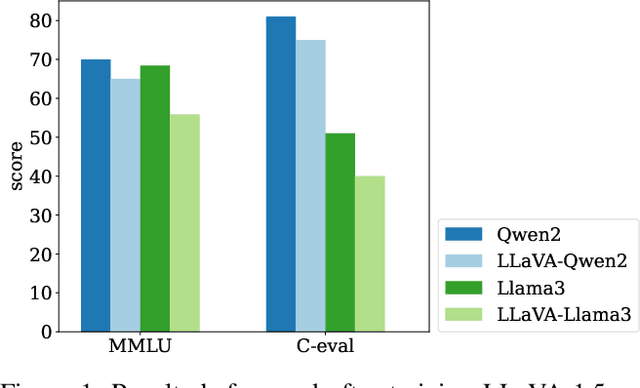
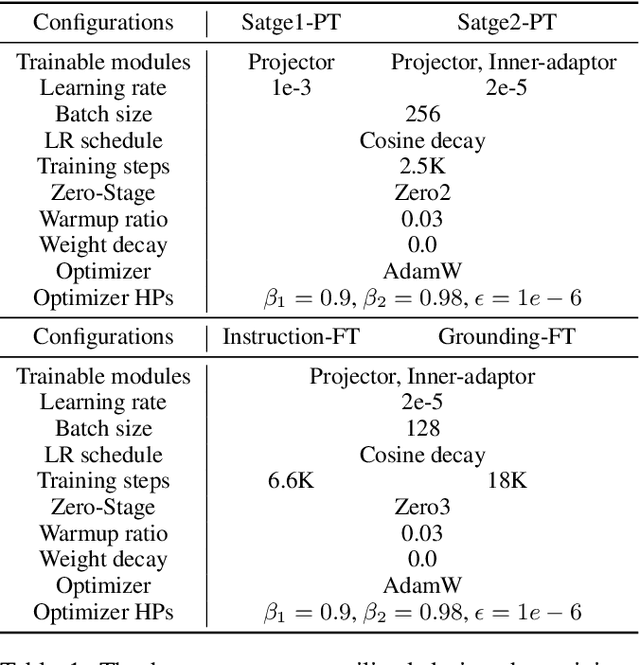

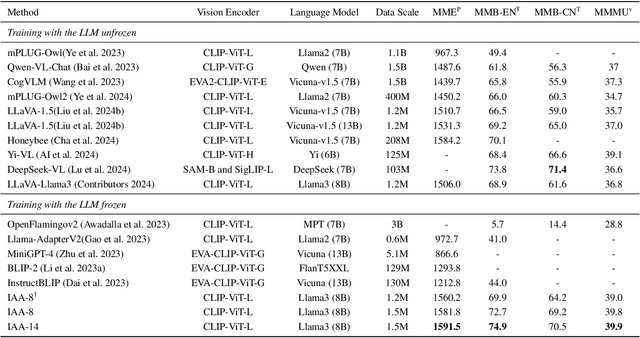
In the field of multimodal large language models (MLLMs), common methods typically involve unfreezing the language model during training to foster profound visual understanding. However, the fine-tuning of such models with vision-language data often leads to a diminution of their natural language processing (NLP) capabilities. To avoid this performance degradation, a straightforward solution is to freeze the language model while developing multimodal competencies. Unfortunately, previous works have not attained satisfactory outcomes. Building on the strategy of freezing the language model, we conduct thorough structural exploration and introduce the Inner-Adaptor Architecture (IAA). Specifically, the architecture incorporates multiple multimodal adaptors at varying depths within the large language model to facilitate direct interaction with the inherently text-oriented transformer layers, thereby enabling the frozen language model to acquire multimodal capabilities. Unlike previous approaches of freezing language models that require large-scale aligned data, our proposed architecture is able to achieve superior performance on small-scale datasets. We conduct extensive experiments to improve the general multimodal capabilities and visual grounding abilities of the MLLM. Our approach remarkably outperforms previous state-of-the-art methods across various vision-language benchmarks without sacrificing performance on NLP tasks. Code and models are available at https://github.com/360CVGroup/Inner-Adaptor-Architecture.
TDS-CLIP: Temporal Difference Side Network for Image-to-Video Transfer Learning
Aug 20, 2024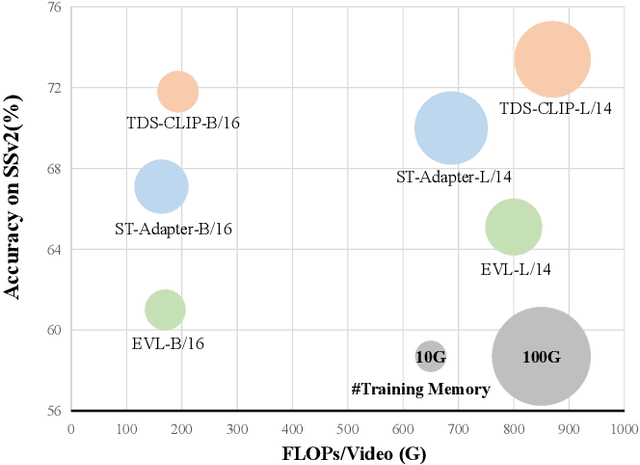
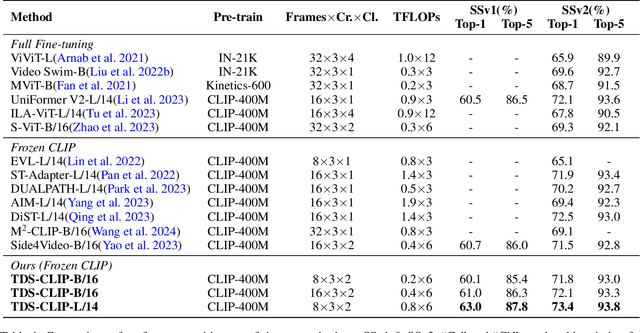
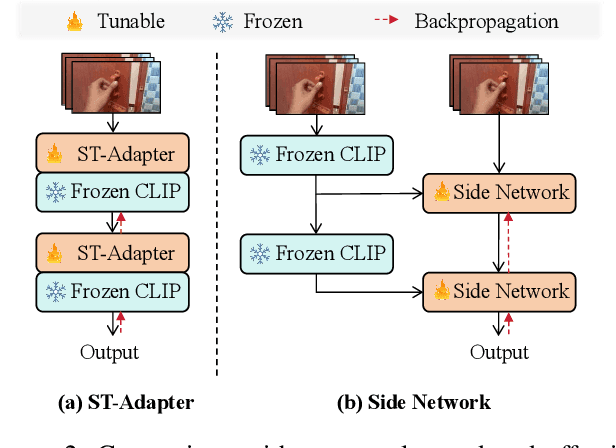
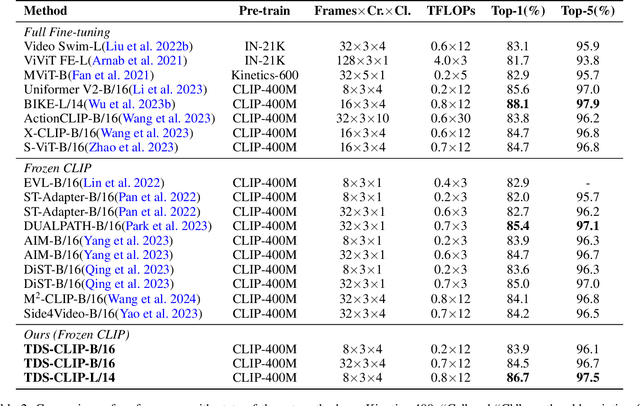
Recently, large-scale pre-trained vision-language models (e.g., CLIP), have garnered significant attention thanks to their powerful representative capabilities. This inspires researchers in transferring the knowledge from these large pre-trained models to other task-specific models, e.g., Video Action Recognition (VAR) models, via particularly leveraging side networks to enhance the efficiency of parameter-efficient fine-tuning (PEFT). However, current transferring approaches in VAR tend to directly transfer the frozen knowledge from large pre-trained models to action recognition networks with minimal cost, instead of exploiting the temporal modeling capabilities of the action recognition models themselves. Therefore, in this paper, we propose a memory-efficient Temporal Difference Side Network (TDS-CLIP) to balance knowledge transferring and temporal modeling, avoiding backpropagation in frozen parameter models. Specifically, we introduce a Temporal Difference Adapter (TD-Adapter), which can effectively capture local temporal differences in motion features to strengthen the model's global temporal modeling capabilities. Furthermore, we designed a Side Motion Enhancement Adapter (SME-Adapter) to guide the proposed side network in efficiently learning the rich motion information in videos, thereby improving the side network's ability to capture and learn motion information. Extensive experiments are conducted on three benchmark datasets, including Something-Something V1\&V2, and Kinetics-400. Experimental results demonstrate that our approach achieves competitive performance.
CSI-Free Position Optimization for Movable Antenna Communication Systems: A Black-Box Optimization Approach
Aug 09, 2024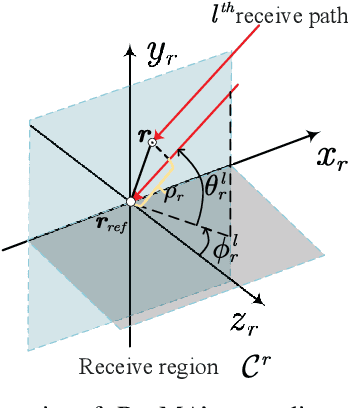
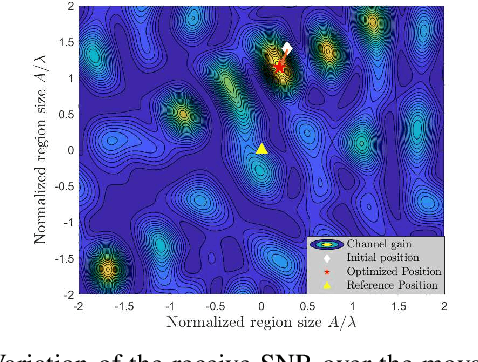
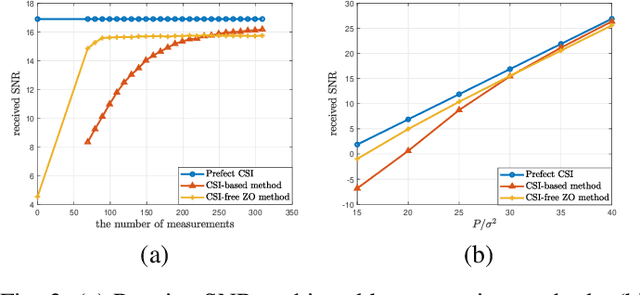
Movable antenna (MA) is a new technology which leverages local movement of antennas to improve channel qualities and enhance the communication performance. Nevertheless, to fully realize the potential of MA systems, complete channel state information (CSI) between the transmitter-MA and the receiver-MA is required, which involves estimating a large number of channel parameters and incurs an excessive amount of training overhead. To address this challenge, in this paper, we propose a CSI-free MA position optimization method. The basic idea is to treat position optimization as a black-box optimization problem and calculate the gradient of the unknown objective function using zeroth-order (ZO) gradient approximation techniques. Simulation results show that the proposed ZO-based method, through adaptively adjusting the position of the MA, can achieve a favorable signal-to-noise-ratio (SNR) using a smaller number of position measurements than the CSI-based approach. Such a merit makes the proposed algorithm more adaptable to fast-changing propagation channels.
In2Core: Leveraging Influence Functions for Coreset Selection in Instruction Finetuning of Large Language Models
Aug 07, 2024Despite advancements, fine-tuning Large Language Models (LLMs) remains costly due to the extensive parameter count and substantial data requirements for model generalization. Accessibility to computing resources remains a barrier for the open-source community. To address this challenge, we propose the In2Core algorithm, which selects a coreset by analyzing the correlation between training and evaluation samples with a trained model. Notably, we assess the model's internal gradients to estimate this relationship, aiming to rank the contribution of each training point. To enhance efficiency, we propose an optimization to compute influence functions with a reduced number of layers while achieving similar accuracy. By applying our algorithm to instruction fine-tuning data of LLMs, we can achieve similar performance with just 50% of the training data. Meantime, using influence functions to analyze model coverage to certain testing samples could provide a reliable and interpretable signal on the training set's coverage of those test points.
Walk Wisely on Graph: Knowledge Graph Reasoning with Dual Agents via Efficient Guidance-Exploration
Aug 03, 2024
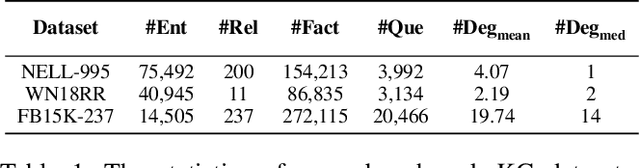
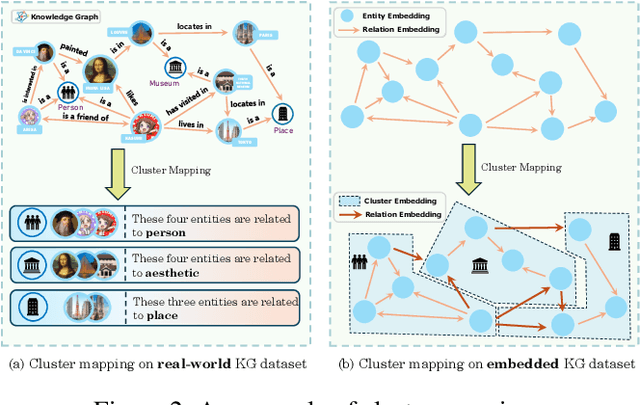
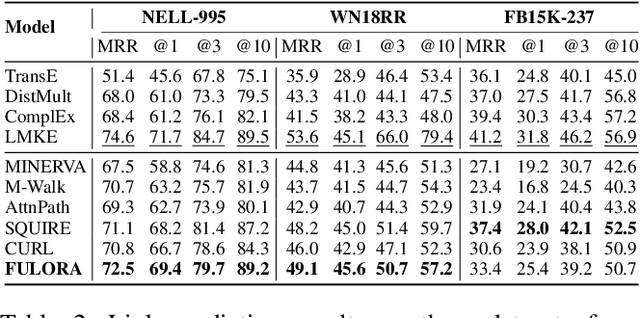
Recent years, multi-hop reasoning has been widely studied for knowledge graph (KG) reasoning due to its efficacy and interpretability. However, previous multi-hop reasoning approaches are subject to two primary shortcomings. First, agents struggle to learn effective and robust policies at the early phase due to sparse rewards. Second, these approaches often falter on specific datasets like sparse knowledge graphs, where agents are required to traverse lengthy reasoning paths. To address these problems, we propose a multi-hop reasoning model with dual agents based on hierarchical reinforcement learning (HRL), which is named FULORA. FULORA tackles the above reasoning challenges by eFficient GUidance-ExpLORAtion between dual agents. The high-level agent walks on the simplified knowledge graph to provide stage-wise hints for the low-level agent walking on the original knowledge graph. In this framework, the low-level agent optimizes a value function that balances two objectives: (1) maximizing return, and (2) integrating efficient guidance from the high-level agent. Experiments conducted on three real-word knowledge graph datasets demonstrate that FULORA outperforms RL-based baselines, especially in the case of long-distance reasoning.
Image Re-Identification: Where Self-supervision Meets Vision-Language Learning
Jul 30, 2024


Recently, large-scale vision-language pre-trained models like CLIP have shown impressive performance in image re-identification (ReID). In this work, we explore whether self-supervision can aid in the use of CLIP for image ReID tasks. Specifically, we propose SVLL-ReID, the first attempt to integrate self-supervision and pre-trained CLIP via two training stages to facilitate the image ReID. We observe that: 1) incorporating language self-supervision in the first training stage can make the learnable text prompts more distinguishable, and 2) incorporating vision self-supervision in the second training stage can make the image features learned by the image encoder more discriminative. These observations imply that: 1) the text prompt learning in the first stage can benefit from the language self-supervision, and 2) the image feature learning in the second stage can benefit from the vision self-supervision. These benefits jointly facilitate the performance gain of the proposed SVLL-ReID. By conducting experiments on six image ReID benchmark datasets without any concrete text labels, we find that the proposed SVLL-ReID achieves the overall best performances compared with state-of-the-arts. Codes will be publicly available at https://github.com/BinWangGzhu/SVLL-ReID.
A New Dataset and Framework for Real-World Blurred Images Super-Resolution
Jul 20, 2024
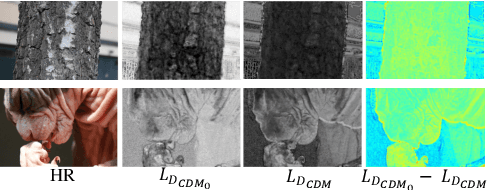


Recent Blind Image Super-Resolution (BSR) methods have shown proficiency in general images. However, we find that the efficacy of recent methods obviously diminishes when employed on image data with blur, while image data with intentional blur constitute a substantial proportion of general data. To further investigate and address this issue, we developed a new super-resolution dataset specifically tailored for blur images, named the Real-world Blur-kept Super-Resolution (ReBlurSR) dataset, which consists of nearly 3000 defocus and motion blur image samples with diverse blur sizes and varying blur intensities. Furthermore, we propose a new BSR framework for blur images called Perceptual-Blur-adaptive Super-Resolution (PBaSR), which comprises two main modules: the Cross Disentanglement Module (CDM) and the Cross Fusion Module (CFM). The CDM utilizes a dual-branch parallelism to isolate conflicting blur and general data during optimization. The CFM fuses the well-optimized prior from these distinct domains cost-effectively and efficiently based on model interpolation. By integrating these two modules, PBaSR achieves commendable performance on both general and blur data without any additional inference and deployment cost and is generalizable across multiple model architectures. Rich experiments show that PBaSR achieves state-of-the-art performance across various metrics without incurring extra inference costs. Within the widely adopted LPIPS metrics, PBaSR achieves an improvement range of approximately 0.02-0.10 with diverse anchor methods and blur types, across both the ReBlurSR and multiple common general BSR benchmarks. Code here: https://github.com/Imalne/PBaSR.
Pruning Large Language Models to Intra-module Low-rank Architecture with Transitional Activations
Jul 08, 2024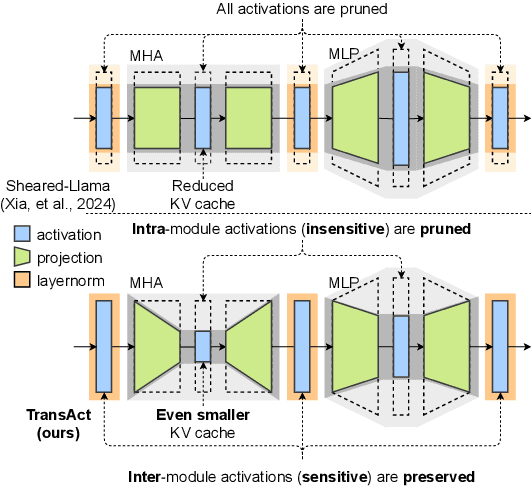

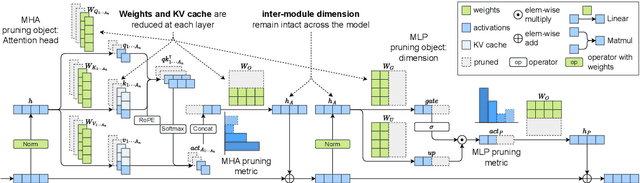
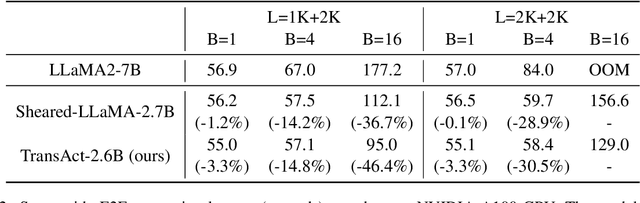
Structured pruning fundamentally reduces computational and memory overheads of large language models (LLMs) and offers a feasible solution for end-side LLM deployment. Structurally pruned models remain dense and high-precision, highly compatible with further tuning and compression. However, as the coarse-grained structured pruning poses large damage to the highly interconnected model, achieving a high compression ratio for scaled-up LLMs remains a challenge. In this paper, we introduce a task-agnostic structured pruning approach coupled with a compact Transformer architecture design. The proposed approach, named TransAct, reduces transitional activations inside multi-head attention (MHA) and multi-layer perceptron (MLP) modules, while preserving the inter-module activations that are sensitive to perturbations. Hence, the LLM is pruned into an intra-module low-rank architecture, significantly reducing weights, KV Cache and attention computation. TransAct is implemented on the LLaMA model and evaluated on downstream benchmarks. Results verify the optimality of our approach at high compression with respect to both efficiency and performance. Further, ablation studies reveal the strength of activation-guided iterative pruning and provide experimental analysis on the redundancy of MHA and MLP modules.
InternLM-XComposer-2.5: A Versatile Large Vision Language Model Supporting Long-Contextual Input and Output
Jul 03, 2024

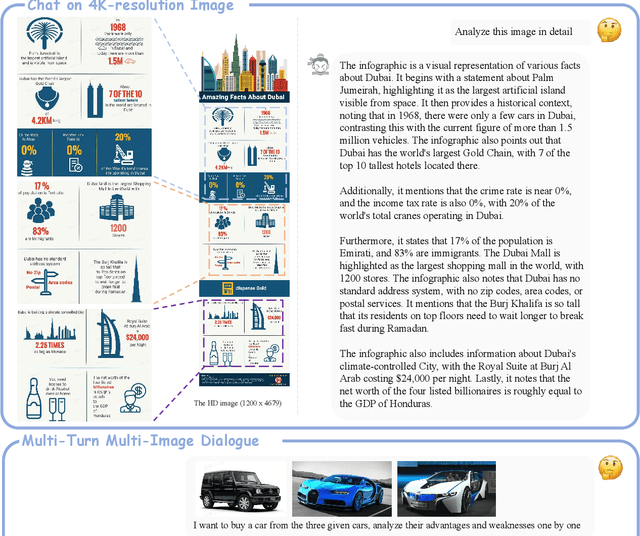
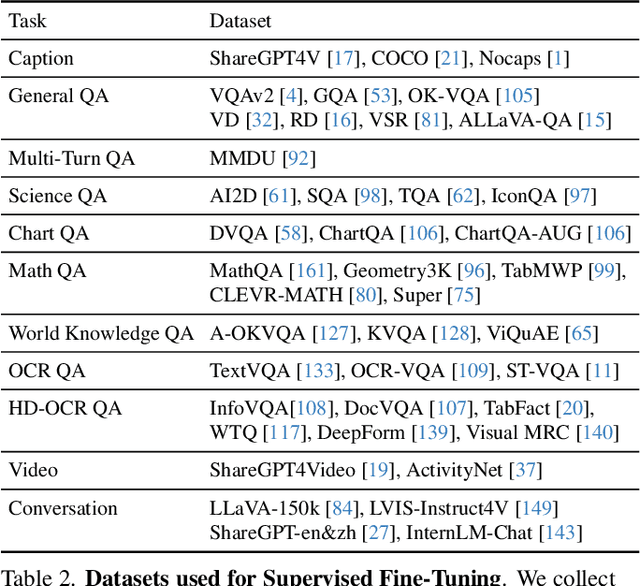
We present InternLM-XComposer-2.5 (IXC-2.5), a versatile large-vision language model that supports long-contextual input and output. IXC-2.5 excels in various text-image comprehension and composition applications, achieving GPT-4V level capabilities with merely 7B LLM backend. Trained with 24K interleaved image-text contexts, it can seamlessly extend to 96K long contexts via RoPE extrapolation. This long-context capability allows IXC-2.5 to excel in tasks requiring extensive input and output contexts. Compared to its previous 2.0 version, InternLM-XComposer-2.5 features three major upgrades in vision-language comprehension: (1) Ultra-High Resolution Understanding, (2) Fine-Grained Video Understanding, and (3) Multi-Turn Multi-Image Dialogue. In addition to comprehension, IXC-2.5 extends to two compelling applications using extra LoRA parameters for text-image composition: (1) Crafting Webpages and (2) Composing High-Quality Text-Image Articles. IXC-2.5 has been evaluated on 28 benchmarks, outperforming existing open-source state-of-the-art models on 16 benchmarks. It also surpasses or competes closely with GPT-4V and Gemini Pro on 16 key tasks. The InternLM-XComposer-2.5 is publicly available at https://github.com/InternLM/InternLM-XComposer.