 Add to Chrome
 Add to Firefox
 Add to Edge
Differential Vector Erasure: Unified Training-Free Concept Erasure for Flow Matching Models
Feb 01, 2026
Text-to-image diffusion models have demonstrated remarkable capabilities in generating high-quality images, yet their tendency to reproduce undesirable concepts, such as NSFW content, copyrighted styles, or specific objects, poses growing concerns for safe and controllable deployment. While existing concept erasure approaches primarily focus on DDPM-based diffusion models and rely on costly fine-tuning, the recent emergence of flow matching models introduces a fundamentally different generative paradigm for which prior methods are not directly applicable. In this paper, we propose Differential Vector Erasure (DVE), a training-free concept erasure method specifically designed for flow matching models. Our key insight is that semantic concepts are implicitly encoded in the directional structure of the velocity field governing the generative flow. Leveraging this observation, we construct a differential vector field that characterizes the directional discrepancy between a target concept and a carefully chosen anchor concept. During inference, DVE selectively removes concept-specific components by projecting the velocity field onto the differential direction, enabling precise concept suppression without affecting irrelevant semantics. Extensive experiments on FLUX demonstrate that DVE consistently outperforms existing baselines on a wide range of concept erasure tasks, including NSFW suppression, artistic style removal, and object erasure, while preserving image quality and diversity.

Blockchain-Based Spectrum Resource Securitization via Semi-Fungible Token-Lock
Jan 22, 2026As 6G networks evolve, spectrum assets require flexible, dynamic, and efficient utilization, motivating blockchain based spectrum securitization. Existing approaches based on ERC404 style hybrid token models rely on frequent minting and burning during asset transfers, which disrupt token identity continuity and increase on chain overhead. This paper proposes the Semi Fungible Token Lock (SFT Lock) method, a lock/unlock based mechanism that preserves NFT identity and historical traceability while enabling fractional ownership and transferability. By replacing mint/burn operations with deterministic state transitions, SFT Lock ensures consistent lifecycle representation of spectrum assets and significantly reduces on chain operations. Based on this mechanism, a modular smart contract architecture is designed to support spectrum authorization, securitization, and sharing, and a staking mechanism is introduced to enhance asset liquidity. Experimental results on a private Ethereum network demonstrate that, compared with ERC404 style hybrid token models, the proposed method achieves substantial gas savings while maintaining functional correctness and traceability.
Democratizing planetary-scale analysis: An ultra-lightweight Earth embedding database for accurate and flexible global land monitoring
Jan 16, 2026The rapid evolution of satellite-borne Earth Observation (EO) systems has revolutionized terrestrial monitoring, yielding petabyte-scale archives. However, the immense computational and storage requirements for global-scale analysis often preclude widespread use, hindering planetary-scale studies. To address these barriers, we present Embedded Seamless Data (ESD), an ultra-lightweight, 30-m global Earth embedding database spanning the 25-year period from 2000 to 2024. By transforming high-dimensional, multi-sensor observations from the Landsat series (5, 7, 8, and 9) and MODIS Terra into information-dense, quantized latent vectors, ESD distills essential geophysical and semantic features into a unified latent space. Utilizing the ESDNet architecture and Finite Scalar Quantization (FSQ), the dataset achieves a transformative ~340-fold reduction in data volume compared to raw archives. This compression allows the entire global land surface for a single year to be encapsulated within approximately 2.4 TB, enabling decadal-scale global analysis on standard local workstations. Rigorous validation demonstrates high reconstructive fidelity (MAE: 0.0130; RMSE: 0.0179; CC: 0.8543). By condensing the annual phenological cycle into 12 temporal steps, the embeddings provide inherent denoising and a semantically organized space that outperforms raw reflectance in land-cover classification, achieving 79.74% accuracy (vs. 76.92% for raw fusion). With robust few-shot learning capabilities and longitudinal consistency, ESD provides a versatile foundation for democratizing planetary-scale research and advancing next-generation geospatial artificial intelligence.
Towards Efficient Low-rate Image Compression with Frequency-aware Diffusion Prior Refinement
Jan 15, 2026Recent advancements in diffusion-based generative priors have enabled visually plausible image compression at extremely low bit rates. However, existing approaches suffer from slow sampling processes and suboptimal bit allocation due to fragmented training paradigms. In this work, we propose Accelerate \textbf{Diff}usion-based Image Compression via \textbf{C}onsistency Prior \textbf{R}efinement (DiffCR), a novel compression framework for efficient and high-fidelity image reconstruction. At the heart of DiffCR is a Frequency-aware Skip Estimation (FaSE) module that refines the $ε$-prediction prior from a pre-trained latent diffusion model and aligns it with compressed latents at different timesteps via Frequency Decoupling Attention (FDA). Furthermore, a lightweight consistency estimator enables fast \textbf{two-step decoding} by preserving the semantic trajectory of diffusion sampling. Without updating the backbone diffusion model, DiffCR achieves substantial bitrate savings (27.2\% BD-rate (LPIPS) and 65.1\% BD-rate (PSNR)) and over $10\times$ speed-up compared to SOTA diffusion-based compression baselines.
Generalization Bounds for Transformer Channel Decoders
Jan 11, 2026Transformer channel decoders, such as the Error Correction Code Transformer (ECCT), have shown strong empirical performance in channel decoding, yet their generalization behavior remains theoretically unclear. This paper studies the generalization performance of ECCT from a learning-theoretic perspective. By establishing a connection between multiplicative noise estimation errors and bit-error-rate (BER), we derive an upper bound on the generalization gap via bit-wise Rademacher complexity. The resulting bound characterizes the dependence on code length, model parameters, and training set size, and applies to both single-layer and multi-layer ECCTs. We further show that parity-check-based masked attention induces sparsity that reduces the covering number, leading to a tighter generalization bound. To the best of our knowledge, this work provides the first theoretical generalization guarantees for this class of decoders.
ActErase: A Training-Free Paradigm for Precise Concept Erasure via Activation Patching
Jan 01, 2026Recent advances in text-to-image diffusion models have demonstrated remarkable generation capabilities, yet they raise significant concerns regarding safety, copyright, and ethical implications. Existing concept erasure methods address these risks by removing sensitive concepts from pre-trained models, but most of them rely on data-intensive and computationally expensive fine-tuning, which poses a critical limitation. To overcome these challenges, inspired by the observation that the model's activations are predominantly composed of generic concepts, with only a minimal component can represent the target concept, we propose a novel training-free method (ActErase) for efficient concept erasure. Specifically, the proposed method operates by identifying activation difference regions via prompt-pair analysis, extracting target activations and dynamically replacing input activations during forward passes. Comprehensive evaluations across three critical erasure tasks (nudity, artistic style, and object removal) demonstrates that our training-free method achieves state-of-the-art (SOTA) erasure performance, while effectively preserving the model's overall generative capability. Our approach also exhibits strong robustness against adversarial attacks, establishing a new plug-and-play paradigm for lightweight yet effective concept manipulation in diffusion models.
Splatwizard: A Benchmark Toolkit for 3D Gaussian Splatting Compression
Dec 31, 2025The recent advent of 3D Gaussian Splatting (3DGS) has marked a significant breakthrough in real-time novel view synthesis. However, the rapid proliferation of 3DGS-based algorithms has created a pressing need for standardized and comprehensive evaluation tools, especially for compression task. Existing benchmarks often lack the specific metrics necessary to holistically assess the unique characteristics of different methods, such as rendering speed, rate distortion trade-offs memory efficiency, and geometric accuracy. To address this gap, we introduce Splatwizard, a unified benchmark toolkit designed specifically for benchmarking 3DGS compression models. Splatwizard provides an easy-to-use framework to implement new 3DGS compression model and utilize state-of-the-art techniques proposed by previous work. Besides, an integrated pipeline that automates the calculation of key performance indicators, including image-based quality metrics, chamfer distance of reconstruct mesh, rendering frame rates, and computational resource consumption is included in the framework as well. Code is available at https://github.com/splatwizard/splatwizard
REVEALER: Reinforcement-Guided Visual Reasoning for Element-Level Text-Image Alignment Evaluation
Dec 29, 2025Evaluating the alignment between textual prompts and generated images is critical for ensuring the reliability and usability of text-to-image (T2I) models. However, most existing evaluation methods rely on coarse-grained metrics or static QA pipelines, which lack fine-grained interpretability and struggle to reflect human preferences. To address this, we propose REVEALER, a unified framework for element-level alignment evaluation based on reinforcement-guided visual reasoning. Adopting a structured "grounding-reasoning-conclusion" paradigm, our method enables Multimodal Large Language Models (MLLMs) to explicitly localize semantic elements and derive interpretable alignment judgments. We optimize the model via Group Relative Policy Optimization(GRPO) using a composite reward function that incorporates structural format, grounding accuracy, and alignment fidelity. Extensive experiments across four benchmarks-EvalMuse-40K, RichHF, MHaluBench, and GenAI-Bench-demonstrate that REVEALER achieves state-of-the-art performance. Our approach consistently outperforms both strong proprietary models and supervised baselines while demonstrating superior inference efficiency compared to existing iterative visual reasoning methods.
Chain-of-Generation: Progressive Latent Diffusion for Text-Guided Molecular Design
Nov 14, 2025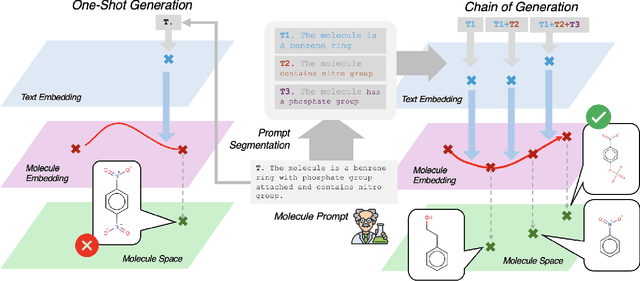
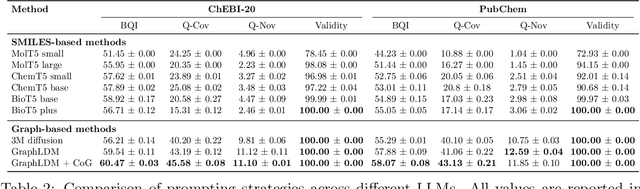
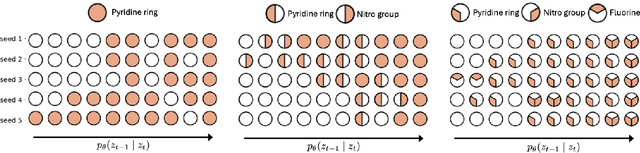
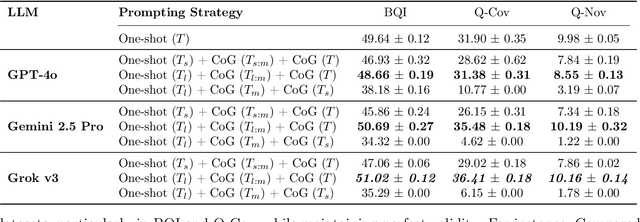
Text-conditioned molecular generation aims to translate natural-language descriptions into chemical structures, enabling scientists to specify functional groups, scaffolds, and physicochemical constraints without handcrafted rules. Diffusion-based models, particularly latent diffusion models (LDMs), have recently shown promise by performing stochastic search in a continuous latent space that compactly captures molecular semantics. Yet existing methods rely on one-shot conditioning, where the entire prompt is encoded once and applied throughout diffusion, making it hard to satisfy all the requirements in the prompt. We discuss three outstanding challenges of one-shot conditioning generation, including the poor interpretability of the generated components, the failure to generate all substructures, and the overambition in considering all requirements simultaneously. We then propose three principles to address those challenges, motivated by which we propose Chain-of-Generation (CoG), a training-free multi-stage latent diffusion framework. CoG decomposes each prompt into curriculum-ordered semantic segments and progressively incorporates them as intermediate goals, guiding the denoising trajectory toward molecules that satisfy increasingly rich linguistic constraints. To reinforce semantic guidance, we further introduce a post-alignment learning phase that strengthens the correspondence between textual and molecular latent spaces. Extensive experiments on benchmark and real-world tasks demonstrate that CoG yields higher semantic alignment, diversity, and controllability than one-shot baselines, producing molecules that more faithfully reflect complex, compositional prompts while offering transparent insight into the generation process.
SWE-Compass: Towards Unified Evaluation of Agentic Coding Abilities for Large Language Models
Nov 07, 2025Evaluating large language models (LLMs) for software engineering has been limited by narrow task coverage, language bias, and insufficient alignment with real-world developer workflows. Existing benchmarks often focus on algorithmic problems or Python-centric bug fixing, leaving critical dimensions of software engineering underexplored. To address these gaps, we introduce SWE-Compass1, a comprehensive benchmark that unifies heterogeneous code-related evaluations into a structured and production-aligned framework. SWE-Compass spans 8 task types, 8 programming scenarios, and 10 programming languages, with 2000 high-quality instances curated from authentic GitHub pull requests and refined through systematic filtering and validation. We benchmark ten state-of-the-art LLMs under two agentic frameworks, SWE-Agent and Claude Code, revealing a clear hierarchy of difficulty across task types, languages, and scenarios. Moreover, by aligning evaluation with real-world developer practices, SWE-Compass provides a rigorous and reproducible foundation for diagnosing and advancing agentic coding capabilities in large language models.