 Add to Chrome
 Add to Firefox
 Add to Edge
Did You Hear That? Introducing AADG: A Framework for Generating Benchmark Data in Audio Anomaly Detection
Oct 04, 2024
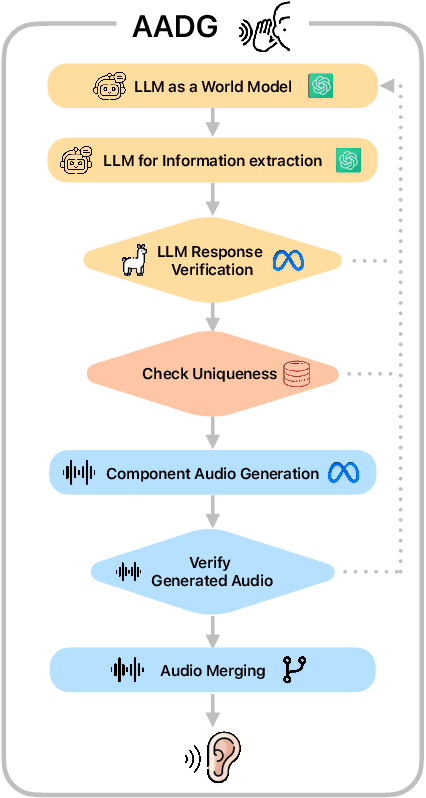
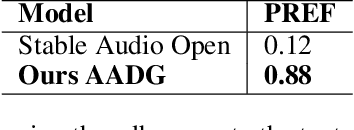
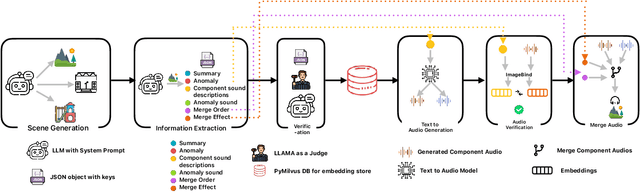
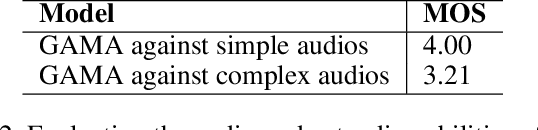
We introduce a novel, general-purpose audio generation framework specifically designed for anomaly detection and localization. Unlike existing datasets that predominantly focus on industrial and machine-related sounds, our framework focuses a broader range of environments, particularly useful in real-world scenarios where only audio data are available, such as in video-derived or telephonic audio. To generate such data, we propose a new method inspired by the LLM-Modulo framework, which leverages large language models(LLMs) as world models to simulate such real-world scenarios. This tool is modular allowing a plug-and-play approach. It operates by first using LLMs to predict plausible real-world scenarios. An LLM further extracts the constituent sounds, the order and the way in which these should be merged to create coherent wholes. Much like the LLM-Modulo framework, we include rigorous verification of each output stage, ensuring the reliability of the generated data. The data produced using the framework serves as a benchmark for anomaly detection applications, potentially enhancing the performance of models trained on audio data, particularly in handling out-of-distribution cases. Our contributions thus fill a critical void in audio anomaly detection resources and provide a scalable tool for generating diverse, realistic audio data.

ImageFolder: Autoregressive Image Generation with Folded Tokens
Oct 02, 2024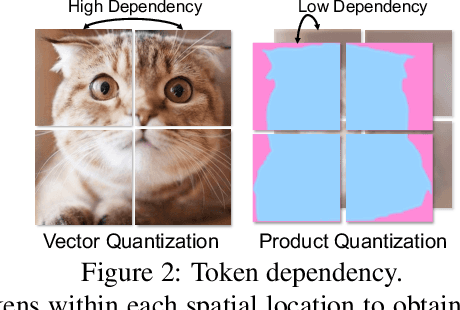


Image tokenizers are crucial for visual generative models, e.g., diffusion models (DMs) and autoregressive (AR) models, as they construct the latent representation for modeling. Increasing token length is a common approach to improve the image reconstruction quality. However, tokenizers with longer token lengths are not guaranteed to achieve better generation quality. There exists a trade-off between reconstruction and generation quality regarding token length. In this paper, we investigate the impact of token length on both image reconstruction and generation and provide a flexible solution to the tradeoff. We propose ImageFolder, a semantic tokenizer that provides spatially aligned image tokens that can be folded during autoregressive modeling to improve both generation efficiency and quality. To enhance the representative capability without increasing token length, we leverage dual-branch product quantization to capture different contexts of images. Specifically, semantic regularization is introduced in one branch to encourage compacted semantic information while another branch is designed to capture the remaining pixel-level details. Extensive experiments demonstrate the superior quality of image generation and shorter token length with ImageFolder tokenizer.
ESPnet-Codec: Comprehensive Training and Evaluation of Neural Codecs for Audio, Music, and Speech
Sep 24, 2024Neural codecs have become crucial to recent speech and audio generation research. In addition to signal compression capabilities, discrete codecs have also been found to enhance downstream training efficiency and compatibility with autoregressive language models. However, as extensive downstream applications are investigated, challenges have arisen in ensuring fair comparisons across diverse applications. To address these issues, we present a new open-source platform ESPnet-Codec, which is built on ESPnet and focuses on neural codec training and evaluation. ESPnet-Codec offers various recipes in audio, music, and speech for training and evaluation using several widely adopted codec models. Together with ESPnet-Codec, we present VERSA, a standalone evaluation toolkit, which provides a comprehensive evaluation of codec performance over 20 audio evaluation metrics. Notably, we demonstrate that ESPnet-Codec can be integrated into six ESPnet tasks, supporting diverse applications.
Revisiting Acoustic Features for Robust ASR
Sep 24, 2024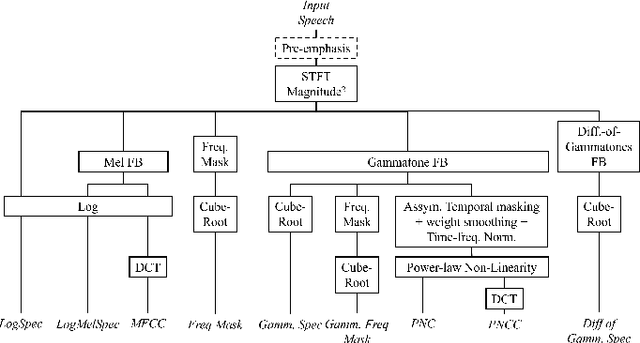
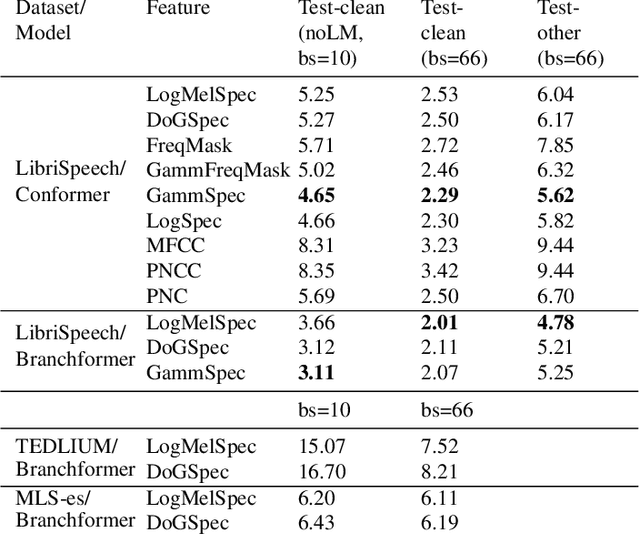
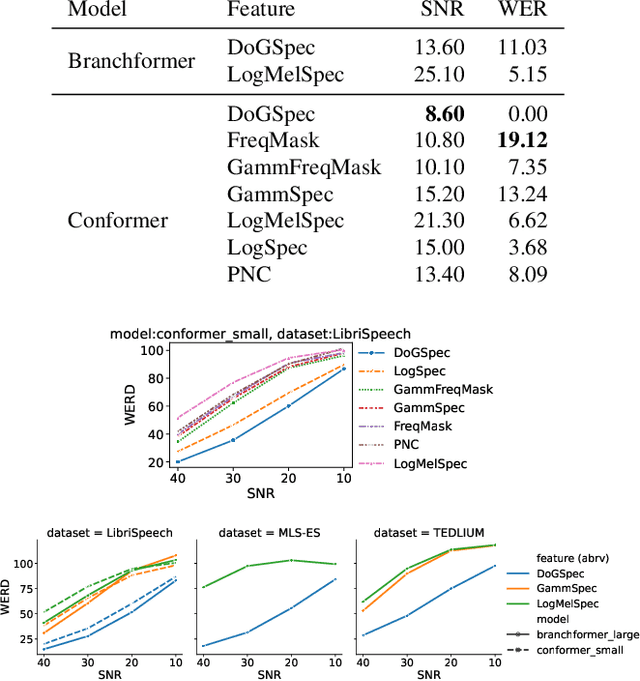
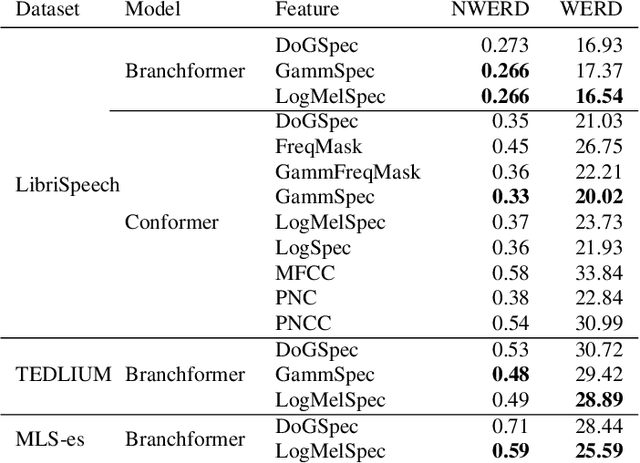
Automatic Speech Recognition (ASR) systems must be robust to the myriad types of noises present in real-world environments including environmental noise, room impulse response, special effects as well as attacks by malicious actors (adversarial attacks). Recent works seek to improve accuracy and robustness by developing novel Deep Neural Networks (DNNs) and curating diverse training datasets for them, while using relatively simple acoustic features. While this approach improves robustness to the types of noise present in the training data, it confers limited robustness against unseen noises and negligible robustness to adversarial attacks. In this paper, we revisit the approach of earlier works that developed acoustic features inspired by biological auditory perception that could be used to perform accurate and robust ASR. In contrast, Specifically, we evaluate the ASR accuracy and robustness of several biologically inspired acoustic features. In addition to several features from prior works, such as gammatone filterbank features (GammSpec), we also propose two new acoustic features called frequency masked spectrogram (FreqMask) and difference of gammatones spectrogram (DoGSpec) to simulate the neuro-psychological phenomena of frequency masking and lateral suppression. Experiments on diverse models and datasets show that (1) DoGSpec achieves significantly better robustness than the highly popular log mel spectrogram (LogMelSpec) with minimal accuracy degradation, and (2) GammSpec achieves better accuracy and robustness to non-adversarial noises from the Speech Robust Bench benchmark, but it is outperformed by DoGSpec against adversarial attacks.
DeWinder: Single-Channel Wind Noise Reduction using Ultrasound Sensing
Sep 10, 2024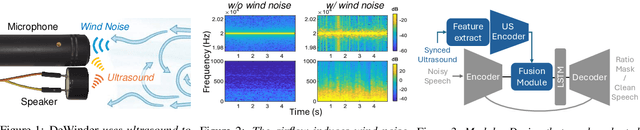
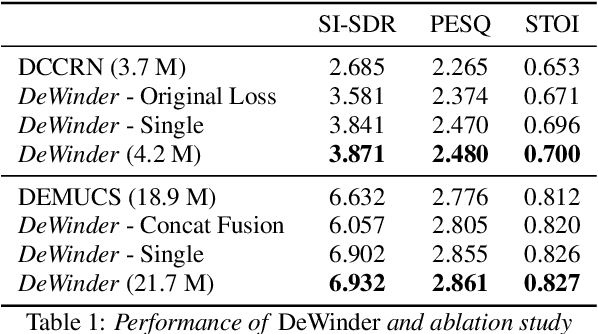
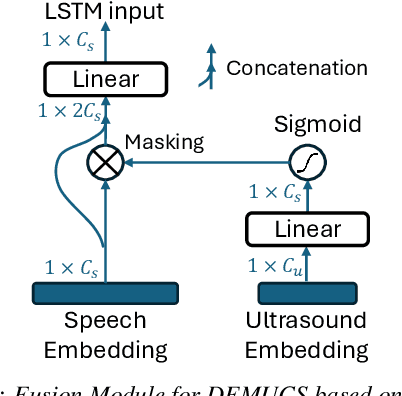
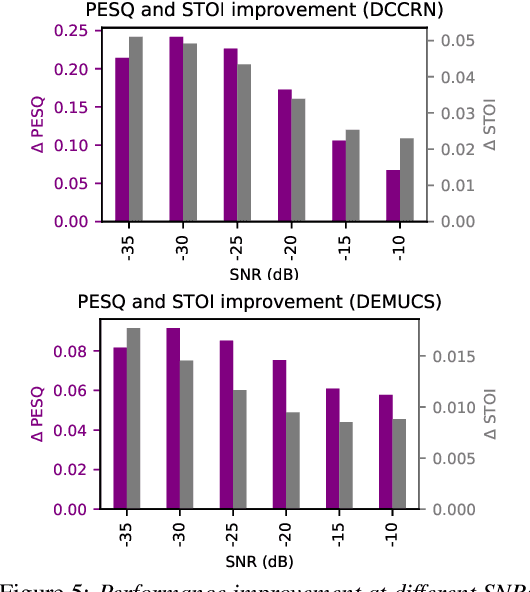
The quality of audio recordings in outdoor environments is often degraded by the presence of wind. Mitigating the impact of wind noise on the perceptual quality of single-channel speech remains a significant challenge due to its non-stationary characteristics. Prior work in noise suppression treats wind noise as a general background noise without explicit modeling of its characteristics. In this paper, we leverage ultrasound as an auxiliary modality to explicitly sense the airflow and characterize the wind noise. We propose a multi-modal deep-learning framework to fuse the ultrasonic Doppler features and speech signals for wind noise reduction. Our results show that DeWinder can significantly improve the noise reduction capabilities of state-of-the-art speech enhancement models.
PDAF: A Phonetic Debiasing Attention Framework For Speaker Verification
Sep 09, 2024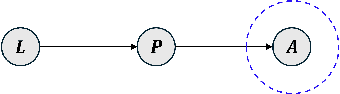
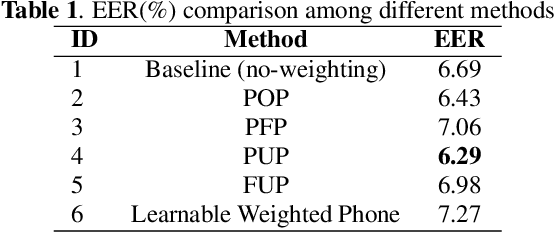
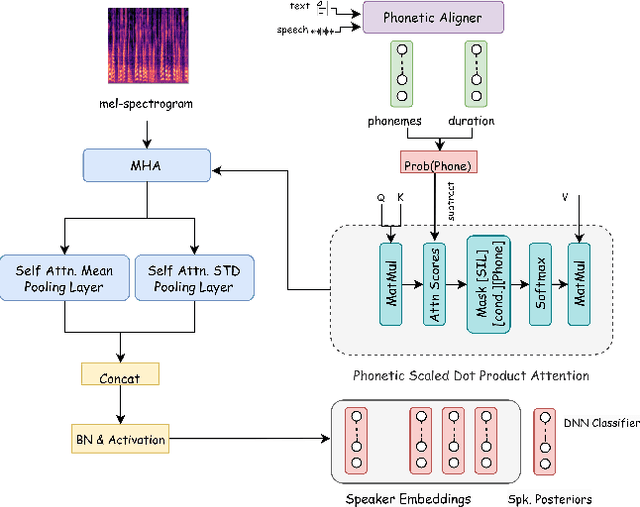
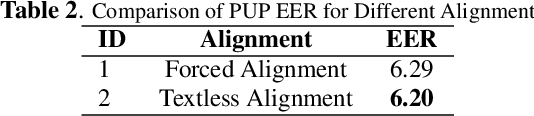
Speaker verification systems are crucial for authenticating identity through voice. Traditionally, these systems focus on comparing feature vectors, overlooking the speech's content. However, this paper challenges this by highlighting the importance of phonetic dominance, a measure of the frequency or duration of phonemes, as a crucial cue in speaker verification. A novel Phoneme Debiasing Attention Framework (PDAF) is introduced, integrating with existing attention frameworks to mitigate biases caused by phonetic dominance. PDAF adjusts the weighting for each phoneme and influences feature extraction, allowing for a more nuanced analysis of speech. This approach paves the way for more accurate and reliable identity authentication through voice. Furthermore, by employing various weighting strategies, we evaluate the influence of phonetic features on the efficacy of the speaker verification system.
Efficient Autoregressive Audio Modeling via Next-Scale Prediction
Aug 16, 2024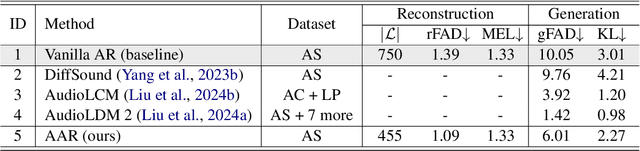
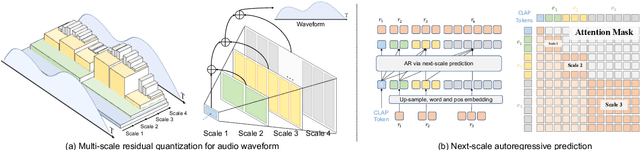
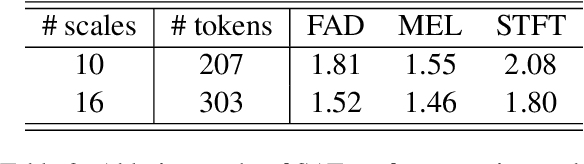
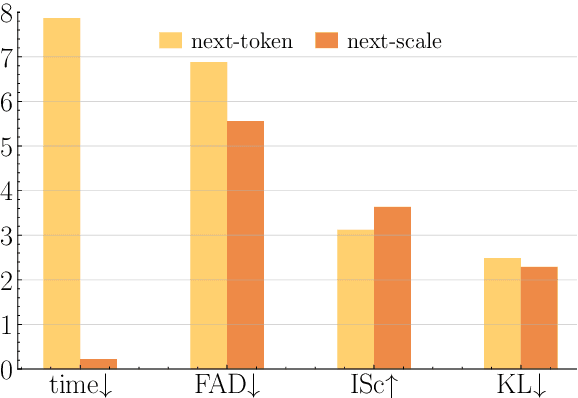
Audio generation has achieved remarkable progress with the advance of sophisticated generative models, such as diffusion models (DMs) and autoregressive (AR) models. However, due to the naturally significant sequence length of audio, the efficiency of audio generation remains an essential issue to be addressed, especially for AR models that are incorporated in large language models (LLMs). In this paper, we analyze the token length of audio tokenization and propose a novel \textbf{S}cale-level \textbf{A}udio \textbf{T}okenizer (SAT), with improved residual quantization. Based on SAT, a scale-level \textbf{A}coustic \textbf{A}uto\textbf{R}egressive (AAR) modeling framework is further proposed, which shifts the next-token AR prediction to next-scale AR prediction, significantly reducing the training cost and inference time. To validate the effectiveness of the proposed approach, we comprehensively analyze design choices and demonstrate the proposed AAR framework achieves a remarkable \textbf{35}$\times$ faster inference speed and +\textbf{1.33} Fr\'echet Audio Distance (FAD) against baselines on the AudioSet benchmark. Code: \url{https://github.com/qiuk2/AAR}.
Speech vs. Transcript: Does It Matter for Human Annotators in Speech Summarization?
Aug 12, 2024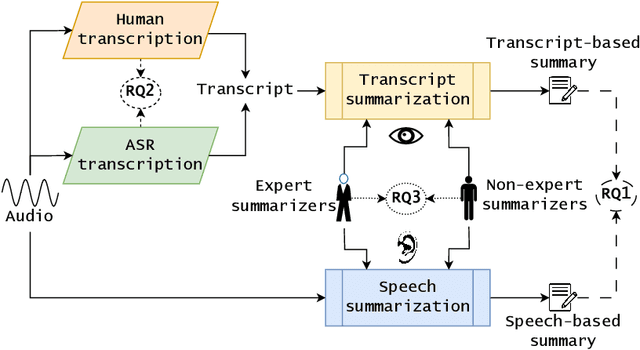
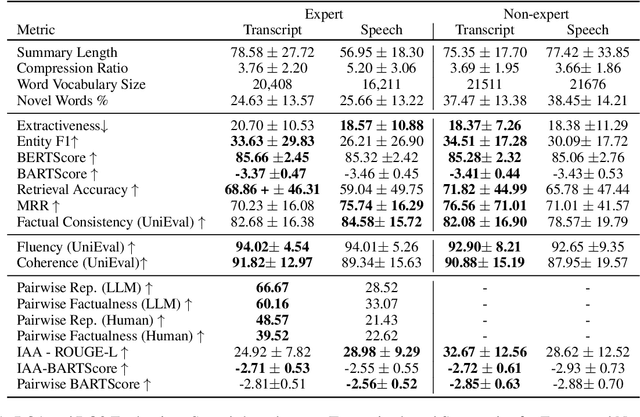


Reference summaries for abstractive speech summarization require human annotation, which can be performed by listening to an audio recording or by reading textual transcripts of the recording. In this paper, we examine whether summaries based on annotators listening to the recordings differ from those based on annotators reading transcripts. Using existing intrinsic evaluation based on human evaluation, automatic metrics, LLM-based evaluation, and a retrieval-based reference-free method. We find that summaries are indeed different based on the source modality, and that speech-based summaries are more factually consistent and information-selective than transcript-based summaries. Meanwhile, transcript-based summaries are impacted by recognition errors in the source, and expert-written summaries are more informative and reliable. We make all the collected data and analysis code public(https://github.com/cmu-mlsp/interview_humanssum) to facilitate the reproduction of our work and advance research in this area.
Audio Entailment: Assessing Deductive Reasoning for Audio Understanding
Jul 25, 2024Recent literature uses language to build foundation models for audio. These Audio-Language Models (ALMs) are trained on a vast number of audio-text pairs and show remarkable performance in tasks including Text-to-Audio Retrieval, Captioning, and Question Answering. However, their ability to engage in more complex open-ended tasks, like Interactive Question-Answering, requires proficiency in logical reasoning -- a skill not yet benchmarked. We introduce the novel task of Audio Entailment to evaluate an ALM's deductive reasoning ability. This task assesses whether a text description (hypothesis) of audio content can be deduced from an audio recording (premise), with potential conclusions being entailment, neutral, or contradiction, depending on the sufficiency of the evidence. We create two datasets for this task with audio recordings sourced from two audio captioning datasets -- AudioCaps and Clotho -- and hypotheses generated using Large Language Models (LLMs). We benchmark state-of-the-art ALMs and find deficiencies in logical reasoning with both zero-shot and linear probe evaluations. Finally, we propose "caption-before-reason", an intermediate step of captioning that improves the zero-shot and linear-probe performance of ALMs by an absolute 6% and 3%, respectively.
SELM: Enhancing Speech Emotion Recognition for Out-of-Domain Scenarios
Jul 22, 2024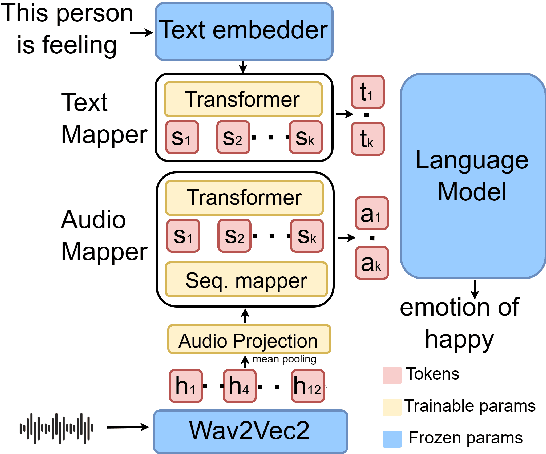
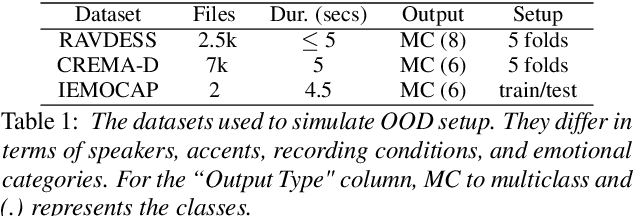
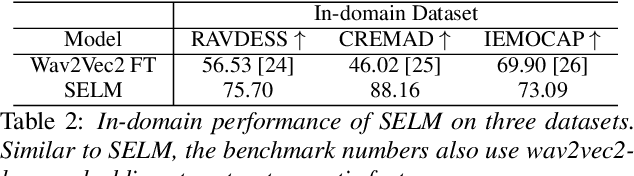
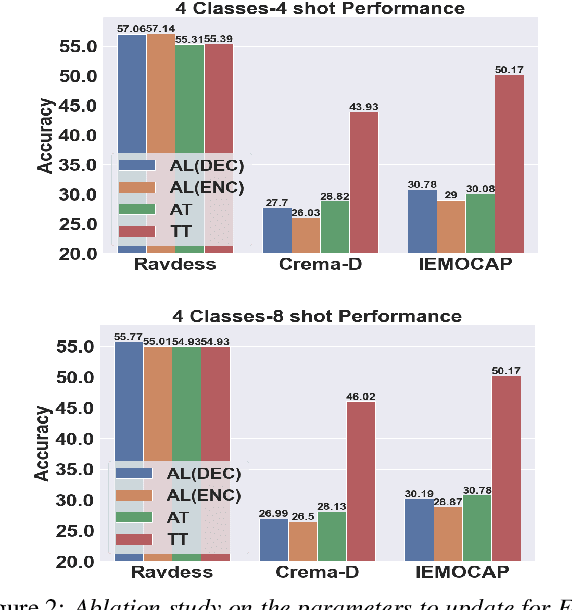
Speech Emotion Recognition (SER) has been traditionally formulated as a classification task. However, emotions are generally a spectrum whose distribution varies from situation to situation leading to poor Out-of-Domain (OOD) performance. We take inspiration from statistical formulation of Automatic Speech Recognition (ASR) and formulate the SER task as generating the most likely sequence of text tokens to infer emotion. The formulation breaks SER into predicting acoustic model features weighted by language model prediction. As an instance of this approach, we present SELM, an audio-conditioned language model for SER that predicts different emotion views. We train SELM on curated speech emotion corpus and test it on three OOD datasets (RAVDESS, CREMAD, IEMOCAP) not used in training. SELM achieves significant improvements over the state-of-the-art baselines, with 17% and 7% relative accuracy gains for RAVDESS and CREMA-D, respectively. Moreover, SELM can further boost its performance by Few-Shot Learning using a few annotated examples. The results highlight the effectiveness of our SER formulation, especially to improve performance in OOD scenarios.