 Add to Chrome
 Add to Firefox
 Add to Edge
MMSF: Multitask and Multimodal Supervised Framework for WSI Classification and Survival Analysis
Jan 28, 2026
Multimodal evidence is critical in computational pathology: gigapixel whole slide images capture tumor morphology, while patient-level clinical descriptors preserve complementary context for prognosis. Integrating such heterogeneous signals remains challenging because feature spaces exhibit distinct statistics and scales. We introduce MMSF, a multitask and multimodal supervised framework built on a linear-complexity MIL backbone that explicitly decomposes and fuses cross-modal information. MMSF comprises a graph feature extraction module embedding tissue topology at the patch level, a clinical data embedding module standardizing patient attributes, a feature fusion module aligning modality-shared and modality-specific representations, and a Mamba-based MIL encoder with multitask prediction heads. Experiments on CAMELYON16 and TCGA-NSCLC demonstrate 2.1--6.6\% accuracy and 2.2--6.9\% AUC improvements over competitive baselines, while evaluations on five TCGA survival cohorts yield 7.1--9.8\% C-index improvements compared with unimodal methods and 5.6--7.1\% over multimodal alternatives.

A deep local attention network for pre-operative lymph node metastasis prediction in pancreatic cancer via multiphase CT imaging
Jan 04, 2023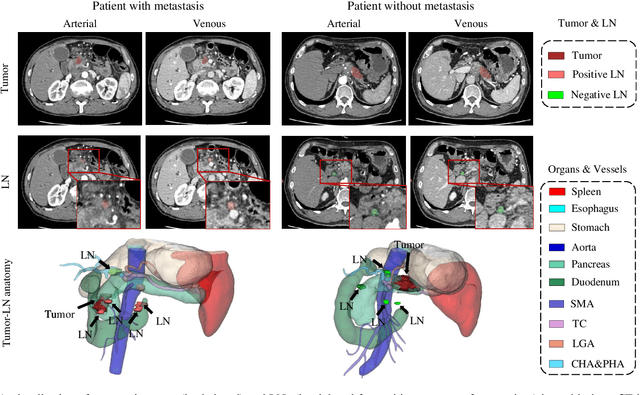
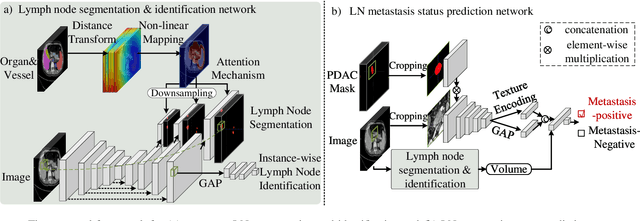


Lymph node (LN) metastasis status is one of the most critical prognostic and cancer staging factors for patients with resectable pancreatic ductal adenocarcinoma (PDAC), or in general, for any types of solid malignant tumors. Preoperative prediction of LN metastasis from non-invasive CT imaging is highly desired, as it might be straightforwardly used to guide the following neoadjuvant treatment decision and surgical planning. Most studies only capture the tumor characteristics in CT imaging to implicitly infer LN metastasis and very few work exploit direct LN's CT imaging information. To the best of our knowledge, this is the first work to propose a fully-automated LN segmentation and identification network to directly facilitate the LN metastasis status prediction task. Nevertheless LN segmentation/detection is very challenging since LN can be easily confused with other hard negative anatomic structures (e.g., vessels) from radiological images. We explore the anatomical spatial context priors of pancreatic LN locations by generating a guiding attention map from related organs and vessels to assist segmentation and infer LN status. As such, LN segmentation is impelled to focus on regions that are anatomically adjacent or plausible with respect to the specific organs and vessels. The metastasized LN identification network is trained to classify the segmented LN instances into positives or negatives by reusing the segmentation network as a pre-trained backbone and padding a new classification head. More importantly, we develop a LN metastasis status prediction network that combines the patient-wise aggregation results of LN segmentation/identification and deep imaging features extracted from the tumor region. Extensive quantitative nested five-fold cross-validation is conducted on a discovery dataset of 749 patients with PDAC.