 Add to Chrome
 Add to Firefox
 Add to Edge
Terahertz Beam Squint Mitigation via Six-Dimensional Movable Antennas
Mar 25, 2026
Analog beamforming holds great potential for future terahertz (THz) communications due to its ability to generate high-gain directional beams with low-cost phase shifters. However, conventional analog beamforming may suffer substantial performance degradation in wideband systems due to the beam squint effect. Instead of relying on high-cost true-time delayers, we propose an efficient six-dimensional movable antenna (6DMA) architecture to mitigate the beam-squint effect. In particular, we study a wideband wide-beam coverage problem in this paper, aiming to maximize the minimum beamforming gain over a given range of azimuth/elevation angles and frequencies by jointly optimizing the analog beamforming vector, the MA positions within a two-dimensional (2D) region, and the three-dimensional (3D) rotation angles of the antenna array. However, this problem is non-convex and intractable to solve optimally due to the coupling of the spatial and frequency domains and that of the antenna weights, positions and rotation. To tackle this problem, we first derive an optimal solution to it in a special case with azimuth or elevation angle coverage only. It is shown that rotating a uniform linear array (ULA) is sufficient to achieve global optimality and eliminate beam-squint effects. While for other general cases, an alternating optimization (AO) algorithm is proposed to obtain a high-quality suboptimal solution, where the antennas' beamforming weights, positions, and rotation angles are alternately optimized by combining successive convex approximation (SCA), sequential update with Gibbs sampling (GS), and hybrid coarse- and fine-grained search. Simulation results demonstrate that our proposed scheme can significantly outperform conventional antenna arrays without antenna movement or rotation, thus offering a cost-effective solution for wideband transmission over THz bands.

Rotatable Antenna Array-Enhanced Null Steering: Performance Analysis and Optimization
Dec 13, 2025Conventional fixed-orientation antenna (FOA) arrays offer limited degrees of freedom (DoF) for flexible beamforming such as null steering. To address this limitation, we propose a new rotatable antenna array (RAA) architecture in this paper, which enables three-dimensional (3D) rotational control of an antenna array to provide enhanced spatial flexibility for null steering. To characterize its performance, we aim to jointly optimize the 3D rotational angles of the RAA, to maximize the beam gain over a given desired direction, while nulling those over multiple interference directions under zero-forcing (ZF) beamforming. However, this problem is non-convex and challenging to tackle due to the highly nonlinear expression of the beam gain in terms of the rotational angles. To gain insights, we first examine several special cases including both isotropic and directional antenna radiation patterns, deriving the conditions under which full beam gain can be achieved over the desired direction while meeting the nulling constraints for interference directions. These conditions clearly indicate that compared with FOA arrays, RAAs can significantly relax the angular separation requirement for achieving effective null steering. For other general cases, we propose a sequential update algorithm, that iteratively refines the 3D rotational angles by discretizing the 3D angular search space. To avoid undesired local optimum, a Gibbs sampling (GS) procedure is also employed between two consecutive rounds of sequential update for solution exploration. Simulation results verify our analytical results and show superior null-steering performance of RAAs to FOA arrays.
THz Beam Squint Mitigation via 3D Rotatable Antennas
Mar 11, 2025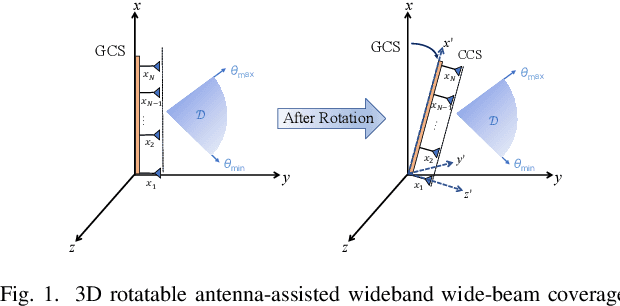
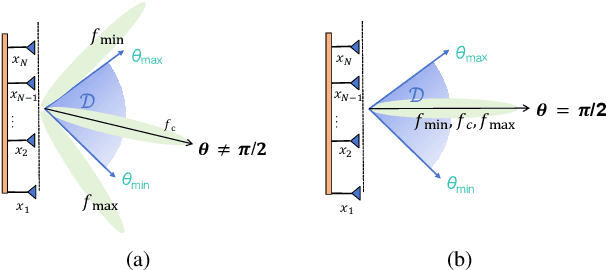
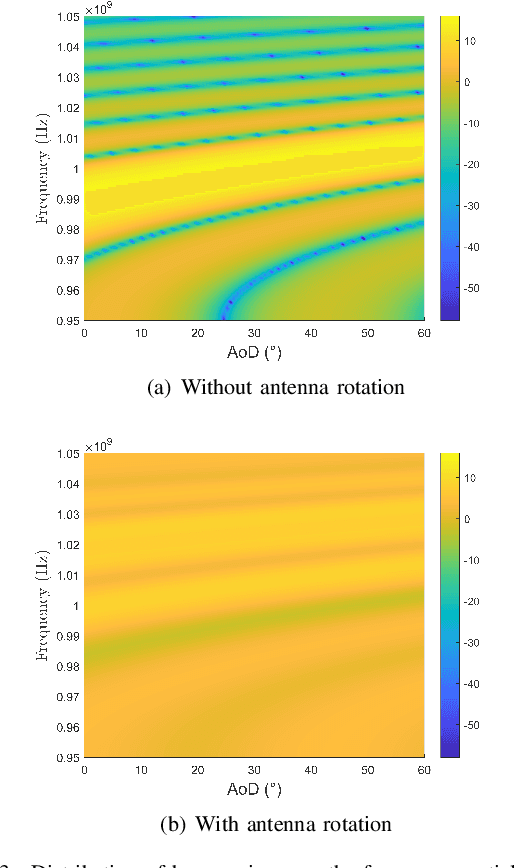
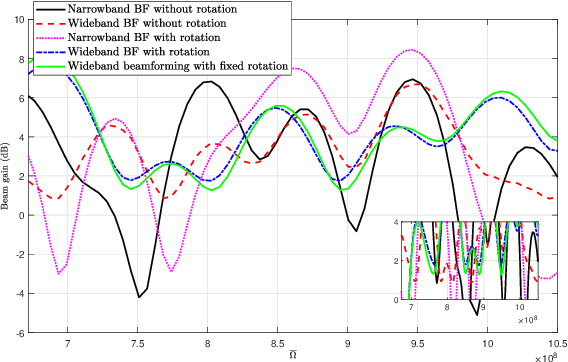
Analog beamforming holds great potential for future terahertz (THz) communications due to its ability to generate high-gain directional beams with low-cost phase shifters.However, conventional analog beamforming may suffer substantial performance degradation in wideband systems due to the beam-squint effects. Instead of relying on high-cost true time delayers, we propose in this paper an efficient three-dimensional (3D) rotatable antenna technology to mitigate the beam-squint effects, motivated by the fact that beam squint disappears along the boresight direction. In particular, we focus on a wideband wide-beam coverage problem in this paper, aiming to maximize the minimum beamforming gain within a given angle and frequency range by jointly optimizing the analog beamforming vector and the 3D rotation angles of the antenna array. However, this problem is non-convex and difficult to be optimally solved due to the coupling of the spatial and frequency domains and that of the antenna weights and rotation. To tackle this issue, we first reformulate the problem into an equivalent form by merging the spatial and frequency domains into a single composite domain. Next, we combine alternating optimization (AO) and successive convex approximation (SCA) algorithms to optimize the analog beamforming and rotation angles within this composite domain. Simulation results demonstrate that the proposed scheme can significantly outperform conventional schemes without antenna rotation, thus offering a cost-effective solution for wideband transmission over THz bands.