 Add to Chrome
 Add to Firefox
 Add to Edge
Relaying Signal When Monitoring Traffic: Double Use of Aerial Vehicles Towards Intelligent Low-Altitude Networking
Dec 16, 2025
In intelligent low-altitude networks, integrating monitoring tasks into communication unmanned aerial vehicles (UAVs) can consume resources and increase handoff latency for communication links. To address this challenge, we propose a strategy that enables a "double use" of UAVs, unifying the monitoring and relay handoff functions into a single, efficient process. Our scheme, guided by an integrated sensing and communication framework, coordinates these multi-role UAVs through a proactive handoff network that fuses multi-view sensory data from aerial and ground vehicles. A lightweight vehicle inspection module and a two-stage training procedure are developed to ensure monitoring accuracy and collaborative efficiency. Simulation results demonstrate the effectiveness of this integrated approach: it reduces communication outage probability by nearly 10% at a 200 Mbps requirement without compromising monitoring performance and maintains high resilience (86% achievable rate) even in the absence of multiple UAVs, outperforming traditional ground-based handoff schemes. Our code is available at the https://github.com/Jiahui-L/UAP.

Linear Model of RIS-Aided High-Mobility Communication System
Feb 28, 2025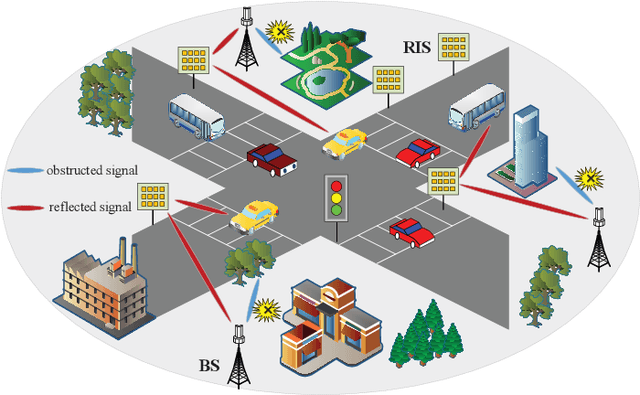
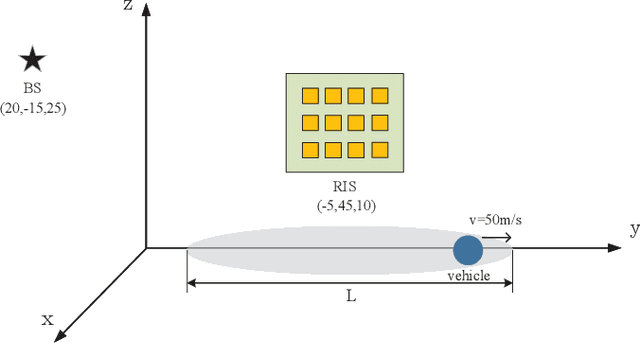
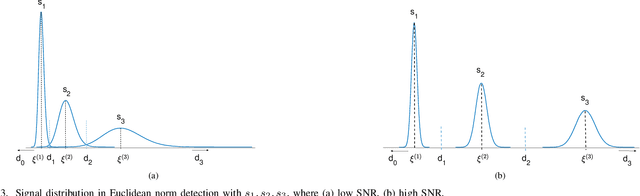
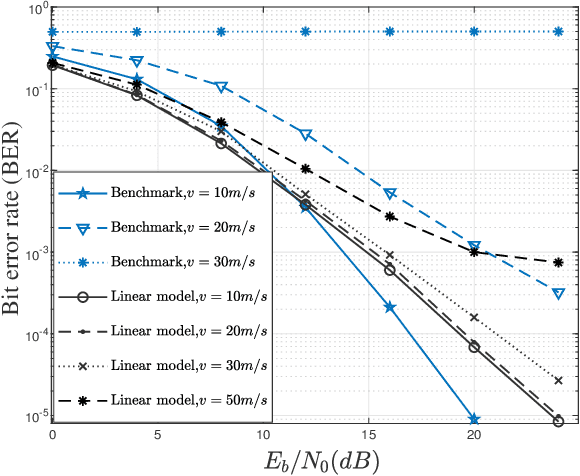
Reconfigurable intelligent surface (RIS)-aided vehicle-to-everything (V2X) communication has emerged as a crucial solution for providing reliable data services to vehicles on the road. However, in delay-sensitive or high-mobility communications, the rapid movement of vehicles can lead to random scattering in the environment and time-selective fading in the channel. In view of this, we investigate in this paper an innovative linear model with low-complexity transmitter signal design and receiver detection methods, which boost stability in fast-fading environments and reduce channel training overhead. Specifically, considering the differences in hardware design and signal processing at the receiving end between uplink and downlink communication systems, distinct solutions are proposed. Accordingly, we first integrate the Rician channel introduced by the RIS with the corresponding signal processing algorithms to model the RIS-aided downlink communication system as a Doppler-robust linear model. Inspired by this property, we design a precoding scheme based on the linear model to reduce the complexity of precoding. Then, by leveraging the linear model and the large-scale antenna array at the base station (BS) side, we improve the linear model for the uplink communication system and derive its asymptotic performance in closed-form. Simulation results demonstrate the performance advantages of the proposed RIS-aided high-mobility communication system compared to other benchmark schemes.
* accepted in IEEE Transactions on Vehicular Technology( Early Access )