 Add to Chrome
 Add to Firefox
 Add to Edge
Path Integral Value Matching for Linear Quadratic Stochastic Optimal Control
Aug 11, 2026
Linear Quadratic Stochastic Optimal Control (LQ-SOC) establishes a fundamental framework for steering noisy dynamical systems and has recently gained renewed interest in the machine learning community. However, current state-of-the-art policy-based methods suffer from prohibitive computational costs and instability due to their heavy reliance on full-trajectory simulation. To overcome these limitations, we propose a paradigm shift toward a value-based approach by revisiting Path Integral Control (PIC). Although standard PIC suffers from the same high-variance bottleneck as policy-based methods, we discover that by truncating and marginalizing the original path integral formulation, we can derive a temporal recursive form of the value function. Building upon this theoretical foundation, we propose the Path Integral Value Matching (PI-VM) algorithm. Specifically, we employ temporal-difference learning to approximate the recursive value dynamics, and further integrate the Girsanov theorem with experience replay to enable off-policy training. We benchmark PI-VM against SOTA policy-based methods across various SOC benchmarks and sampling tasks. Empirical results demonstrate that PI-VM matches SOTA precision with an order-of-magnitude efficiency gain in low-dimensional settings, while effectively mitigating mode collapse in high-dimensional scenarios. Consequently, PI-VM offers a scalable solution for solving complex SOC problems.

scDFM: Distributional Flow Matching Model for Robust Single-Cell Perturbation Prediction
Feb 06, 2026A central goal in systems biology and drug discovery is to predict the transcriptional response of cells to perturbations. This task is challenging due to the noisy and sparse nature of single-cell measurements, as well as the fact that perturbations often induce population-level shifts rather than changes in individual cells. Existing deep learning methods typically assume cell-level correspondences, limiting their ability to capture such global effects. We present scDFM, a generative framework based on conditional flow matching that models the full distribution of perturbed cells conditioned on control states. By incorporating a maximum mean discrepancy (MMD) objective, our method aligns perturbed and control populations beyond cell-level correspondences. To further improve robustness to sparsity and noise, we introduce the Perturbation-Aware Differential Transformer (PAD-Transformer), a backbone architecture that leverages gene interaction graphs and differential attention to capture context-specific expression changes. Across multiple genetic and drug perturbation benchmarks, scDFM consistently outperforms prior methods, demonstrating strong generalization in both unseen and combinatorial settings. In the combinatorial setting, it reduces mean squared error by 19.6% relative to the strongest baseline. These results highlight the importance of distribution-level generative modeling for robust in silico perturbation prediction. The code is available at https://github.com/AI4Science-WestlakeU/scDFM
RealPDEBench: A Benchmark for Complex Physical Systems with Real-World Data
Jan 05, 2026Predicting the evolution of complex physical systems remains a central problem in science and engineering. Despite rapid progress in scientific Machine Learning (ML) models, a critical bottleneck is the lack of expensive real-world data, resulting in most current models being trained and validated on simulated data. Beyond limiting the development and evaluation of scientific ML, this gap also hinders research into essential tasks such as sim-to-real transfer. We introduce RealPDEBench, the first benchmark for scientific ML that integrates real-world measurements with paired numerical simulations. RealPDEBench consists of five datasets, three tasks, eight metrics, and ten baselines. We first present five real-world measured datasets with paired simulated datasets across different complex physical systems. We further define three tasks, which allow comparisons between real-world and simulated data, and facilitate the development of methods to bridge the two. Moreover, we design eight evaluation metrics, spanning data-oriented and physics-oriented metrics, and finally benchmark ten representative baselines, including state-of-the-art models, pretrained PDE foundation models, and a traditional method. Experiments reveal significant discrepancies between simulated and real-world data, while showing that pretraining with simulated data consistently improves both accuracy and convergence. In this work, we hope to provide insights from real-world data, advancing scientific ML toward bridging the sim-to-real gap and real-world deployment. Our benchmark, datasets, and instructions are available at https://realpdebench.github.io/.
On the Guidance of Flow Matching
Feb 04, 2025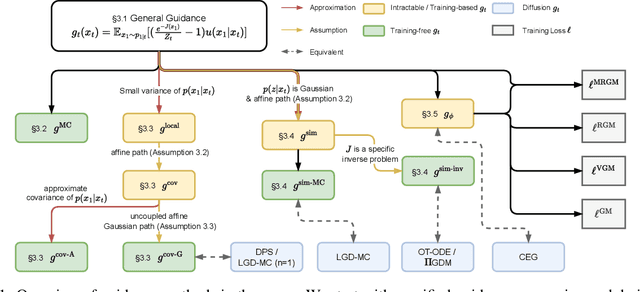
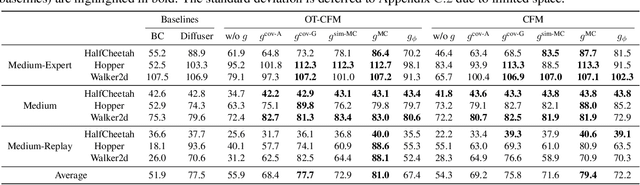
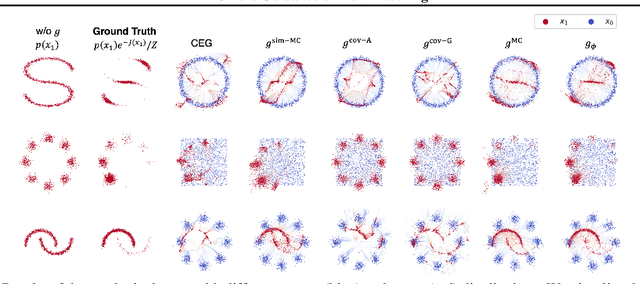
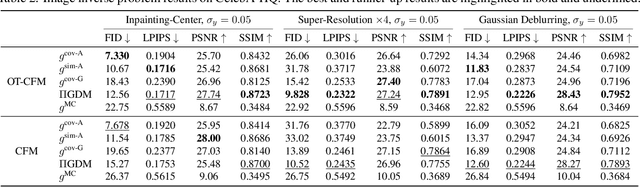
Flow matching has shown state-of-the-art performance in various generative tasks, ranging from image generation to decision-making, where guided generation is pivotal. However, the guidance of flow matching is more general than and thus substantially different from that of its predecessor, diffusion models. Therefore, the challenge in guidance for general flow matching remains largely underexplored. In this paper, we propose the first framework of general guidance for flow matching. From this framework, we derive a family of guidance techniques that can be applied to general flow matching. These include a new training-free asymptotically exact guidance, novel training losses for training-based guidance, and two classes of approximate guidance that cover classical gradient guidance methods as special cases. We theoretically investigate these different methods to give a practical guideline for choosing suitable methods in different scenarios. Experiments on synthetic datasets, image inverse problems, and offline reinforcement learning demonstrate the effectiveness of our proposed guidance methods and verify the correctness of our flow matching guidance framework. Code to reproduce the experiments can be found at https://github.com/AI4Science-WestlakeU/flow_guidance.