 Add to Chrome
 Add to Firefox
 Add to Edge
A Semantic Space is Worth 256 Language Descriptions: Make Stronger Segmentation Models with Descriptive Properties
Dec 21, 2023
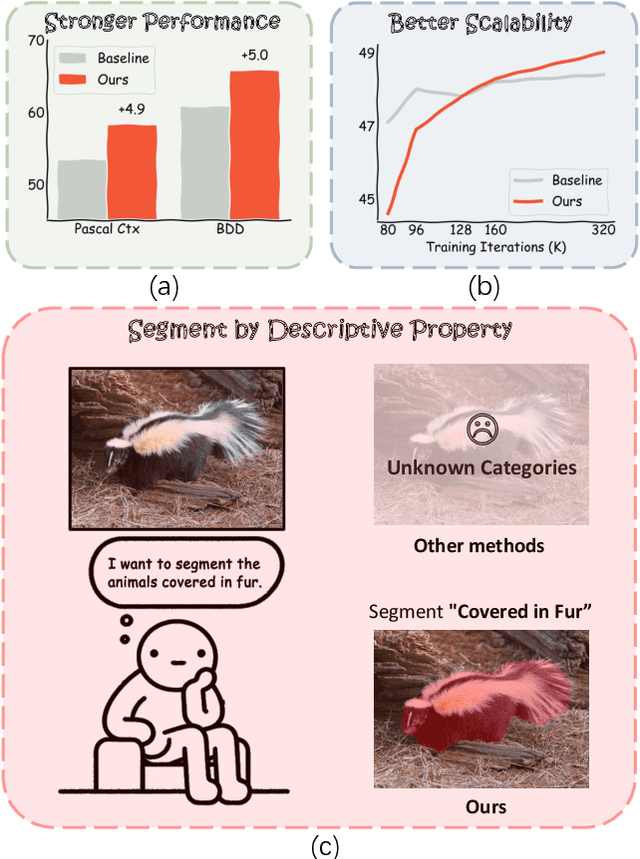

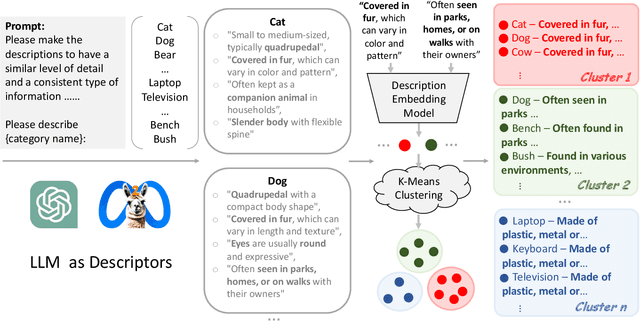

This paper introduces ProLab, a novel approach using property-level label space for creating strong interpretable segmentation models. Instead of relying solely on category-specific annotations, ProLab uses descriptive properties grounded in common sense knowledge for supervising segmentation models. It is based on two core designs. First, we employ Large Language Models (LLMs) and carefully crafted prompts to generate descriptions of all involved categories that carry meaningful common sense knowledge and follow a structured format. Second, we introduce a description embedding model preserving semantic correlation across descriptions and then cluster them into a set of descriptive properties (e.g., 256) using K-Means. These properties are based on interpretable common sense knowledge consistent with theories of human recognition. We empirically show that our approach makes segmentation models perform stronger on five classic benchmarks (e.g., ADE20K, COCO-Stuff, Pascal Context, Cityscapes, and BDD). Our method also shows better scalability with extended training steps than category-level supervision. Our interpretable segmentation framework also emerges with the generalization ability to segment out-of-domain or unknown categories using only in-domain descriptive properties. Code is available at https://github.com/lambert-x/ProLab.

Continual Adversarial Defense
Dec 15, 2023


In response to the rapidly evolving nature of adversarial attacks on a monthly basis, numerous defenses have been proposed to generalize against as many known attacks as possible. However, designing a defense method that can generalize to all types of attacks, including unseen ones, is not realistic because the environment in which defense systems operate is dynamic and comprises various unique attacks used by many attackers. The defense system needs to upgrade itself by utilizing few-shot defense feedback and efficient memory. Therefore, we propose the first continual adversarial defense (CAD) framework that adapts to any attacks in a dynamic scenario, where various attacks emerge stage by stage. In practice, CAD is modeled under four principles: (1) continual adaptation to new attacks without catastrophic forgetting, (2) few-shot adaptation, (3) memory-efficient adaptation, and (4) high accuracy on both clean and adversarial images. We leverage cutting-edge continual learning, few-shot learning, and ensemble learning techniques to qualify the principles. Experiments conducted on CIFAR-10 and ImageNet-100 validate the effectiveness of our approach against multiple stages of 10 modern adversarial attacks and significant improvements over 10 baseline methods. In particular, CAD is capable of quickly adapting with minimal feedback and a low cost of defense failure, while maintaining good performance against old attacks. Our research sheds light on a brand-new paradigm for continual defense adaptation against dynamic and evolving attacks.
Causal-CoG: A Causal-Effect Look at Context Generation for Boosting Multi-modal Language Models
Dec 09, 2023


While Multi-modal Language Models (MLMs) demonstrate impressive multimodal ability, they still struggle on providing factual and precise responses for tasks like visual question answering (VQA). In this paper, we address this challenge from the perspective of contextual information. We propose Causal Context Generation, Causal-CoG, which is a prompting strategy that engages contextual information to enhance precise VQA during inference. Specifically, we prompt MLMs to generate contexts, i.e, text description of an image, and engage the generated contexts for question answering. Moreover, we investigate the advantage of contexts on VQA from a causality perspective, introducing causality filtering to select samples for which contextual information is helpful. To show the effectiveness of Causal-CoG, we run extensive experiments on 10 multimodal benchmarks and show consistent improvements, e.g., +6.30% on POPE, +13.69% on Vizwiz and +6.43% on VQAv2 compared to direct decoding, surpassing existing methods. We hope Casual-CoG inspires explorations of context knowledge in multimodal models, and serves as a plug-and-play strategy for MLM decoding.
Rejuvenating image-GPT as Strong Visual Representation Learners
Dec 04, 2023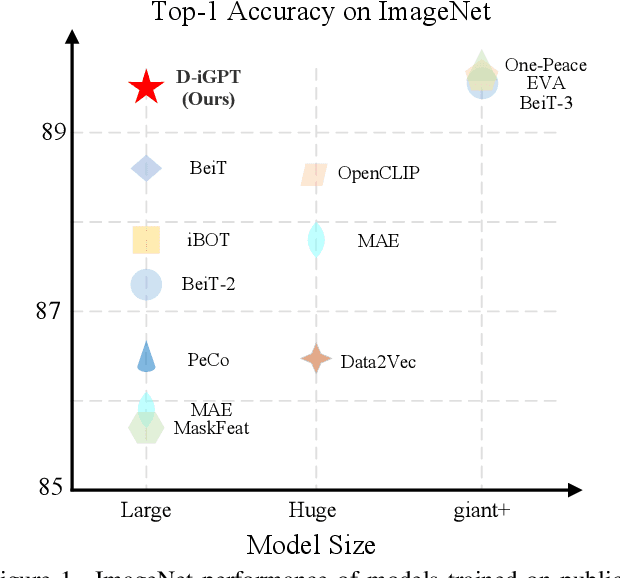
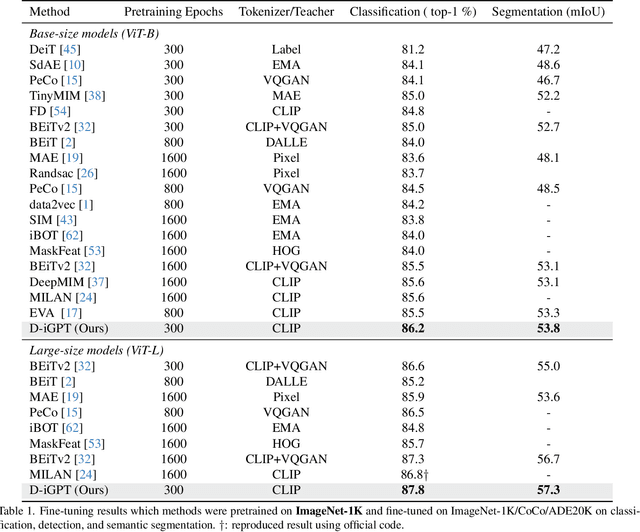
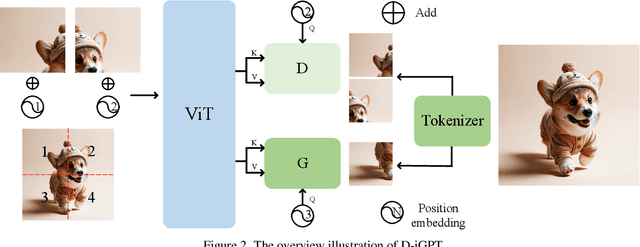
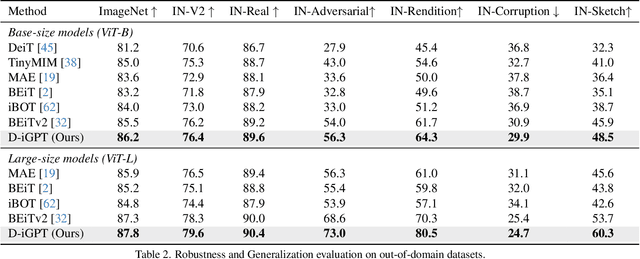
This paper enhances image-GPT (iGPT), one of the pioneering works that introduce autoregressive pretraining to predict next pixels for visual representation learning. Two simple yet essential changes are made. First, we shift the prediction target from raw pixels to semantic tokens, enabling a higher-level understanding of visual content. Second, we supplement the autoregressive modeling by instructing the model to predict not only the next tokens but also the visible tokens. This pipeline is particularly effective when semantic tokens are encoded by discriminatively trained models, such as CLIP. We introduce this novel approach as D-iGPT. Extensive experiments showcase that D-iGPT excels as a strong learner of visual representations: A notable achievement of D-iGPT is its compelling performance on the ImageNet-1K dataset -- by training on publicly available datasets, D-iGPT achieves 89.5\% top-1 accuracy with a vanilla ViT-Large model. This model also shows strong generalization on the downstream task and robustness on out-of-distribution samples. Code is avaiable at \href{https://github.com/OliverRensu/D-iGPT}{https://github.com/OliverRensu/D-iGPT}.
SCLIP: Rethinking Self-Attention for Dense Vision-Language Inference
Dec 04, 2023Recent advances in contrastive language-image pretraining (CLIP) have demonstrated strong capabilities in zero-shot classification by aligning visual representations with target text embeddings in an image level. However, in dense prediction tasks, CLIP often struggles to localize visual features within an image and fails to give accurate pixel-level predictions, which prevents it from functioning as a generalized visual foundation model. In this work, we aim to enhance CLIP's potential for semantic segmentation with minimal modifications to its pretrained models. By rethinking self-attention, we surprisingly find that CLIP can adapt to dense prediction tasks by simply introducing a novel Correlative Self-Attention (CSA) mechanism. Specifically, we replace the traditional self-attention block of CLIP vision encoder's last layer by our CSA module and reuse its pretrained projection matrices of query, key, and value, leading to a training-free adaptation approach for CLIP's zero-shot semantic segmentation. Extensive experiments show the advantage of CSA: we obtain a 38.2% average zero-shot mIoU across eight semantic segmentation benchmarks highlighted in this paper, significantly outperforming the existing SoTA's 33.9% and the vanilla CLIP's 14.1%.
Sequential Modeling Enables Scalable Learning for Large Vision Models
Dec 01, 2023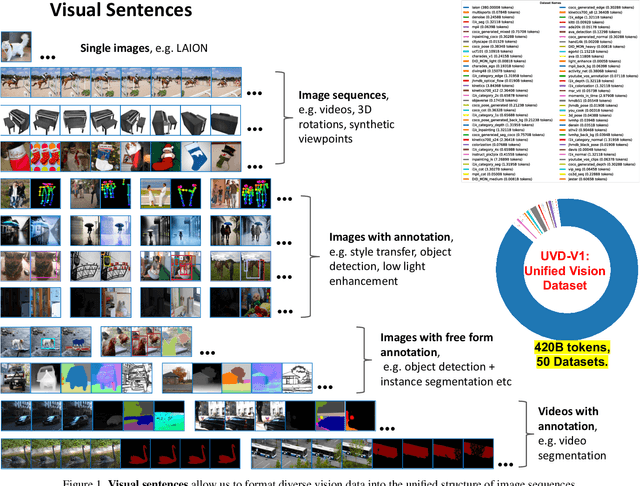
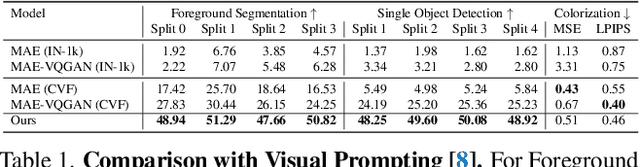
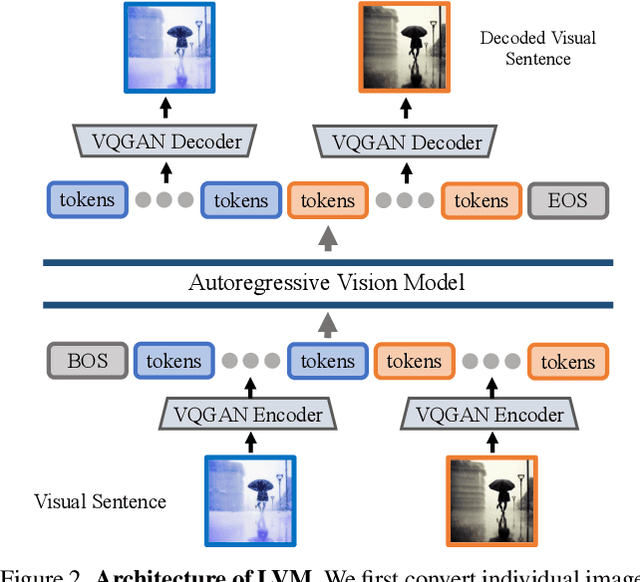
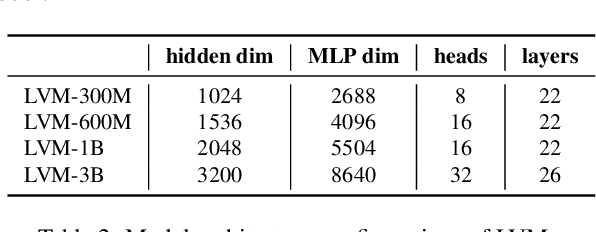
We introduce a novel sequential modeling approach which enables learning a Large Vision Model (LVM) without making use of any linguistic data. To do this, we define a common format, "visual sentences", in which we can represent raw images and videos as well as annotated data sources such as semantic segmentations and depth reconstructions without needing any meta-knowledge beyond the pixels. Once this wide variety of visual data (comprising 420 billion tokens) is represented as sequences, the model can be trained to minimize a cross-entropy loss for next token prediction. By training across various scales of model architecture and data diversity, we provide empirical evidence that our models scale effectively. Many different vision tasks can be solved by designing suitable visual prompts at test time.
Prompt-Based Exemplar Super-Compression and Regeneration for Class-Incremental Learning
Nov 30, 2023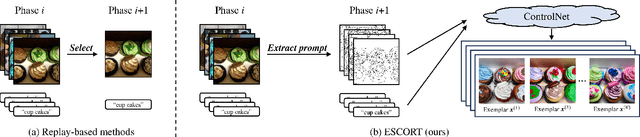
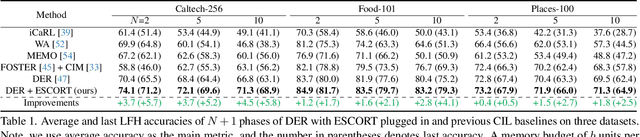
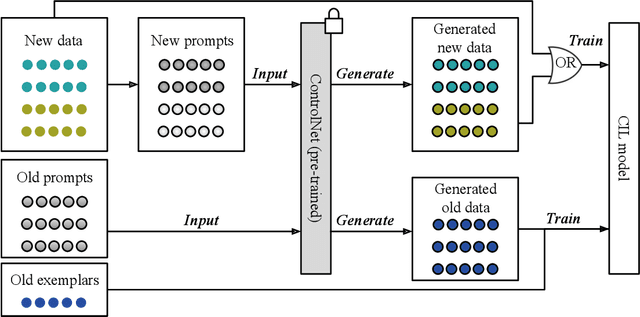
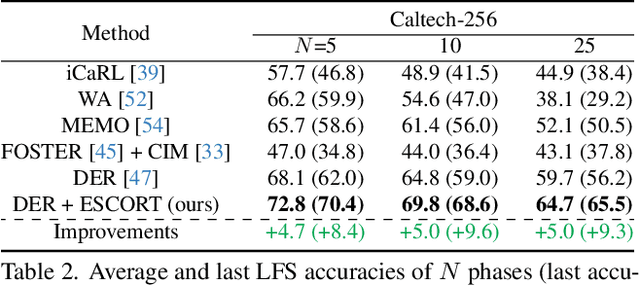
Replay-based methods in class-incremental learning (CIL) have attained remarkable success, as replaying the exemplars of old classes can significantly mitigate catastrophic forgetting. Despite their effectiveness, the inherent memory restrictions of CIL result in saving a limited number of exemplars with poor diversity, leading to data imbalance and overfitting issues. In this paper, we introduce a novel exemplar super-compression and regeneration method, ESCORT, which substantially increases the quantity and enhances the diversity of exemplars. Rather than storing past images, we compress images into visual and textual prompts, e.g., edge maps and class tags, and save the prompts instead, reducing the memory usage of each exemplar to 1/24 of the original size. In subsequent learning phases, diverse high-resolution exemplars are generated from the prompts by a pre-trained diffusion model, e.g., ControlNet. To minimize the domain gap between generated exemplars and real images, we propose partial compression and diffusion-based data augmentation, allowing us to utilize an off-the-shelf diffusion model without fine-tuning it on the target dataset. Therefore, the same diffusion model can be downloaded whenever it is needed, incurring no memory consumption. Comprehensive experiments demonstrate that our method significantly improves model performance across multiple CIL benchmarks, e.g., 5.0 percentage points higher than the previous state-of-the-art on 10-phase Caltech-256 dataset.
Learning Part Segmentation from Synthetic Animals
Nov 30, 2023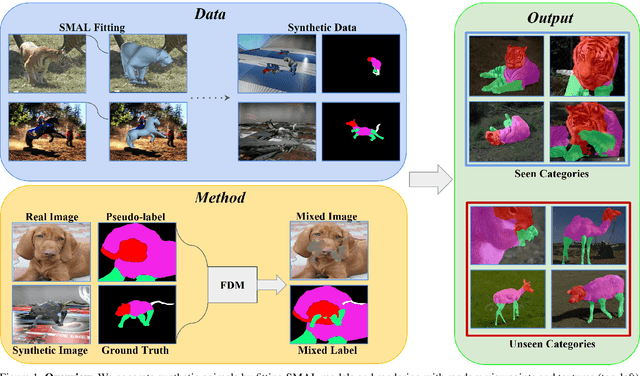
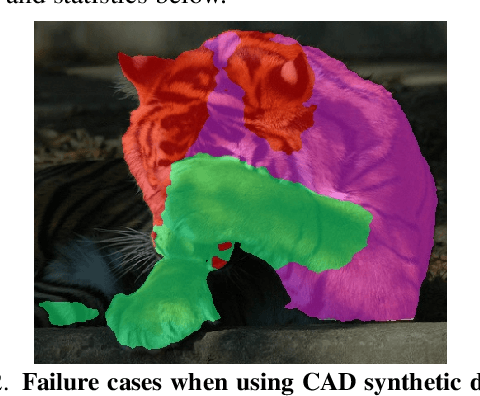
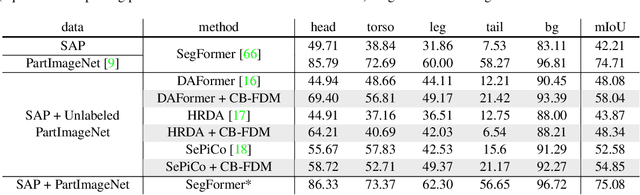

Semantic part segmentation provides an intricate and interpretable understanding of an object, thereby benefiting numerous downstream tasks. However, the need for exhaustive annotations impedes its usage across diverse object types. This paper focuses on learning part segmentation from synthetic animals, leveraging the Skinned Multi-Animal Linear (SMAL) models to scale up existing synthetic data generated by computer-aided design (CAD) animal models. Compared to CAD models, SMAL models generate data with a wider range of poses observed in real-world scenarios. As a result, our first contribution is to construct a synthetic animal dataset of tigers and horses with more pose diversity, termed Synthetic Animal Parts (SAP). We then benchmark Syn-to-Real animal part segmentation from SAP to PartImageNet, namely SynRealPart, with existing semantic segmentation domain adaptation methods and further improve them as our second contribution. Concretely, we examine three Syn-to-Real adaptation methods but observe relative performance drop due to the innate difference between the two tasks. To address this, we propose a simple yet effective method called Class-Balanced Fourier Data Mixing (CB-FDM). Fourier Data Mixing aligns the spectral amplitudes of synthetic images with real images, thereby making the mixed images have more similar frequency content to real images. We further use Class-Balanced Pseudo-Label Re-Weighting to alleviate the imbalanced class distribution. We demonstrate the efficacy of CB-FDM on SynRealPart over previous methods with significant performance improvements. Remarkably, our third contribution is to reveal that the learned parts from synthetic tiger and horse are transferable across all quadrupeds in PartImageNet, further underscoring the utility and potential applications of animal part segmentation.
MaXTron: Mask Transformer with Trajectory Attention for Video Panoptic Segmentation
Nov 30, 2023Video panoptic segmentation requires consistently segmenting (for both `thing' and `stuff' classes) and tracking objects in a video over time. In this work, we present MaXTron, a general framework that exploits Mask XFormer with Trajectory Attention to tackle the task. MaXTron enriches an off-the-shelf mask transformer by leveraging trajectory attention. The deployed mask transformer takes as input a short clip consisting of only a few frames and predicts the clip-level segmentation. To enhance the temporal consistency, MaXTron employs within-clip and cross-clip tracking modules, efficiently utilizing trajectory attention. Originally designed for video classification, trajectory attention learns to model the temporal correspondences between neighboring frames and aggregates information along the estimated motion paths. However, it is nontrivial to directly extend trajectory attention to the per-pixel dense prediction tasks due to its quadratic dependency on input size. To alleviate the issue, we propose to adapt the trajectory attention for both the dense pixel features and object queries, aiming to improve the short-term and long-term tracking results, respectively. Particularly, in our within-clip tracking module, we propose axial-trajectory attention that effectively computes the trajectory attention for tracking dense pixels sequentially along the height- and width-axes. The axial decomposition significantly reduces the computational complexity for dense pixel features. In our cross-clip tracking module, since the object queries in mask transformer are learned to encode the object information, we are able to capture the long-term temporal connections by applying trajectory attention to object queries, which learns to track each object across different clips. Without bells and whistles, MaXTron demonstrates state-of-the-art performances on video segmentation benchmarks.
Instruct2Attack: Language-Guided Semantic Adversarial Attacks
Nov 27, 2023We propose Instruct2Attack (I2A), a language-guided semantic attack that generates semantically meaningful perturbations according to free-form language instructions. We make use of state-of-the-art latent diffusion models, where we adversarially guide the reverse diffusion process to search for an adversarial latent code conditioned on the input image and text instruction. Compared to existing noise-based and semantic attacks, I2A generates more natural and diverse adversarial examples while providing better controllability and interpretability. We further automate the attack process with GPT-4 to generate diverse image-specific text instructions. We show that I2A can successfully break state-of-the-art deep neural networks even under strong adversarial defenses, and demonstrate great transferability among a variety of network architectures.