 Add to Chrome
 Add to Firefox
 Add to Edge
MemChain: Learning Interpretable Memory Traces for Memory-Augmented LLM Agents
Jul 27, 2026
Memory-augmented LLM agents typically answer queries by retrieving relevant memories and feeding them directly to an answer model. This retrieval-as-evidence paradigm assumes retrieved memories are already suitable for reasoning, leaving the answer model to resolve redundancy, conflicts, and weak relevance while incurring substantial context overhead in long-term memory tasks. We propose MemChain, a trainable post-retrieval memory policy that transforms retrieved candidates into answer-facing active memory, represented as a compact and grounded evidence context. Given a user query and retrieved candidates, MemChain first generates a question-conditioned evidence plan, then constructs an ordered grounded evidence trace that organizes retrieved memories according to their semantic roles and dependencies, and finally executes explicit memory actions to produce a concise evidence context for answer generation. To train the mediator, we introduce a two-stage learning framework. Supervised trace learning first teaches the policy to generate structurally valid plans, traces, actions, and evidence contexts. We then propose Trace-Guided Memory Policy Optimization (TMPO), a reinforcement learning objective that optimizes the memory policy using downstream answer quality while jointly encouraging trace grounding, evidence support, structural validity, and answer stability across multiple rollouts. Experiments on LoCoMo and LongMemEval-S demonstrate that MemChain consistently achieves state-of-the-art performance across both closed-source and open-weight frozen answer models while substantially reducing the memory context passed to the answer model.

UCOB: Learning to Utilize and Evolve Agentic Skills via Credit-Aware On-Policy Bidirectional Self-Distillation
Jun 28, 2026Skill memories can improve agentic reinforcement learning by reusing past experience as textual guidance, but retrieved skills are not oracular: they may help in one state while misleading the same policy in another. This makes the common privileged-teacher assumption fragile, namely that a skill-conditioned prompt can be treated as a fixed teacher for the no-skill prompt. We introduce UCOB, a framework for learning to utilize and evolve agentic skills via credit-aware on-policy bidirectional self-distillation. UCOB treats skill-conditioned and no-skill prompts as two on-policy context views of the same model, compares their return-to-go within the same task and anchor state, and uses the higher-return view as the local teacher. This local credit signal internalizes useful skill-conditioned behavior, corrects misleading skill usage, and guides task/state skill memory updates, utility-aware retrieval, and reflection self-training. Experiments on agentic tasks, including ALFWorld, WebShop, and Search-QA, show that UCOB outperforms skill-free RL, skill-memory baselines, and self-distillation methods across model scales, with up to 23.5 and 18.0 point gains over SOTA baselines on ALFWorld and WebShop. Ablations and analyses further validate its core mechanisms and efficiency.
Are Full Rollouts Necessary for On-Policy Distillation?
Jun 01, 2026On-policy distillation (OPD) provides dense teacher feedback along student-generated rollouts rather than fixed teacher traces and has emerged as a promising post-training paradigm. However, standard OPD typically generates full rollouts during training, which is computationally expensive and may expose the student to unreliable teacher feedback at late rollout positions, especially during early training. We identify the rollout horizon as a key bottleneck in OPD that substantially impacts training efficiency. Unlike Reinforcement Learning with Verifiable Rewards (RLVR), OPD does not require a final answer reward to provide learning signals. Therefore, full rollouts may not always be necessary for OPD. Motivated by this insight, we propose two simple horizon-control strategies: Progressive OPD (POPD), which gradually expands the rollout horizon during training, and Truncated OPD (TOPD), which permanently performs distillation on reliable truncated rollouts. Experiments on mathematical reasoning show that POPD improves the training efficiency of OPD by up to 3$\times$, while TOPD matches OPD performance using only 10\% of the rollout horizon, leading to substantial wall-clock and memory reductions. These results demonstrate that controlling the rollout horizon offers a simple and practical path to more efficient OPD.
One LR Doesn't Fit All: Heavy-Tail Guided Layerwise Learning Rates for LLMs
May 21, 2026Learning rate configuration is a fundamental aspect of modern deep learning. The prevailing practice of applying a uniform learning rate across all layers overlooks the structural heterogeneity of Transformers, potentially limiting their effectiveness as the backbone of Large Language Models (LLMs). In this paper, we introduce Layerwise Learning Rate (LLR), an adaptive scheme that assigns distinct learning rates to individual Transformer layers. Our method is grounded in Heavy-Tailed Self-Regularization (HT-SR) theory, which characterizes the empirical spectral density (ESD) of weight correlation matrices to quantify heavy-tailedness. Layers with weaker heavy-tailedness are assigned larger learning rates to accelerate their training, while layers with stronger heavy-tailedness receive smaller learning rates. By tailoring learning rates in this manner, LLR promotes balanced training across layers, leading to faster convergence and improved generalization. Extensive experiments across architectures (from LLaMA to GPT-nano), optimizers (AdamW and Muon), and parameter scales (60M-1B) demonstrate that LLR achieves up to 1.5x training speedup and outperforms baselines, notably raising average zero-shot accuracy from 47.09% to 49.02%. A key advantage of LLR is its low tuning overhead: it transfers nearly optimal LR settings directly from the uniform baseline. Code is available at https://github.com/hed-ucas/Layer-wise-Learning-Rate.
$π$-Play: Multi-Agent Self-Play via Privileged Self-Distillation without External Data
Apr 15, 2026Deep search agents have emerged as a promising paradigm for addressing complex information-seeking tasks, but their training remains challenging due to sparse rewards, weak credit assignment, and limited labeled data. Self-play offers a scalable route to reduce data dependence, but conventional self-play optimizes students only through sparse outcome rewards, leading to low learning efficiency. In this work, we observe that self-play naturally produces a question construction path (QCP) during task generation, an intermediate artifact that captures the reverse solution process. This reveals a new source of privileged information for self-distillation: self-play can itself provide high-quality privileged context for the teacher model in a low-cost and scalable manner, without relying on human feedback or curated privileged information. Leveraging this insight, we propose Privileged Information Self-Play ($π$-Play), a multi-agent self-evolution framework. In $π$-Play, an examiner generates tasks together with their QCPs, and a teacher model leverages QCP as privileged context to densely supervise a student via self-distillation. This design transforms conventional sparse-reward self-play into a dense-feedback self-evolution loop. Extensive experiments show that data-free $π$-Play surpasses fully supervised search agents and improves evolutionary efficiency by 2-3$\times$ over conventional self-play.
Saliency-Guided Representation with Consistency Policy Learning for Visual Unsupervised Reinforcement Learning
Apr 07, 2026Zero-shot unsupervised reinforcement learning (URL) offers a promising direction for building generalist agents capable of generalizing to unseen tasks without additional supervision. Among existing approaches, successor representations (SR) have emerged as a prominent paradigm due to their effectiveness in structured, low-dimensional settings. However, SR methods struggle to scale to high-dimensional visual environments. Through empirical analysis, we identify two key limitations of SR in visual URL: (1) SR objectives often lead to suboptimal representations that attend to dynamics-irrelevant regions, resulting in inaccurate successor measures and degraded task generalization; and (2) these flawed representations hinder SR policies from modeling multi-modal skill-conditioned action distributions and ensuring skill controllability. To address these limitations, we propose Saliency-Guided Representation with Consistency Policy Learning (SRCP), a novel framework that improves zero-shot generalization of SR methods in visual URL. SRCP decouples representation learning from successor training by introducing a saliency-guided dynamics task to capture dynamics-relevant representations, thereby improving successor measure and task generalization. Moreover, it integrates a fast-sampling consistency policy with URL-specific classifier-free guidance and tailored training objectives to improve skill-conditioned policy modeling and controllability. Extensive experiments on 16 tasks across 4 datasets from the ExORL benchmark demonstrate that SRCP achieves state-of-the-art zero-shot generalization in visual URL and is compatible with various SR methods.
Dynamic Dual-Granularity Skill Bank for Agentic RL
Mar 30, 2026Agentic reinforcement learning (RL) can benefit substantially from reusable experience, yet existing skill-based methods mainly extract trajectory-level guidance and often lack principled mechanisms for maintaining an evolving skill memory. We propose D2Skill, a dynamic dual-granularity skill bank for agentic RL that organizes reusable experience into task skills for high-level guidance and step skills for fine-grained decision support and error correction. D2Skill jointly trains the policy and skill bank through paired baseline and skill-injected rollouts under the same policy, using their performance gap to derive hindsight utility signals for both skill updating and policy optimization. Built entirely from training-time experience, the skill bank is continuously expanded through reflection and maintained with utility-aware retrieval and pruning. Experiments on ALFWorld and WebShop with Qwen2.5-7B-Instruct and Qwen3-4B-Instruct-2507 show that D2Skill consistently improves success rates over skill-free baselines by 10-20 points. Further ablations and analyses show that both dual-granularity skill modeling and dynamic skill maintenance are critical to these gains, while the learned skills exhibit higher utility, transfer across evaluation settings, and introduce only modest training overhead.
SRFT: A Single-Stage Method with Supervised and Reinforcement Fine-Tuning for Reasoning
Jun 24, 2025Large language models (LLMs) have achieved remarkable progress in reasoning tasks, yet the optimal integration of Supervised Fine-Tuning (SFT) and Reinforcement Learning (RL) remains a fundamental challenge. Through comprehensive analysis of token distributions, learning dynamics, and integration mechanisms from entropy-based perspectives, we reveal key differences between these paradigms: SFT induces coarse-grained global changes to LLM policy distributions, while RL performs fine-grained selective optimizations, with entropy serving as a critical indicator of training effectiveness. Building on these observations, we propose Supervised Reinforcement Fine-Tuning (SRFT), a single-stage method that unifies both fine-tuning paradigms through entropy-aware weighting mechanisms. Our approach simultaneously applies SFT and RL to directly optimize the LLM using demonstrations and self-exploration rollouts rather than through two-stage sequential methods. Extensive experiments show that SRFT achieves 59.1% average accuracy, outperforming zero-RL methods by 9.0% on five mathematical reasoning benchmarks and 10.9% on three out-of-distribution benchmarks.
AlphaDecay:Module-wise Weight Decay for Heavy-Tailed Balancing in LLMs
Jun 17, 2025Weight decay is a standard regularization technique for training large language models (LLMs). While it is common to assign a uniform decay rate to every layer, this approach overlooks the structural diversity of LLMs and the varying spectral properties across modules. In this paper, we introduce AlphaDecay, a simple yet effective method that adaptively assigns different weight decay strengths to each module of an LLM. Our approach is guided by Heavy-Tailed Self-Regularization (HT-SR) theory, which analyzes the empirical spectral density (ESD) of weight correlation matrices to quantify "heavy-tailedness." Modules exhibiting more pronounced heavy-tailed ESDs, reflecting stronger feature learning, are assigned weaker decay, while modules with lighter-tailed spectra receive stronger decay. Our method leverages tailored weight decay assignments to balance the module-wise differences in spectral properties, leading to improved performance. Extensive pre-training tasks with various model sizes from 60M to 1B demonstrate that AlphaDecay achieves better perplexity and generalization than conventional uniform decay and other adaptive decay baselines.
Learning When to Think: Shaping Adaptive Reasoning in R1-Style Models via Multi-Stage RL
May 16, 2025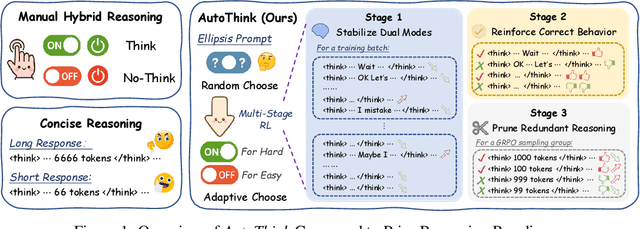
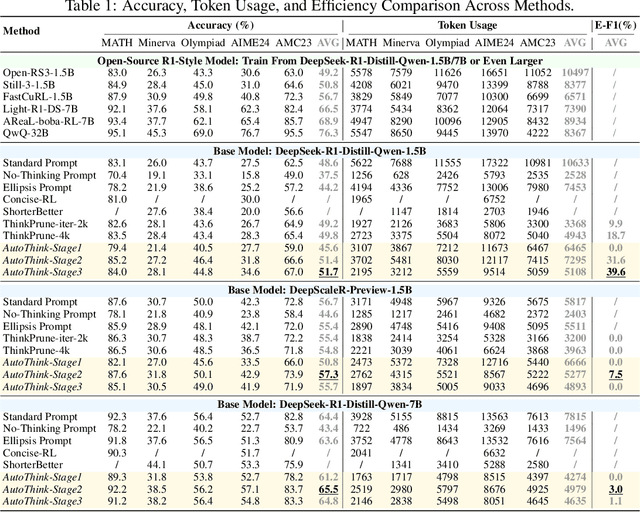
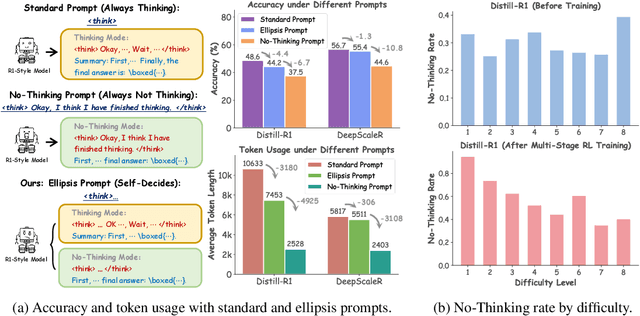
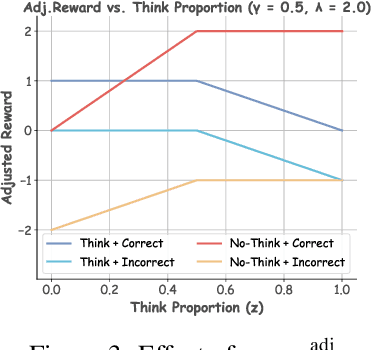
Large reasoning models (LRMs) are proficient at generating explicit, step-by-step reasoning sequences before producing final answers. However, such detailed reasoning can introduce substantial computational overhead and latency, particularly for simple problems. To address this over-thinking problem, we explore how to equip LRMs with adaptive thinking capabilities: enabling them to dynamically decide whether or not to engage in explicit reasoning based on problem complexity. Building on R1-style distilled models, we observe that inserting a simple ellipsis ("...") into the prompt can stochastically trigger either a thinking or no-thinking mode, revealing a latent controllability in the reasoning behavior. Leveraging this property, we propose AutoThink, a multi-stage reinforcement learning (RL) framework that progressively optimizes reasoning policies via stage-wise reward shaping. AutoThink learns to invoke explicit reasoning only when necessary, while defaulting to succinct responses for simpler tasks. Experiments on five mainstream mathematical benchmarks demonstrate that AutoThink achieves favorable accuracy-efficiency trade-offs compared to recent prompting and RL-based pruning methods. It can be seamlessly integrated into any R1-style model, including both distilled and further fine-tuned variants. Notably, AutoThink improves relative accuracy by 6.4 percent while reducing token usage by 52 percent on DeepSeek-R1-Distill-Qwen-1.5B, establishing a scalable and adaptive reasoning paradigm for LRMs.