 Add to Chrome
 Add to Firefox
 Add to Edge
Muse: Representation Geometry of Muon Beyond Normalized Momentum
Jul 16, 2026
Muon-style optimizers apply a polar map to matrix momentum, but their updates also depend on the representation of each parameter block before orthogonalization. We study this representation choice as a form of optimizer geometry and introduce {\method}, a family of Muon-style optimizers that shares the same momentum rule and Newton--Schulz backend across native, nearest-square, skinny, and vector representations. Each Frobenius-isometric representation induces a distinct polar steepest-descent geometry, in which the shorter matrix dimension determines the number of supported singular channels, the pullback scaling, and the constants in stochastic nonconvex convergence bounds. In a teacher--student model, curvature collapse and an isotropic Marchenko--Pastur spectral profile connect early-stage dissipation to the represented nuclear-to-squared-Frobenius norm ratio. Pretraining experiments on LLaMA2-130M and LLaMA2-600M, together with fixed-momentum diagnostics, show that balanced non-native representations can match the performance of the native representation, whereas reducing the shorter dimension weakens the scaling and singular-channel support, leading to behavior that increasingly resembles normalized momentum.

MGUP: A Momentum-Gradient Alignment Update Policy for Stochastic Optimization
Jun 16, 2026Efficient optimization is essential for training large language models. Although intra-layer selective updates have been explored, a general mechanism that enables fine-grained control while ensuring convergence guarantees is still lacking. To bridge this gap, we propose \textbf{MGUP}, a novel mechanism for selective updates. \textbf{MGUP} augments standard momentum-based optimizers by applying larger step-sizes to a selected fixed proportion of parameters in each iteration, while applying smaller, non-zero step-sizes to the rest. As a nearly {plug-and-play} module, \textbf{MGUP} seamlessly integrates with optimizers such as AdamW, Lion, and Muon. This yields powerful variants such as \textbf{MGUP-AdamW}, \textbf{MGUP-Lion}, and \textbf{MGUP-Muon}. Under standard assumptions, we provide theoretical convergence guarantees for \textbf{MGUP-AdamW} (without weight decay) in stochastic optimization. Extensive experiments across diverse tasks, including MAE pretraining, LLM pretraining, and downstream fine-tuning, demonstrate that our \textbf{MGUP}-enhanced optimizers achieve superior or more stable performance compared to their original base optimizers. We offer a principled, versatile, and theoretically grounded strategy for efficient intra-layer selective updates, accelerating and stabilizing the training of large-scale models. The code is publicly available at https://github.com/MaeChd/MGUP.
OptMuon: Closed-Loop Orthogonalized Momentum Methods for Stochastic Optimization with Zero-Noise Optimality
Jun 07, 2026Orthogonalized momentum updates, as used in Muon-style optimizers, have recently shown strong empirical stability in large-scale deep learning. However, existing orthogonalized methods are typically paired with constant or open-loop magnitude rules, and therefore do not explicitly calibrate their update magnitudes from the observed optimization trajectory. Motivated by the closed-loop perspective behind Lipschitz-free and noise-adaptive methods, we propose OptMuon, a family of adaptive momentum orthogonalization methods for stochastic nonconvex optimization. OptMuon combines Muon-style polar-factor directions with a trajectory-dependent AdaGrad-Norm-type coefficient schedule, so that the update magnitude is determined by the observed gradient and momentum history rather than by a prescribed Lipschitz-dependent rule. The schedule does not use the smoothness constant, the variance level, or the bounded-gradient constant in parameter selection, and its running-maximum correction prevents isolated gradient spikes from causing excessive coefficient collapse. Under lower-boundedness, unbiased stochastic gradients with bounded variance, smoothness, and an almost-sure bounded stochastic-gradient condition, we prove two complementary guarantees. OptMuon-A achieves the noise-adaptive rate \(\tilde{\mathcal O}(T^{-1/2}+σ^{1/2}T^{-1/4})\) under average smoothness, while OptMuon-I achieves \(\tilde{\mathcal O}(T^{-1/2}+σ^{1/3}T^{-1/3})\) under individual smoothness. In the zero-noise regime, both bounds automatically reduce to a nearly optimal deterministic first-order rate \(\tilde{\mathcal O}(T^{-1/2})\) without manual hyperparameter retuning. These results show that closed-loop scalar adaptation can be combined with Muon-style momentum orthogonalization while retaining noise adaptivity and zero-noise optimality up to logarithmic factors.
MuonEq: Balancing Before Orthogonalization with Lightweight Equilibration
Mar 30, 2026Orthogonalized-update optimizers such as Muon improve training of matrix-valued parameters, but existing extensions mostly act either after orthogonalization by rescaling updates or before it with heavier whitening-based preconditioners. We introduce {\method}, a lightweight family of pre-orthogonalization equilibration schemes for Muon in three forms: two-sided row/column normalization (RC), row normalization (R), and column normalization (C). These variants rebalance the momentum matrix before finite-step Newton--Schulz using row/column squared-norm statistics and only $\mathcal{O}(m+n)$ auxiliary state. We show that finite-step orthogonalization is governed by input spectral properties, especially stable rank and condition number, and that row/column normalization is a zeroth-order whitening surrogate that removes marginal scale mismatch. For the hidden matrix weights targeted by {\method}, the row-normalized variant R is the natural default and preserves the $\widetilde{\mathcal{O}}(T^{-1/4})$ stationarity guarantee of Muon-type methods. In LLaMA2 pretraining on C4, the default R variant consistently outperforms Muon on 130M and 350M models, yielding faster convergence and lower validation perplexity.
OptEMA: Adaptive Exponential Moving Average for Stochastic Optimization with Zero-Noise Optimality
Mar 10, 2026The Exponential Moving Average (EMA) is a cornerstone of widely used optimizers such as Adam. However, existing theoretical analyses of Adam-style methods have notable limitations: their guarantees can remain suboptimal in the zero-noise regime, rely on restrictive boundedness conditions (e.g., bounded gradients or objective gaps), use constant or open-loop stepsizes, or require prior knowledge of Lipschitz constants. To overcome these bottlenecks, we introduce OptEMA and analyze two novel variants: OptEMA-M, which applies an adaptive, decreasing EMA coefficient to the first-order moment with a fixed second-order decay, and OptEMA-V, which swaps these roles. Crucially, OptEMA is closed-loop and Lipschitz-free in the sense that its effective stepsizes are trajectory-dependent and do not require the Lipschitz constant for parameterization. Under standard stochastic gradient descent (SGD) assumptions, namely smoothness, a lower-bounded objective, and unbiased gradients with bounded variance, we establish rigorous convergence guarantees. Both variants achieve a noise-adaptive convergence rate of $\widetilde{\mathcal{O}}(T^{-1/2}+σ^{1/2} T^{-1/4})$ for the average gradient norm, where $σ$ is the noise level. In particular, in the zero-noise regime where $σ=0$, our bounds reduce to the nearly optimal deterministic rate $\widetilde{\mathcal{O}}(T^{-1/2})$ without manual hyperparameter retuning.
On the Convergence of Muon and Beyond
Sep 19, 2025The Muon optimizer has demonstrated remarkable empirical success in handling matrix-structured parameters for training neural networks. However, a significant gap persists between its practical performance and theoretical understanding. Existing analyses indicate that the standard Muon variant achieves only a suboptimal convergence rate of $\mathcal{O}(T^{-1/4})$ in stochastic non-convex settings, where $T$ denotes the number of iterations. To explore the theoretical limits of the Muon framework, we construct and analyze a variance-reduced variant, termed Muon-VR2. We provide the first rigorous proof that incorporating a variance-reduction mechanism enables Muon-VR2 to attain an optimal convergence rate of $\tilde{\mathcal{O}}(T^{-1/3})$, thereby matching the theoretical lower bound for this class of problems. Moreover, our analysis establishes convergence guarantees for Muon variants under the Polyak-{\L}ojasiewicz (P{\L}) condition. Extensive experiments on vision (CIFAR-10) and language (C4) benchmarks corroborate our theoretical findings on per-iteration convergence. Overall, this work provides the first proof of optimality for a Muon-style optimizer and clarifies the path toward developing more practically efficient, accelerated variants.
AlphaDecay:Module-wise Weight Decay for Heavy-Tailed Balancing in LLMs
Jun 17, 2025Weight decay is a standard regularization technique for training large language models (LLMs). While it is common to assign a uniform decay rate to every layer, this approach overlooks the structural diversity of LLMs and the varying spectral properties across modules. In this paper, we introduce AlphaDecay, a simple yet effective method that adaptively assigns different weight decay strengths to each module of an LLM. Our approach is guided by Heavy-Tailed Self-Regularization (HT-SR) theory, which analyzes the empirical spectral density (ESD) of weight correlation matrices to quantify "heavy-tailedness." Modules exhibiting more pronounced heavy-tailed ESDs, reflecting stronger feature learning, are assigned weaker decay, while modules with lighter-tailed spectra receive stronger decay. Our method leverages tailored weight decay assignments to balance the module-wise differences in spectral properties, leading to improved performance. Extensive pre-training tasks with various model sizes from 60M to 1B demonstrate that AlphaDecay achieves better perplexity and generalization than conventional uniform decay and other adaptive decay baselines.
Adaptive Accelerated Proximal Gradient Methods with Variance Reduction for Composite Nonconvex Finite-Sum Minimization
Feb 28, 2025This paper proposes {\sf AAPG-SPIDER}, an Adaptive Accelerated Proximal Gradient (AAPG) method with variance reduction for minimizing composite nonconvex finite-sum functions. It integrates three acceleration techniques: adaptive stepsizes, Nesterov's extrapolation, and the recursive stochastic path-integrated estimator SPIDER. While targeting stochastic finite-sum problems, {\sf AAPG-SPIDER} simplifies to {\sf AAPG} in the full-batch, non-stochastic setting, which is also of independent interest. To our knowledge, {\sf AAPG-SPIDER} and {\sf AAPG} are the first learning-rate-free methods to achieve optimal iteration complexity for this class of \textit{composite} minimization problems. Specifically, {\sf AAPG} achieves the optimal iteration complexity of $\mathcal{O}(N \epsilon^{-2})$, while {\sf AAPG-SPIDER} achieves $\mathcal{O}(N + \sqrt{N} \epsilon^{-2})$ for finding $\epsilon$-approximate stationary points, where $N$ is the number of component functions. Under the Kurdyka-Lojasiewicz (KL) assumption, we establish non-ergodic convergence rates for both methods. Preliminary experiments on sparse phase retrieval and linear eigenvalue problems demonstrate the superior performance of {\sf AAPG-SPIDER} and {\sf AAPG} compared to existing methods.
AlphaAdam:Asynchronous Masked Optimization with Dynamic Alpha for Selective Updates
Jan 30, 2025In the training of large language models (LLMs), updating parameters more efficiently and stably has always been an important challenge. To achieve efficient parameter updates, existing methods usually achieve performance comparable to full parameter updates through methods such as low-dimensional decomposition or layer-wise selective updates. In this work, we propose AlphaAdam, an optimization framework for LLM from the perspective of intra-layer parameter updates. By decoupling parameter updates and dynamically adjusting their strength, AlphaAdam accelerates convergence and improves training stability. We construct parameter masks based on the consistency of historical momentum and gradient direction and combine them with an adaptive mask strength strategy to ensure efficient optimization and theoretical convergence guarantees, which is also applicable to most momentum-based optimizers. Extensive experiments show that AlphaAdam outperforms state-of-the-art methods such as AdamW in terms of convergence speed and computational efficiency across tasks, including GPT-2 pre-trained and fine-tuned RoBERTa and Llama-7B. Our AlphaAdam implements an optimizer enhancement framework for LLMs through intra-layer asynchronous masked adaptive updates. Our code is available in this \href{https://github.com/MaeChd/AlphaAdam}{link}
ADMM for Structured Fractional Minimization
Nov 12, 2024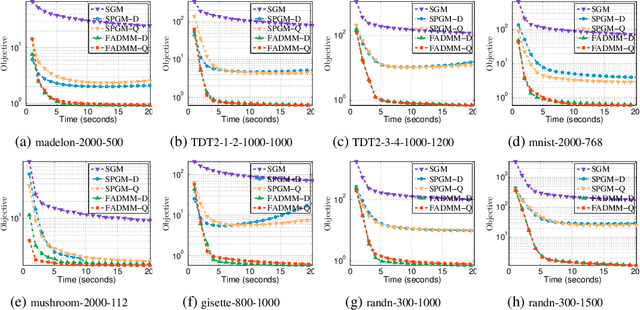
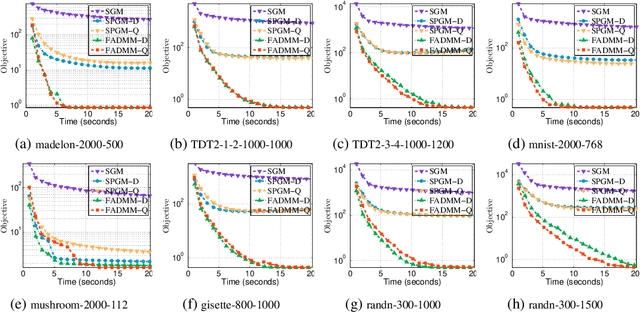
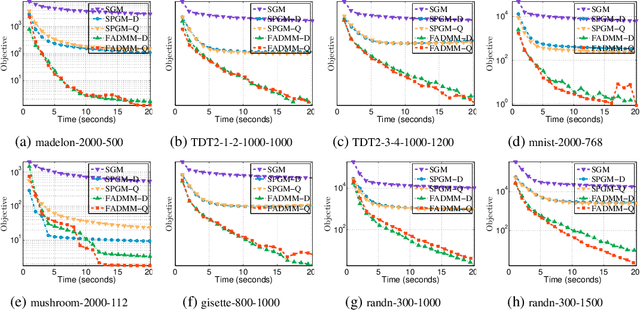
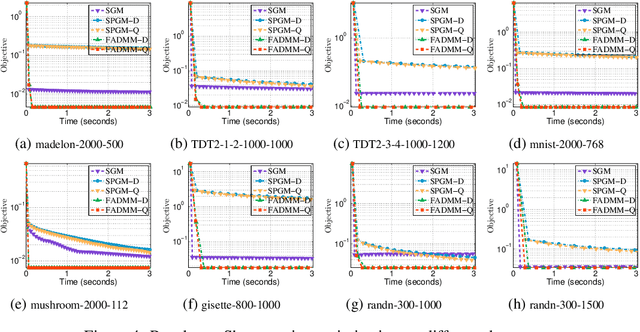
We consider a class of structured fractional minimization problems, where the numerator includes a differentiable function, a simple nonconvex nonsmooth function, a concave nonsmooth function, and a convex nonsmooth function composed with a linear operator, while the denominator is a continuous function that is either weakly convex or has a weakly convex square root. These problems are widespread and span numerous essential applications in machine learning and data science. Existing methods are mainly based on subgradient methods and smoothing proximal gradient methods, which may suffer from slow convergence and numerical stability issues. In this paper, we introduce {\sf FADMM}, the first Alternating Direction Method of Multipliers tailored for this class of problems. {\sf FADMM} decouples the original problem into linearized proximal subproblems, featuring two variants: one using Dinkelbach's parametric method ({\sf FADMM-D}) and the other using the quadratic transform method ({\sf FADMM-Q}). By introducing a novel Lyapunov function, we establish that {\sf FADMM} converges to $\epsilon$-approximate critical points of the problem within an oracle complexity of $\mathcal{O}(1/\epsilon^{3})$. Our experiments on synthetic and real-world data for sparse Fisher discriminant analysis, robust Sharpe ratio minimization, and robust sparse recovery demonstrate the effectiveness of our approach. Keywords: Fractional Minimization, Nonconvex Optimization, Proximal Linearized ADMM, Nonsmooth Optimization, Convergence Analysis