 Add to Chrome
 Add to Firefox
 Add to Edge
Learning as Reasoning Unfolds: Progressive Rollout Allocation for Efficient Reinforcement Learning
Jul 24, 2026
Reinforcement learning with verifiable rewards (RLVR) has emerged as a highly effective framework for improving LLM reasoning, with methods such as GRPO among its most successful instantiations. However, GRPO relies on repeated generation of long chain-of-thought rollouts. Training time scales with the number of rollouts, a large fraction of which are uninformative. Thus, GRPO is computationally expensive and unstable. To mitigate this, existing approaches either generate a larger pool of rollouts and filter the most informative prompts, or leverage historical signals for filtering at later stages of training. These strategies offer modest performance gains, but slow down the overall process. To address this, we propose VarIance Guided Online Rollout allocation (VIGOR) which instead of allocating a fixed rollout budget per example, begins with a small number of rollouts for all examples in a batch and iteratively allocates additional rollouts to those with the highest group reward variance until a fixed total rollout budget is reached. Theoretically, we show that under RLVR, reward variance controls the gradient magnitude, and derive VIGOR's closed-form speedup ratio over GRPO, which grows with refinement rounds under Pareto-distributed reward variance. Experiments on mathematical reasoning and coding tasks show that VIGOR reaches target accuracy with up to 2.3$\times$ fewer rollouts on math, reaches GRPO's final coding full pass rate with 1.49$\times$ fewer rollouts, and improves the coding average test pass rate by 3.4 points.

OMEGA: A Low-Latency GNN Serving System for Large Graphs
Jan 15, 2025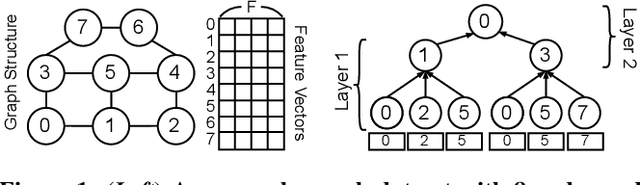

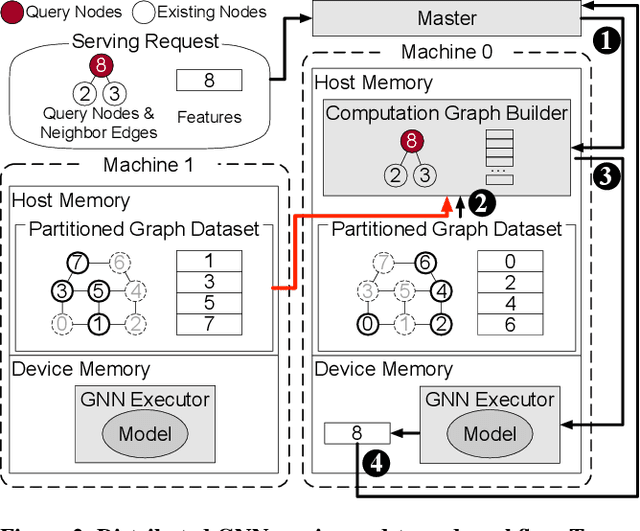

Graph Neural Networks (GNNs) have been widely adopted for their ability to compute expressive node representations in graph datasets. However, serving GNNs on large graphs is challenging due to the high communication, computation, and memory overheads of constructing and executing computation graphs, which represent information flow across large neighborhoods. Existing approximation techniques in training can mitigate the overheads but, in serving, still lead to high latency and/or accuracy loss. To this end, we propose OMEGA, a system that enables low-latency GNN serving for large graphs with minimal accuracy loss through two key ideas. First, OMEGA employs selective recomputation of precomputed embeddings, which allows for reusing precomputed computation subgraphs while selectively recomputing a small fraction to minimize accuracy loss. Second, we develop computation graph parallelism, which reduces communication overhead by parallelizing the creation and execution of computation graphs across machines. Our evaluation with large graph datasets and GNN models shows that OMEGA significantly outperforms state-of-the-art techniques.
Efficient Placard Discovery for Semantic Mapping During Frontier Exploration
Oct 27, 2021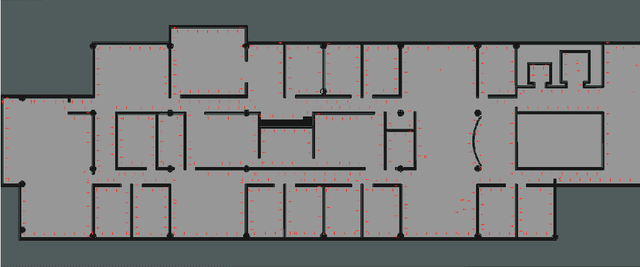
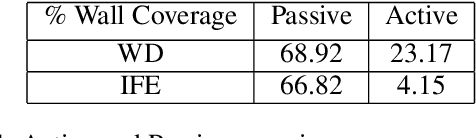
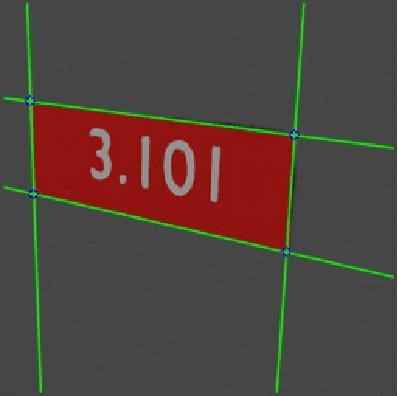
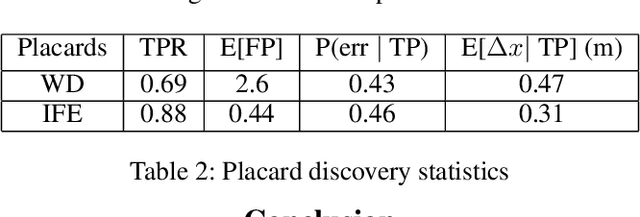
Semantic mapping is the task of providing a robot with a map of its environment beyond the open, navigable space of traditional Simultaneous Localization and Mapping (SLAM) algorithms by attaching semantics to locations. The system presented in this work reads door placards to annotate the locations of offices. Whereas prior work on this system developed hand-crafted detectors, this system leverages YOLOv2 for detection and a segmentation network for segmentation. Placards are localized by computing their pose from a homography computed from a segmented quadrilateral outline. This work also introduces an Interruptable Frontier Exploration algorithm, enabling the robot to explore its environment to construct its SLAM map while pausing to inspect placards observed during this process. This allows the robot to autonomously discover room placards without human intervention while speeding up significantly over previous autonomous exploration methods.