 Add to Chrome
 Add to Firefox
 Add to Edge
facial recognition
Facial recognition is an AI-based technique for identifying or confirming an individual's identity using their face. It maps facial features from an image or video and then compares the information with a collection of known faces to find a match.
Papers and Code
DEEMO: De-identity Multimodal Emotion Recognition and Reasoning
Apr 28, 2025
Emotion understanding is a critical yet challenging task. Most existing approaches rely heavily on identity-sensitive information, such as facial expressions and speech, which raises concerns about personal privacy. To address this, we introduce the De-identity Multimodal Emotion Recognition and Reasoning (DEEMO), a novel task designed to enable emotion understanding using de-identified video and audio inputs. The DEEMO dataset consists of two subsets: DEEMO-NFBL, which includes rich annotations of Non-Facial Body Language (NFBL), and DEEMO-MER, an instruction dataset for Multimodal Emotion Recognition and Reasoning using identity-free cues. This design supports emotion understanding without compromising identity privacy. In addition, we propose DEEMO-LLaMA, a Multimodal Large Language Model (MLLM) that integrates de-identified audio, video, and textual information to enhance both emotion recognition and reasoning. Extensive experiments show that DEEMO-LLaMA achieves state-of-the-art performance on both tasks, outperforming existing MLLMs by a significant margin, achieving 74.49% accuracy and 74.45% F1-score in de-identity emotion recognition, and 6.20 clue overlap and 7.66 label overlap in de-identity emotion reasoning. Our work contributes to ethical AI by advancing privacy-preserving emotion understanding and promoting responsible affective computing.

Soften the Mask: Adaptive Temporal Soft Mask for Efficient Dynamic Facial Expression Recognition
Feb 28, 2025Dynamic Facial Expression Recognition (DFER) facilitates the understanding of psychological intentions through non-verbal communication. Existing methods struggle to manage irrelevant information, such as background noise and redundant semantics, which impacts both efficiency and effectiveness. In this work, we propose a novel supervised temporal soft masked autoencoder network for DFER, namely AdaTosk, which integrates a parallel supervised classification branch with the self-supervised reconstruction branch. The self-supervised reconstruction branch applies random binary hard mask to generate diverse training samples, encouraging meaningful feature representations in visible tokens. Meanwhile the classification branch employs an adaptive temporal soft mask to flexibly mask visible tokens based on their temporal significance. Its two key components, respectively of, class-agnostic and class-semantic soft masks, serve to enhance critical expression moments and reduce semantic redundancy over time. Extensive experiments conducted on widely-used benchmarks demonstrate that our AdaTosk remarkably reduces computational costs compared with current state-of-the-art methods while still maintaining competitive performance.
Robust Dynamic Facial Expression Recognition
Feb 22, 2025The study of Dynamic Facial Expression Recognition (DFER) is a nascent field of research that involves the automated recognition of facial expressions in video data. Although existing research has primarily focused on learning representations under noisy and hard samples, the issue of the coexistence of both types of samples remains unresolved. In order to overcome this challenge, this paper proposes a robust method of distinguishing between hard and noisy samples. This is achieved by evaluating the prediction agreement of the model on different sampled clips of the video. Subsequently, methodologies that reinforce the learning of hard samples and mitigate the impact of noisy samples can be employed. Moreover, to identify the principal expression in a video and enhance the model's capacity for representation learning, comprising a key expression re-sampling framework and a dual-stream hierarchical network is proposed, namely Robust Dynamic Facial Expression Recognition (RDFER). The key expression re-sampling framework is designed to identify the key expression, thereby mitigating the potential confusion caused by non-target expressions. RDFER employs two sequence models with the objective of disentangling short-term facial movements and long-term emotional changes. The proposed method has been shown to outperform current State-Of-The-Art approaches in DFER through extensive experimentation on benchmark datasets such as DFEW and FERV39K. A comprehensive analysis provides valuable insights and observations regarding the proposed agreement. This work has significant implications for the field of dynamic facial expression recognition and promotes the further development of the field of noise-consistent robust learning in dynamic facial expression recognition. The code is available from [https://github.com/Cross-Innovation-Lab/RDFER].
BAH Dataset for Ambivalence/Hesitancy Recognition in Videos for Behavioural Change
May 25, 2025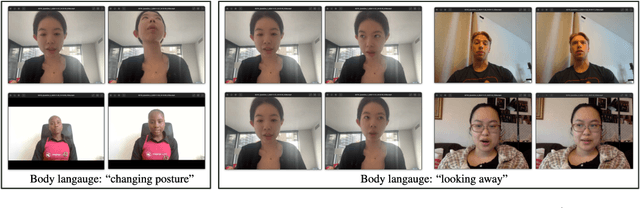
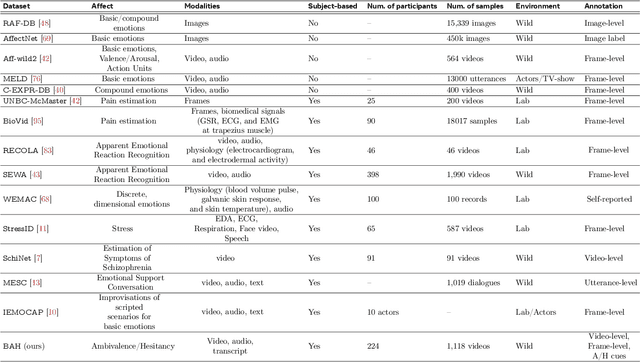
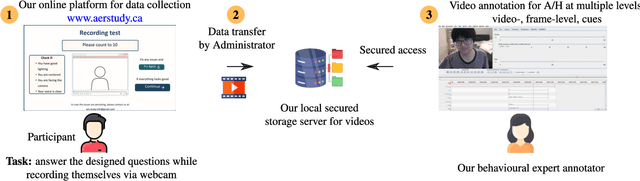
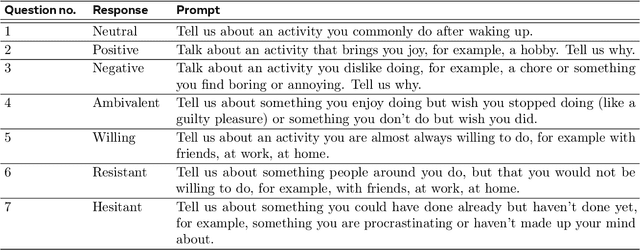
Recognizing complex emotions linked to ambivalence and hesitancy (A/H) can play a critical role in the personalization and effectiveness of digital behaviour change interventions. These subtle and conflicting emotions are manifested by a discord between multiple modalities, such as facial and vocal expressions, and body language. Although experts can be trained to identify A/H, integrating them into digital interventions is costly and less effective. Automatic learning systems provide a cost-effective alternative that can adapt to individual users, and operate seamlessly within real-time, and resource-limited environments. However, there are currently no datasets available for the design of ML models to recognize A/H. This paper introduces a first Behavioural Ambivalence/Hesitancy (BAH) dataset collected for subject-based multimodal recognition of A/H in videos. It contains videos from 224 participants captured across 9 provinces in Canada, with different age, and ethnicity. Through our web platform, we recruited participants to answer 7 questions, some of which were designed to elicit A/H while recording themselves via webcam with microphone. BAH amounts to 1,118 videos for a total duration of 8.26 hours with 1.5 hours of A/H. Our behavioural team annotated timestamp segments to indicate where A/H occurs, and provide frame- and video-level annotations with the A/H cues. Video transcripts and their timestamps are also included, along with cropped and aligned faces in each frame, and a variety of participants meta-data. We include results baselines for BAH at frame- and video-level recognition in multi-modal setups, in addition to zero-shot prediction, and for personalization using unsupervised domain adaptation. The limited performance of baseline models highlights the challenges of recognizing A/H in real-world videos. The data, code, and pretrained weights are available.
Biased Heritage: How Datasets Shape Models in Facial Expression Recognition
Mar 05, 2025In recent years, the rapid development of artificial intelligence (AI) systems has raised concerns about our ability to ensure their fairness, that is, how to avoid discrimination based on protected characteristics such as gender, race, or age. While algorithmic fairness is well-studied in simple binary classification tasks on tabular data, its application to complex, real-world scenarios-such as Facial Expression Recognition (FER)-remains underexplored. FER presents unique challenges: it is inherently multiclass, and biases emerge across intersecting demographic variables, each potentially comprising multiple protected groups. We present a comprehensive framework to analyze bias propagation from datasets to trained models in image-based FER systems, while introducing new bias metrics specifically designed for multiclass problems with multiple demographic groups. Our methodology studies bias propagation by (1) inducing controlled biases in FER datasets, (2) training models on these biased datasets, and (3) analyzing the correlation between dataset bias metrics and model fairness notions. Our findings reveal that stereotypical biases propagate more strongly to model predictions than representational biases, suggesting that preventing emotion-specific demographic patterns should be prioritized over general demographic balance in FER datasets. Additionally, we observe that biased datasets lead to reduced model accuracy, challenging the assumed fairness-accuracy trade-off.
Nonlinear Dynamical Systems for Automatic Face Annotation in Head Tracking and Pose Estimation
Feb 21, 2025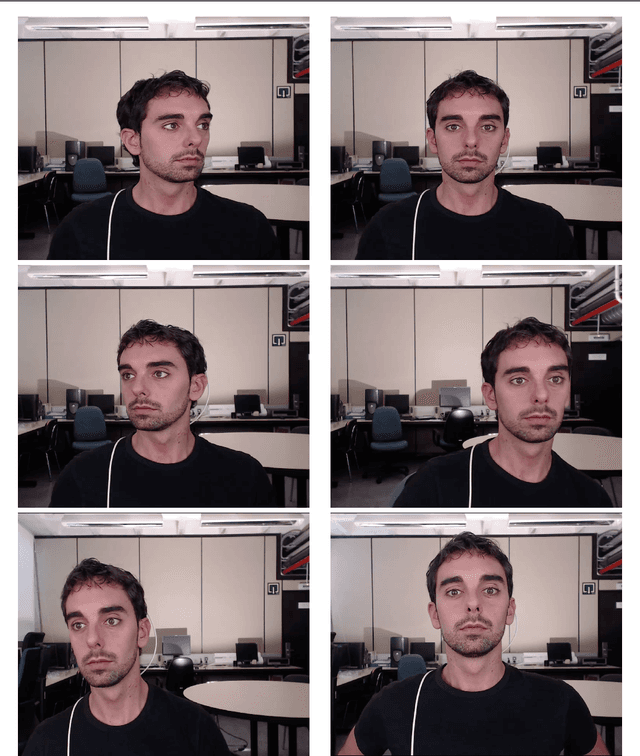
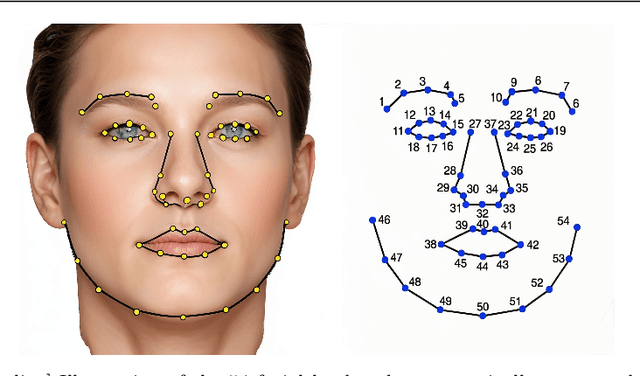
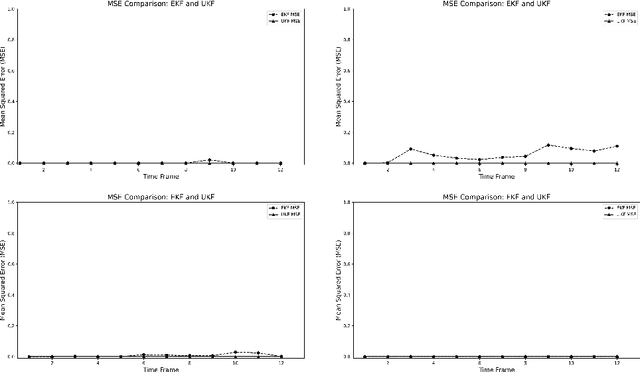
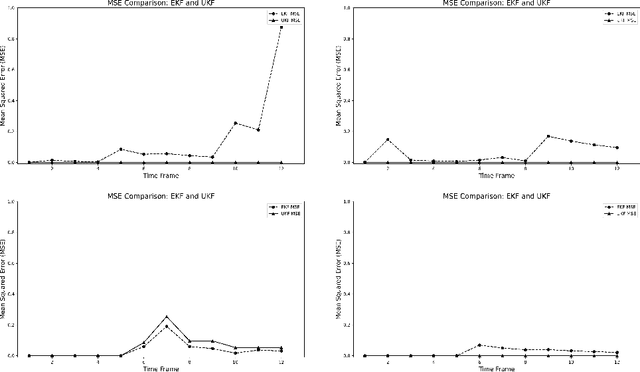
Facial landmark tracking plays a vital role in applications such as facial recognition, expression analysis, and medical diagnostics. In this paper, we consider the performance of the Extended Kalman Filter (EKF) and Unscented Kalman Filter (UKF) in tracking 3D facial motion in both deterministic and stochastic settings. We first analyze a noise-free environment where the state transition is purely deterministic, demonstrating that UKF outperforms EKF by achieving lower mean squared error (MSE) due to its ability to capture higher-order nonlinearities. However, when stochastic noise is introduced, EKF exhibits superior robustness, maintaining lower mean square error (MSE) compared to UKF, which becomes more sensitive to measurement noise and occlusions. Our results highlight that UKF is preferable for high-precision applications in controlled environments, whereas EKF is better suited for real-world scenarios with unpredictable noise. These findings provide practical insights for selecting the appropriate filtering technique in 3D facial tracking applications, such as motion capture and facial recognition.
End-to-End Facial Expression Detection in Long Videos
Apr 10, 2025Facial expression detection involves two interrelated tasks: spotting, which identifies the onset and offset of expressions, and recognition, which classifies them into emotional categories. Most existing methods treat these tasks separately using a two-step training pipelines. A spotting model first detects expression intervals. A recognition model then classifies the detected segments. However, this sequential approach leads to error propagation, inefficient feature learning, and suboptimal performance due to the lack of joint optimization of the two tasks. We propose FEDN, an end-to-end Facial Expression Detection Network that jointly optimizes spotting and recognition. Our model introduces a novel attention-based feature extraction module, incorporating segment attention and sliding window attention to improve facial feature learning. By unifying two tasks within a single network, we greatly reduce error propagation and enhance overall performance. Experiments on CASME}^2 and CASME^3 demonstrate state-of-the-art accuracy for both spotting and detection, underscoring the benefits of joint optimization for robust facial expression detection in long videos.
PhysioSync: Temporal and Cross-Modal Contrastive Learning Inspired by Physiological Synchronization for EEG-Based Emotion Recognition
Apr 24, 2025Electroencephalography (EEG) signals provide a promising and involuntary reflection of brain activity related to emotional states, offering significant advantages over behavioral cues like facial expressions. However, EEG signals are often noisy, affected by artifacts, and vary across individuals, complicating emotion recognition. While multimodal approaches have used Peripheral Physiological Signals (PPS) like GSR to complement EEG, they often overlook the dynamic synchronization and consistent semantics between the modalities. Additionally, the temporal dynamics of emotional fluctuations across different time resolutions in PPS remain underexplored. To address these challenges, we propose PhysioSync, a novel pre-training framework leveraging temporal and cross-modal contrastive learning, inspired by physiological synchronization phenomena. PhysioSync incorporates Cross-Modal Consistency Alignment (CM-CA) to model dynamic relationships between EEG and complementary PPS, enabling emotion-related synchronizations across modalities. Besides, it introduces Long- and Short-Term Temporal Contrastive Learning (LS-TCL) to capture emotional synchronization at different temporal resolutions within modalities. After pre-training, cross-resolution and cross-modal features are hierarchically fused and fine-tuned to enhance emotion recognition. Experiments on DEAP and DREAMER datasets demonstrate PhysioSync's advanced performance under uni-modal and cross-modal conditions, highlighting its effectiveness for EEG-centered emotion recognition.
Attention-aggregated Attack for Boosting the Transferability of Facial Adversarial Examples
May 06, 2025Adversarial examples have revealed the vulnerability of deep learning models and raised serious concerns about information security. The transfer-based attack is a hot topic in black-box attacks that are practical to real-world scenarios where the training datasets, parameters, and structure of the target model are unknown to the attacker. However, few methods consider the particularity of class-specific deep models for fine-grained vision tasks, such as face recognition (FR), giving rise to unsatisfactory attacking performance. In this work, we first investigate what in a face exactly contributes to the embedding learning of FR models and find that both decisive and auxiliary facial features are specific to each FR model, which is quite different from the biological mechanism of human visual system. Accordingly we then propose a novel attack method named Attention-aggregated Attack (AAA) to enhance the transferability of adversarial examples against FR, which is inspired by the attention divergence and aims to destroy the facial features that are critical for the decision-making of other FR models by imitating their attentions on the clean face images. Extensive experiments conducted on various FR models validate the superiority and robust effectiveness of the proposed method over existing methods.
Encrypted Vector Similarity Computations Using Partially Homomorphic Encryption: Applications and Performance Analysis
Mar 07, 2025
This paper explores the use of partially homomorphic encryption (PHE) for encrypted vector similarity search, with a focus on facial recognition and broader applications like reverse image search, recommendation engines, and large language models (LLMs). While fully homomorphic encryption (FHE) exists, we demonstrate that encrypted cosine similarity can be computed using PHE, offering a more practical alternative. Since PHE does not directly support cosine similarity, we propose a method that normalizes vectors in advance, enabling dot product calculations as a proxy. We also apply min-max normalization to handle negative dimension values. Experiments on the Labeled Faces in the Wild (LFW) dataset use DeepFace's FaceNet128d, FaceNet512d, and VGG-Face (4096d) models in a two-tower setup. Pre-encrypted embeddings are stored in one tower, while an edge device captures images, computes embeddings, and performs encrypted-plaintext dot products via additively homomorphic encryption. We implement this with LightPHE, evaluating Paillier, Damgard-Jurik, and Okamoto-Uchiyama schemes, excluding others due to performance or decryption complexity. Tests at 80-bit and 112-bit security (NIST-secure until 2030) compare PHE against FHE (via TenSEAL), analyzing encryption, decryption, operation time, cosine similarity loss, key/ciphertext sizes. Results show PHE is less computationally intensive, faster, and produces smaller ciphertexts/keys, making it well-suited for memory-constrained environments and real-world privacy-preserving encrypted similarity search.