 Add to Chrome
 Add to Firefox
 Add to Edge
Ambivalence/Hesitancy Recognition in Videos for Personalized Digital Health Interventions
Apr 14, 2026
Using behavioural science, health interventions focus on behaviour change by providing a framework to help patients acquire and maintain healthy habits that improve medical outcomes. In-person interventions are costly and difficult to scale, especially in resource-limited regions. Digital health interventions offer a cost-effective approach, potentially supporting independent living and self-management. Automating such interventions, especially through machine learning, has gained considerable attention recently. Ambivalence and hesitancy (A/H) play a primary role for individuals to delay, avoid, or abandon health interventions. A/H are subtle and conflicting emotions that place a person in a state between positive and negative evaluations of a behaviour, or between acceptance and refusal to engage in it. They manifest as affective inconsistency across modalities or within a modality, such as language, facial, vocal expressions, and body language. While experts can be trained to recognize A/H, integrating them into digital health interventions is costly and less effective. Automatic A/H recognition is therefore critical for the personalization and cost-effectiveness of digital health interventions. Here, we explore the application of deep learning models for A/H recognition in videos, a multi-modal task by nature. In particular, this paper covers three learning setups: supervised learning, unsupervised domain adaptation for personalization, and zero-shot inference via large language models (LLMs). Our experiments are conducted on the unique and recently published BAH video dataset for A/H recognition. Our results show limited performance, suggesting that more adapted multi-modal models are required for accurate A/H recognition. Better methods for modeling spatio-temporal and multimodal fusion are necessary to leverage conflicts within/across modalities.

BAH Dataset for Ambivalence/Hesitancy Recognition in Videos for Behavioural Change
May 25, 2025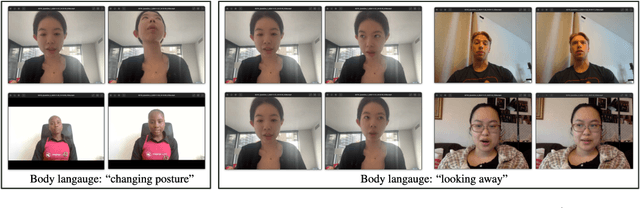
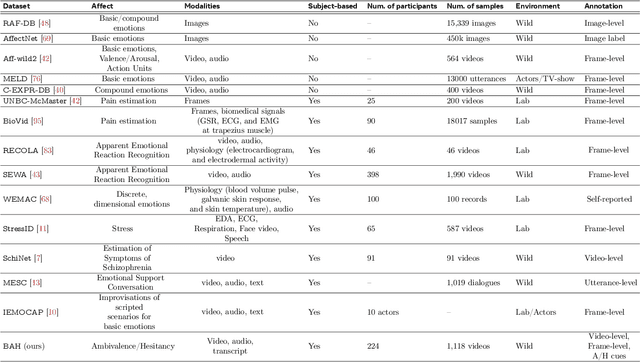
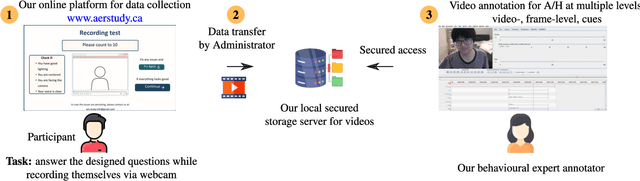
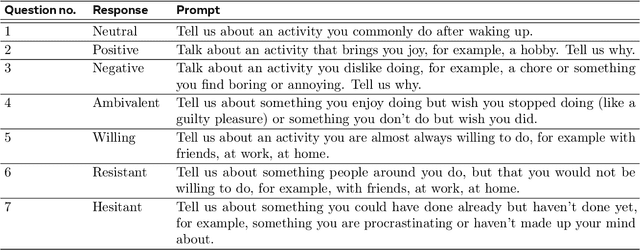
Recognizing complex emotions linked to ambivalence and hesitancy (A/H) can play a critical role in the personalization and effectiveness of digital behaviour change interventions. These subtle and conflicting emotions are manifested by a discord between multiple modalities, such as facial and vocal expressions, and body language. Although experts can be trained to identify A/H, integrating them into digital interventions is costly and less effective. Automatic learning systems provide a cost-effective alternative that can adapt to individual users, and operate seamlessly within real-time, and resource-limited environments. However, there are currently no datasets available for the design of ML models to recognize A/H. This paper introduces a first Behavioural Ambivalence/Hesitancy (BAH) dataset collected for subject-based multimodal recognition of A/H in videos. It contains videos from 224 participants captured across 9 provinces in Canada, with different age, and ethnicity. Through our web platform, we recruited participants to answer 7 questions, some of which were designed to elicit A/H while recording themselves via webcam with microphone. BAH amounts to 1,118 videos for a total duration of 8.26 hours with 1.5 hours of A/H. Our behavioural team annotated timestamp segments to indicate where A/H occurs, and provide frame- and video-level annotations with the A/H cues. Video transcripts and their timestamps are also included, along with cropped and aligned faces in each frame, and a variety of participants meta-data. We include results baselines for BAH at frame- and video-level recognition in multi-modal setups, in addition to zero-shot prediction, and for personalization using unsupervised domain adaptation. The limited performance of baseline models highlights the challenges of recognizing A/H in real-world videos. The data, code, and pretrained weights are available.