 Add to Chrome
 Add to Firefox
 Add to Edge
Text Classification
Text classification is the process of categorizing text documents into predefined categories or labels.
Papers and Code
Item Region-based Style Classification Network (IRSN): A Fashion Style Classifier Based on Domain Knowledge of Fashion Experts
Dec 23, 2025
Fashion style classification is a challenging task because of the large visual variation within the same style and the existence of visually similar styles. Styles are expressed not only by the global appearance, but also by the attributes of individual items and their combinations. In this study, we propose an item region-based fashion style classification network (IRSN) to effectively classify fashion styles by analyzing item-specific features and their combinations in addition to global features. IRSN extracts features of each item region using item region pooling (IRP), analyzes them separately, and combines them using gated feature fusion (GFF). In addition, we improve the feature extractor by applying a dual-backbone architecture that combines a domain-specific feature extractor and a general feature extractor pre-trained with a large-scale image-text dataset. In experiments, applying IRSN to six widely-used backbones, including EfficientNet, ConvNeXt, and Swin Transformer, improved style classification accuracy by an average of 6.9% and a maximum of 14.5% on the FashionStyle14 dataset and by an average of 7.6% and a maximum of 15.1% on the ShowniqV3 dataset. Visualization analysis also supports that the IRSN models are better than the baseline models at capturing differences between similar style classes.
* This is a pre-print of an article published in Applied Intelligence. The final authenticated version is available online at: https://doi.org/10.1007/s10489-024-05683-9

Automatic Detection of Complex Quotation Patterns in Aggadic Literature
Dec 29, 2025This paper presents ACT (Allocate Connections between Texts), a novel three-stage algorithm for the automatic detection of biblical quotations in Rabbinic literature. Unlike existing text reuse frameworks that struggle with short, paraphrased, or structurally embedded quotations, ACT combines a morphology-aware alignment algorithm with a context-sensitive enrichment stage that identifies complex citation patterns such as "Wave" and "Echo" quotations. Our approach was evaluated against leading systems, including Dicta, Passim, Text-Matcher, as well as human-annotated critical editions. We further assessed three ACT configurations to isolate the contribution of each component. Results demonstrate that the full ACT pipeline (ACT-QE) outperforms all baselines, achieving an F1 score of 0.91, with superior Recall (0.89) and Precision (0.94). Notably, ACT-2, which lacks stylistic enrichment, achieves higher Recall (0.90) but suffers in Precision, while ACT-3, using longer n-grams, offers a tradeoff between coverage and specificity. In addition to improving quotation detection, ACT's ability to classify stylistic patterns across corpora opens new avenues for genre classification and intertextual analysis. This work contributes to digital humanities and computational philology by addressing the methodological gap between exhaustive machine-based detection and human editorial judgment. ACT lays a foundation for broader applications in historical textual analysis, especially in morphologically rich and citation-dense traditions like Aggadic literature.
Retrieving Objects from 3D Scenes with Box-Guided Open-Vocabulary Instance Segmentation
Dec 22, 2025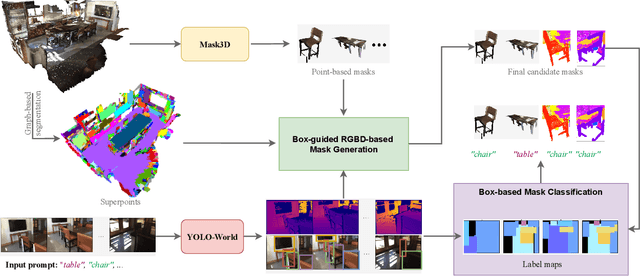

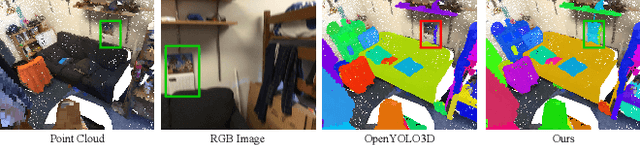
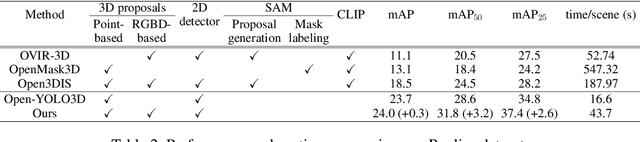
Locating and retrieving objects from scene-level point clouds is a challenging problem with broad applications in robotics and augmented reality. This task is commonly formulated as open-vocabulary 3D instance segmentation. Although recent methods demonstrate strong performance, they depend heavily on SAM and CLIP to generate and classify 3D instance masks from images accompanying the point cloud, leading to substantial computational overhead and slow processing that limit their deployment in real-world settings. Open-YOLO 3D alleviates this issue by using a real-time 2D detector to classify class-agnostic masks produced directly from the point cloud by a pretrained 3D segmenter, eliminating the need for SAM and CLIP and significantly reducing inference time. However, Open-YOLO 3D often fails to generalize to object categories that appear infrequently in the 3D training data. In this paper, we propose a method that generates 3D instance masks for novel objects from RGB images guided by a 2D open-vocabulary detector. Our approach inherits the 2D detector's ability to recognize novel objects while maintaining efficient classification, enabling fast and accurate retrieval of rare instances from open-ended text queries. Our code will be made available at https://github.com/ndkhanh360/BoxOVIS.
Detection and Analysis of Sensitive and Illegal Content on the Ethereum Blockchain Using Machine Learning Techniques
Dec 19, 2025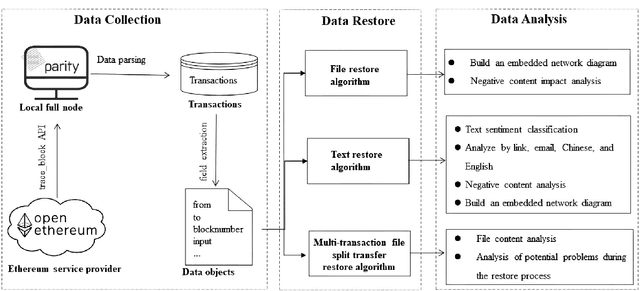
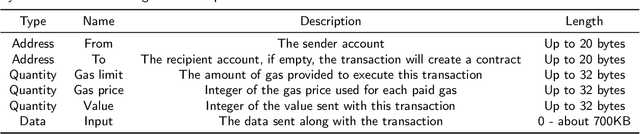
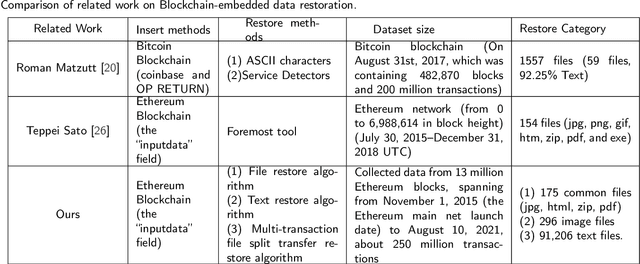
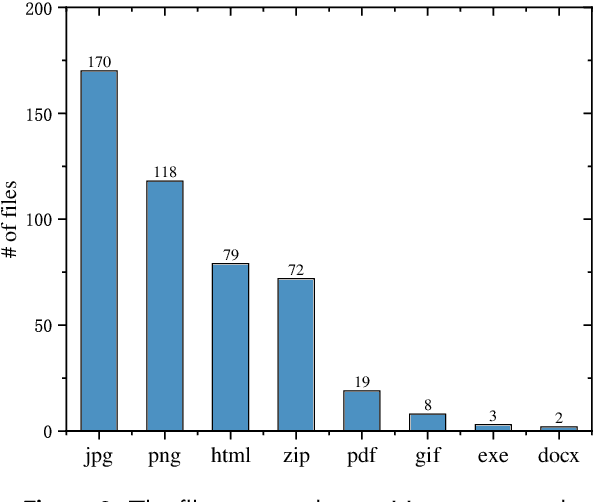
Blockchain technology, lauded for its transparent and immutable nature, introduces a novel trust model. However, its decentralized structure raises concerns about potential inclusion of malicious or illegal content. This study focuses on Ethereum, presenting a data identification and restoration algorithm. Successfully recovering 175 common files, 296 images, and 91,206 texts, we employed the FastText algorithm for sentiment analysis, achieving a 0.9 accuracy after parameter tuning. Classification revealed 70,189 neutral, 5,208 positive, and 15,810 negative texts, aiding in identifying sensitive or illicit information. Leveraging the NSFWJS library, we detected seven indecent images with 100% accuracy. Our findings expose the coexistence of benign and harmful content on the Ethereum blockchain, including personal data, explicit images, divisive language, and racial discrimination. Notably, sensitive information targeted Chinese government officials. Proposing preventative measures, our study offers valuable insights for public comprehension of blockchain technology and regulatory agency guidance. The algorithms employed present innovative solutions to address blockchain data privacy and security concerns.
Application of deep learning approaches for medieval historical documents transcription
Dec 21, 2025Handwritten text recognition and optical character recognition solutions show excellent results with processing data of modern era, but efficiency drops with Latin documents of medieval times. This paper presents a deep learning method to extract text information from handwritten Latin-language documents of the 9th to 11th centuries. The approach takes into account the properties inherent in medieval documents. The paper provides a brief introduction to the field of historical document transcription, a first-sight analysis of the raw data, and the related works and studies. The paper presents the steps of dataset development for further training of the models. The explanatory data analysis of the processed data is provided as well. The paper explains the pipeline of deep learning models to extract text information from the document images, from detecting objects to word recognition using classification models and embedding word images. The paper reports the following results: recall, precision, F1 score, intersection over union, confusion matrix, and mean string distance. The plots of the metrics are also included. The implementation is published on the GitHub repository.
* 15 pages, 15 figures, 4 tables. Originally published by CEUR Workshop Proceedings (CEUR-WS.org, ISSN 1613-0073), available: https://ceur-ws.org/Vol-4133/S_05_Kozlenko.pdf
Luxical: High-Speed Lexical-Dense Text Embeddings
Dec 11, 2025Frontier language model quality increasingly hinges on our ability to organize web-scale text corpora for training. Today's dominant tools trade off speed and flexibility: lexical classifiers (e.g., FastText) are fast but limited to producing classification output scores, while the vector-valued outputs of transformer text embedding models flexibly support numerous workflows (e.g., clustering, classification, and retrieval) but are computationally expensive to produce. We introduce Luxical, a library for high-speed "lexical-dense" text embeddings that aims to recover the best properties of both approaches for web-scale text organization. Luxical combines sparse TF--IDF features, a small ReLU network, and a knowledge distillation training regimen to approximate large transformer embedding models at a fraction of their operational cost. In this technical report, we describe the Luxical architecture and training objective and evaluate a concrete Luxical model in two disparate applications: a targeted webcrawl document retrieval test and an end-to-end language model data curation task grounded in text classification. In these tasks we demonstrate speedups ranging from 3x to 100x over varying-sized neural baselines, and comparable to FastText model inference during the data curation task. On these evaluations, the tested Luxical model illustrates favorable compute/quality trade-offs for large-scale text organization, matching the quality of neural baselines. Luxical is available as open-source software at https://github.com/datologyai/luxical.
Coarse-to-Fine Open-Set Graph Node Classification with Large Language Models
Dec 21, 2025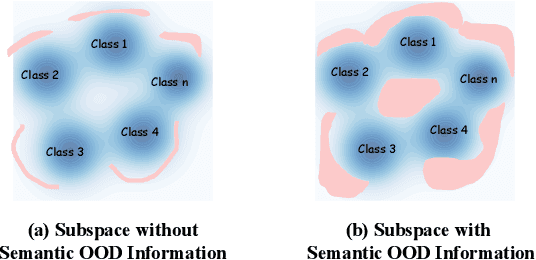
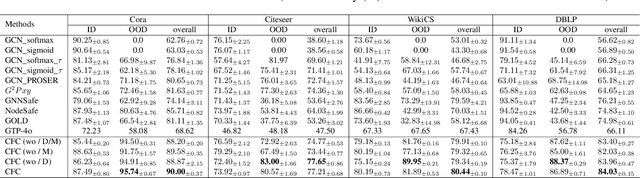
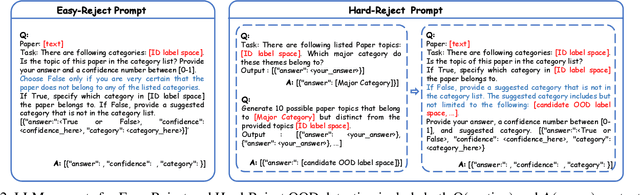
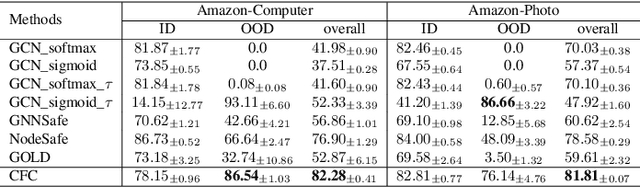
Developing open-set classification methods capable of classifying in-distribution (ID) data while detecting out-of-distribution (OOD) samples is essential for deploying graph neural networks (GNNs) in open-world scenarios. Existing methods typically treat all OOD samples as a single class, despite real-world applications, especially high-stake settings such as fraud detection and medical diagnosis, demanding deeper insights into OOD samples, including their probable labels. This raises a critical question: can OOD detection be extended to OOD classification without true label information? To address this question, we propose a Coarse-to-Fine open-set Classification (CFC) framework that leverages large language models (LLMs) for graph datasets. CFC consists of three key components: a coarse classifier that uses LLM prompts for OOD detection and outlier label generation, a GNN-based fine classifier trained with OOD samples identified by the coarse classifier for enhanced OOD detection and ID classification, and refined OOD classification achieved through LLM prompts and post-processed OOD labels. Unlike methods that rely on synthetic or auxiliary OOD samples, CFC employs semantic OOD instances that are genuinely out-of-distribution based on their inherent meaning, improving interpretability and practical utility. Experimental results show that CFC improves OOD detection by ten percent over state-of-the-art methods on graph and text domains and achieves up to seventy percent accuracy in OOD classification on graph datasets.
Fixed-Budget Parameter-Efficient Training with Frozen Encoders Improves Multimodal Chest X-Ray Classification
Dec 25, 2025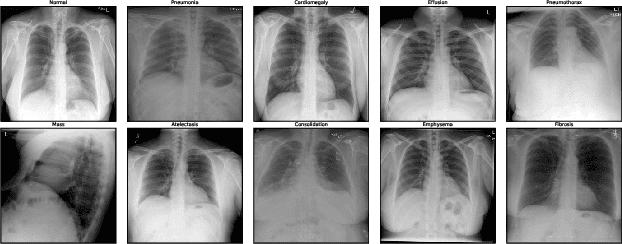
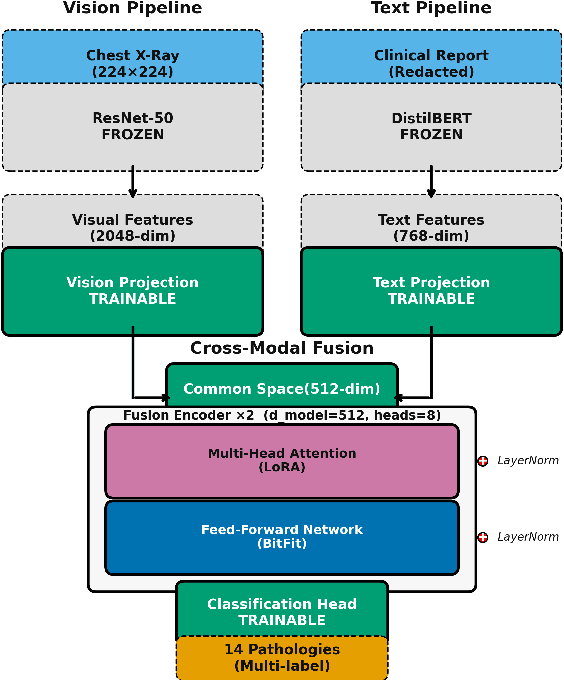
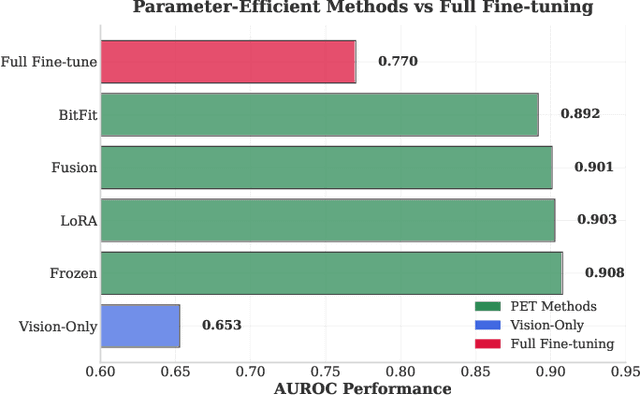
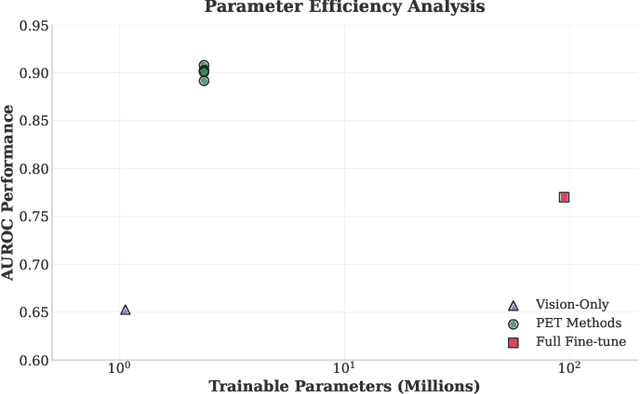
Multimodal chest X-Ray analysis often fine-tunes large vision-language models, which is computationally costly. We study parameter-efficient training (PET) strategies, including frozen encoders, BitFit, LoRA, and adapters for multi-label classification on the Indiana University Chest X-Ray dataset (3,851 image-report pairs; 579 test samples). To mitigate data leakage, we redact pathology terms from reports used as text inputs while retaining clinical context. Under a fixed parameter budget (2.37M parameters, 2.51% of total), all PET variants achieve AUROC between 0.892 and 0.908, outperforming full fine-tuning (0.770 AUROC), which uses 94.3M trainable parameters, a 40x reduction. External validation on CheXpert (224,316 images, 58x larger) confirms scalability: all PET methods achieve >0.69 AUROC with <9% trainable parameters, with Adapter achieving best performance (0.7214 AUROC). Budget-matched comparisons reveal that vision-only models (0.653 AUROC, 1.06M parameters) outperform budget-matched multimodal models (0.641 AUROC, 1.06M parameters), indicating improvements arise primarily from parameter allocation rather than cross-modal synergy. While PET methods show degraded calibration (ECE: 0.29-0.34) compared to simpler models (ECE: 0.049), this represents a tractable limitation addressable through post-hoc calibration methods. These findings demonstrate that frozen encoder strategies provide superior discrimination at substantially reduced computational cost, though calibration correction is essential for clinical deployment.
Convolutional Lie Operator for Sentence Classification
Dec 18, 2025Traditional Convolutional Neural Networks have been successful in capturing local, position-invariant features in text, but their capacity to model complex transformation within language can be further explored. In this work, we explore a novel approach by integrating Lie Convolutions into Convolutional-based sentence classifiers, inspired by the ability of Lie group operations to capture complex, non-Euclidean symmetries. Our proposed models SCLie and DPCLie empirically outperform traditional Convolutional-based sentence classifiers, suggesting that Lie-based models relatively improve the accuracy by capturing transformations not commonly associated with language. Our findings motivate more exploration of new paradigms in language modeling.
High-Dimensional Data Processing: Benchmarking Machine Learning and Deep Learning Architectures in Local and Distributed Environments
Dec 11, 2025


This document reports the sequence of practices and methodologies implemented during the Big Data course. It details the workflow beginning with the processing of the Epsilon dataset through group and individual strategies, followed by text analysis and classification with RestMex and movie feature analysis with IMDb. Finally, it describes the technical implementation of a distributed computing cluster with Apache Spark on Linux using Scala.