 Add to Chrome
 Add to Firefox
 Add to Edge
Characterising cardiac tissue properties with graph neural networks
Aug 16, 2026
Characterising electrophysiological properties of cardiac tissue efficiently and accurately from spatially sparse intracardiac measurements is clinically important for localising ablation targets and improving arrhythmia treatment. We developed a graph neural network-based framework trained on synthetic electrogram signals on 2D flat surfaces to identify areas of interest in the context of cardiac ablation for premature ventricular complexes (PVCs). Our method achieved an average precision of 0.96, 0.97, and 0.95 for the detection of single-patch fibrosis, rapid depolarisation and high excitability, respectively. The trained model can then be applied to 2D curved surfaces with few-shot fine-tuning, demonstrating its generalisation capability. Future work will develop this framework further for clinical use in PVC ablation.

TEMPER: Tensorized Efficient Manifold-constrained Parameterization for Expressive Residual Routing
Aug 08, 2026Residual connections rely on a static residual pathway, and are essential for training deep neural networks. Hyper-connections (HC) increase the expressivity of residual routing by incorporating multiple residual streams and learning dynamic information flow, while manifold-constrained (mHC) variants stabilize training through doubly stochastic residual mixing. However, a generator-level bottleneck remains in existing methods: they use dense, unstructured generators for pre-branch aggregation, residual mixing, and post-branch redistribution, which results in parameter count growing rapidly with the number of streams. To address this issue, we propose \underline{\textbf{T}}ensorized \underline{\textbf{E}}fficient \underline{\textbf{M}}anifold-constrained \underline{\textbf{P}}arameterization for \underline{\textbf{E}}xpressive Residual \underline{\textbf{R}}outing (\textbf{TEMPER}), which represents these generators as multi-way tensors over the input-stream, feature, and output-stream modes, and parameterizes them using tensor networks. Such a structured low-rank formulation is shown to preserve token-dependent manifold-constrained routing interface while substantially reducing parameter growth. It also promotes interpretability and intuition, as: i) tensor ranks control the dimensionality of the learned routing subspace, with full ranks recovering dense routing; while ii) the generator approximation errors bound differences in routing logits and, consequently, in the routed-block outputs. Comprehensive experiments show that TEMPER matches or outperforms existing methods across language modeling and commonsense reasoning tasks, while requiring substantially fewer additional parameters. At eight residual streams, TEMPER achieves the best CORE score while using about $84\%$ fewer additional parameters than mHC, thus showing a stronger performance-parameter efficiency trade-off.
Beyond Co-Movement: Locality by Exposures Enables a Joint Factor-Graph Framework for Portfolio Diversification
Aug 06, 2026Current portfolio construction methods are either agnostic to the effects of idiosyncratic shocks (standard factor models) or to the latent data structure driving systematic returns (recent graph-based approaches). This presents an opportunity to combine the complementary market aspects captured by the factor and graph domains, allowing asset allocations to operate directly on the underlying market structure, rather than on its observed co-movement or its finite-sample artefacts. In this work, we introduce the Mutually-INformed Graph-Locality and Exposures framework (MINGLE), which mutually regularises the factor and graph domains by redefining graph locality through systematic factor exposure profiles, rather than via observed co-movements. This is formalised through a unified Alternating Direction Method of Multipliers (ADMM) framework that jointly learns a latent factor representation and its induced graph topology directly from market returns. The resulting exposure-similarity graph aligns more closely with established economic sectors than conventional correlation-based graphs. Portfolios constructed from this representation are shown to consistently outperform their correlation-based counterparts across a range of volatility regimes and transaction cost levels. For rigour, paired statistical testing confirms that these gains stem from the reconciliation of the graph and factor domains.
FinSMART: Financial Sentiment Analysis for Algorithmic Trading through Market-Aligned Reinforcement Learning
Jul 30, 2026Recent advances in Generative AI have substantially improved financial sentiment analysis through post-trained financial large language models (LLMs). However, existing approaches remain confined to a market-agnostic, supervised learning paradigm that relies on limited, static and human-annotated datasets, and thus are incapable of adapting to evolving market conditions. To address this limitation, we introduce FinSMART, the first market-aligned reinforcement learning framework for financial sentiment analysis, which directly optimizes sentiment signals using realized market outcomes. To deal with the noisy, non-stationary, and multifactorial nature of financial markets, FinSMART incorporates a signal extraction pipeline that combines market-aware data filtering with a discrete asymmetric trading reward, enabling stable reinforcement learning from economically meaningful market feedback. Experimental results demonstrate that FinSMART significantly outperforms existing state-of-the-art methods in profitability, risk-adjusted performance, and sentiment signal quality, improving cumulative trading returns by 220% over the strongest baseline. Uniquely, the FinSMART framework naturally supports market-aware retraining, at any point in time, by replacing costly manual annotation with newly observed financial articles and their realized market outcomes. Such a retraining strategy enables the model to continuously adapt to changing market dynamics, resulting in consistent performance gains over its static counterpart. These findings demonstrate the practical applicability of market-aligned reinforcement learning and highlight its potential as a next-generation paradigm for developing adaptive financial LLMs.
Tensorizing Engram: Sharing Latents Across N-Gram Embeddings is Beneficial in LLMs
Jun 06, 2026Modern language models represent text using discrete token-level embeddings, which forces recurring multi-token patterns to be learned implicitly across Transformer layers. Both Over-tokenized Transformers and Engram attempt to address this limitation by explicitly incorporating multi-token (n-gram) memories. However, they rely on separate hash tables for each n-gram order, which introduces hash collisions and prevents nested n-grams from sharing the underlying latent structures. To address these issues, we propose Tensorized Engram (TN-gram), a compact memory module that represents tensorized n-gram embeddings through shared factors in the Canonical Polyadic (CP) form. TN-gram learns shared token-position factors together with order-absorption vectors to encode the embeddings of different n-gram order. Comprehensive experiments demonstrate that TN-gram matches or even outperforms Engram-style n-gram modules while requiring much fewer parameters.
Joint Training Scattering Matrix Learning and Channel Estimation for Beyond-Diagonal Reconfigurable Intelligent Surfaces
Mar 26, 2026Beyond-diagonal reconfigurable intelligent surface (BD-RIS) generalizes the conventional diagonal RIS (D-RIS) by introducing tunable inter-element connections, offering enhanced wave manipulation capabilities. However, realizing the advantages of BD-RIS requires accurate channel state information (CSI), whose acquisition becomes significantly more challenging due to the increased number of channel coefficients, leading to prohibitively large pilot training overhead in BD-RIS-aided multi-user multiple-input multiple-output (MU-MIMO) systems. Existing studies reduce pilot overhead by exploiting the channel correlations induced by the Kronecker-product or multi-linear structure of BD-RIS-aided channels, which neglect the spatial correlation among antennas and the statistical correlation across RIS-user channels. In this paper, we propose a learning-based channel estimation framework, namely the joint training scattering matrix learning and channel estimation framework (JTSMLCEF), which jointly optimizes the BD-RIS training scattering matrix and estimates the cascaded channels in an end-to-end manner to achieve accurate channel estimation and reduce the pilot overhead. The proposed JTSMLCEF follows a two-phase channel estimation protocol to enable adaptive training scattering matrix optimization with a training scattering matrix optimizer (TSMO) and cascaded channel estimation with a dual-attention channel estimator (DACE). Specifically, the DACE is designed with intra-user and inter-user attention modules to capture the multi-dimensional correlations in multi-user cascaded channels. Simulation results demonstrate the superiority of JTSMLCEF. Compared with the current state-of-the-art method, it reduces the pilot overhead by $80\%$ while further reducing the normalized mean squared error (NMSE) by $82.6\%$ and $92.5\%$ in indoor and urban micro-cell (UMi) scenarios, respectively.
KromHC: Manifold-Constrained Hyper-Connections with Kronecker-Product Residual Matrices
Jan 29, 2026The success of Hyper-Connections (HC) in neural networks (NN) has also highlighted issues related to its training instability and restricted scalability. The Manifold-Constrained Hyper-Connections (mHC) mitigate these challenges by projecting the residual connection space onto a Birkhoff polytope, however, it faces two issues: 1) its iterative Sinkhorn-Knopp (SK) algorithm does not always yield exact doubly stochastic residual matrices; 2) mHC incurs a prohibitive $\mathcal{O}(n^3C)$ parameter complexity with $n$ as the width of the residual stream and $C$ as the feature dimension. The recently proposed mHC-lite reparametrizes the residual matrix via the Birkhoff-von-Neumann theorem to guarantee double stochasticity, but also faces a factorial explosion in its parameter complexity, $\mathcal{O} \left( nC \cdot n! \right)$. To address both challenges, we propose \textbf{KromHC}, which uses the \underline{Kro}necker products of smaller doubly stochastic matrices to parametrize the residual matrix in \underline{mHC}. By enforcing manifold constraints across the factor residual matrices along each mode of the tensorized residual stream, KromHC guarantees exact double stochasticity of the residual matrices while reducing parameter complexity to $\mathcal{O}(n^2C)$. Comprehensive experiments demonstrate that KromHC matches or even outperforms state-of-the-art (SOTA) mHC variants, while requiring significantly fewer trainable parameters. The code is available at \texttt{https://github.com/wz1119/KromHC}.
RefineBridge: Generative Bridge Models Improve Financial Forecasting by Foundation Models
Dec 25, 2025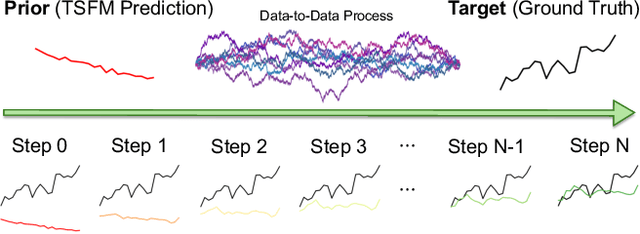
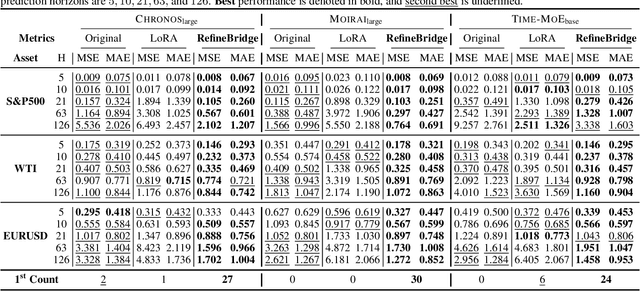
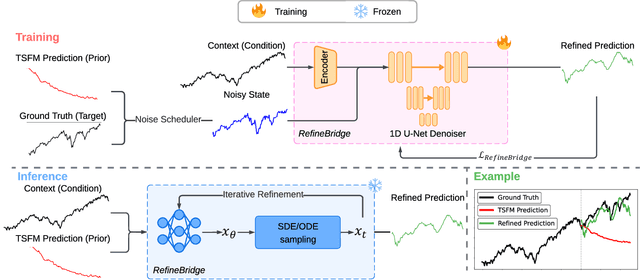
Financial time series forecasting is particularly challenging for transformer-based time series foundation models (TSFMs) due to non-stationarity, heavy-tailed distributions, and high-frequency noise present in data. Low-rank adaptation (LoRA) has become a popular parameter-efficient method for adapting pre-trained TSFMs to downstream data domains. However, it still underperforms in financial data, as it preserves the network architecture and training objective of TSFMs rather than complementing the foundation model. To further enhance TSFMs, we propose a novel refinement module, RefineBridge, built upon a tractable Schrödinger Bridge (SB) generative framework. Given the forecasts of TSFM as generative prior and the observed ground truths as targets, RefineBridge learns context-conditioned stochastic transport maps to improve TSFM predictions, iteratively approaching the ground-truth target from even a low-quality prior. Simulations on multiple financial benchmarks demonstrate that RefineBridge consistently improves the performance of state-of-the-art TSFMs across different prediction horizons.
Coarse-to-Fine Open-Set Graph Node Classification with Large Language Models
Dec 21, 2025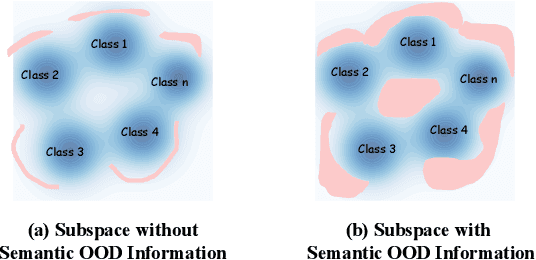
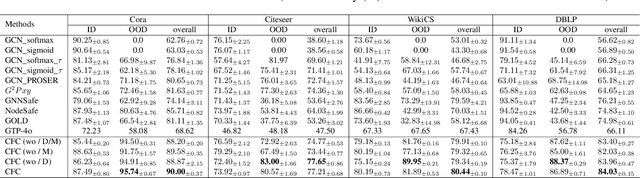

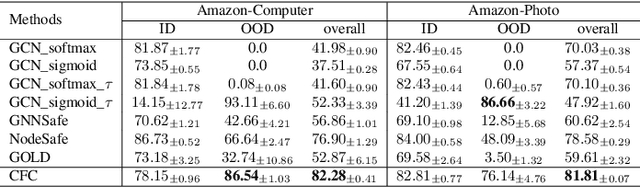
Developing open-set classification methods capable of classifying in-distribution (ID) data while detecting out-of-distribution (OOD) samples is essential for deploying graph neural networks (GNNs) in open-world scenarios. Existing methods typically treat all OOD samples as a single class, despite real-world applications, especially high-stake settings such as fraud detection and medical diagnosis, demanding deeper insights into OOD samples, including their probable labels. This raises a critical question: can OOD detection be extended to OOD classification without true label information? To address this question, we propose a Coarse-to-Fine open-set Classification (CFC) framework that leverages large language models (LLMs) for graph datasets. CFC consists of three key components: a coarse classifier that uses LLM prompts for OOD detection and outlier label generation, a GNN-based fine classifier trained with OOD samples identified by the coarse classifier for enhanced OOD detection and ID classification, and refined OOD classification achieved through LLM prompts and post-processed OOD labels. Unlike methods that rely on synthetic or auxiliary OOD samples, CFC employs semantic OOD instances that are genuinely out-of-distribution based on their inherent meaning, improving interpretability and practical utility. Experimental results show that CFC improves OOD detection by ten percent over state-of-the-art methods on graph and text domains and achieves up to seventy percent accuracy in OOD classification on graph datasets.
Machine Intelligence on the Edge: Interpretable Cardiac Pattern Localisation Using Reinforcement Learning
Aug 29, 2025Matched filters are widely used to localise signal patterns due to their high efficiency and interpretability. However, their effectiveness deteriorates for low signal-to-noise ratio (SNR) signals, such as those recorded on edge devices, where prominent noise patterns can closely resemble the target within the limited length of the filter. One example is the ear-electrocardiogram (ear-ECG), where the cardiac signal is attenuated and heavily corrupted by artefacts. To address this, we propose the Sequential Matched Filter (SMF), a paradigm that replaces the conventional single matched filter with a sequence of filters designed by a Reinforcement Learning agent. By formulating filter design as a sequential decision-making process, SMF adaptively design signal-specific filter sequences that remain fully interpretable by revealing key patterns driving the decision-making. The proposed SMF framework has strong potential for reliable and interpretable clinical decision support, as demonstrated by its state-of-the-art R-peak detection and physiological state classification performance on two challenging real-world ECG datasets. The proposed formulation can also be extended to a broad range of applications that require accurate pattern localisation from noise-corrupted signals.