 Add to Chrome
 Add to Firefox
 Add to Edge
Fixed-Budget Parameter-Efficient Training with Frozen Encoders Improves Multimodal Chest X-Ray Classification
Dec 25, 2025
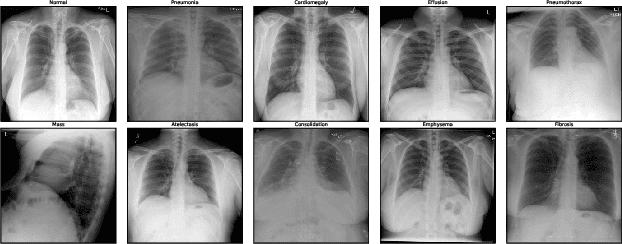
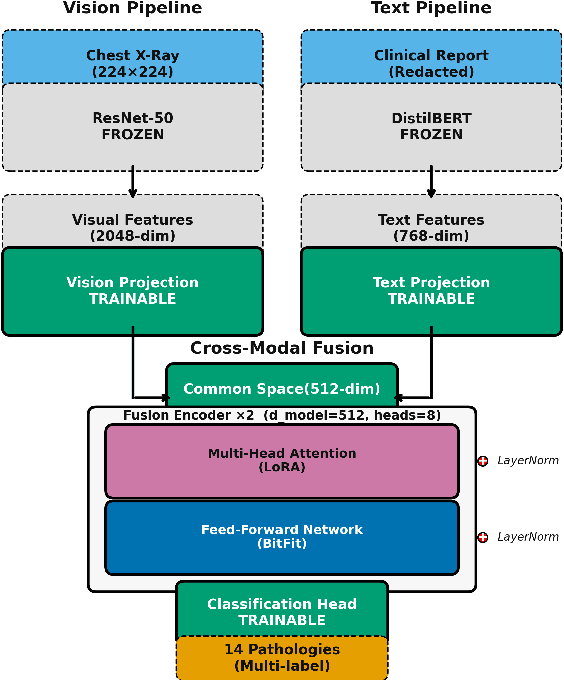
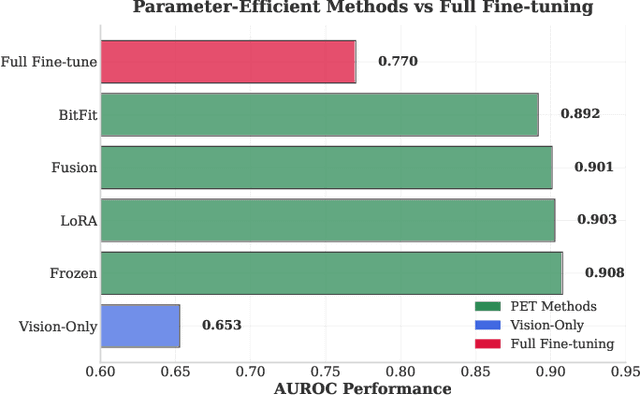
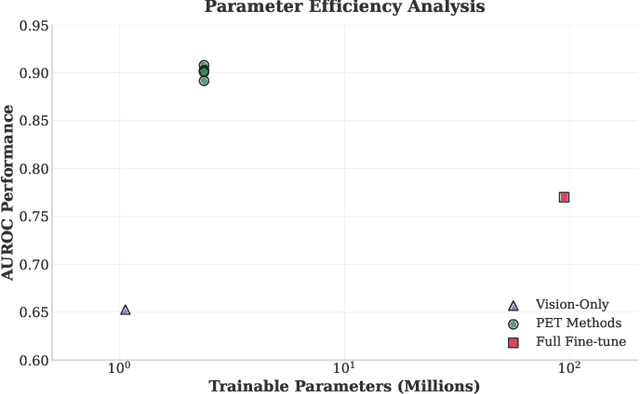
Multimodal chest X-Ray analysis often fine-tunes large vision-language models, which is computationally costly. We study parameter-efficient training (PET) strategies, including frozen encoders, BitFit, LoRA, and adapters for multi-label classification on the Indiana University Chest X-Ray dataset (3,851 image-report pairs; 579 test samples). To mitigate data leakage, we redact pathology terms from reports used as text inputs while retaining clinical context. Under a fixed parameter budget (2.37M parameters, 2.51% of total), all PET variants achieve AUROC between 0.892 and 0.908, outperforming full fine-tuning (0.770 AUROC), which uses 94.3M trainable parameters, a 40x reduction. External validation on CheXpert (224,316 images, 58x larger) confirms scalability: all PET methods achieve >0.69 AUROC with <9% trainable parameters, with Adapter achieving best performance (0.7214 AUROC). Budget-matched comparisons reveal that vision-only models (0.653 AUROC, 1.06M parameters) outperform budget-matched multimodal models (0.641 AUROC, 1.06M parameters), indicating improvements arise primarily from parameter allocation rather than cross-modal synergy. While PET methods show degraded calibration (ECE: 0.29-0.34) compared to simpler models (ECE: 0.049), this represents a tractable limitation addressable through post-hoc calibration methods. These findings demonstrate that frozen encoder strategies provide superior discrimination at substantially reduced computational cost, though calibration correction is essential for clinical deployment.

Fixed-Threshold Evaluation of a Hybrid CNN-ViT for AI-Generated Image Detection Across Photos and Art
Dec 25, 2025AI image generators create both photorealistic images and stylized art, necessitating robust detectors that maintain performance under common post-processing transformations (JPEG compression, blur, downscaling). Existing methods optimize single metrics without addressing deployment-critical factors such as operating point selection and fixed-threshold robustness. This work addresses misleading robustness estimates by introducing a fixed-threshold evaluation protocol that holds decision thresholds, selected once on clean validation data, fixed across all post-processing transformations. Traditional methods retune thresholds per condition, artificially inflating robustness estimates and masking deployment failures. We report deployment-relevant performance at three operating points (Low-FPR, ROC-optimal, Best-F1) under systematic degradation testing using a lightweight CNN-ViT hybrid with gated fusion and optional frequency enhancement. Our evaluation exposes a statistically validated forensic-semantic spectrum: frequency-aided CNNs excel on pristine photos but collapse under compression (93.33% to 61.49%), whereas ViTs degrade minimally (92.86% to 88.36%) through robust semantic pattern recognition. Multi-seed experiments demonstrate that all architectures achieve 15% higher AUROC on artistic content (0.901-0.907) versus photorealistic images (0.747-0.759), confirming that semantic patterns provide fundamentally more reliable detection cues than forensic artifacts. Our hybrid approach achieves balanced cross-domain performance: 91.4% accuracy on tiny-genimage photos, 89.7% on AiArtData art/graphics, and 98.3% (competitive) on CIFAKE. Fixed-threshold evaluation eliminates retuning inflation, reveals genuine robustness gaps, and yields actionable deployment guidance: prefer CNNs for clean photo verification, ViTs for compressed content, and hybrids for art/graphics screening.
Comparative Analysis of Resource-Efficient CNN Architectures for Brain Tumor Classification
Nov 23, 2024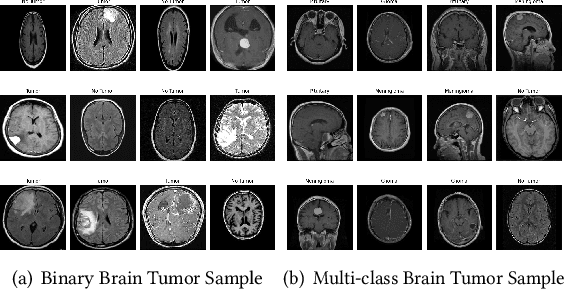
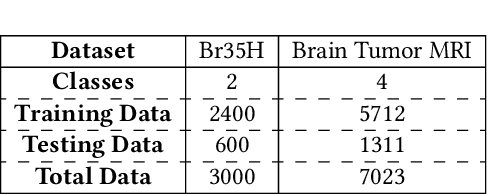
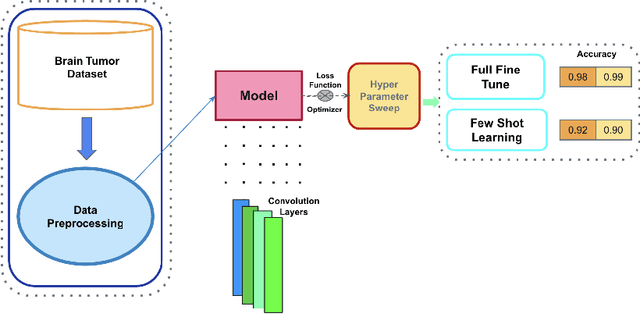
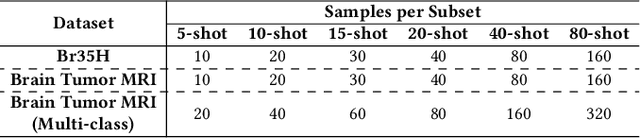
Accurate brain tumor classification in MRI images is critical for timely diagnosis and treatment planning. While deep learning models like ResNet-18, VGG-16 have shown high accuracy, they often come with increased complexity and computational demands. This study presents a comparative analysis of effective yet simple Convolutional Neural Network (CNN) architecture and pre-trained ResNet18, and VGG16 model for brain tumor classification using two publicly available datasets: Br35H:: Brain Tumor Detection 2020 and Brain Tumor MRI Dataset. The custom CNN architecture, despite its lower complexity, demonstrates competitive performance with the pre-trained ResNet18 and VGG16 models. In binary classification tasks, the custom CNN achieved an accuracy of 98.67% on the Br35H dataset and 99.62% on the Brain Tumor MRI Dataset. For multi-class classification, the custom CNN, with a slight architectural modification, achieved an accuracy of 98.09%, on the Brain Tumor MRI Dataset. Comparatively, ResNet18 and VGG16 maintained high performance levels, but the custom CNNs provided a more computationally efficient alternative. Additionally,the custom CNNs were evaluated using few-shot learning (0, 5, 10, 15, 20, 40, and 80 shots) to assess their robustness, achieving notable accuracy improvements with increased shots. This study highlights the potential of well-designed, less complex CNN architectures as effective and computationally efficient alternatives to deeper, pre-trained models for medical imaging tasks, including brain tumor classification. This study underscores the potential of custom CNNs in medical imaging tasks and encourages further exploration in this direction.