 Add to Chrome
 Add to Firefox
 Add to Edge
RAIL: Rethinking Auditory Intelligence in Large Audio-Language Models with a CHC-Grounded Benchmark
Jun 09, 2026
Humans process rich auditory environments through tightly integrated cognitive capabilities such as audio perception, audio reasoning, and memory. Despite recent progress in large audio-language models (LALMs) across speech understanding and multimodal audio reasoning, current evaluation paradigms remain largely task- or modality-centric, focusing on end performance while overlooking underlying auditory cognitive behaviours. This reveals a fundamental gap between how auditory cognition is understood in humans and how it is evaluated in LALMs, particularly in the lack of frameworks that operationalise cognitive principles beyond task-level metrics to systematically capture model behaviour. In this work, we introduce RAIL, a human-centric evaluation paradigm grounded in the Cattell-Horn-Carroll (CHC) cognitive framework. RAIL formalises auditory cognition into five core capabilities and develop them into structured evaluation tasks that probe how models process, retain, and integrate auditory information. We further construct a cognitively grounded benchmark with principled data curation and human-aligned evaluation protocols. Evaluating 26 state-of-the-art LALMs, we find that current models exhibit highly uneven performance across cognitive abilities. RAIL establishes a new evaluation paradigm that moves beyond task-centric benchmarking toward cognitively grounded assessment of auditory intelligence.

Spectral Flattening Is All Muon Needs: How Orthogonalization Controls Learning Rate and Convergence
May 13, 2026Muon orthogonalizes the momentum buffer before each update, replacing its singular values with ones via Newton-Schulz iterations. This simple change lets Muon tolerate far larger learning rates and converge faster than other optimizers, but why? We show that the mechanism is spectral flattening, and develop two results around it. First, we prove that Muon's maximal stable step size scales with the average singular value of the gradient rather than the largest, which bottlenecks standard gradient descent. Second, we recast Muon as a preconditioned gradient method and show, under a Kronecker-factored curvature model, that it improves the effective convergence factor, with the improvement controlled by the spectrum of the gradient covariance. Extensive experiments validate both results: Muon remains stable at learning rates that cause SGD to diverge within the first few iterations, and reaches accuracy milestones several epochs earlier even at identical step sizes. Taken together, our results offer a principled, geometric explanation for Muon's empirical success.
Dimensionality-Aware Anomaly Detection in Learned Representations of Self-Supervised Speech Models
May 04, 2026Self-supervised speech models (S3Ms) achieve strong downstream performance, yet their learned representations remain poorly understood under natural and adversarial perturbations. Prior studies rely on representation similarity or global dimensionality, offering limited visibility into local geometric changes. We ask: how do perturbations deform local geometry, and do these shifts track downstream automatic speech recognition (ASR) degradation? To address this, we present GRIDS, a framework using Local Intrinsic Dimensionality (LID) across layer-wise representations in WavLM and wav2vec 2.0. We find that LID increases for all low signal-to noise ratio (SNR) perturbations and diverges at high SNR: benign noise converges toward the clean profile, while adversarial inputs retain early-layer LID elevation. We show LID elevation co-occurs with increased WER, and that layer-wise LID features enable anomaly detection (AUROC 0.78-1.00), opening the door to transcript-free monitoring in S3Ms.
On the Use of Bagging for Local Intrinsic Dimensionality Estimation
Mar 25, 2026The theory of Local Intrinsic Dimensionality (LID) has become a valuable tool for characterizing local complexity within and across data manifolds, supporting a range of data mining and machine learning tasks. Accurate LID estimation requires samples drawn from small neighborhoods around each query to avoid biases from nonlocal effects and potential manifold mixing, yet limited data within such neighborhoods tends to cause high estimation variance. As a variance reduction strategy, we propose an ensemble approach that uses subbagging to preserve the local distribution of nearest neighbor (NN) distances. The main challenge is that the uniform reduction in total sample size within each subsample increases the proximity threshold for finding a fixed number k of NNs around the query. As a result, in the specific context of LID estimation, the sampling rate has an additional, complex interplay with the neighborhood size, where both combined determine the sample size as well as the locality and resolution considered for estimation. We analyze both theoretically and experimentally how the choice of the sampling rate and the k-NN size used for LID estimation, alongside the ensemble size, affects performance, enabling informed prior selection of these hyper-parameters depending on application-based preferences. Our results indicate that within broad and well-characterized regions of the hyper-parameters space, using a bagged estimator will most often significantly reduce variance as well as the mean squared error when compared to the corresponding non-bagged baseline, with controllable impact on bias. We additionally propose and evaluate different ways of combining bagging with neighborhood smoothing for substantial further improvements on LID estimation performance.
Attention in Space: Functional Roles of VLM Heads for Spatial Reasoning
Mar 21, 2026Despite remarkable advances in large Vision-Language Models (VLMs), spatial reasoning remains a persistent challenge. In this work, we investigate how attention heads within VLMs contribute to spatial reasoning by analyzing their functional roles through a mechanistic interpretability lens. We introduce CogVSR, a dataset that decomposes complex spatial reasoning questions into step-by-step subquestions designed to simulate human-like reasoning via a chain-of-thought paradigm, with each subquestion linked to specific cognitive functions such as spatial perception or relational reasoning. Building on CogVSR, we develop a probing framework to identify and characterize attention heads specialized for these functions. Our analysis across diverse VLM families reveals that these functional heads are universally sparse, vary in number and distribution across functions. Notably, spatially specialized heads are fewer than those for other cognitive functions, highlighting their scarcity. We propose methods to activate latent spatial heads, improving spatial understanding. Intervention experiments further demonstrate their critical role in spatial reasoning: removing functional heads leads to performance degradation, while emphasizing them enhances accuracy. This study provides new interpretability driven insights into how VLMs attend to space and paves the way for enhancing complex spatial reasoning in multimodal models.
CoCoEmo: Composable and Controllable Human-Like Emotional TTS via Activation Steering
Feb 03, 2026Emotional expression in human speech is nuanced and compositional, often involving multiple, sometimes conflicting, affective cues that may diverge from linguistic content. In contrast, most expressive text-to-speech systems enforce a single utterance-level emotion, collapsing affective diversity and suppressing mixed or text-emotion-misaligned expression. While activation steering via latent direction vectors offers a promising solution, it remains unclear whether emotion representations are linearly steerable in TTS, where steering should be applied within hybrid TTS architectures, and how such complex emotion behaviors should be evaluated. This paper presents the first systematic analysis of activation steering for emotional control in hybrid TTS models, introducing a quantitative, controllable steering framework, and multi-rater evaluation protocols that enable composable mixed-emotion synthesis and reliable text-emotion mismatch synthesis. Our results demonstrate, for the first time, that emotional prosody and expressive variability are primarily synthesized by the TTS language module instead of the flow-matching module, and also provide a lightweight steering approach for generating natural, human-like emotional speech.
Local Intrinsic Dimensionality of Ground Motion Data for Early Detection of Complex Catastrophic Slope Failure
Jan 07, 2026Local Intrinsic Dimensionality (LID) has shown strong potential for identifying anomalies and outliers in high-dimensional data across a wide range of real-world applications, including landslide failure detection in granular media. Early and accurate identification of failure zones in landslide-prone areas is crucial for effective geohazard mitigation. While existing approaches typically rely on surface displacement data analyzed through statistical or machine learning techniques, they often fall short in capturing both the spatial correlations and temporal dynamics that are inherent in such data. To address this gap, we focus on ground-monitored landslides and introduce a novel approach that jointly incorporates spatial and temporal information, enabling the detection of complex landslides and including multiple successive failures occurring in distinct areas of the same slope. To be specific, our method builds upon an existing LID-based technique, known as sLID. We extend its capabilities in three key ways. (1) Kinematic enhancement: we incorporate velocity into the sLID computation to better capture short-term temporal dependencies and deformation rate relationships. (2) Spatial fusion: we apply Bayesian estimation to aggregate sLID values across spatial neighborhoods, effectively embedding spatial correlations into the LID scores. (3) Temporal modeling: we introduce a temporal variant, tLID, that learns long-term dynamics from time series data, providing a robust temporal representation of displacement behavior. Finally, we integrate both components into a unified framework, referred to as spatiotemporal LID (stLID), to identify samples that are anomalous in either or both dimensions. Extensive experiments show that stLID consistently outperforms existing methods in failure detection precision and lead-time.
Coarse-to-Fine Open-Set Graph Node Classification with Large Language Models
Dec 21, 2025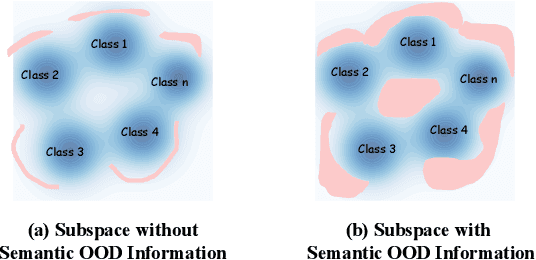
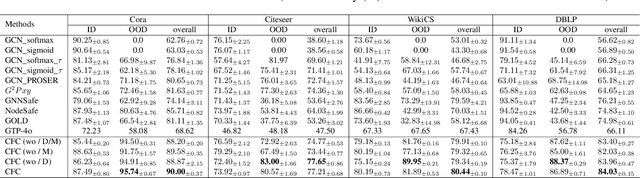

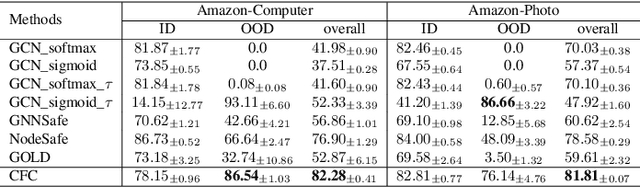
Developing open-set classification methods capable of classifying in-distribution (ID) data while detecting out-of-distribution (OOD) samples is essential for deploying graph neural networks (GNNs) in open-world scenarios. Existing methods typically treat all OOD samples as a single class, despite real-world applications, especially high-stake settings such as fraud detection and medical diagnosis, demanding deeper insights into OOD samples, including their probable labels. This raises a critical question: can OOD detection be extended to OOD classification without true label information? To address this question, we propose a Coarse-to-Fine open-set Classification (CFC) framework that leverages large language models (LLMs) for graph datasets. CFC consists of three key components: a coarse classifier that uses LLM prompts for OOD detection and outlier label generation, a GNN-based fine classifier trained with OOD samples identified by the coarse classifier for enhanced OOD detection and ID classification, and refined OOD classification achieved through LLM prompts and post-processed OOD labels. Unlike methods that rely on synthetic or auxiliary OOD samples, CFC employs semantic OOD instances that are genuinely out-of-distribution based on their inherent meaning, improving interpretability and practical utility. Experimental results show that CFC improves OOD detection by ten percent over state-of-the-art methods on graph and text domains and achieves up to seventy percent accuracy in OOD classification on graph datasets.
DynaPURLS: Dynamic Refinement of Part-aware Representations for Skeleton-based Zero-Shot Action Recognition
Dec 12, 2025Zero-shot skeleton-based action recognition (ZS-SAR) is fundamentally constrained by prevailing approaches that rely on aligning skeleton features with static, class-level semantics. This coarse-grained alignment fails to bridge the domain shift between seen and unseen classes, thereby impeding the effective transfer of fine-grained visual knowledge. To address these limitations, we introduce \textbf{DynaPURLS}, a unified framework that establishes robust, multi-scale visual-semantic correspondences and dynamically refines them at inference time to enhance generalization. Our framework leverages a large language model to generate hierarchical textual descriptions that encompass both global movements and local body-part dynamics. Concurrently, an adaptive partitioning module produces fine-grained visual representations by semantically grouping skeleton joints. To fortify this fine-grained alignment against the train-test domain shift, DynaPURLS incorporates a dynamic refinement module. During inference, this module adapts textual features to the incoming visual stream via a lightweight learnable projection. This refinement process is stabilized by a confidence-aware, class-balanced memory bank, which mitigates error propagation from noisy pseudo-labels. Extensive experiments on three large-scale benchmark datasets, including NTU RGB+D 60/120 and PKU-MMD, demonstrate that DynaPURLS significantly outperforms prior art, setting new state-of-the-art records. The source code is made publicly available at https://github.com/Alchemist0754/DynaPURLS
Investigating The Functional Roles of Attention Heads in Vision Language Models: Evidence for Reasoning Modules
Dec 11, 2025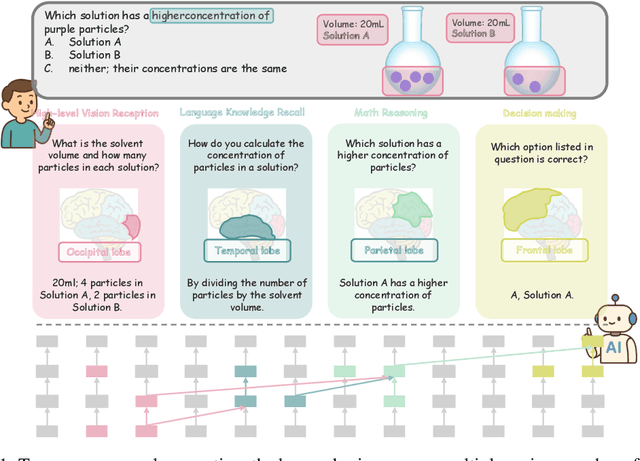
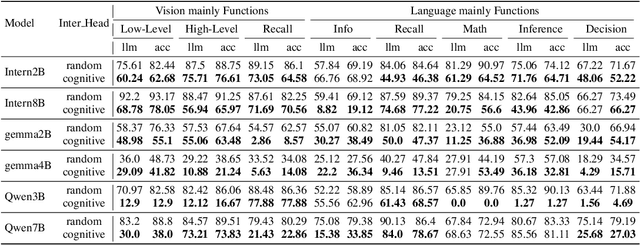
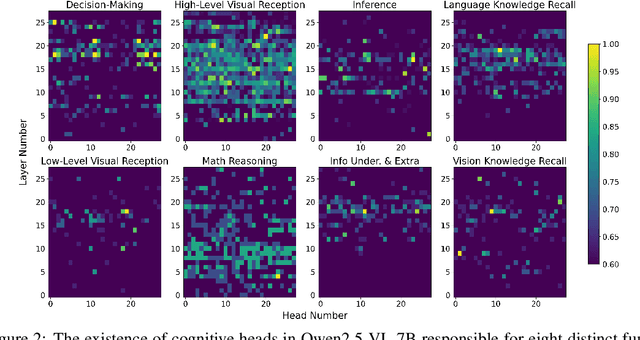

Despite excelling on multimodal benchmarks, vision-language models (VLMs) largely remain a black box. In this paper, we propose a novel interpretability framework to systematically analyze the internal mechanisms of VLMs, focusing on the functional roles of attention heads in multimodal reasoning. To this end, we introduce CogVision, a dataset that decomposes complex multimodal questions into step-by-step subquestions designed to simulate human reasoning through a chain-of-thought paradigm, with each subquestion associated with specific receptive or cognitive functions such as high-level visual reception and inference. Using a probing-based methodology, we identify attention heads that specialize in these functions and characterize them as functional heads. Our analysis across diverse VLM families reveals that these functional heads are universally sparse, vary in number and distribution across functions, and mediate interactions and hierarchical organization. Furthermore, intervention experiments demonstrate their critical role in multimodal reasoning: removing functional heads leads to performance degradation, while emphasizing them enhances accuracy. These findings provide new insights into the cognitive organization of VLMs and suggest promising directions for designing models with more human-aligned perceptual and reasoning abilities.