 Add to Chrome
 Add to Firefox
 Add to Edge
Video Salient Object Detection
Papers and Code
ForensicZip: More Tokens are Better but Not Necessary in Forensic Vision-Language Models
Mar 12, 2026
Multimodal Large Language Models (MLLMs) enable interpretable multimedia forensics by generating textual rationales for forgery detection. However, processing dense visual sequences incurs high computational costs, particularly for high-resolution images and videos. Visual token pruning is a practical acceleration strategy, yet existing methods are largely semantic-driven, retaining salient objects while discarding background regions where manipulation traces such as high-frequency anomalies and temporal jitters often reside. To address this issue, we introduce ForensicZip, a training-free framework that reformulates token compression from a forgery-driven perspective. ForensicZip models temporal token evolution as a Birth-Death Optimal Transport problem with a slack dummy node, quantifying physical discontinuities indicating transient generative artifacts. The forensic scoring further integrates transport-based novelty with high-frequency priors to separate forensic evidence from semantic content under large-ratio compression. Experiments on deepfake and AIGC benchmarks show that at 10\% token retention, ForensicZip achieves $2.97\times$ speedup and over 90\% FLOPs reduction while maintaining state-of-the-art detection performance.

Samba+: General and Accurate Salient Object Detection via A More Unified Mamba-based Framework
Feb 02, 2026Existing salient object detection (SOD) models are generally constrained by the limited receptive fields of convolutional neural networks (CNNs) and quadratic computational complexity of Transformers. Recently, the emerging state-space model, namely Mamba, has shown great potential in balancing global receptive fields and computational efficiency. As a solution, we propose Saliency Mamba (Samba), a pure Mamba-based architecture that flexibly handles various distinct SOD tasks, including RGB/RGB-D/RGB-T SOD, video SOD (VSOD), RGB-D VSOD, and visible-depth-thermal SOD. Specifically, we rethink the scanning strategy of Mamba for SOD, and introduce a saliency-guided Mamba block (SGMB) that features a spatial neighborhood scanning (SNS) algorithm to preserve the spatial continuity of salient regions. A context-aware upsampling (CAU) method is also proposed to promote hierarchical feature alignment and aggregation by modeling contextual dependencies. As one step further, to avoid the "task-specific" problem as in previous SOD solutions, we develop Samba+, which is empowered by training Samba in a multi-task joint manner, leading to a more unified and versatile model. Two crucial components that collaboratively tackle challenges encountered in input of arbitrary modalities and continual adaptation are investigated. Specifically, a hub-and-spoke graph attention (HGA) module facilitates adaptive cross-modal interactive fusion, and a modality-anchored continual learning (MACL) strategy alleviates inter-modal conflicts together with catastrophic forgetting. Extensive experiments demonstrate that Samba individually outperforms existing methods across six SOD tasks on 22 datasets with lower computational cost, whereas Samba+ achieves even superior results on these tasks and datasets by using a single trained versatile model. Additional results further demonstrate the potential of our Samba framework.
SAM-DAQ: Segment Anything Model with Depth-guided Adaptive Queries for RGB-D Video Salient Object Detection
Nov 13, 2025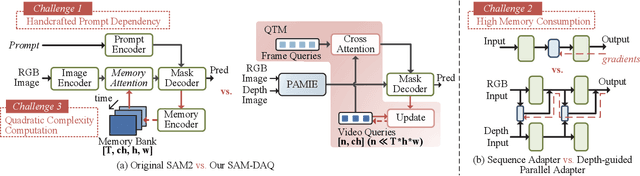
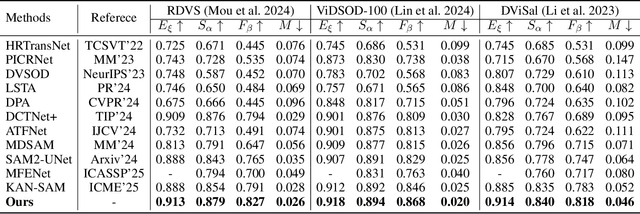
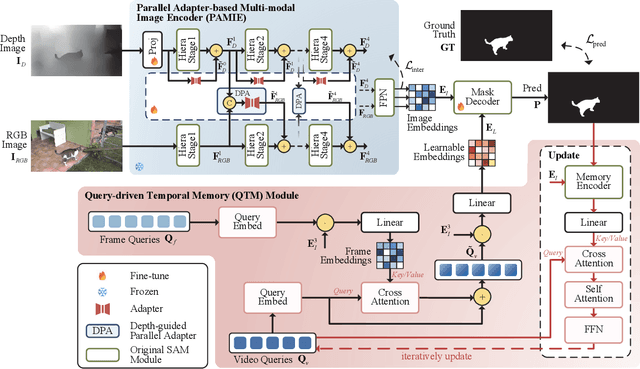
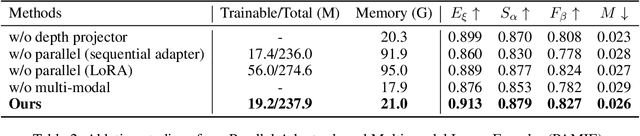
Recently segment anything model (SAM) has attracted widespread concerns, and it is often treated as a vision foundation model for universal segmentation. Some researchers have attempted to directly apply the foundation model to the RGB-D video salient object detection (RGB-D VSOD) task, which often encounters three challenges, including the dependence on manual prompts, the high memory consumption of sequential adapters, and the computational burden of memory attention. To address the limitations, we propose a novel method, namely Segment Anything Model with Depth-guided Adaptive Queries (SAM-DAQ), which adapts SAM2 to pop-out salient objects from videos by seamlessly integrating depth and temporal cues within a unified framework. Firstly, we deploy a parallel adapter-based multi-modal image encoder (PAMIE), which incorporates several depth-guided parallel adapters (DPAs) in a skip-connection way. Remarkably, we fine-tune the frozen SAM encoder under prompt-free conditions, where the DPA utilizes depth cues to facilitate the fusion of multi-modal features. Secondly, we deploy a query-driven temporal memory (QTM) module, which unifies the memory bank and prompt embeddings into a learnable pipeline. Concretely, by leveraging both frame-level queries and video-level queries simultaneously, the QTM module can not only selectively extract temporal consistency features but also iteratively update the temporal representations of the queries. Extensive experiments are conducted on three RGB-D VSOD datasets, and the results show that the proposed SAM-DAQ consistently outperforms state-of-the-art methods in terms of all evaluation metrics.
Learning to Tell Apart: Weakly Supervised Video Anomaly Detection via Disentangled Semantic Alignment
Nov 13, 2025Recent advancements in weakly-supervised video anomaly detection have achieved remarkable performance by applying the multiple instance learning paradigm based on multimodal foundation models such as CLIP to highlight anomalous instances and classify categories. However, their objectives may tend to detect the most salient response segments, while neglecting to mine diverse normal patterns separated from anomalies, and are prone to category confusion due to similar appearance, leading to unsatisfactory fine-grained classification results. Therefore, we propose a novel Disentangled Semantic Alignment Network (DSANet) to explicitly separate abnormal and normal features from coarse-grained and fine-grained aspects, enhancing the distinguishability. Specifically, at the coarse-grained level, we introduce a self-guided normality modeling branch that reconstructs input video features under the guidance of learned normal prototypes, encouraging the model to exploit normality cues inherent in the video, thereby improving the temporal separation of normal patterns and anomalous events. At the fine-grained level, we present a decoupled contrastive semantic alignment mechanism, which first temporally decomposes each video into event-centric and background-centric components using frame-level anomaly scores and then applies visual-language contrastive learning to enhance class-discriminative representations. Comprehensive experiments on two standard benchmarks, namely XD-Violence and UCF-Crime, demonstrate that DSANet outperforms existing state-of-the-art methods.
GAPNet: A Lightweight Framework for Image and Video Salient Object Detection via Granularity-Aware Paradigm
Aug 11, 2025Recent salient object detection (SOD) models predominantly rely on heavyweight backbones, incurring substantial computational cost and hindering their practical application in various real-world settings, particularly on edge devices. This paper presents GAPNet, a lightweight network built on the granularity-aware paradigm for both image and video SOD. We assign saliency maps of different granularities to supervise the multi-scale decoder side-outputs: coarse object locations for high-level outputs and fine-grained object boundaries for low-level outputs. Specifically, our decoder is built with granularity-aware connections which fuse high-level features of low granularity and low-level features of high granularity, respectively. To support these connections, we design granular pyramid convolution (GPC) and cross-scale attention (CSA) modules for efficient fusion of low-scale and high-scale features, respectively. On top of the encoder, a self-attention module is built to learn global information, enabling accurate object localization with negligible computational cost. Unlike traditional U-Net-based approaches, our proposed method optimizes feature utilization and semantic interpretation while applying appropriate supervision at each processing stage. Extensive experiments show that the proposed method achieves a new state-of-the-art performance among lightweight image and video SOD models. Code is available at https://github.com/yuhuan-wu/GAPNet.
Unleashing the Power of Motion and Depth: A Selective Fusion Strategy for RGB-D Video Salient Object Detection
Jul 29, 2025Applying salient object detection (SOD) to RGB-D videos is an emerging task called RGB-D VSOD and has recently gained increasing interest, due to considerable performance gains of incorporating motion and depth and that RGB-D videos can be easily captured now in daily life. Existing RGB-D VSOD models have different attempts to derive motion cues, in which extracting motion information explicitly from optical flow appears to be a more effective and promising alternative. Despite this, there remains a key issue that how to effectively utilize optical flow and depth to assist the RGB modality in SOD. Previous methods always treat optical flow and depth equally with respect to model designs, without explicitly considering their unequal contributions in individual scenarios, limiting the potential of motion and depth. To address this issue and unleash the power of motion and depth, we propose a novel selective cross-modal fusion framework (SMFNet) for RGB-D VSOD, incorporating a pixel-level selective fusion strategy (PSF) that achieves optimal fusion of optical flow and depth based on their actual contributions. Besides, we propose a multi-dimensional selective attention module (MSAM) to integrate the fused features derived from PSF with the remaining RGB modality at multiple dimensions, effectively enhancing feature representation to generate refined features. We conduct comprehensive evaluation of SMFNet against 19 state-of-the-art models on both RDVS and DVisal datasets, making the evaluation the most comprehensive RGB-D VSOD benchmark up to date, and it also demonstrates the superiority of SMFNet over other models. Meanwhile, evaluation on five video benchmark datasets incorporating synthetic depth validates the efficacy of SMFNet as well. Our code and benchmark results are made publicly available at https://github.com/Jia-hao999/SMFNet.
MSC: A Marine Wildlife Video Dataset with Grounded Segmentation and Clip-Level Captioning
Aug 06, 2025Marine videos present significant challenges for video understanding due to the dynamics of marine objects and the surrounding environment, camera motion, and the complexity of underwater scenes. Existing video captioning datasets, typically focused on generic or human-centric domains, often fail to generalize to the complexities of the marine environment and gain insights about marine life. To address these limitations, we propose a two-stage marine object-oriented video captioning pipeline. We introduce a comprehensive video understanding benchmark that leverages the triplets of video, text, and segmentation masks to facilitate visual grounding and captioning, leading to improved marine video understanding and analysis, and marine video generation. Additionally, we highlight the effectiveness of video splitting in order to detect salient object transitions in scene changes, which significantly enrich the semantics of captioning content. Our dataset and code have been released at https://msc.hkustvgd.com.
Shallow Features Matter: Hierarchical Memory with Heterogeneous Interaction for Unsupervised Video Object Segmentation
Jul 30, 2025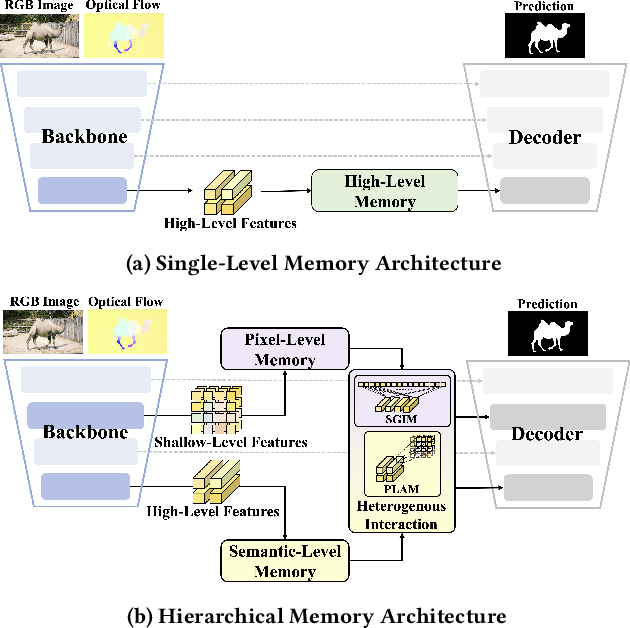
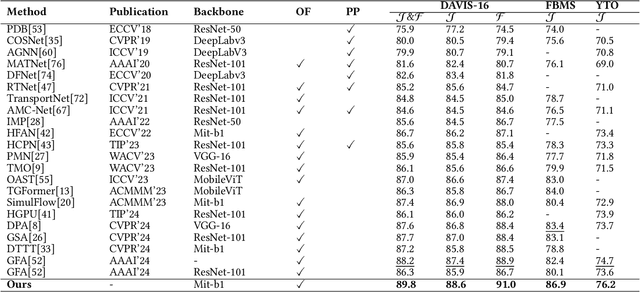
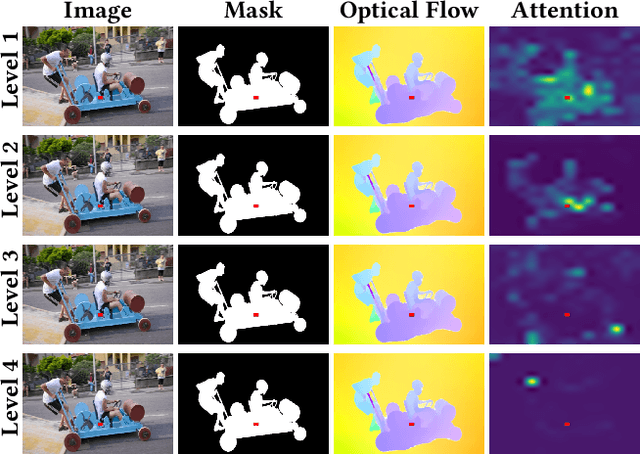
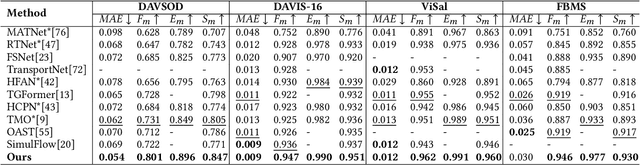
Unsupervised Video Object Segmentation (UVOS) aims to predict pixel-level masks for the most salient objects in videos without any prior annotations. While memory mechanisms have been proven critical in various video segmentation paradigms, their application in UVOS yield only marginal performance gains despite sophisticated design. Our analysis reveals a simple but fundamental flaw in existing methods: over-reliance on memorizing high-level semantic features. UVOS inherently suffers from the deficiency of lacking fine-grained information due to the absence of pixel-level prior knowledge. Consequently, memory design relying solely on high-level features, which predominantly capture abstract semantic cues, is insufficient to generate precise predictions. To resolve this fundamental issue, we propose a novel hierarchical memory architecture to incorporate both shallow- and high-level features for memory, which leverages the complementary benefits of pixel and semantic information. Furthermore, to balance the simultaneous utilization of the pixel and semantic memory features, we propose a heterogeneous interaction mechanism to perform pixel-semantic mutual interactions, which explicitly considers their inherent feature discrepancies. Through the design of Pixel-guided Local Alignment Module (PLAM) and Semantic-guided Global Integration Module (SGIM), we achieve delicate integration of the fine-grained details in shallow-level memory and the semantic representations in high-level memory. Our Hierarchical Memory with Heterogeneous Interaction Network (HMHI-Net) consistently achieves state-of-the-art performance across all UVOS and video saliency detection benchmarks. Moreover, HMHI-Net consistently exhibits high performance across different backbones, further demonstrating its superiority and robustness. Project page: https://github.com/ZhengxyFlow/HMHI-Net .
Intrinsic Saliency Guided Trunk-Collateral Network for Unsupervised Video Object Segmentation
Apr 08, 2025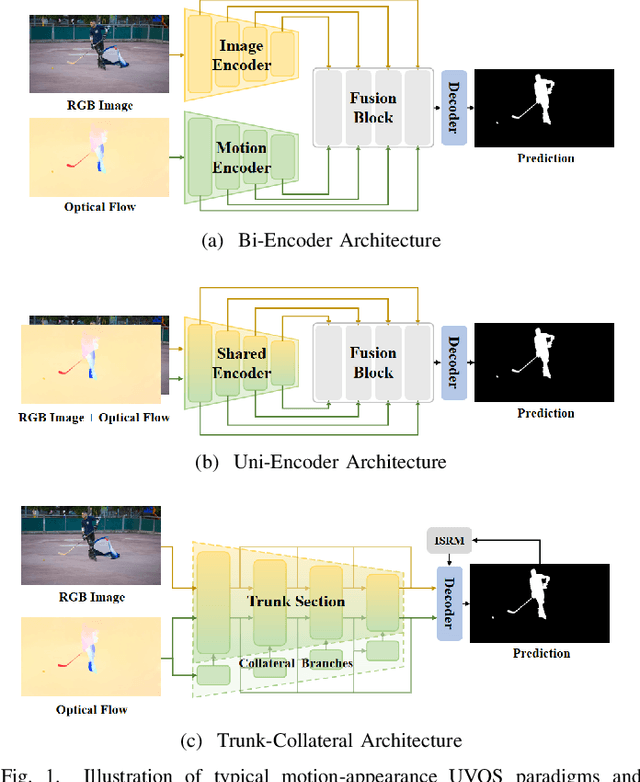
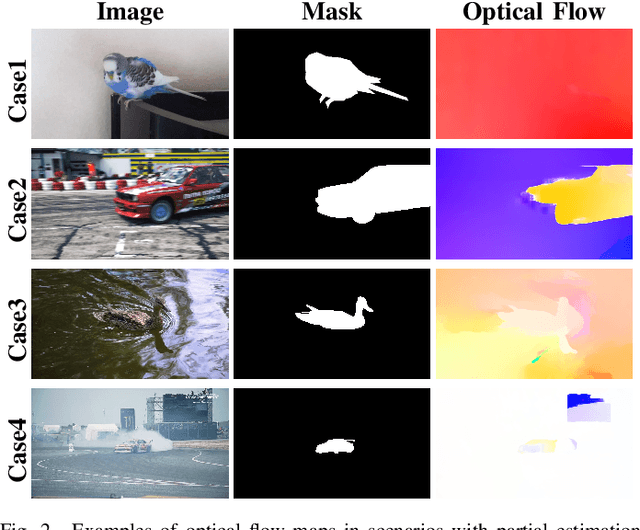
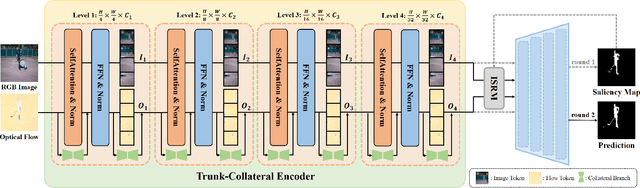
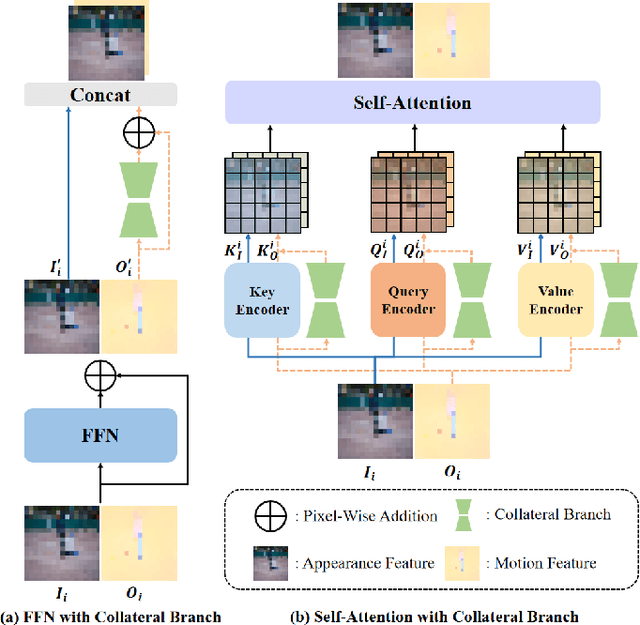
Recent unsupervised video object segmentation (UVOS) methods predominantly adopt the motion-appearance paradigm. Mainstream motion-appearance approaches use either the two-encoder structure to separately encode motion and appearance features, or the single-encoder structure for joint encoding. However, these methods fail to properly balance the motion-appearance relationship. Consequently, even with complex fusion modules for motion-appearance integration, the extracted suboptimal features degrade the models' overall performance. Moreover, the quality of optical flow varies across scenarios, making it insufficient to rely solely on optical flow to achieve high-quality segmentation results. To address these challenges, we propose the Intrinsic Saliency guided Trunk-Collateral Net}work (ISTC-Net), which better balances the motion-appearance relationship and incorporates model's intrinsic saliency information to enhance segmentation performance. Specifically, considering that optical flow maps are derived from RGB images, they share both commonalities and differences. We propose a novel Trunk-Collateral structure. The shared trunk backbone captures the motion-appearance commonality, while the collateral branch learns the uniqueness of motion features. Furthermore, an Intrinsic Saliency guided Refinement Module (ISRM) is devised to efficiently leverage the model's intrinsic saliency information to refine high-level features, and provide pixel-level guidance for motion-appearance fusion, thereby enhancing performance without additional input. Experimental results show that ISTC-Net achieved state-of-the-art performance on three UVOS datasets (89.2% J&F on DAVIS-16, 76% J on YouTube-Objects, 86.4% J on FBMS) and four standard video salient object detection (VSOD) benchmarks with the notable increase, demonstrating its effectiveness and superiority over previous methods.
Balancing long- and short-term dynamics for the modeling of saliency in videos
Apr 08, 2025The role of long- and short-term dynamics towards salient object detection in videos is under-researched. We present a Transformer-based approach to learn a joint representation of video frames and past saliency information. Our model embeds long- and short-term information to detect dynamically shifting saliency in video. We provide our model with a stream of video frames and past saliency maps, which acts as a prior for the next prediction, and extract spatiotemporal tokens from both modalities. The decomposition of the frame sequence into tokens lets the model incorporate short-term information from within the token, while being able to make long-term connections between tokens throughout the sequence. The core of the system consists of a dual-stream Transformer architecture to process the extracted sequences independently before fusing the two modalities. Additionally, we apply a saliency-based masking scheme to the input frames to learn an embedding that facilitates the recognition of deviations from previous outputs. We observe that the additional prior information aids in the first detection of the salient location. Our findings indicate that the ratio of spatiotemporal long- and short-term features directly impacts the model's performance. While increasing the short-term context is beneficial up to a certain threshold, the model's performance greatly benefits from an expansion of the long-term context.