 Add to Chrome
 Add to Firefox
 Add to Edge
M$^4$-SAM: Multi-Modal Mixture-of-Experts with Memory-Augmented SAM for RGB-D Video Salient Object Detection
May 12, 2026
The Segment Anything Model 2 (SAM2) has emerged as a foundation model for universal segmentation. Owing to its generalizable visual representations, SAM2 has been successfully applied to various downstream tasks. However, extending SAM2 to the RGB-D video salient object detection (RGB-D VSOD) task encounters three challenges including limited spatial modeling of linear LoRA, insufficient employment of SAM's multi-scale features, and dependence of initialization on explicit prompts. To address the issues, we present Multi-Modal Mixture-of-Experts with Memory-Augmented SAM (M$^4$-SAM), which equips SAM2 with modality-related PEFT, hierarchical feature fusion, and prompt-free memory initialization. Firstly, we inject Modality-Aware MoE-LORA, which employs convolutional experts to encode local spatial priors and introduces a modality dispatcher for efficient multi-modal fine-tuning, into SAM2's encoder. Secondly, we deploy Gated Multi-Level Feature Fusion, which hierarchically aggregates multi-scale encoder features with an adaptive gating mechanism, to balance spatial details and semantic context. Finally, to conduct zero-shot VSOD without manual prompts, we utilize a Pseudo-Guided Initialization, where a coarse mask is regarded as a pseudo prior and used to bootstrap the memory bank. Extensive experiments demonstrate that M$^4$-SAM achieves the state-of-the-art performance across all evaluation metrics on three public RGB-D VSOD datasets.

SAM-DAQ: Segment Anything Model with Depth-guided Adaptive Queries for RGB-D Video Salient Object Detection
Nov 13, 2025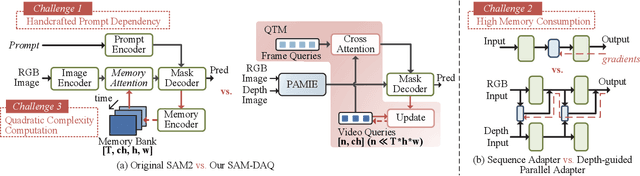
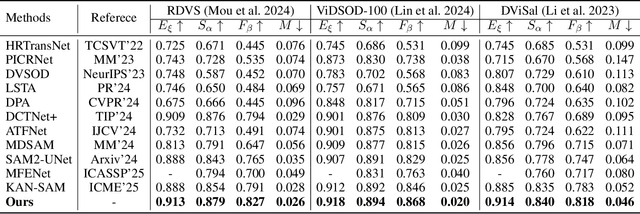
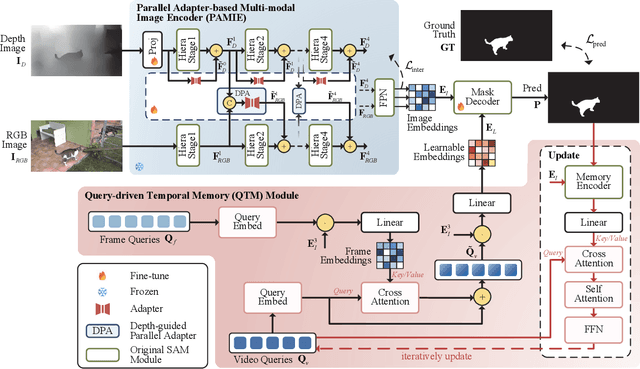
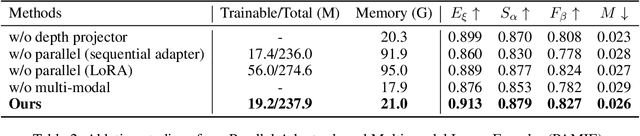
Recently segment anything model (SAM) has attracted widespread concerns, and it is often treated as a vision foundation model for universal segmentation. Some researchers have attempted to directly apply the foundation model to the RGB-D video salient object detection (RGB-D VSOD) task, which often encounters three challenges, including the dependence on manual prompts, the high memory consumption of sequential adapters, and the computational burden of memory attention. To address the limitations, we propose a novel method, namely Segment Anything Model with Depth-guided Adaptive Queries (SAM-DAQ), which adapts SAM2 to pop-out salient objects from videos by seamlessly integrating depth and temporal cues within a unified framework. Firstly, we deploy a parallel adapter-based multi-modal image encoder (PAMIE), which incorporates several depth-guided parallel adapters (DPAs) in a skip-connection way. Remarkably, we fine-tune the frozen SAM encoder under prompt-free conditions, where the DPA utilizes depth cues to facilitate the fusion of multi-modal features. Secondly, we deploy a query-driven temporal memory (QTM) module, which unifies the memory bank and prompt embeddings into a learnable pipeline. Concretely, by leveraging both frame-level queries and video-level queries simultaneously, the QTM module can not only selectively extract temporal consistency features but also iteratively update the temporal representations of the queries. Extensive experiments are conducted on three RGB-D VSOD datasets, and the results show that the proposed SAM-DAQ consistently outperforms state-of-the-art methods in terms of all evaluation metrics.