 Add to Chrome
 Add to Firefox
 Add to Edge
Thermal Infrared Object Tracking
Papers and Code
UBATrack: Spatio-Temporal State Space Model for General Multi-Modal Tracking
Jan 21, 2026
Multi-modal object tracking has attracted considerable attention by integrating multiple complementary inputs (e.g., thermal, depth, and event data) to achieve outstanding performance. Although current general-purpose multi-modal trackers primarily unify various modal tracking tasks (i.e., RGB-Thermal infrared, RGB-Depth or RGB-Event tracking) through prompt learning, they still overlook the effective capture of spatio-temporal cues. In this work, we introduce a novel multi-modal tracking framework based on a mamba-style state space model, termed UBATrack. Our UBATrack comprises two simple yet effective modules: a Spatio-temporal Mamba Adapter (STMA) and a Dynamic Multi-modal Feature Mixer. The former leverages Mamba's long-sequence modeling capability to jointly model cross-modal dependencies and spatio-temporal visual cues in an adapter-tuning manner. The latter further enhances multi-modal representation capacity across multiple feature dimensions to improve tracking robustness. In this way, UBATrack eliminates the need for costly full-parameter fine-tuning, thereby improving the training efficiency of multi-modal tracking algorithms. Experiments show that UBATrack outperforms state-of-the-art methods on RGB-T, RGB-D, and RGB-E tracking benchmarks, achieving outstanding results on the LasHeR, RGBT234, RGBT210, DepthTrack, VOT-RGBD22, and VisEvent datasets.

Navigation Around Unknown Space Objects Using Visible-Thermal Image Fusion
Dec 13, 2025As the popularity of on-orbit operations grows, so does the need for precise navigation around unknown resident space objects (RSOs) such as other spacecraft, orbital debris, and asteroids. The use of Simultaneous Localization and Mapping (SLAM) algorithms is often studied as a method to map out the surface of an RSO and find the inspector's relative pose using a lidar or conventional camera. However, conventional cameras struggle during eclipse or shadowed periods, and lidar, though robust to lighting conditions, tends to be heavier, bulkier, and more power-intensive. Thermal-infrared cameras can track the target RSO throughout difficult illumination conditions without these limitations. While useful, thermal-infrared imagery lacks the resolution and feature-richness of visible cameras. In this work, images of a target satellite in low Earth orbit are photo-realistically simulated in both visible and thermal-infrared bands. Pixel-level fusion methods are used to create visible/thermal-infrared composites that leverage the best aspects of each camera. Navigation errors from a monocular SLAM algorithm are compared between visible, thermal-infrared, and fused imagery in various lighting and trajectories. Fused imagery yields substantially improved navigation performance over visible-only and thermal-only methods.
SpectraSentinel: LightWeight Dual-Stream Real-Time Drone Detection, Tracking and Payload Identification
Jul 30, 2025The proliferation of drones in civilian airspace has raised urgent security concerns, necessitating robust real-time surveillance systems. In response to the 2025 VIP Cup challenge tasks - drone detection, tracking, and payload identification - we propose a dual-stream drone monitoring framework. Our approach deploys independent You Only Look Once v11-nano (YOLOv11n) object detectors on parallel infrared (thermal) and visible (RGB) data streams, deliberately avoiding early fusion. This separation allows each model to be specifically optimized for the distinct characteristics of its input modality, addressing the unique challenges posed by small aerial objects in diverse environmental conditions. We customize data preprocessing and augmentation strategies per domain - such as limiting color jitter for IR imagery - and fine-tune training hyperparameters to enhance detection performance under conditions of heavy noise, low light, and motion blur. The resulting lightweight YOLOv11n models demonstrate high accuracy in distinguishing drones from birds and in classifying payload types, all while maintaining real-time performance. This report details the rationale for a dual-modality design, the specialized training pipelines, and the architectural optimizations that collectively enable efficient and accurate drone surveillance across RGB and IR channels.
A Novel Tuning Method for Real-time Multiple-Object Tracking Utilizing Thermal Sensor with Complexity Motion Pattern
Jul 03, 2025Multi-Object Tracking in thermal images is essential for surveillance systems, particularly in challenging environments where RGB cameras struggle due to low visibility or poor lighting conditions. Thermal sensors enhance recognition tasks by capturing infrared signatures, but a major challenge is their low-level feature representation, which makes it difficult to accurately detect and track pedestrians. To address this, the paper introduces a novel tuning method for pedestrian tracking, specifically designed to handle the complex motion patterns in thermal imagery. The proposed framework optimizes two-stages, ensuring that each stage is tuned with the most suitable hyperparameters to maximize tracking performance. By fine-tuning hyperparameters for real-time tracking, the method achieves high accuracy without relying on complex reidentification or motion models. Extensive experiments on PBVS Thermal MOT dataset demonstrate that the approach is highly effective across various thermal camera conditions, making it a robust solution for real-world surveillance applications.
SMMT: Siamese Motion Mamba with Self-attention for Thermal Infrared Target Tracking
May 07, 2025Thermal infrared (TIR) object tracking often suffers from challenges such as target occlusion, motion blur, and background clutter, which significantly degrade the performance of trackers. To address these issues, this paper pro-poses a novel Siamese Motion Mamba Tracker (SMMT), which integrates a bidirectional state-space model and a self-attention mechanism. Specifically, we introduce the Motion Mamba module into the Siamese architecture to ex-tract motion features and recover overlooked edge details using bidirectional modeling and self-attention. We propose a Siamese parameter-sharing strate-gy that allows certain convolutional layers to share weights. This approach reduces computational redundancy while preserving strong feature represen-tation. In addition, we design a motion edge-aware regression loss to improve tracking accuracy, especially for motion-blurred targets. Extensive experi-ments are conducted on four TIR tracking benchmarks, including LSOTB-TIR, PTB-TIR, VOT-TIR2015, and VOT-TIR 2017. The results show that SMMT achieves superior performance in TIR target tracking.
Lightweight RGB-T Tracking with Mobile Vision Transformers
Jun 23, 2025Single-modality object tracking (e.g., RGB-only) encounters difficulties in challenging imaging conditions, such as low illumination and adverse weather conditions. To solve this, multimodal tracking (e.g., RGB-T models) aims to leverage complementary data such as thermal infrared features. While recent Vision Transformer-based multimodal trackers achieve strong performance, they are often computationally expensive due to large model sizes. In this work, we propose a novel lightweight RGB-T tracking algorithm based on Mobile Vision Transformers (MobileViT). Our tracker introduces a progressive fusion framework that jointly learns intra-modal and inter-modal interactions between the template and search regions using separable attention. This design produces effective feature representations that support more accurate target localization while achieving a small model size and fast inference speed. Compared to state-of-the-art efficient multimodal trackers, our model achieves comparable accuracy while offering significantly lower parameter counts (less than 4 million) and the fastest GPU inference speed of 122 frames per second. This paper is the first to propose a tracker using Mobile Vision Transformers for RGB-T tracking and multimodal tracking at large. Tracker code and model weights will be made publicly available upon acceptance.
Diff-MM: Exploring Pre-trained Text-to-Image Generation Model for Unified Multi-modal Object Tracking
May 19, 2025Multi-modal object tracking integrates auxiliary modalities such as depth, thermal infrared, event flow, and language to provide additional information beyond RGB images, showing great potential in improving tracking stabilization in complex scenarios. Existing methods typically start from an RGB-based tracker and learn to understand auxiliary modalities only from training data. Constrained by the limited multi-modal training data, the performance of these methods is unsatisfactory. To alleviate this limitation, this work proposes a unified multi-modal tracker Diff-MM by exploiting the multi-modal understanding capability of the pre-trained text-to-image generation model. Diff-MM leverages the UNet of pre-trained Stable Diffusion as a tracking feature extractor through the proposed parallel feature extraction pipeline, which enables pairwise image inputs for object tracking. We further introduce a multi-modal sub-module tuning method that learns to gain complementary information between different modalities. By harnessing the extensive prior knowledge in the generation model, we achieve a unified tracker with uniform parameters for RGB-N/D/T/E tracking. Experimental results demonstrate the promising performance of our method compared with recently proposed trackers, e.g., its AUC outperforms OneTracker by 8.3% on TNL2K.
FGSGT: Saliency-Guided Siamese Network Tracker Based on Key Fine-Grained Feature Information for Thermal Infrared Target Tracking
Apr 19, 2025Thermal infrared (TIR) images typically lack detailed features and have low contrast, making it challenging for conventional feature extraction models to capture discriminative target characteristics. As a result, trackers are often affected by interference from visually similar objects and are susceptible to tracking drift. To address these challenges, we propose a novel saliency-guided Siamese network tracker based on key fine-grained feature infor-mation. First, we introduce a fine-grained feature parallel learning convolu-tional block with a dual-stream architecture and convolutional kernels of varying sizes. This design captures essential global features from shallow layers, enhances feature diversity, and minimizes the loss of fine-grained in-formation typically encountered in residual connections. In addition, we propose a multi-layer fine-grained feature fusion module that uses bilinear matrix multiplication to effectively integrate features across both deep and shallow layers. Next, we introduce a Siamese residual refinement block that corrects saliency map prediction errors using residual learning. Combined with deep supervision, this mechanism progressively refines predictions, ap-plying supervision at each recursive step to ensure consistent improvements in accuracy. Finally, we present a saliency loss function to constrain the sali-ency predictions, directing the network to focus on highly discriminative fi-ne-grained features. Extensive experiment results demonstrate that the pro-posed tracker achieves the highest precision and success rates on the PTB-TIR and LSOTB-TIR benchmarks. It also achieves a top accuracy of 0.78 on the VOT-TIR 2015 benchmark and 0.75 on the VOT-TIR 2017 benchmark.
Visual Object Tracking across Diverse Data Modalities: A Review
Dec 13, 2024

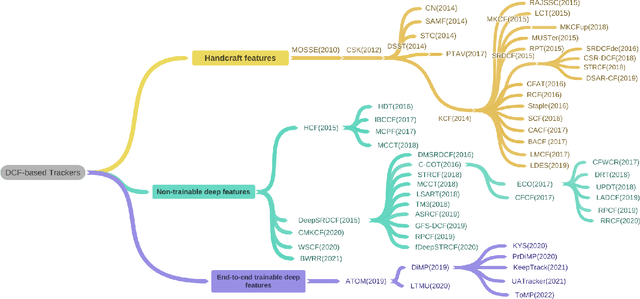

Visual Object Tracking (VOT) is an attractive and significant research area in computer vision, which aims to recognize and track specific targets in video sequences where the target objects are arbitrary and class-agnostic. The VOT technology could be applied in various scenarios, processing data of diverse modalities such as RGB, thermal infrared and point cloud. Besides, since no one sensor could handle all the dynamic and varying environments, multi-modal VOT is also investigated. This paper presents a comprehensive survey of the recent progress of both single-modal and multi-modal VOT, especially the deep learning methods. Specifically, we first review three types of mainstream single-modal VOT, including RGB, thermal infrared and point cloud tracking. In particular, we conclude four widely-used single-modal frameworks, abstracting their schemas and categorizing the existing inheritors. Then we summarize four kinds of multi-modal VOT, including RGB-Depth, RGB-Thermal, RGB-LiDAR and RGB-Language. Moreover, the comparison results in plenty of VOT benchmarks of the discussed modalities are presented. Finally, we provide recommendations and insightful observations, inspiring the future development of this fast-growing literature.
Progressive Domain Adaptation for Thermal Infrared Object Tracking
Jul 28, 2024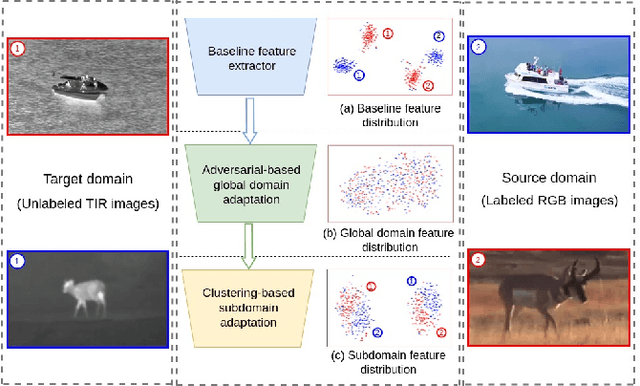
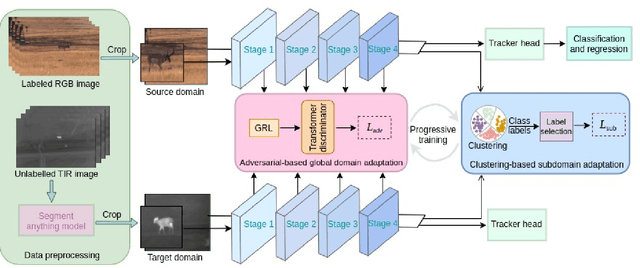
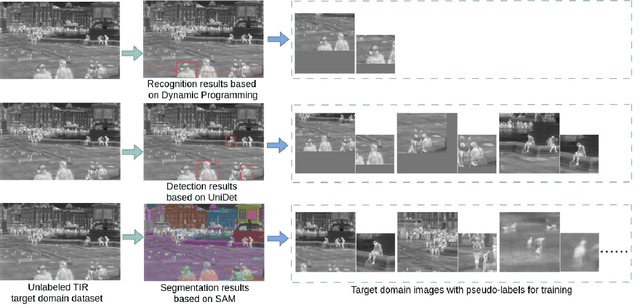
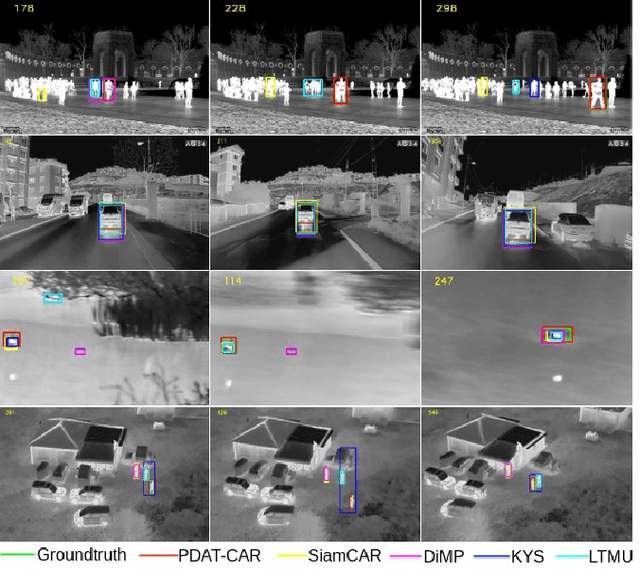
Due to the lack of large-scale labeled Thermal InfraRed (TIR) training datasets, most existing TIR trackers are trained directly on RGB datasets. However, tracking methods trained on RGB datasets suffer a significant drop-off in TIR data due to the domain shift issue. To this end, in this work, we propose a Progressive Domain Adaptation framework for TIR Tracking (PDAT), which transfers useful knowledge learned from RGB tracking to TIR tracking. The framework makes full use of large-scale labeled RGB datasets without requiring time-consuming and labor-intensive labeling of large-scale TIR data. Specifically, we first propose an adversarial-based global domain adaptation module to reduce domain gap on the feature level coarsely. Second, we design a clustering-based subdomain adaptation method to further align the feature distributions of the RGB and TIR datasets finely. These two domain adaptation modules gradually eliminate the discrepancy between the two domains, and thus learn domain-invariant fine-grained features through progressive training. Additionally, we collect a largescale TIR dataset with over 1.48 million unlabeled TIR images for training the proposed domain adaptation framework. Experimental results on five TIR tracking benchmarks show that the proposed method gains a nearly 6% success rate, demonstrating its effectiveness.