 Add to Chrome
 Add to Firefox
 Add to Edge
DeCoDrift: Stabilizing Decoder Coupling in Closed-Loop Foundation Segmentation
May 25, 2026
Foundation segmentation models such as Segment Anything Model (SAM) are now routinely used in iterative pipelines, where each predicted mask is fed back as the next prompt. This practice turns segmentation into a closed-loop dynamical process, yet the decoder-level behavior of these systems remains largely unexamined. We show that this feedback loop can induce a previously overlooked failure mode, decoder coupling drift, in which the mask decoder's cross-attention progressively loses alignment with the target object, causing errors to accumulate across iterations. We study this phenomenon by instrumenting SAM's mask decoder and deriving ground-truth-free measures of prompt-image coupling, attention stability, and temporal consistency. On volumetric electron microscopy data, these decoder-internal signals reveal that standard iterative prompting systematically degrades attention alignment and temporal coherence relative to oracle-anchored feedback. We then formalize iterative prompting as a discrete-time dynamical system and show how proximal anchoring reduces error amplification in the feedback loop. Building on this analysis, we introduce DeCoDrift, a training-free inference-time stabilization framework that constrains prompt updates and preserves decoder coupling across iterations. Across extensive experiments, DeCoDrift consistently improves attention stability, temporal coherence, and segmentation quality over standard iterative prompting, without retraining or ground-truth supervision. More broadly, our results show that decoder-internal dynamics are not merely diagnostic: they provide actionable signals for stabilizing foundation segmentation models in closed-loop use.

Bengali-Loop: Community Benchmarks for Long-Form Bangla ASR and Speaker Diarization
Feb 15, 2026Bengali (Bangla) remains under-resourced in long-form speech technology despite its wide use. We present Bengali-Loop, two community benchmarks to address this gap: (1) a long-form ASR corpus of 191 recordings (158.6 hours, 792k words) from 11 YouTube channels, collected via a reproducible subtitle-extraction pipeline and human-in-the-loop transcript verification; and (2) a speaker diarization corpus of 24 recordings (22 hours, 5,744 annotated segments) with fully manual speaker-turn labels in CSV format. Both benchmarks target realistic multi-speaker, long-duration content (e.g., Bangla drama/natok). We establish baselines (Tugstugi: 34.07% WER; pyannote.audio: 40.08% DER) and provide standardized evaluation protocols (WER/CER, DER), annotation rules, and data formats to support reproducible benchmarking and future model development for Bangla long-form ASR and diarization.
SpectraSentinel: LightWeight Dual-Stream Real-Time Drone Detection, Tracking and Payload Identification
Jul 30, 2025The proliferation of drones in civilian airspace has raised urgent security concerns, necessitating robust real-time surveillance systems. In response to the 2025 VIP Cup challenge tasks - drone detection, tracking, and payload identification - we propose a dual-stream drone monitoring framework. Our approach deploys independent You Only Look Once v11-nano (YOLOv11n) object detectors on parallel infrared (thermal) and visible (RGB) data streams, deliberately avoiding early fusion. This separation allows each model to be specifically optimized for the distinct characteristics of its input modality, addressing the unique challenges posed by small aerial objects in diverse environmental conditions. We customize data preprocessing and augmentation strategies per domain - such as limiting color jitter for IR imagery - and fine-tune training hyperparameters to enhance detection performance under conditions of heavy noise, low light, and motion blur. The resulting lightweight YOLOv11n models demonstrate high accuracy in distinguishing drones from birds and in classifying payload types, all while maintaining real-time performance. This report details the rationale for a dual-modality design, the specialized training pipelines, and the architectural optimizations that collectively enable efficient and accurate drone surveillance across RGB and IR channels.
End-to-End Bangla AI for Solving Math Olympiad Problem Benchmark: Leveraging Large Language Model Using Integrated Approach
Jan 08, 2025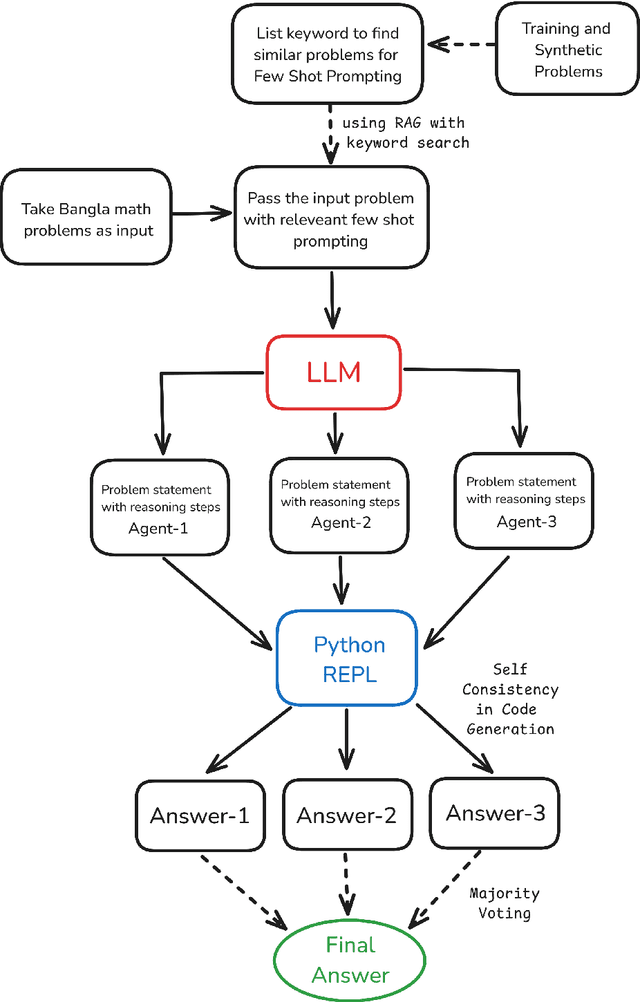
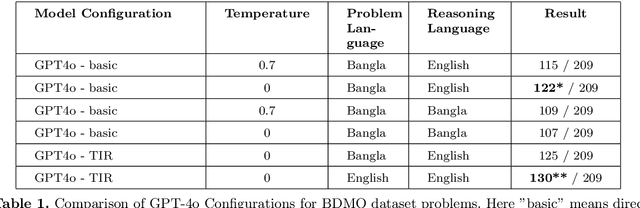
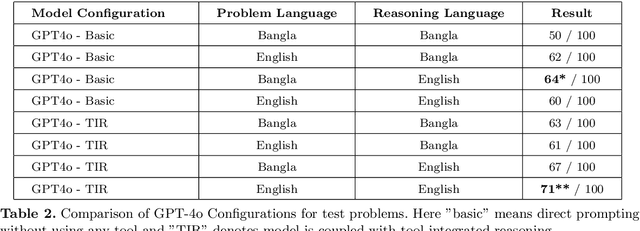

This work introduces systematic approach for enhancing large language models (LLMs) to address Bangla AI mathematical challenges. Through the assessment of diverse LLM configurations, fine-tuning with specific datasets, and the implementation of Retrieval-Augmented Generation (RAG), we enhanced the model's reasoning precision in a multilingual setting. Crucial discoveries indicate that customized prompting, dataset augmentation, and iterative reasoning improve the model's efficiency regarding Olympiad-level mathematical challenges.