 Add to Chrome
 Add to Firefox
 Add to Edge
Speech Emotion Recognition Machine Learning
Papers and Code
Evaluating Interactive 2D Visualization as a Sample Selection Strategy for Biomedical Time-Series Data Annotation
Mar 27, 2026
Reliable machine-learning models in biomedical settings depend on accurate labels, yet annotating biomedical time-series data remains challenging. Algorithmic sample selection may support annotation, but evidence from studies involving real human annotators is scarce. Consequently, we compare three sample selection methods for annotation: random sampling (RND), farthest-first traversal (FAFT), and a graphical user interface-based method enabling exploration of complementary 2D visualizations (2DVs) of high-dimensional data. We evaluated the methods across four classification tasks in infant motility assessment (IMA) and speech emotion recognition (SER). Twelve annotators, categorized as experts or non-experts, performed data annotation under a limited annotation budget, and post-annotation experiments were conducted to evaluate the sampling methods. Across all classification tasks, 2DV performed best when aggregating labels across annotators. In IMA, 2DV most effectively captured rare classes, but also exhibited greater annotator-to-annotator label distribution variability resulting from the limited annotation budget, decreasing classification performance when models were trained on individual annotators' labels; in these cases, FAFT excelled. For SER, 2DV outperformed the other methods among expert annotators and matched their performance for non-experts in the individual-annotator setting. A failure risk analysis revealed that RND was the safest choice when annotator count or annotator expertise was uncertain, whereas 2DV had the highest risk due to its greater label distribution variability. Furthermore, post-experiment interviews indicated that 2DV made the annotation task more interesting and enjoyable. Overall, 2DV-based sampling appears promising for biomedical time-series data annotation, particularly when the annotation budget is not highly constrained.

MSP-Conversation: A Corpus for Naturalistic, Time-Continuous Emotion Recognition
Mar 23, 2026Affective computing aims to understand and model human emotions for computational systems. Within this field, speech emotion recognition (SER) focuses on predicting emotions conveyed through speech. While early SER systems relied on limited datasets and traditional machine learning models, recent deep learning approaches demand largescale, naturalistic emotional corpora. To address this need, we introduce the MSP-Conversation corpus: a dataset of more than 70 hours of conversational audio with time-continuous emotional annotations and detailed speaker diarizations. The time-continuous annotations capture the dynamic and contextdependent nature of emotional expression. The annotations in the corpus include fine-grained temporal traces of valence, arousal, and dominance. The audio data is sourced from publicly available podcasts and overlaps with a subset of the isolated speaking turns in the MSP-Podcast corpus to facilitate direct comparisons between annotation methods (i.e., in-context versus out-of-context annotations). The paper outlines the development of the corpus, annotation methodology, analyses of the annotations, and baseline SER experiments, establishing the MSP-Conversation corpus as a valuable resource for advancing research in dynamic SER in naturalistic settings.
Color-based Emotion Representation for Speech Emotion Recognition
Feb 18, 2026Speech emotion recognition (SER) has traditionally relied on categorical or dimensional labels. However, this technique is limited in representing both the diversity and interpretability of emotions. To overcome this limitation, we focus on color attributes, such as hue, saturation, and value, to represent emotions as continuous and interpretable scores. We annotated an emotional speech corpus with color attributes via crowdsourcing and analyzed them. Moreover, we built regression models for color attributes in SER using machine learning and deep learning, and explored the multitask learning of color attribute regression and emotion classification. As a result, we demonstrated the relationship between color attributes and emotions in speech, and successfully developed color attribute regression models for SER. We also showed that multitask learning improved the performance of each task.
Quantifying Quanvolutional Neural Networks Robustness for Speech in Healthcare Applications
Jan 05, 2026Speech-based machine learning systems are sensitive to noise, complicating reliable deployment in emotion recognition and voice pathology detection. We evaluate the robustness of a hybrid quantum machine learning model, quanvolutional neural networks (QNNs) against classical convolutional neural networks (CNNs) under four acoustic corruptions (Gaussian noise, pitch shift, temporal shift, and speed variation) in a clean-train/corrupted-test regime. Using AVFAD (voice pathology) and TESS (speech emotion), we compare three QNN models (Random, Basic, Strongly) to a simple CNN baseline (CNN-Base), ResNet-18 and VGG-16 using accuracy and corruption metrics (CE, mCE, RCE, RmCE), and analyze architectural factors (circuit complexity or depth, convergence) alongside per-emotion robustness. QNNs generally outperform the CNN-Base under pitch shift, temporal shift, and speed variation (up to 22% lower CE/RCE at severe temporal shift), while the CNN-Base remains more resilient to Gaussian noise. Among quantum circuits, QNN-Basic achieves the best overall robustness on AVFAD, and QNN-Random performs strongest on TESS. Emotion-wise, fear is most robust (80-90% accuracy under severe corruptions), neutral can collapse under strong Gaussian noise (5.5% accuracy), and happy is most vulnerable to pitch, temporal, and speed distortions. QNNs also converge up to six times faster than the CNN-Base. To our knowledge, this is a systematic study of QNN robustness for speech under common non-adversarial acoustic corruptions, indicating that shallow entangling quantum front-ends can improve noise resilience while sensitivity to additive noise remains a challenge.
Lessons Learnt: Revisit Key Training Strategies for Effective Speech Emotion Recognition in the Wild
Aug 10, 2025In this study, we revisit key training strategies in machine learning often overlooked in favor of deeper architectures. Specifically, we explore balancing strategies, activation functions, and fine-tuning techniques to enhance speech emotion recognition (SER) in naturalistic conditions. Our findings show that simple modifications improve generalization with minimal architectural changes. Our multi-modal fusion model, integrating these optimizations, achieves a valence CCC of 0.6953, the best valence score in Task 2: Emotional Attribute Regression. Notably, fine-tuning RoBERTa and WavLM separately in a single-modality setting, followed by feature fusion without training the backbone extractor, yields the highest valence performance. Additionally, focal loss and activation functions significantly enhance performance without increasing complexity. These results suggest that refining core components, rather than deepening models, leads to more robust SER in-the-wild.
Speech-Based Depressive Mood Detection in the Presence of Multiple Sclerosis: A Cross-Corpus and Cross-Lingual Study
Aug 25, 2025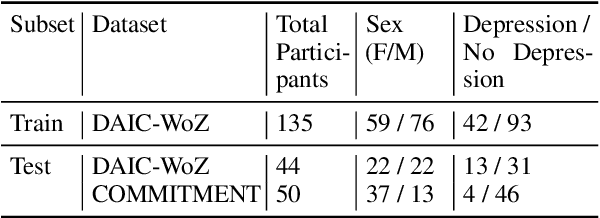
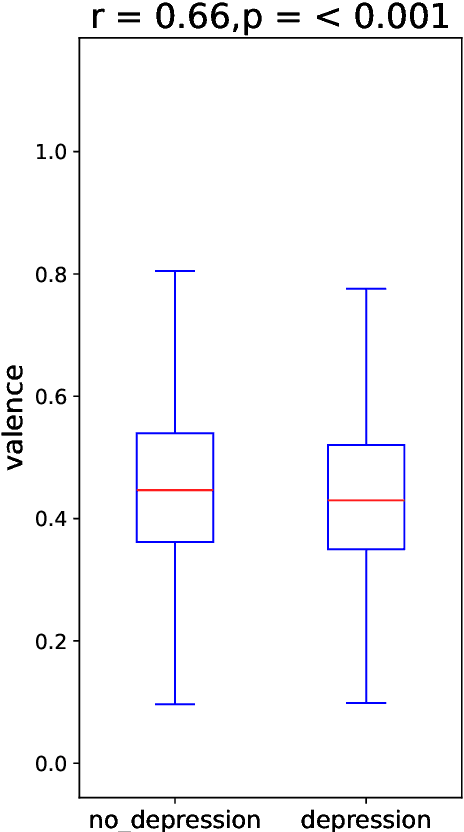
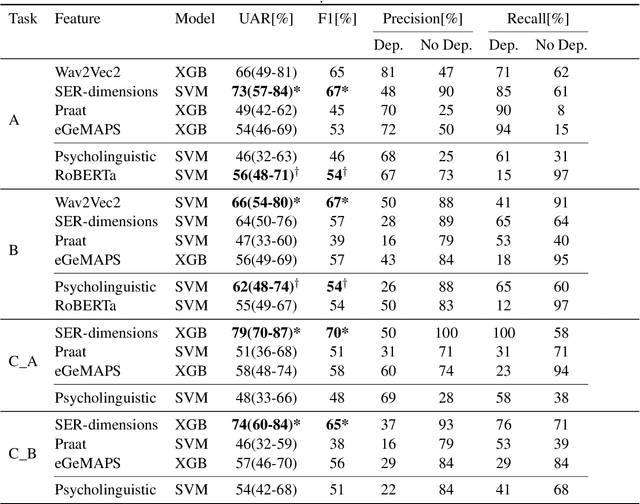
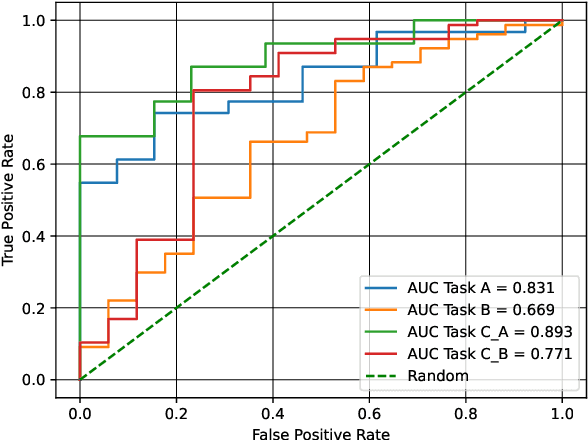
Depression commonly co-occurs with neurodegenerative disorders like Multiple Sclerosis (MS), yet the potential of speech-based Artificial Intelligence for detecting depression in such contexts remains unexplored. This study examines the transferability of speech-based depression detection methods to people with MS (pwMS) through cross-corpus and cross-lingual analysis using English data from the general population and German data from pwMS. Our approach implements supervised machine learning models using: 1) conventional speech and language features commonly used in the field, 2) emotional dimensions derived from a Speech Emotion Recognition (SER) model, and 3) exploratory speech feature analysis. Despite limited data, our models detect depressive mood in pwMS with moderate generalisability, achieving a 66% Unweighted Average Recall (UAR) on a binary task. Feature selection further improved performance, boosting UAR to 74%. Our findings also highlight the relevant role emotional changes have as an indicator of depressive mood in both the general population and within PwMS. This study provides an initial exploration into generalising speech-based depression detection, even in the presence of co-occurring conditions, such as neurodegenerative diseases.
End-to-end Acoustic-linguistic Emotion and Intent Recognition Enhanced by Semi-supervised Learning
Jul 10, 2025Emotion and intent recognition from speech is essential and has been widely investigated in human-computer interaction. The rapid development of social media platforms, chatbots, and other technologies has led to a large volume of speech data streaming from users. Nevertheless, annotating such data manually is expensive, making it challenging to train machine learning models for recognition purposes. To this end, we propose applying semi-supervised learning to incorporate a large scale of unlabelled data alongside a relatively smaller set of labelled data. We train end-to-end acoustic and linguistic models, each employing multi-task learning for emotion and intent recognition. Two semi-supervised learning approaches, including fix-match learning and full-match learning, are compared. The experimental results demonstrate that the semi-supervised learning approaches improve model performance in speech emotion and intent recognition from both acoustic and text data. The late fusion of the best models outperforms the acoustic and text baselines by joint recognition balance metrics of 12.3% and 10.4%, respectively.
BoSS: Beyond-Semantic Speech
Jul 23, 2025Human communication involves more than explicit semantics, with implicit signals and contextual cues playing a critical role in shaping meaning. However, modern speech technologies, such as Automatic Speech Recognition (ASR) and Text-to-Speech (TTS) often fail to capture these beyond-semantic dimensions. To better characterize and benchmark the progression of speech intelligence, we introduce Spoken Interaction System Capability Levels (L1-L5), a hierarchical framework illustrated the evolution of spoken dialogue systems from basic command recognition to human-like social interaction. To support these advanced capabilities, we propose Beyond-Semantic Speech (BoSS), which refers to the set of information in speech communication that encompasses but transcends explicit semantics. It conveys emotions, contexts, and modifies or extends meanings through multidimensional features such as affective cues, contextual dynamics, and implicit semantics, thereby enhancing the understanding of communicative intentions and scenarios. We present a formalized framework for BoSS, leveraging cognitive relevance theories and machine learning models to analyze temporal and contextual speech dynamics. We evaluate BoSS-related attributes across five different dimensions, reveals that current spoken language models (SLMs) are hard to fully interpret beyond-semantic signals. These findings highlight the need for advancing BoSS research to enable richer, more context-aware human-machine communication.
A Human Digital Twin Architecture for Knowledge-based Interactions and Context-Aware Conversations
Apr 04, 2025Recent developments in Artificial Intelligence (AI) and Machine Learning (ML) are creating new opportunities for Human-Autonomy Teaming (HAT) in tasks, missions, and continuous coordinated activities. A major challenge is enabling humans to maintain awareness and control over autonomous assets, while also building trust and supporting shared contextual understanding. To address this, we present a real-time Human Digital Twin (HDT) architecture that integrates Large Language Models (LLMs) for knowledge reporting, answering, and recommendation, embodied in a visual interface. The system applies a metacognitive approach to enable personalized, context-aware responses aligned with the human teammate's expectations. The HDT acts as a visually and behaviorally realistic team member, integrated throughout the mission lifecycle, from training to deployment to after-action review. Our architecture includes speech recognition, context processing, AI-driven dialogue, emotion modeling, lip-syncing, and multimodal feedback. We describe the system design, performance metrics, and future development directions for more adaptive and realistic HAT systems.
learning discriminative features from spectrograms using center loss for speech emotion recognition
Jan 02, 2025Identifying the emotional state from speech is essential for the natural interaction of the machine with the speaker. However, extracting effective features for emotion recognition is difficult, as emotions are ambiguous. We propose a novel approach to learn discriminative features from variable length spectrograms for emotion recognition by cooperating softmax cross-entropy loss and center loss together. The softmax cross-entropy loss enables features from different emotion categories separable, and center loss efficiently pulls the features belonging to the same emotion category to their center. By combining the two losses together, the discriminative power will be highly enhanced, which leads to network learning more effective features for emotion recognition. As demonstrated by the experimental results, after introducing center loss, both the unweighted accuracy and weighted accuracy are improved by over 3\% on Mel-spectrogram input, and more than 4\% on Short Time Fourier Transform spectrogram input.
* Accepted at ICASSP 2019